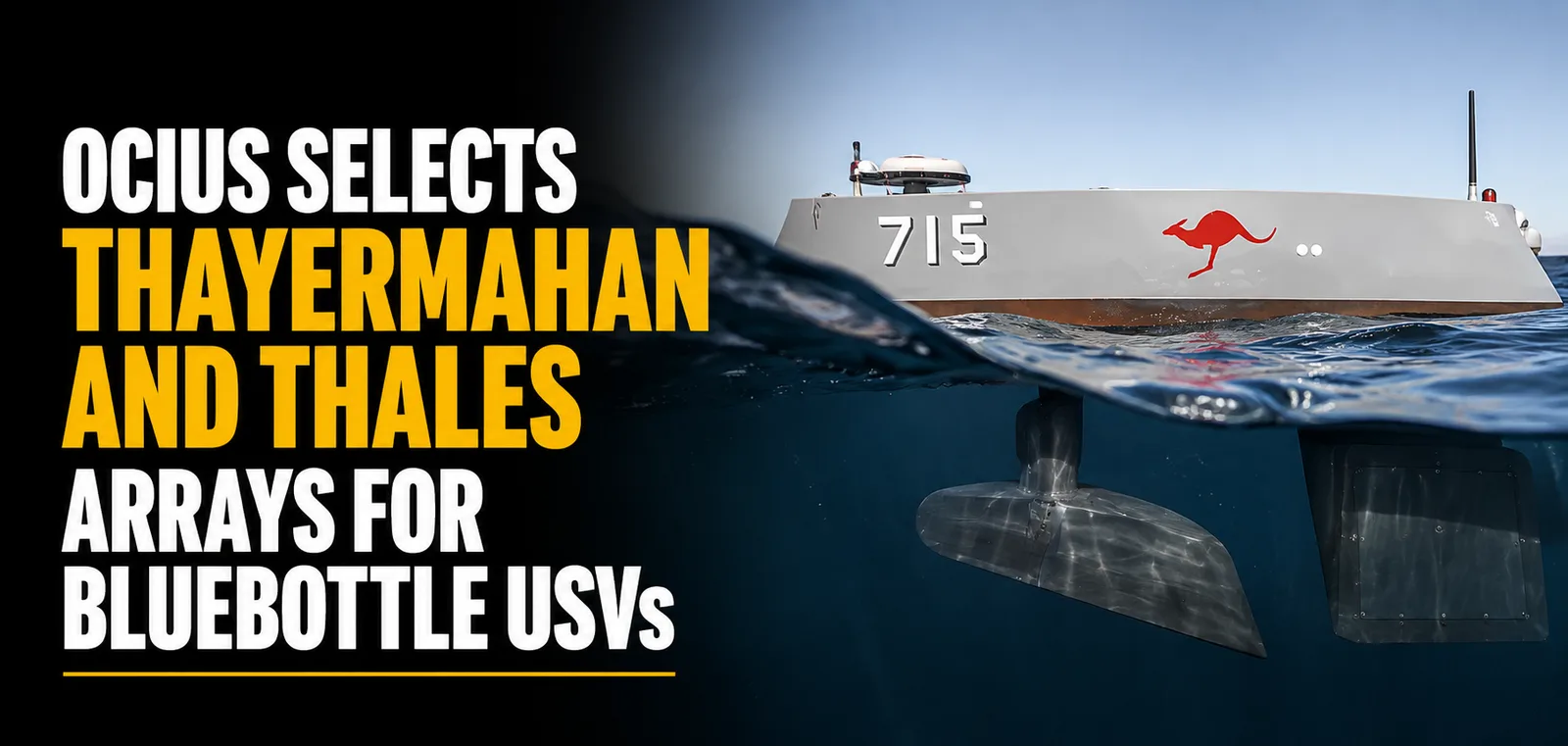
Australia’s Ocius Technology has selected acoustic sensing systems from ThayerMahan and Thales Australia for different elements of its expanding Bluebottle uncrewed surface vessel fleet, strengthening persistent anti-submarine warfare and maritime surveillance across the Royal Australian Navy’s SEA1200 programme and Maritime Border Command operations.
Under SEA1200, Ocius has awarded ThayerMahan a contract for 40 Outpost acoustic-intelligence payloads with TransparenSea processing software for the 40 new Bluebottles ordered by the Royal Australian Navy. Separately, Ocius has selected Thales Australia’s locally manufactured BlueSentry thin-line arrays and acoustic processing for Bluebottles supporting surveillance in Australia’s northern maritime approaches. Public sources do not establish that both acoustic systems will be carried simultaneously on the same vessels.
Key Facts
- Announcement: 25–26 August 2026
- Platform: Ocius Bluebottle uncrewed surface vessel
- RAN programme: SEA1200
- ThayerMahan order: 40 Outpost acoustic-intelligence payloads with TransparenSea software
- Thales system: BlueSentry thin-line towed array and acoustic processing
- RAN Bluebottle expansion: 40 new vessels, taking the operational fleet to 55
- Government investment announced in March 2026: AUD$176 million
- BlueSentry quantity: Not publicly disclosed
Two Acoustic Solutions for Different Mission Sets
The new agreements should not be read as a single dual-sonar configuration for every Bluebottle. Ocius is using its payload-agnostic keel, winch and payload-bay architecture to integrate different acoustic systems according to customer and mission requirements.
For the Royal Australian Navy’s SEA1200 programme, ThayerMahan will provide 40 Outpost acoustic-intelligence payloads and associated TransparenSea processing software. The systems are intended to support a distributed surveillance architecture capable of detecting, localising and tracking undersea contacts and delivering processed information to operators and commanders.
For ongoing Maritime Border Command surveillance to Australia’s north, Ocius has selected Thales Australia’s BlueSentry thin-line arrays and acoustic processing. Ocius and Thales describe this as an operational long-endurance surveillance configuration intended to improve awareness of Australia’s maritime approaches and offshore interests.
The number of BlueSentry-equipped vessels has not been disclosed. Public reporting indicates the systems will be integrated across Bluebottles already supporting northern surveillance operations, but no source reviewed for this article identifies a fixed fleet quantity or confirms a one-for-one pairing with the 40 new SEA1200 vessels.
SEA1200 Moves Bluebottle from Experimentation to Programme of Record
The sensor awards sit inside a much larger transition in Royal Australian Navy autonomous operations. On 11 March 2026, the Australian Government announced an AUD$176 million investment to deliver 40 new Australian-designed and built Bluebottle USVs, expanding the Navy’s fleet to 55 vessels.
The government described Bluebottle as a long-endurance platform powered by solar, wind and wave energy and capable of persistent surface and subsurface surveillance while operating as part of a teamed maritime force.
In April 2026, the Navy formally named its Maritime Autonomous Systems Unit. Defence said the unit had been created through Project SEA1200 to accelerate the development, integration and operational employment of maritime autonomous systems for persistent long-range ISR and strike missions. Bluebottle sits in that structure alongside Ghost Shark extra-large autonomous underwater vehicles and Speartooth large uncrewed underwater vehicles.
This is important because the latest acoustic-sensor awards are not isolated technology demonstrations. They are being tied to a formal Navy organisational and acquisition structure designed to operate multiple complementary uncrewed systems.
The AUD$176 Million Figure Requires Care
The authoritative 11 March government media release describes an AUD$176 million investment to deliver 40 new Bluebottles and increase the Navy’s operational fleet to 55. That is the value used in this article.
A same-day ministerial press-conference transcript records Defence Industry Minister Pat Conroy referring to a “$126 million contract” for the 40 vessels. Secondary reporting published at the time commonly converted AUD$176 million to approximately US$126 million. Because the official written release explicitly identifies the investment as AUD$176 million, Defence Agenda treats that figure as the authoritative Australian-dollar programme value and does not represent AUD$126 million as a separate confirmed acquisition amount.
The value of the ThayerMahan Outpost subcontract and the value or quantity of the Thales BlueSentry procurement have not been publicly disclosed.
ThayerMahan Outpost Adds Distributed Acoustic Intelligence
ThayerMahan describes Outpost as a platform-agnostic acoustic-intelligence payload based on deep-towed passive arrays, onboard processing and near-real-time intelligence dissemination through its TransparenSea software.
The company says trials with the Royal Australian Navy demonstrated more than 85 consecutive days of acoustic-intelligence operations, during which the system detected, classified, tracked and maintained contacts of interest. ThayerMahan also says achieved ranges exceeded expectations and cites reliability, power consumption and software usability as factors behind its selection.
Those results are manufacturer claims and detailed RAN test data, detection ranges and target types have not been publicly released. The strongest independently verifiable procurement fact is that Ocius has ordered 40 Outpost systems for Bluebottle integration under SEA1200.
Operationally, the important feature is not one sensor’s maximum detection range but the ability to distribute multiple passive acoustic nodes across a large maritime area. A network of quiet, persistent USVs can create overlapping surveillance zones and forward acoustic information to commanders without requiring a crewed frigate, submarine, helicopter or maritime patrol aircraft to remain continuously on station.
BlueSentry Provides a Sovereign Australian Array
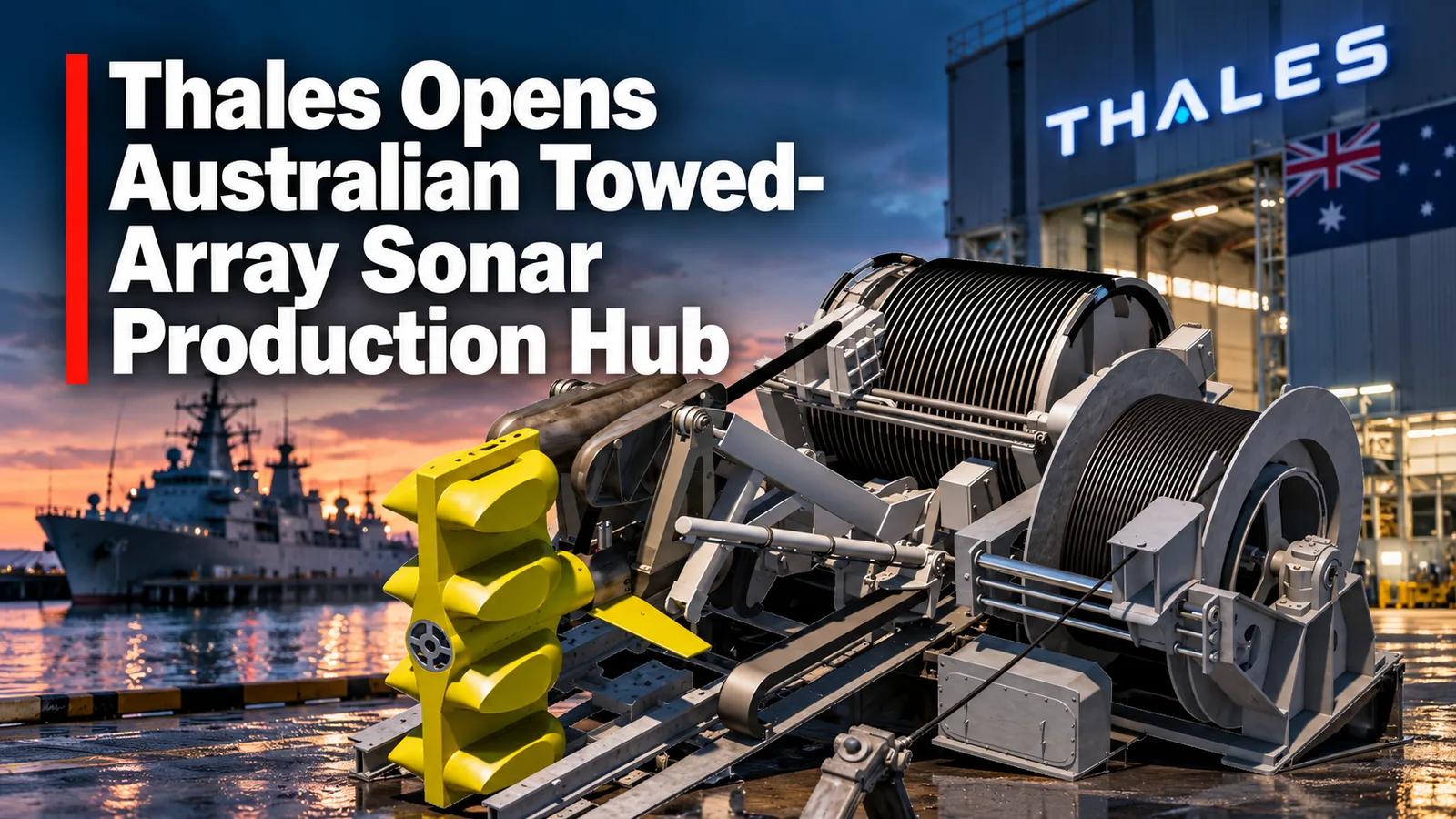
Thales Australia’s BlueSentry is a thin-line towed array designed and manufactured in Australia for anti-submarine warfare and maritime-domain-awareness missions. Thales says the system can be deployed from USVs, UUVs, warships, submarines and other vessels using a configurable architecture designed for platforms with restricted size, weight and power margins.
Current Thales product data lists an array diameter of 26 mm, a 130 m tow cable, minimum power consumption of 45 W, nominal 24 VDC power and a deployed operating-speed range of approximately 0.5 to 4 knots. The brochure also lists a 500 m survival depth and configurable acoustic frequency, channel count and array length.
These are manufacturer-published specifications for the BlueSentry product family and should not be interpreted as the exact classified configuration or operating envelope selected for Maritime Border Command Bluebottles.
Thales says BlueSentry draws on acoustic technology developed for systems used on Australia’s Collins-class submarines. The company has also demonstrated BlueSentry on other autonomous surface vessels, including a 26-day Saildrone Surveyor mission off California in which the system detected and tracked surface vessels, submarines and UUVs in real time, according to Thales.
A Decade of Ocius–Thales Acoustic Experimentation
The Bluebottle–Thales relationship is not new. In August 2017, Ocius and Thales demonstrated an early solar-, wind- and wave-powered Bluebottle prototype with a Thales thin-line array deployed on 60 m of cable off New South Wales.
That demonstration followed an Australian Defence Capability and Technology Demonstrator investment and became part of a longer experimentation path involving Defence, the Royal Australian Navy and the Defence Innovation Hub.
In 2020, the Australian Government awarded Thales Australia a further Defence Innovation Hub contract to develop the BlueSentry autonomous sonar system for integration with the Ocius Bluebottle architecture. The August 2026 decision therefore represents an operationalisation of technology that has been developed and tested with Bluebottle over many years rather than a first-time payload pairing.
Why Bluebottle Is Suited to Passive Acoustic Surveillance
Passive anti-submarine surveillance depends heavily on the acoustic environment around the sensor. Machinery noise, propellers, generators and high platform speed can reduce the ability to discriminate quiet underwater contacts.
Ocius designed Bluebottle around renewable energy and low-speed persistent operations. The company says the platform can remain at sea for months, with up to roughly 300 days of annual utilisation, and uses a keel-mounted winch to deploy active or passive acoustic arrays to variable depths.
Ocius also claims Bluebottle can operate for up to six months without refuelling or human intervention. Defence Industry Minister Pat Conroy has publicly cited deployments averaging around 75 days and individual deployments lasting more than six months.
The combination of low acoustic signature, long endurance and retractable arrays is particularly relevant to passive ASW. Instead of moving rapidly through a search area, a network of Bluebottles can remain at tactically useful positions and listen over extended periods.
Persistence Changes the ASW Geometry
Traditional anti-submarine warfare often relies on expensive crewed assets that cannot remain everywhere at once. Frigates, submarines, maritime patrol aircraft and helicopters remain essential for classification, prosecution and high-end warfighting, but their operating cost and availability limit the amount of ocean they can continuously monitor.
Persistent acoustic USVs offer a different force-design model. Multiple unmanned sensors can form a distributed surveillance layer, identify or maintain contacts and cue higher-value assets when additional classification or intervention is required.
This does not turn Bluebottle into an autonomous submarine hunter in the full kinetic sense. The publicly announced configurations are primarily sensing, processing and intelligence-distribution systems. No weapon has been announced as part of the ThayerMahan or Thales acoustic agreements.
The value lies in increasing the density and duration of the sensor network while keeping personnel away from routine surveillance tasks.
AUKUS Pillar II Dimension
The ThayerMahan agreement is also being framed as a practical AUKUS Pillar II outcome. An Australian autonomous maritime platform is being paired with a U.S.-developed acoustic-intelligence payload and processing architecture for operational Royal Australian Navy use.
ThayerMahan says its export-cleared Outpost systems are manufactured in the United States and describes the 40-system order as a major example of allied industrial and technology cooperation. The company characterises the programme as the largest-volume acquisition of unmanned subsea and surface acoustic-sensing packages to date, although that comparative claim is a company statement rather than an independently audited global ranking.
The AUKUS significance is broader than hardware transfer. Pillar II is intended to accelerate collaboration in areas including autonomy and undersea warfare. A fielded Australian-US acoustic surveillance architecture provides a concrete example of those two technology areas converging in an operational programme.
Industrial Impact
Ocius manufactures and integrates Bluebottles in Sydney, with hull production also supported from the New South Wales Hunter region. The March 2026 programme was expected to create approximately 50 additional Ocius jobs and expand opportunities across the Australian supply chain.
Thales adds a sovereign Australian acoustic component through BlueSentry, which it says is developed, manufactured and integrated at its Rydalmere facility in Western Sydney. ThayerMahan brings U.S. acoustic sensing and processing into the SEA1200 architecture.
The result is a mixed sovereign-and-allied supply model: Australian USV production, Australian sonar capability for one mission set and U.S. acoustic intelligence for another.
This approach also reduces platform lock-in. Ocius’ payload architecture allows different arrays to be selected according to mission needs instead of forcing one sensor suite across every Bluebottle.
Limitations and Counterpoint
Several important procurement and performance details remain unavailable. Neither Ocius nor the Australian Government has published the value of the ThayerMahan subcontract, the value of the BlueSentry agreement or the number of BlueSentry systems to be acquired.
Detailed acoustic performance is also appropriately limited. Public sources do not provide verified submarine detection ranges, probability of detection, false-alarm rates, contact-classification performance, operating depth for the specific Bluebottle configurations or the communications architecture used to pass sensitive acoustic data.
ThayerMahan’s 85-day trial results and its claims regarding detection performance are company-provided. Thales product specifications are likewise manufacturer data. They provide useful technical context but should not be represented as independent RAN acceptance-test results.
Finally, distributed passive surveillance is only one component of ASW. Contact localisation, identification and prosecution still require integration with other sensors, command systems and crewed or uncrewed assets.
Implications / Next
The immediate milestone is integration and delivery of the 40 Outpost-equipped Bluebottles under the SEA1200 programme. The pace at which those vessels enter operational service will determine how quickly the Royal Australian Navy can build a large distributed acoustic-surveillance network.
For BlueSentry, the key indicator will be how broadly the system is rolled out across Bluebottles supporting Maritime Border Command and whether the operational configuration remains surveillance-focused or expands into more formal Navy ASW tasking.
Future disclosures on network architecture will also matter. The effectiveness of 40 or more acoustic USVs depends on how their data is fused with information from submarines, surface combatants, maritime patrol aircraft, UUVs, sonobuoys and fixed or deployable seabed sensors.
The SEA1200 Maritime Autonomous Systems Unit provides an institutional mechanism for that integration. If Bluebottle, Ghost Shark and Speartooth can operate as complementary sensor and mission nodes rather than separate technology programmes, Australia will have moved beyond autonomous-platform procurement toward an integrated hybrid undersea force.
Conclusion
Ocius’ selection of ThayerMahan and Thales Australia marks a significant expansion of Bluebottle from persistent surface surveillance into a larger distributed undersea-sensing architecture.
The most important procurement fact is the 40-system ThayerMahan Outpost order tied to the Royal Australian Navy’s SEA1200 Bluebottle expansion. Thales BlueSentry provides a separate Australian-made acoustic option for northern maritime-surveillance operations, with quantity and contract value still undisclosed.
Together, the two sensor pathways show the central advantage of the Bluebottle architecture: long endurance and a payload-agnostic acoustic interface allow Australia to field different sensing solutions across a common autonomous platform. The next measure of success will be not simply how many arrays are delivered, but how effectively those sensors are networked into the Navy’s wider undersea warfare architecture.