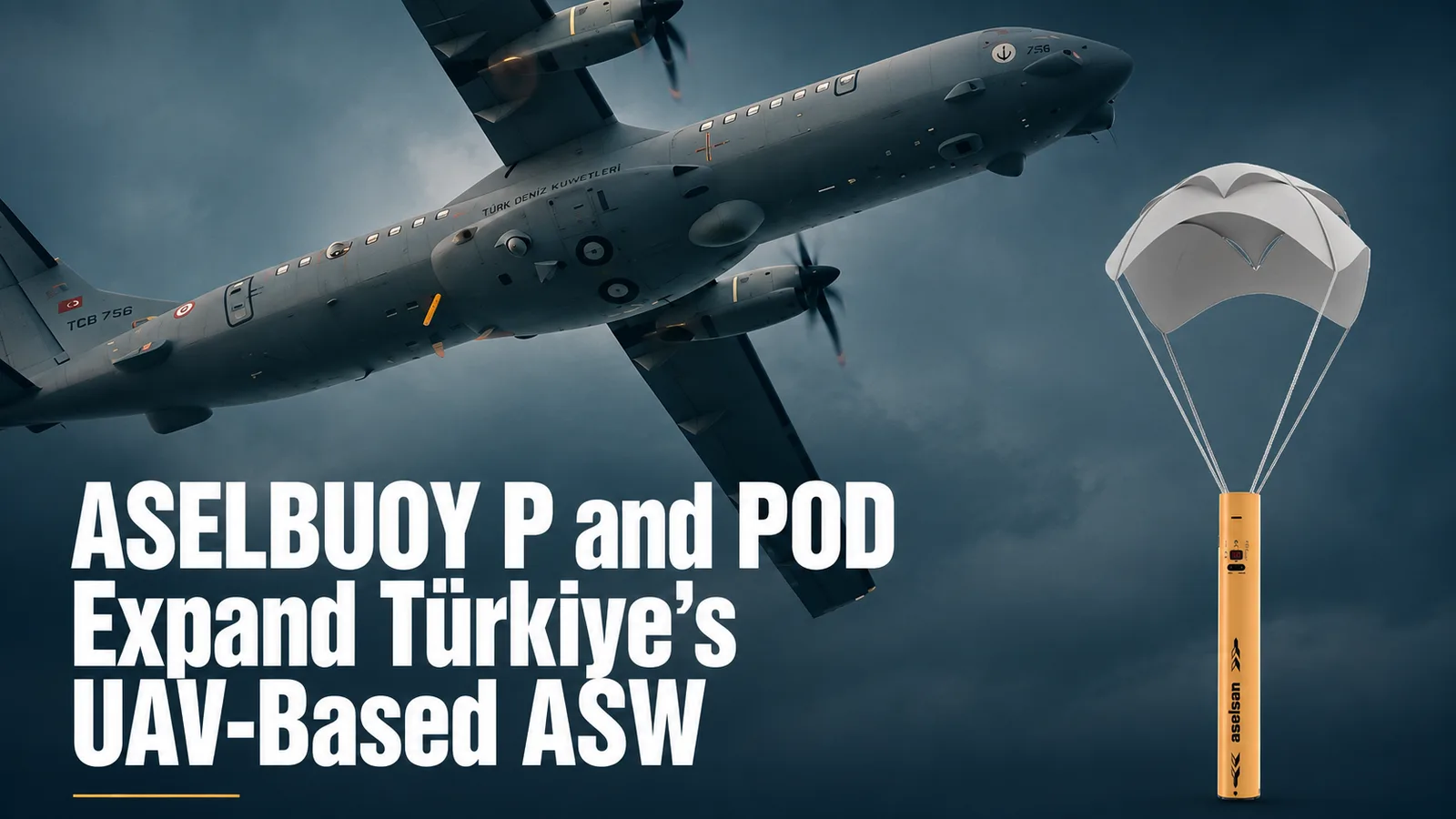
ASELBUOY P and POD are expanding Türkiye’s anti-submarine warfare architecture by combining passive underwater acoustic sensing with a modular system for deploying sonobuoys from airborne platforms, including unmanned aerial vehicles.
Key Facts
- Developer: ASELSAN.
- Mission: Anti-submarine warfare, underwater acoustic surveillance and submarine detection.
- ASELBUOY P: Passive acoustic sonobuoy designed to detect underwater acoustic signatures and relay information to air and surface platforms.
- ASELBUOY POD: Modular airborne launcher developed to deploy sonobuoys, with particular relevance to UAV integration.
- Platforms: ASELBUOY P can be deployed from maritime patrol aircraft, UAVs and helicopters.
- Production status: ASELSAN CEO Ahmet Akyol said in February 2026 that the sonobuoy had entered serial production following the first production contract with the Turkish Naval Forces Command.
- Operational significance: UAV integration could extend anti-submarine surveillance without requiring a crewed maritime patrol aircraft or helicopter to remain continuously over the search area.
ASELSAN’s approach connects two elements that are normally treated separately: the underwater acoustic sensor and the airborne mechanism required to deploy that sensor into the operating area. Together, ASELBUOY P and ASELBUOY POD could allow unmanned aircraft to become active participants in the anti-submarine warfare sensor network rather than functioning only as surface-surveillance platforms.
ASELBUOY P Adds Passive Acoustic Detection
ASELBUOY P is designed to listen to the underwater acoustic environment after being released into the mission area.
According to information provided to Defence Agenda, the system can be deployed from maritime patrol aircraft, unmanned aerial vehicles and helicopters. After entering the water, its underwater acoustic sensor monitors the surrounding environment for signatures associated with submarines and other underwater contacts.
Detection information is then transmitted through the communications equipment contained in the buoy at the surface. This allows airborne and surface units to receive acoustic information while remaining physically separated from the sensor itself.
The result is a distributed sensor architecture. Instead of relying entirely on the organic sonar of one ship or aircraft, commanders can place multiple acoustic sensing points across a larger maritime area.
ASELBUOY POD Adds the Deployment Layer
The second part of the architecture is ASELBUOY POD.
ASELSAN developed the system as a modular launcher that allows sonobuoys to be integrated with airborne platforms, particularly UAVs. The pod provides the controlled release mechanism required to deploy the sensors safely and according to mission requirements.
The system is also designed to support different sonobuoy types. That flexibility is operationally important because anti-submarine warfare rarely depends on a single sensor configuration.
A future mission package could potentially combine different acoustic sensors according to water conditions, threat behaviour and the geometry of the search area, provided those sonobuoy types are qualified for the launcher and platform.
Why UAV-Based Anti-Submarine Warfare Matters
The more significant development is not the sonobuoy alone. It is the possibility of moving sonobuoy deployment onto unmanned aircraft.
Traditional airborne anti-submarine warfare relies heavily on maritime patrol aircraft and naval helicopters. These platforms combine endurance, sensors, communications and, in some configurations, weapons. They are also expensive assets with finite availability and crew requirements.
A UAV equipped with sonobuoy launch capability could complement those platforms by maintaining surveillance over an area for longer periods or by deploying acoustic sensors without committing a crewed aircraft to every stage of the mission.
This does not eliminate the requirement for maritime patrol aircraft, helicopters or surface combatants. Instead, it potentially distributes the ASW mission across a wider network of crewed and uncrewed platforms.
ASELBUOY 100 P Provides a NATO A-Size Sensor
Open-source information identifies ASELSAN’s passive system as the aselBUOY 100 P, a NATO A-size passive directional sonobuoy.
Naval News reported in February 2026 that the sonobuoy measures approximately 915 mm in length and 120 mm in diameter, with a weight of around 10 kg.
The publication reported an acoustic operating band of 5–2,400 Hz and selectable deployment depths of 30 metres and 150 metres.
Acoustic information can be transmitted through 96 VHF communication channels in the 136–173.5 MHz band, with an indicated communication range of up to 20 km under stated conditions.
Reported programmable operating periods include 30 minutes and one, two, four or eight hours. The expendable sensor is designed to self-scuttle after the programmed mission period.
The Sonobuoy Programme Has Moved Into Serial Production
The programme has also moved beyond laboratory development.
Speaking to Naval News during World Defense Show 2026 in Riyadh, ASELSAN President and CEO Ahmet Akyol said the company had completed the initial development and testing phase and entered serial production earlier in 2026.
Akyol also said ASELSAN had signed its first production contract with the Turkish Naval Forces Command.
This is an important programme marker. Serial production means the discussion is no longer limited to whether Türkiye can develop a domestic sonobuoy. The focus shifts toward production scale, integration, deployment doctrine and operational use.
UAV Integration Is the Next Important Threshold
Akyol said in February 2026 that ASELSAN was preparing live deployment tests of the passive sonobuoy from a UAV and that ASELSAN-developed launching pods would support the integration.
Publicly available sources reviewed by Defence Agenda do not yet provide a later official confirmation that this specific UAV live-drop test campaign has been completed. The distinction is important because successful aircraft integration involves more than fitting the pod mechanically to an airframe.
Release behaviour, aerodynamic interaction, parachute deployment, water entry, communications, mission-system integration and safe separation from the aircraft all need to function as one operational chain.
Once validated, however, the integration could significantly broaden the number of platforms able to contribute to airborne ASW missions.
Distributed Sonobuoys Extend the Underwater Sensor Network
The operational value of a sonobuoy comes from distribution.
A single passive sensor provides acoustic information from one position. Multiple sonobuoys deployed across a search area can create a wider acoustic picture and allow operators to compare contacts across geographically separated sensors.
That becomes particularly relevant in complex littoral waters where temperature layers, seabed conditions, shipping activity and ambient noise can make underwater detection difficult.
UAVs could add another degree of flexibility by deploying sensors into areas selected dynamically by the wider command-and-control network.
This concept aligns with a broader trend toward distributed maritime sensing in which ships, aircraft, UAVs, USVs and underwater systems contribute separate pieces of the same operational picture.
ASELSAN Is Building a Wider Underwater Warfare Portfolio
ASELBUOY is not an isolated product inside ASELSAN’s naval portfolio.
The company has developed underwater acoustic and naval protection systems including ship and submarine sonar, torpedo countermeasure solutions and acoustic decoys.
A Breaking Defense overview of ASELSAN’s underwater portfolio positioned aselBUOY 100 P as part of a broader sensor and protection architecture rather than a stand-alone disposable sensor.
This system-level approach matters because modern ASW requires several stages: detection, localisation, classification, tracking, command-and-control and, where authorised, engagement.
Sonobuoys strengthen the detection and tracking side of that chain, while networked platforms can distribute the resulting acoustic picture to other operational units.
Unmanned Systems Are Moving Into the Underwater Battlespace
The ASELBUOY P and POD concept also reflects the growing role of unmanned systems in maritime warfare.
Defence Agenda has previously examined how autonomous underwater systems and swarming drones are reshaping maritime operations. The same transition is increasingly visible above the water, where UAVs and USVs can serve as distributed sensor carriers.
Türkiye has also expanded its unmanned maritime portfolio through systems such as the MARLIN electronic-warfare USV, illustrating how uncrewed platforms are moving beyond simple reconnaissance into specialised naval mission sets.
Adding sonobuoy deployment to UAVs extends this logic into anti-submarine warfare.
Persistence Could Be the Main UAV Advantage
For anti-submarine warfare, endurance is especially valuable.
Submarine searches can continue for extended periods and may require repeated deployment of acoustic sensors as the contact moves or environmental conditions change.
Unmanned platforms can potentially increase persistence without imposing the same crew endurance constraints associated with a manned aircraft.
The practical benefit will depend on the UAV selected, its payload capacity, mission endurance, communications architecture and the number of sonobuoys that can be carried.
No public information reviewed for this article establishes a specific operational UAV, carriage quantity or fielded configuration for ASELBUOY POD. Those details should therefore be treated as integration variables rather than confirmed programme characteristics.
Manned and Unmanned Platforms Would Work Together
The strongest operational model is likely to be collaborative rather than fully unmanned.
A maritime patrol aircraft could provide broad-area command, processing and additional sensors. A frigate could contribute hull-mounted or towed sonar. Helicopters could investigate contacts with dipping sonar. UAVs could extend the search area and deploy additional sonobuoys.
Each platform would therefore contribute according to its strengths.
This distributed model can improve sensor coverage while reducing the need for every platform to carry every capability.
Passive Detection Preserves a Low-Emission Search Option
ASELBUOY P is a passive system, meaning it listens for underwater acoustic energy rather than transmitting an active acoustic pulse.
Passive detection has an important tactical advantage because the sensor does not need to illuminate the underwater environment acoustically to search for a contact.
However, passive detection also depends heavily on the acoustic signature of the target and the surrounding environment.
Quiet submarines, difficult propagation conditions and high ambient noise can complicate detection. This is why modern ASW architectures typically combine passive and active sensors rather than relying exclusively on one method.
An Active Sonobuoy Could Expand the Architecture
ASELSAN has also been associated with development of an active sonobuoy variant.
Naval News reported in February 2026 that the company was developing an active system intended to improve detection of passive and quieter underwater targets, although no detailed current programme status was provided.
If an active variant matures alongside ASELBUOY P, a common pod architecture capable of deploying multiple sonobuoy types could offer commanders greater tactical flexibility.
Such a combination could support passive search, active localisation and multi-sensor patterns according to the threat and operating environment.
Industrial Sovereignty Is Another Part of the Programme
The programme also carries an industrial dimension for Türkiye.
Sonobuoys are expendable sensors. Sustained ASW training and operations therefore consume inventory, making domestic production capacity strategically different from the acquisition of a limited number of reusable sonar systems.
A domestic production line can support stock replenishment, training requirements, configuration changes and future integration without relying entirely on foreign supply.
That becomes more significant as Türkiye expands both its unmanned aviation ecosystem and its domestic naval combat-system portfolio.
The Main Challenge Is System Integration
The core technical risk is no longer simply whether an individual sonobuoy can detect underwater acoustic signals.
The more difficult challenge is creating a complete operational chain connecting the UAV, pod, expendable sensor, communications link, acoustic processing system and command network.
A scalable system also needs mission planning, sensor management and data fusion so operators can manage multiple deployed sonobuoys rather than receiving isolated acoustic feeds.
This software and networking layer may ultimately determine how much operational value the hardware provides.
Implications / Next
The next major programme indicator will be public confirmation of successful UAV deployment and integration testing.
After that, the key questions will concern platform qualification, the number and type of sonobuoys carried, mission-system integration and whether acoustic data can be incorporated seamlessly into Türkiye’s wider naval command-and-control architecture.
Production scale will also matter. Because sonobuoys are expendable, operational relevance depends on maintaining sufficient inventory for both training and sustained wartime use.
If ASELSAN successfully combines serially produced sonobuoys, a modular launcher and operational UAV integration, Türkiye could gain an additional distributed ASW layer that complements maritime patrol aircraft, helicopters and surface combatants.
Conclusion
ASELBUOY P and POD represent more than a new underwater sensor and launcher.
The combination creates a pathway for transferring part of the airborne anti-submarine warfare mission to unmanned platforms.
ASELBUOY P provides the passive acoustic sensing layer. ASELBUOY POD provides the controlled airborne deployment mechanism. Networked together with other naval assets, the two systems could expand acoustic coverage and increase the persistence of Türkiye’s underwater surveillance architecture.
The programme’s strategic significance will ultimately depend on successful UAV integration, production scale and the ability to fuse sonobuoy data into a wider multi-platform ASW network.
For further Defence Agenda coverage, follow our naval warfare, defence technology and unmanned systems sections. Related coverage includes autonomous underwater systems and swarming drones, Türkiye’s electronic-warfare USV and ASELSAN’s integrated defence systems portfolio.
Further Reading
- ASELSAN: aselBUOY 100 P Passive Directional Sonobuoy
- Naval News: ASELSAN prepares aselBUOY sonobuoy tests from UAVs
- Breaking Defense: ASELSAN’s integrated approach to undersea superiority
- Defence Agenda: Autonomous Underwater Systems and Swarming Drones
- Defence Agenda: Türkiye’s Electronic Warfare USV
- Defence Agenda: ASELSAN Integrated Defence Systems