AUKUS undersea warfare development moved another step toward operational interoperability during RIMPAC 26 as Australia and the United States tested autonomous underwater vehicles, remotely operated systems and acoustic communications in scenarios focused on protecting critical undersea infrastructure.
Australia’s Department of Defence said on 13 August 2026 that Royal Australian Navy, Defence Science and Technology Group and U.S. Navy personnel had jointly tested AUKUS Pillar II subsea and seabed warfare capabilities off Hawaii during Exercise Rim of the Pacific 2026.
The significance lies less in any single vehicle than in the ability to connect platforms, underwater communications and mission systems supplied by different countries. AUKUS Pillar II is increasingly moving from technology demonstrations toward an interoperable undersea architecture in which allied autonomous systems can search, communicate and exchange mission information across national boundaries.
Key Facts
- Exercise: RIMPAC 26, conducted around Hawaii from 24 June to 31 July 2026.
- AUKUS participants: Australian and U.S. personnel from the Royal Australian Navy, DSTG and U.S. Navy took part in the subsea activity.
- Mission: Testing subsea and seabed warfare capabilities in scenarios focused on protecting critical undersea infrastructure.
- Australian systems: Kongsberg HUGIN Superior AUV, Schilling work-class ROV, Lightfish Seasat USV and Rock Lobster underwater acoustic relay.
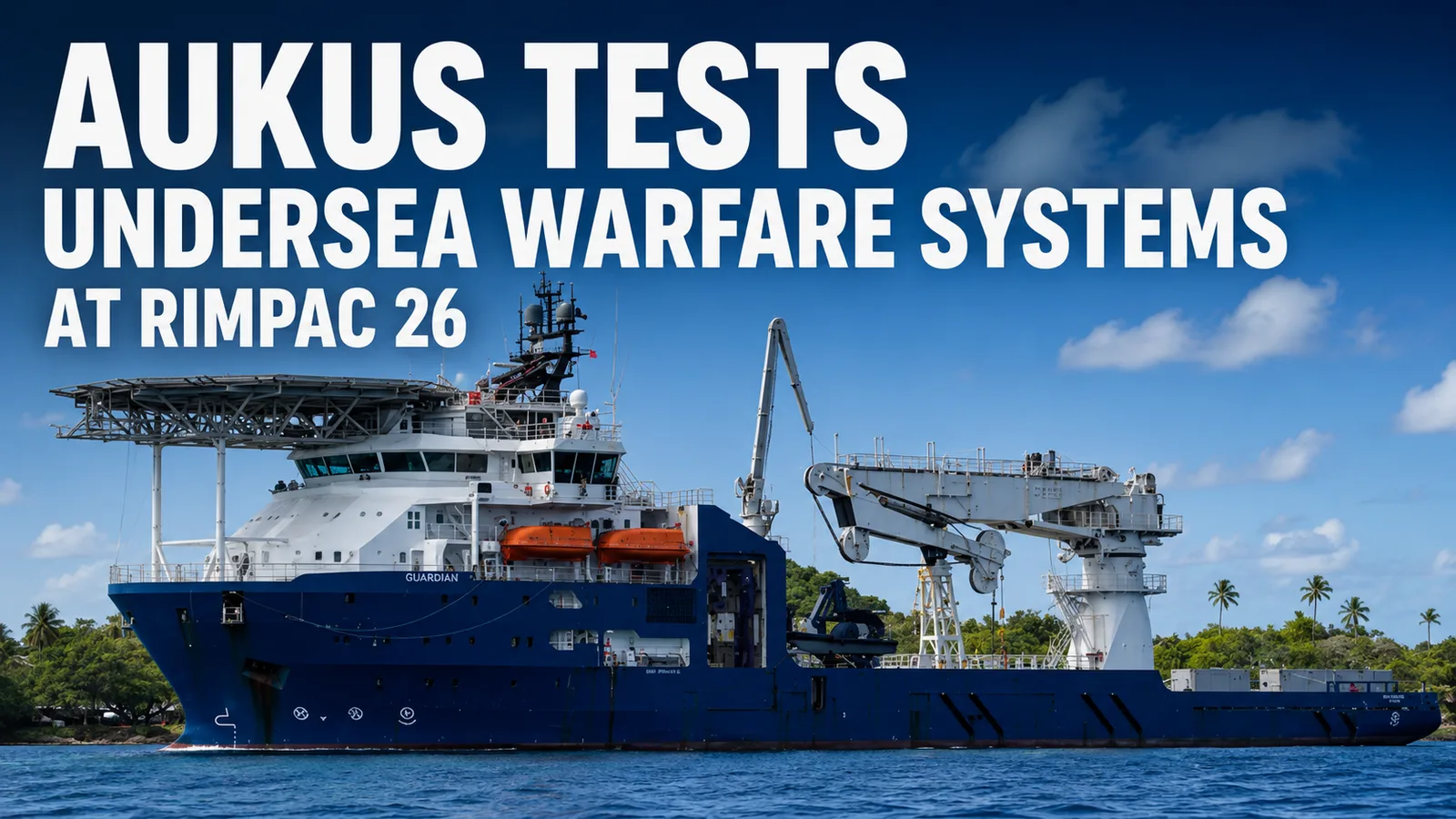
- Support vessel: Australian Defence Vessel Guidance supported deployment and testing of robotic, autonomous, crewed and uncrewed underwater systems.
- Interoperability: Australian and U.S. underwater acoustic communications technologies were tested together.
- AUKUS trajectory: The first AUKUS Pillar II signature project will develop payloads and enabling systems for uncrewed undersea vehicles, with delivery beginning in 2027.
AUKUS Undersea Warfare Moves Into RIMPAC
RIMPAC provides AUKUS with an unusually demanding environment for undersea experimentation.
Rather than operating autonomous systems in isolation on a dedicated test range, Australia and the United States were able to evaluate them inside the world’s largest multinational maritime exercise.
Australia’s 13 August account states that RIMPAC 26 involved 34 nations and more than 25,000 personnel. An earlier Australian Defence release on 24 June initially listed 31 participating nations, suggesting the final participation count was subsequently revised or expanded.
The wider exercise included surface ships, submarines, aircraft and specialised maritime forces, allowing undersea autonomous systems to be assessed against a more realistic operational backdrop.
Critical Undersea Infrastructure Was the Mission Focus
The AUKUS activity centred on protecting critical undersea infrastructure.
Submarine communications cables, energy infrastructure and seabed systems are increasingly treated as strategic assets because disruption can create military, economic and political effects without requiring conventional attacks against territory.
That is pushing navies toward persistent seabed awareness rather than relying exclusively on ships or submarines responding after an incident occurs.
Autonomous vehicles are particularly attractive for this mission because they can survey areas where maintaining a crewed vessel continuously would be expensive, manpower-intensive or operationally risky.
Defence Agenda has examined this wider competition in Threats to Undersea Infrastructure in Seabed Warfare, where surveillance, attribution and persistent monitoring increasingly form part of national maritime-security strategies.
HUGIN Superior Provided the Autonomous Search Layer
Australia deployed a Kongsberg HUGIN Superior autonomous underwater vehicle during the RIMPAC activity.
Defence said HUGIN Superior operated alongside a Schilling work-class remotely operated vehicle to conduct a complex navigation and search mission across part of the exercise undersea domain.
Kongsberg describes HUGIN Superior as a large autonomous underwater platform optimised for high-resolution seabed survey, mapping, navigation and defence-related missions.
The standard sensor package includes synthetic aperture sonar, multibeam sonar, cameras, a laser profiler, sub-bottom profiler and magnetometer, giving the platform several ways to characterise the seabed and identify anomalies.
Kongsberg states that HUGIN Superior can operate for more than 70 hours and provides in-mission navigation accuracy better than 0.04% of distance travelled. Those are manufacturer specifications rather than RIMPAC-specific performance figures.
The ROV Adds Human-Controlled Intervention
The Schilling work-class ROV provides a different capability from the autonomous HUGIN.
An AUV can independently survey a large area and identify potential objects or anomalies. A remotely operated vehicle can then provide closer inspection or perform tasks requiring direct operator control.
This combination reflects a broader trend in undersea warfare: autonomy is not replacing every remotely operated or crewed capability.
Instead, navies are combining systems according to mission requirements. Autonomous platforms provide persistence and coverage, while remotely operated systems retain close human control for more complex intervention.
Underwater Communications Are the Harder Integration Problem
The more strategically important part of the RIMPAC demonstration may have been communications rather than vehicle performance.
Radio-frequency communications used by aircraft, ships and ground forces do not propagate effectively through seawater. Underwater platforms therefore rely heavily on acoustic communications, inertial navigation and intermittent links to the surface.
These limitations become more difficult when autonomous systems from several countries have to work together.
Different vehicles may use different communication protocols, command systems and data standards. Interoperability requires those systems to exchange mission-relevant information without extensive bespoke integration for every exercise.
This is precisely the problem AUKUS Pillar II is attempting to solve.
Rock Lobster Links Underwater Systems Across the Network
Australia deployed the Rock Lobster underwater acoustic communications relay alongside the Lightfish Seasat uncrewed surface vessel during RIMPAC.
Rock Lobster was developed by L3Harris in collaboration with the Royal Australian Navy and DSTG.
Australian Defence previously described Rock Lobster as a deployable underwater acoustic communications relay designed to move mission-relevant information between submerged systems and wider networks.
During earlier Autonomous Warrior testing, the system successfully relayed mission-relevant information from the United States to an underwater system operating in Jervis Bay.
RIMPAC extends that concept into a multinational operational exercise where Australian and American underwater communications technology can be evaluated together.
Lightfish Seasat Adds a Surface Relay Layer
The Lightfish Seasat uncrewed surface vessel adds another node to the network.
Surface vessels can act as bridges between submerged acoustic networks and higher-bandwidth radio or satellite communications above the waterline.
This type of layered architecture is increasingly important because underwater vehicles cannot simply remain connected to a conventional broadband network while submerged.
A surface relay can therefore connect autonomous underwater systems to command centres, ships, aircraft or other network users without forcing every UUV to surface for communications.
ADV Guidance Is Becoming an Autonomous Systems Test Ship
The Australian Defence Vessel Guidance played the support role during the activity.
Defence describes the ship as supporting the testing and deployment of robotic and autonomous, crewed and uncrewed underwater systems as well as undersea-surveillance capabilities.
That makes Guidance more than a conventional support vessel.
It provides the Royal Australian Navy and DSTG with a platform for launching, recovering, controlling and experimenting with new undersea technologies without tying the activity directly to a frontline submarine or surface combatant.
This can accelerate development because emerging technologies can be tested repeatedly before integration requirements are imposed on operational warships.
Maritime Big Play Is Building the Interoperability Baseline
The RIMPAC activity builds directly on the Maritime Big Play experimentation series.
In February 2026, Australia hosted more than 200 defence personnel, scientists and industry participants from the three AUKUS countries during another Maritime Big Play exercise.
Around 30 next-generation capabilities were tested in tactical scenarios, including the Australian-developed Speartooth large uncrewed underwater vehicle and new payload configurations.
The value of a recurring experimentation series is cumulative.
Individual trials identify communication, software and control problems. The next exercise can then test revised interfaces under more demanding conditions.
AUKUS Has Now Created a Dedicated UUV Signature Project
The experimentation cycle is now feeding a formal AUKUS Pillar II project.
Australia, the United Kingdom and the United States announced their first Pillar II signature project on 30 May 2026.
The programme is focused on advanced payloads and enabling systems for uncrewed undersea vehicles, with initial delivery scheduled to begin in 2027.
The objective is not necessarily to make all three countries operate the same UUV.
The more important goal is for payloads, communications and enabling systems to operate across national platforms with much less integration friction.
Australia Is Funding New Undersea Communications Technology
Australian industry is already being funded against this requirement.
On 10 July 2026, Defence awarded $6.2 million to BAE Systems Australia, L3Harris Integrated Mission Systems Australia and Mission Systems Pty Ltd under the AUKUS Maritime Innovation Challenge.
The companies are developing technologies for underwater communications, command-and-control integration and navigational data exchange.
Defence expects those technologies to be demonstrated by the end of 2026 and says the work will support interoperability under the Pillar II UUV signature project.
A separate ASCA programme awarded $7.2 million to three Australian companies in May 2026 to develop new navigation systems for autonomous underwater vehicles operating where GPS is unavailable.
Undersea Navigation Is a Fundamental Autonomy Constraint
Navigation remains one of the defining technical problems for autonomous underwater warfare.
GPS signals do not provide conventional positioning below the surface. Active sonar or other external aids can also create operational trade-offs because some techniques may reveal activity or depend on additional infrastructure.
Long-duration UUV operations therefore require highly accurate inertial navigation and methods of periodically correcting accumulated position error.
The better the navigation system, the longer an autonomous platform can operate independently while still knowing where detected seabed objects are located.
This becomes especially important for infrastructure inspection, mine warfare and intelligence preparation of the operating environment.
Ghost Shark Adds Long-Range Sovereign Capability
Australia’s wider autonomous-undersea strategy extends well beyond the platforms used at RIMPAC.
In September 2025, the government committed $1.7 billion to acquire a fleet of Australian-designed and built Ghost Shark extra-large autonomous undersea vehicles from Anduril Australia.
Defence identifies Ghost Shark missions as including intelligence, surveillance, reconnaissance and strike at long range.
The programme follows approximately $140 million already invested in platform development, payloads and production infrastructure since Australia and Anduril began their collaborative effort in 2022.
Defence Agenda has analysed the programme in Anduril Ghost Shark XL-AUV Factory Opens, including its role in Australia’s distributed and increasingly autonomous undersea force.
Royal Australian Navy Has Created a Dedicated Autonomy Unit
The organisational structure is changing alongside the technology.
On 14 April 2026, the Royal Australian Navy formally named its Maritime Autonomous Systems Unit.
Created through Project SEA 1200, MASU is intended to accelerate development, integration and operational employment of maritime autonomous systems.
The unit is expected to operate several complementary capabilities including Ghost Shark, Bluebottle uncrewed surface vessels and Speartooth large UUVs.
Its Uncrewed Systems Control Centre and Deployable Vehicle Team are designed to allow autonomous systems to be deployed and controlled from different wharf locations.
This is an important transition from experimentation to force structure: autonomous systems are increasingly becoming permanent Navy capabilities rather than temporary science projects.
Australia Is Building a Hybrid Fleet
The Royal Australian Navy now openly describes its future force as a hybrid fleet combining crewed and uncrewed capability.
Nuclear-powered submarines acquired through AUKUS Pillar I will represent the high-end crewed element of that undersea force.
Autonomous systems can complement those submarines by providing persistence, distributed sensing and additional capacity without requiring a human crew on every platform.
The 2026 National Defence Strategy and Integrated Investment Program explicitly prioritise enhanced undersea warfare and wider adoption of autonomous and uncrewed systems.
The Australian government says autonomous platforms including Ghost Shark and Ghost Bat form part of a broader $12–15 billion commitment over the decade intended to proliferate autonomous capability across the Australian Defence Force.
Interoperability Is More Important Than Platform Commonality
The strategic logic behind AUKUS Pillar II is increasingly clear.
Australia, the United Kingdom and the United States do not need identical autonomous vehicles to fight together effectively.
They need platforms that can exchange data, accept compatible mission payloads, operate through interoperable command systems and use common communications standards.
This approach can preserve national industrial programmes while still creating a combined operational architecture.
Defence Agenda examined a similar challenge in NATO’s Allied Underwater Battlespace Mission Network, where the Alliance is working toward common standards linking crewed and uncrewed systems across national fleets.
Remote Control Has Already Crossed Continents
AUKUS has previously demonstrated how far this interoperability can extend.
During the Maritime Big Play activity associated with Exercise Talisman Sabre 2025, operators in Australia controlled the Royal Navy’s experimental uncrewed submarine Excalibur while it was submerged in UK waters.
Defence Agenda covered that milestone in UK Sub Controlled from 10,000 Miles Away.
The experiment illustrated the operational end state AUKUS is pursuing: national ownership of platforms combined with allied ability to task, control and exploit those platforms through interoperable systems.
The Main Technical Risk Is Underwater Connectivity
The major constraint remains communications.
Undersea data links generally provide far less bandwidth than equivalent radio or optical links above the surface. Environmental conditions can affect acoustic performance, while long-range operations create additional latency and command challenges.
Autonomous systems therefore cannot depend on continuous high-bandwidth remote control.
They need enough onboard autonomy to execute a mission when communications are intermittent, combined with reliable mechanisms for exchanging essential information when links become available.
This explains why AUKUS is investing simultaneously in autonomy, underwater communications, navigation and common command interfaces rather than treating UUV procurement as a stand-alone vehicle programme.
The Main Opportunity Is Persistent Seabed Awareness
The most immediate operational opportunity is persistent monitoring of strategically important underwater areas.
Autonomous systems can repeatedly map seabed regions, inspect infrastructure and detect changes that may indicate interference, damage or suspicious activity.
When linked through surface relays and common command systems, several vehicles could contribute to a wider undersea operating picture rather than returning isolated datasets after each mission.
That is particularly relevant to Australia, whose strategic geography depends heavily on maritime trade, subsea communications and long-distance sea lines.
Implications / Next
The first milestone to watch is completion of the 2025 AUKUS Maritime Innovation Challenge demonstrations by the end of 2026.
Those prototypes should provide a clearer indication of how Australia, the United Kingdom and the United States intend to standardise communications and command functions between national UUV fleets.
The second is the start of deliveries under the Pillar II UUV signature project in 2027.
The third is operational integration through MASU and Project SEA 1200. Australia now has dedicated Navy structures responsible for turning experimental autonomous systems into routinely deployable capability.
Ghost Shark production will provide another important measure of scale as the Royal Australian Navy moves toward an indigenous long-range extra-large AUV fleet.
Finally, future Maritime Big Play and RIMPAC exercises will show whether interoperability can move from individual platform pairings toward larger networks containing multiple UUVs, surface relays, crewed ships and allied command systems.
Conclusion
The RIMPAC 26 undersea activity illustrates the practical direction of AUKUS Pillar II.
The partnership is no longer focused only on demonstrating that autonomous underwater vehicles can operate effectively. It is increasingly concerned with whether vehicles, payloads and communications systems developed by different countries can function together as one operational architecture.
HUGIN Superior provided autonomous search capability. The Schilling ROV added remotely controlled inspection. Lightfish Seasat and Rock Lobster extended the communications network. ADV Guidance provided the test and deployment platform.
Together, those elements show why interoperability rather than platform commonality is becoming the central technical objective.
Australia’s parallel investment in Ghost Shark, autonomous navigation, undersea communications and the Maritime Autonomous Systems Unit suggests that this experimentation is already feeding a much larger force-design shift.
The next phase will be measured by whether AUKUS can convert these demonstrations into persistent, interoperable undersea networks capable of supporting real-world surveillance, infrastructure protection and naval operations across the Indo-Pacific.
For further Defence Agenda coverage, read Anduril Ghost Shark XL-AUV Factory Opens, Autonomous Underwater Systems and Swarming Drones, NATO’s New Underwater Mission Network and Threats to Undersea Infrastructure in Seabed Warfare.
Further Reading
- Australian Defence: Advancing High-Tech Undersea Warfare Capabilities
- Australian Defence: AUKUS Partners Launch First Pillar II Signature Project
- Australian Defence: $6.2M AUKUS Maritime Innovation Challenge Awards
- Kongsberg: HUGIN Superior Autonomous Underwater Vehicle
- Defence Agenda: Anduril Ghost Shark XL-AUV Factory Opens
- Defence Agenda: Autonomous Underwater Systems and Swarming Drones
- Defence Agenda: NATO’s New Underwater Mission Network
- Defence Agenda: Threats to Undersea Infrastructure in Seabed Warfare