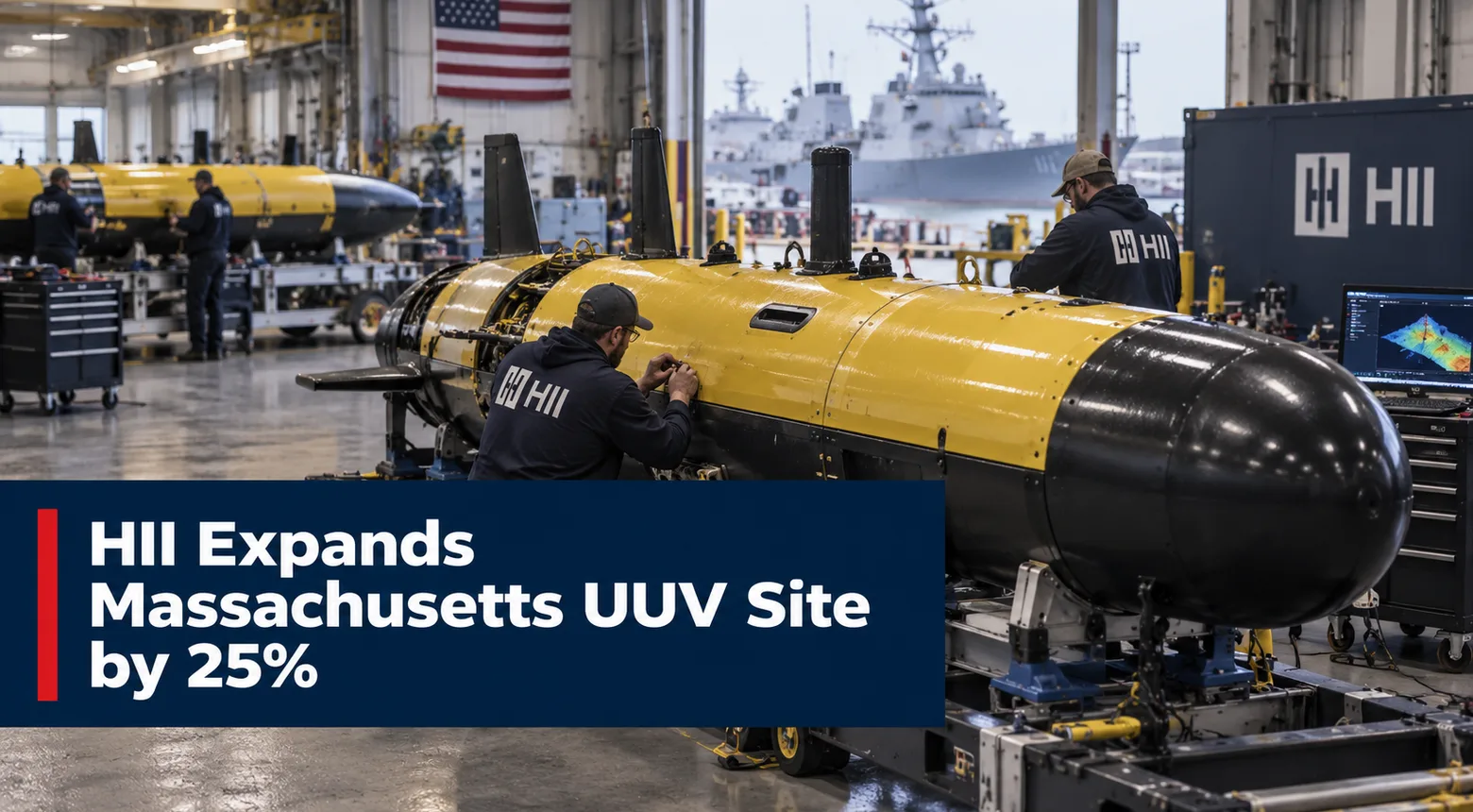
HII has expanded its unmanned maritime production facility in Pocasset, Massachusetts by 10,000 square feet, increasing the existing 40,000-square-foot site by 25% as demand grows for uncrewed undersea and surface systems. The company announced the expansion on 22 September 2026, linking the added capacity to REMUS UUV production, the U.S. Navy’s Lionfish small UUV and the ROMULUS unmanned surface-vessel family.
The expansion adds production capacity to an active programme site
HII said the Pocasset campus now has more capacity to build, develop and integrate autonomous maritime systems rather than simply adding office or research space. The site supports the REMUS family of unmanned underwater vehicles and the newer ROMULUS surface-vessel family, giving the expansion relevance across both undersea and surface autonomy.
The U.S. Navy’s Lionfish small unmanned undersea vehicle is a particularly important production anchor. Lionfish is based on HII’s commercial REMUS 300 platform, and the Navy exercised an option for continued production in July 2026. The expanded facility will also support the larger REMUS 620, giving HII additional flexibility across multiple vehicle classes.
Pocasset combines manufacturing with autonomy integration
The industrial value of the site is broader than hull assembly. HII says the expansion also supports integration of its Odyssey Autonomous Control Solutions software, simulation and modelling tools, and autonomy hardware for future ROMULUS USVs. That means the site is intended to connect vehicle production with mission-system and autonomy integration rather than treating software as a separate downstream activity.
HII reported that about 300 employees work in Pocasset and that 50 employees had been added year-to-date in 2026. Workforce growth does not by itself prove a specific output rate, and HII did not disclose annual unit-production targets for REMUS, Lionfish or ROMULUS in the announcement. The verified milestone is increased floor space and integration capacity, not a quantified production-rate increase.
UUV demand is moving industrial capacity closer to the centre of procurement
The expansion reflects a broader shift in naval autonomy: customers are increasingly focused not only on prototypes and demonstrations but also on repeatable production, sustainment and mission integration. HII said it has delivered more than 750 REMUS vehicles to customers in more than 30 countries, including 14 NATO members, creating a substantial installed base for support and follow-on orders.
The next question for procurement planners is how quickly expanded facilities translate into higher delivery throughput. HII has not published a unit-per-year target for the Pocasset expansion, so Defence Agenda does not infer one. Future Navy option exercises, export contracts and ROMULUS production awards will provide a clearer measure of how the new space is utilised.
Manufacturing scale is becoming a discriminator in maritime autonomy
The maritime-autonomy market is moving into a phase where customer confidence depends increasingly on repeatable manufacturing and fleet support. Demonstrations remain important, but navies purchasing dozens of vehicles need configuration control, spares, software sustainment and a production system capable of replacing losses or adding payload variants without redesigning the platform each time. HII’s Pocasset expansion is relevant because it places those industrial functions beside an established REMUS product line and an active U.S. Navy programme.
The REMUS installed base also gives HII a different starting point from companies entering the market with a first prototype. HII says more than 90% of the REMUS vehicles delivered over the past 25 years remain in active service. That is a manufacturer figure, but it indicates the importance of lifecycle support and backwards-compatible mission integration in the company’s business model.
The expansion should therefore be judged over time by output, lead times and programme execution rather than square footage alone. A 25% increase in facility area may support higher throughput, but it does not mechanically produce a 25% rise in annual vehicle deliveries. Tooling, workforce, suppliers, test capacity and customer funding remain the variables that determine actual production performance.
Implications / Next
Watch for additional Lionfish option awards, REMUS 620 orders and ROMULUS production activity. The 25% figure refers to facility-area expansion, not a confirmed 25% rise in annual vehicle output.