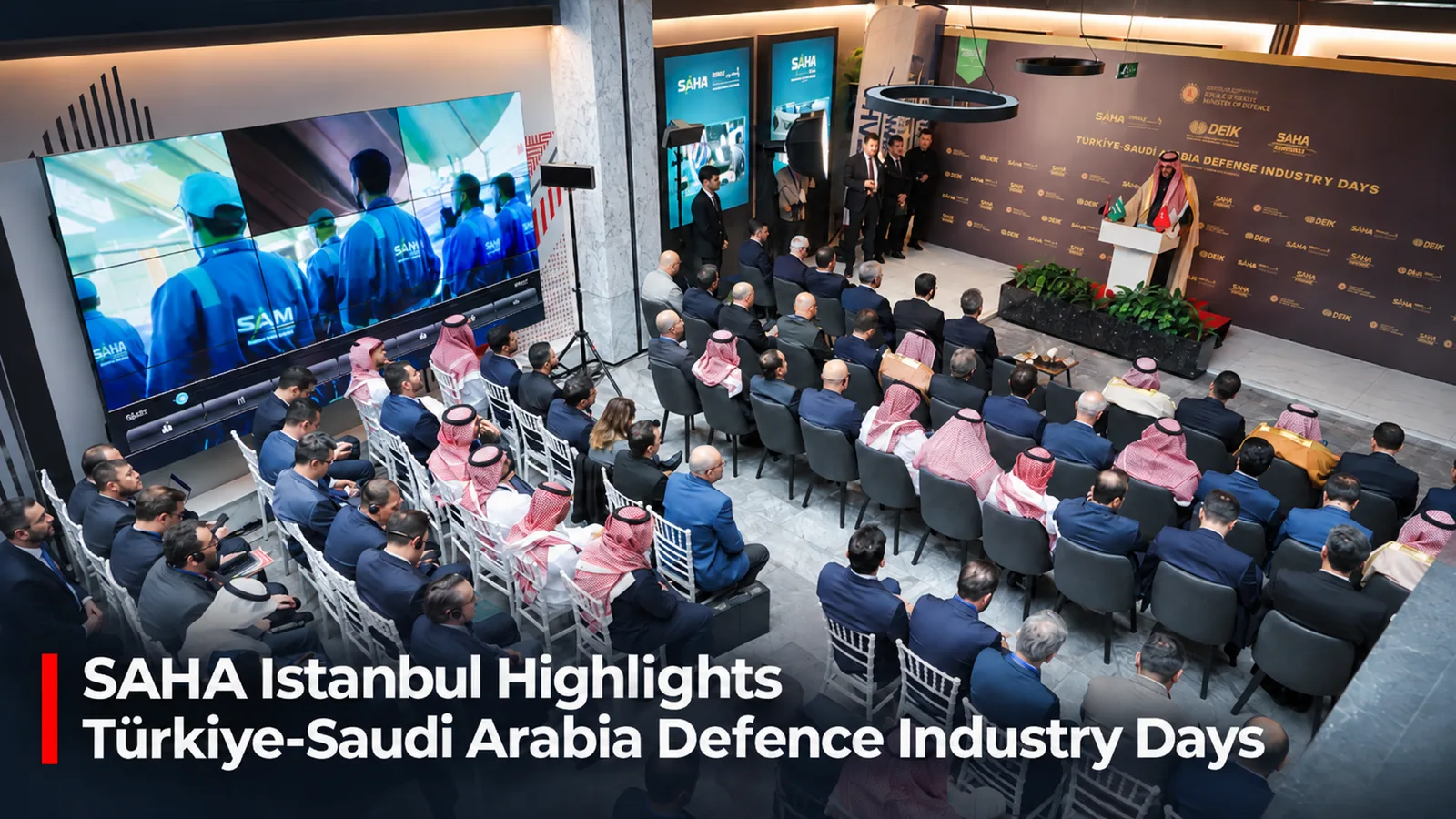
SAHA İstanbul played a central convening role in the Türkiye–Saudi Arabia Defence Industry Days, held in Istanbul on 11–12 November 2026 with the Foreign Economic Relations Board of Türkiye (DEİK) and Saudi Arabian Military Industries (SAMI). The two-day programme brought defence companies into direct business discussions and hosted senior officials from both countries, creating a platform for supplier engagement, localisation and potential joint production. Event reporting recorded 601 bilateral business meetings; these were discussions, not 601 contracts or confirmed purchase orders. The distinction matters as both defence industries seek to turn political engagement into executable industrial programmes. Anadolu Agency identified SAHA İstanbul, DEİK and SAMI as the organisers.
SAHA İstanbul Connects the Two Defence Industry Ecosystems
The programme took place at Property Expo İstanbul in the Vadistanbul area. SAHA İstanbul’s role was not merely as a participant at a bilateral diplomatic event: alongside DEİK and SAMI, the cluster was named as an organiser of a forum designed to connect manufacturers, integrators and suppliers across the two countries. The cluster’s official public updates presented the event as an opportunity for businesses to examine partnerships through B2B meetings and senior-level engagement.
This role gives the programme a supply-chain dimension. Large defence agreements ultimately depend on manufacturing partners, quality systems, local industrial support and qualified subcontractors. A cluster organisation can help firms identify counterparties and organise initial contacts; it cannot, by the act of convening alone, guarantee that a project will secure financing, regulatory approvals, technology-transfer permissions or follow-on orders.
SAHA İstanbul's initial announcement listed 72 Turkish and 30 Saudi companies. Subsequent event coverage by Defence Turkey reported 69 Turkish and 30 Saudi companies conducting meetings, with 295 meetings on 11 November and 306 on 12 November, totalling 601. The discrepancy between 72 and 69 Turkish companies should be retained rather than concealed: the publicly available sources do not establish whether it reflects registration, attendance or an alternative reporting scope. Both counts indicate a business delegation of roughly 100 firms, but a final verified participant register has not been published in the cited material.
The event’s second day also brought institutional engagement into the business setting. Participants included Türkiye’s Presidency of Defence Industries (SSB) president Haluk Görgün, Saudi minister and acting Governor of the General Authority for Military Industries (GAMI) Bandar Al-Khorayef, SAMI chief executive Thamer AlMuhid, DEİK Türkiye–Saudi Arabia Business Council chairman Haşim Süngü, and SAHA İstanbul deputy chairman and ROKETSAN general manager Murat İkinci. The programme also featured other senior public officials. These appearances demonstrated the governmental and industrial level of the meetings, without proving that a specific acquisition decision was made during the event.
Defence Turkey's post-event report said Al-Khorayef met executives from Otokar, ROKETSAN, STM and HAVELSAN on the first day, and representatives of TUSAŞ, MKE and SAHA İstanbul on the second. These meetings were relevant to market access and potential programme partnerships. The public record reviewed for this article does not contain itemised contract values, signed orders or a list of committed joint ventures resulting specifically from the 601 discussions.
SAHA İstanbul's experience with large-scale defence and aerospace networking is also reflected in Defence Agenda's SAHA 2026 post-show review, which examines the role of exhibitions and structured business meetings in international industry engagement. The comparison concerns an institutional capability to create contacts and visibility—not an assertion that the outcomes of the two events are commercially equivalent.
Joint Production and Localisation Shape the Industrial Agenda
In his 12 November 2026 remarks, Görgün described the accumulated capabilities of Türkiye’s defence industry and the intention to share experience through joint development. According to Anadolu Agency, he referred to more than 1,400 defence projects, an approximately US$120 billion programme portfolio, and a network of nearly 4,500 defence-industry SMEs. These figures were presented by Görgün as sector indicators; the portfolio is not a contract value signed at the Istanbul event, nor does it represent a new Saudi purchase commitment.
Görgün also said the Turkish defence authority had held 75 meetings with Saudi counterparts over roughly three and a half years, including engagement with GAMI, SAMI and the General Authority for Defence Development (GADD). The frequency of institutional contacts indicates a continuing process, while the value of the Istanbul format was to bring potential industrial partners into more direct company-level discussion. The 75 meetings are a separate historical metric and must not be added to the 601 event B2B sessions as though both described the same category of activity.
Saudi Arabia’s objectives were stated by Al-Khorayef in the context of Vision 2030. He said domestic defence-industry localisation had risen from around 4% to 27%, while the longer-term policy target was 50%. These are the minister’s reported figures and target, not an independently audited assessment of every Saudi procurement programme. He highlighted technology transfer, industrial partnerships, research and development, and the need to build local manufacturing capacity. Such requirements can affect how Turkish OEMs and subcontractors structure future proposals, including local workshare, skills development and supplier qualification.
The two sides therefore have overlapping, but not identical, commercial objectives. Turkish exporters may seek access to new contracts, while Saudi counterparts may prioritise domestic production, technology partnerships and sustainable industrial capacity. Successful programmes would need negotiated intellectual-property terms, export-control compliance, financing, technical qualification, workforce arrangements and lifecycle support. None of those can be presumed to be settled simply because senior leaders described a willingness to cooperate.
The broader context predates this event. Defence Agenda previously covered Saudi Arabia's defence technology-transfer agreements with Turkish companies at IDEF 2025. Those earlier deals provide evidence of a continuing relationship, but the November 2026 event should not be represented as announcing the same agreements again. The newsworthy development is SAHA İstanbul’s role in organising a new round of industry-level contacts under a more explicit emphasis on industrial cooperation and localisation.
For prospective partners, the follow-up will matter more than the gross meeting count. Buyer qualification, bid invitations, supplier-development programmes, feasibility studies and signed agreements provide progressively stronger evidence of commercial conversion. Reporting should distinguish exploratory discussions from memoranda of understanding, binding contracts and operational deliveries.
Implications / Next: Turning SAHA İstanbul's Contacts into Programmes
The most tangible disclosed output of the 11–12 November programme is 601 B2B meetings, reported alongside senior bilateral talks and the organisers’ commitment to developing industry cooperation. SAHA İstanbul's comparative contribution is the ability to bring a broad range of suppliers and OEMs into one venue, helping prospective partners progress from institutional interest towards company-level engagement. This is a substantive facilitation role, but its commercial results remain to be measured.
Future milestones worth monitoring include jointly announced working groups, named localisation projects, supply agreements, facility investments and technology-transfer arrangements with clear regulatory permissions. It will also be important to establish a reconciled final count of participating firms, given the difference between the organiser’s advance figure and subsequent reports.
For decision-makers in Türkiye and Saudi Arabia, the challenge is not simply to organise more meetings but to convert appropriate contacts into qualified, financeable and deliverable industrial programmes. As of 13 November 2026, no aggregate contract value or independently verified conversion rate has been announced for the Istanbul discussions. The significance of the event lies in an organised industrial platform—with SAHA İstanbul as a named co-organiser—that can support the next stage of bilateral defence-sector engagement.
Further Reading
- Anadolu Agency: Haluk Görgün on Türkiye–Saudi defence cooperation, 12 November 2026
- SAHA İstanbul: Official updates on Türkiye–Saudi Arabia Defence Industry Days
- Defence Turkey: Türkiye–Saudi Arabia Defence Industry Days and 601 meetings
- Defence Agenda: Saudi Arabia defence technology transfer from Türkiye
- Defence Agenda: SAHA 2026 post-show media review