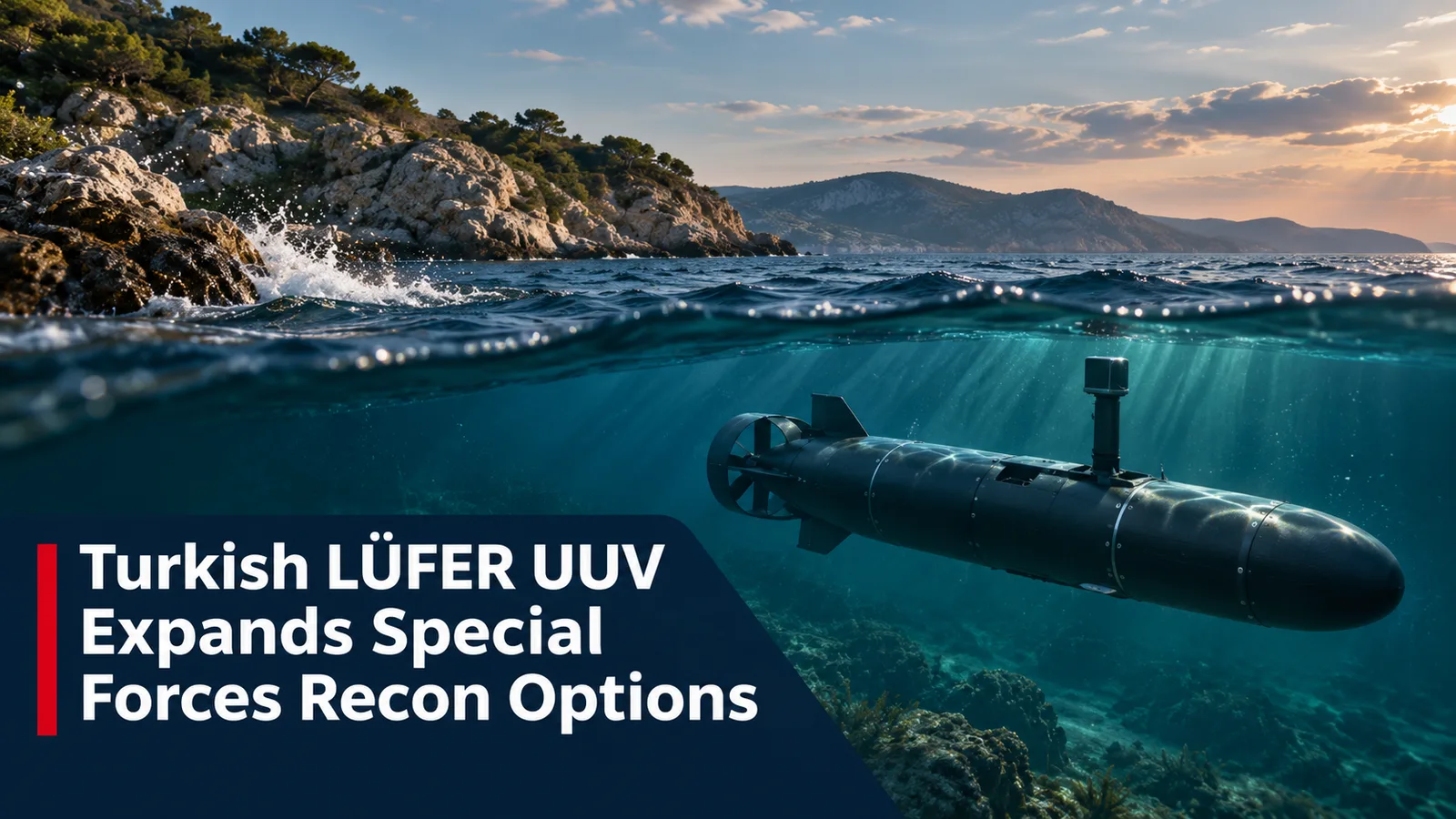
DATUM LÜFER underwater drone was used for coastal reconnaissance during the Turkish Navy's TURNAs-2026 exercise, held from 19 to 27 October 2026. Türkiye's naval special forces deployed the compact, fibre-optic-controlled vehicle from a rigid-hulled inflatable boat and relayed observations of simulated shoreline targets to a command centre. The demonstration, reported by Naval News on 29 October and subsequently examined by TopWar on 2 November, offers evidence of a specific surveillance task rather than a completed underwater attack. It also puts a spotlight on the distinction between LÜFER's stated 15-kilometre fibre-optic cable capacity and a verified endurance or mission-range result.
DATUM LÜFER's Naval Exercise Demonstration and Capabilities
DATUM, the İstanbul-based underwater-engineering company associated with Istanbul Technical University, introduced LÜFER publicly at TEKNOFEST Mavi Vatan in August 2026. The system's first widely reported exercise appearance followed during TURNAs-2026 in the Antalya Bay and eastern Mediterranean region. In the documented scenario, an SAT (Su Altı Taarruz) special-operations team used a small boat to deploy the vehicle near the intended training area. LÜFER collected imagery of the shore and transmitted observations through its control connection, after which other unmanned systems took part in the simulated engagement sequence. The underwater vehicle's role in that sequence was reconnaissance, not a publicly confirmed kinetic strike.
The system is described as approximately 1.2 metres long and 13 kilograms without an explosive payload, allowing a single operator to transport the main vehicle. Naval News lists a fibre-optic spool of up to 15 kilometres and an HD camera for operator-controlled surveillance. Other reporting gives a range of 17–20 kilograms for some configurations. These weights should not be treated as contradictory measurements of the same fully specified load-out: disclosed configurations and whether additional equipment is included differ across sources.
A fibre-optic link provides an alternative to radio-frequency communication for transmitting operator commands and visual data. This can be attractive in environments where radio systems are subject to interference, although the cable introduces its own handling, reliability and deployment limitations. A 15 km spool is not a demonstrated 15 km mission, and it does not by itself establish vehicle endurance, speed, maximum operating depth or the distance at which an operator successfully completed the October scenario. Those measurements were not supplied in the published exercise accounts.
The 2 November TRT Haber interview with DATUM founder Dr Münir Cansın Özden also discusses the vehicle's intended surveillance and optional one-way attack roles. Such a dual-use mission description does not mean both roles have been completed in trials. The available October exercise reporting documents an observation activity and the sharing of reconnaissance information; it does not provide an independently verified warhead detonation, target-damage assessment or formal Navy acceptance record.
The exercise result therefore occupies a useful but bounded place in the programme's development. It offers an example of the equipment being handled by naval special forces and contributing information within a larger scenario. It does not support describing the system as combat-proven, in full-rate production, or formally introduced into the Turkish Navy's inventory. TRT Haber reported an expectation that service entry could follow, but no procurement quantity, contract value or fixed acceptance date was publicly established in the sources reviewed.
DATUM's wider corporate activities provide industrial context. Its official website states that the company was established in 2013 and that Istanbul Technical University became a partner in 2018. It describes work on crewed mini-submarines, unmanned underwater vehicles and maritime test equipment. Those capabilities explain the engineering environment from which LÜFER emerged, but they should not be used as substitute evidence for the vehicle's individual qualification milestones.
KOFANA, Procurement Readiness and the Next Underwater Milestones
LÜFER is not DATUM's only recently disclosed underwater project. Reporting from Naval News and TopWar describes KOFANA, a much larger, remotely controlled uncrewed underwater vehicle intended for heavier missions. Its published characteristics include a 7.1-metre hull, displacement of approximately four tonnes, a reported 700-kilogram payload allowance and an 80-kilometre fibre-optic communications link. The larger system is conceived for mine-related missions and other roles, but the public specification sheet is not evidence that an integrated mine-deployment-and-return sequence has been demonstrated.
The difference in programme maturity matters more than the headline difference in platform size. LÜFER has a reported, bounded reconnaissance scenario involving naval personnel. The published KOFANA material establishes an industrial concept and manufacturer specifications, but the cited accounts do not document successful end-to-end execution of its proposed heavy-payload mission. Evidence from tests of a separate mine or carrier platform would not establish the readiness of KOFANA itself.
The difference between cable length and tested range also carries through to KOFANA. An advertised 80 km communications link does not establish that the vehicle can traverse a corresponding underwater mission profile, sustain communications throughout it or return reliably. Published information does not provide a sufficient independent dataset for a mission-endurance or recovery comparison. Both designs must be judged by actual test conditions and repeatable performance, rather than by isolated specification maxima.
For procurement authorities, the relevant questions include demonstrated mission availability, maintenance and inspection requirements, secure handling of mission data, communications continuity, training, support arrangements and verified lifecycle costs. A man-portable reconnaissance platform and a heavier underwater mission vehicle create very different logistics demands. Neither lower personnel exposure nor claimed electronic-warfare resilience automatically removes the need for validated operating procedures and naval safety assessment.
The wider naval market is pursuing different approaches to underwater autonomy. Defence Agenda's examination of remote mine-hunting systems and human oversight explains how remotely collected sensing data still depends on verification and operator decisions. The UK's Atlantic Net undersea surveillance initiative addresses a different scale of distributed sensing, while the Thales US Navy remote mine-hunting procurement provides a useful example of how signed quantities and formal acquisition milestones can be distinguished from development announcements. These programmes are contextual comparisons; none is a customer order for DATUM.
LÜFER's next meaningful evidence would be further instrumented trials, documented performance in different operating conditions and a confirmed customer acceptance or delivery announcement. For KOFANA, comparable evidence would need to cover representative mission trials and recovery, rather than specifications alone. No contract value, production quantity or operational fielding date for either vehicle was confirmed in the reviewed reporting as of 16 November 2026.
The significance of TURNAs-2026 is therefore specific. Türkiye has a reported example of a small fibre-optic underwater reconnaissance vehicle contributing to a special-operations training scenario. That is a meaningful development milestone for DATUM, but claims about fully mature strike capability, sustained long-range performance or a completed naval procurement programme remain unverified.
Further Reading
- Naval News — DATUM LÜFER showcased in Turkish naval exercise (29 October 2026)
- TRT Haber — Interview on LÜFER and KOFANA (2 November 2026)
- DATUM — Company profile and underwater-systems work
- TopWar — LÜFER and KOFANA technical assessment (2 November 2026)
- Defence Agenda — Remote Mine Hunters Reshape Naval Mine Warfare
- Defence Agenda — UK Announces £90M Atlantic Net Undersea Surveillance
- Defence Agenda — Thales Wins $53.9M US Navy Mine-Hunting Contract