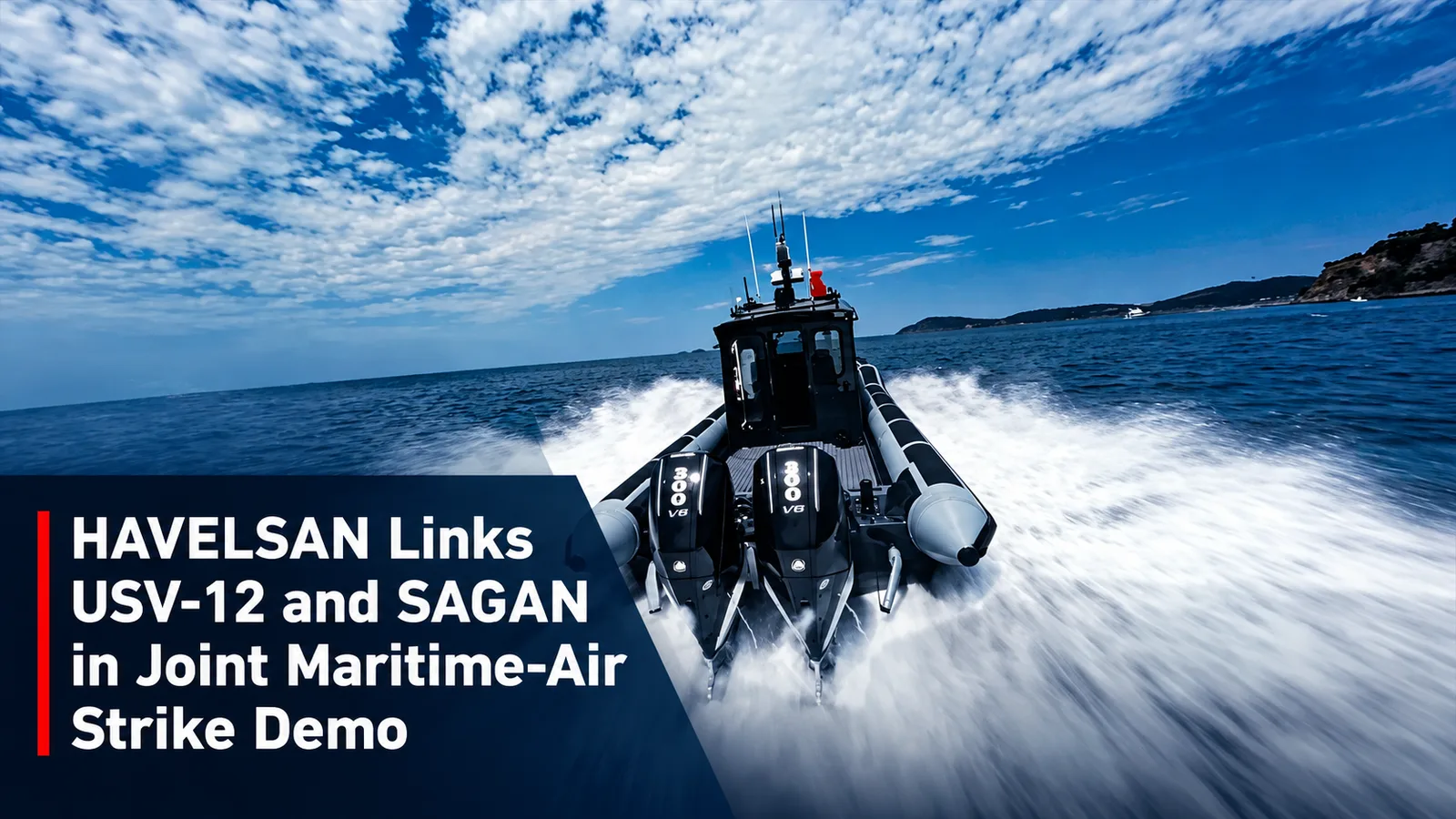
HAVELSAN has demonstrated a coordinated unmanned maritime-air mission by integrating VN Deniz Teknolojileri’s USV-12 unmanned surface vessel with ASİSGUARD’s SAGAN FPV UAV under a common command-and-control architecture. During the field activity, SAGAN launched autonomously from the moving USV-12 and delivered a 60 mm mortar onto a designated target before completing its mission.
The event is important because the capability being demonstrated is larger than either platform. HAVELSAN used its command-and-control, mission-management and autonomy stack to coordinate two unmanned systems from different manufacturers and manage target engagement through a shared operational framework.
The USV-12 Acted as a Mobile Launch Platform
Anadolu Agency reported that USV-12 conducted autonomous surface navigation while carrying SAGAN. The UAV then performed an autonomous take-off from the unmanned vessel and delivered the 60 mm mortar onto the assigned target. HAVELSAN’s mission-management layer coordinated the activity while the final target-engagement process remained under operator control.
This is a useful distinction. The demonstration did not simply place a drone on a boat; it linked navigation, launch, mission execution and engagement management across two unmanned domains. That is the operational step required if unmanned surface vessels are to become mobile launch, sensor or effect-delivery nodes rather than stand-alone reconnaissance craft.
USV-12 Provides a Fast, Modular Maritime Node
HAVELSAN’s current USV-12 product data describes a 12-metre unmanned surface vessel developed with VN Maritime Technologies. The platform has a published cruising speed of 25 knots, a maximum speed above 45 knots and an approximate full-load displacement of 7.5 tonnes.
The vessel is designed around modular payload integration and autonomous mission execution. HAVELSAN lists intelligence, surveillance and reconnaissance, patrol, search and rescue, surface warfare, oceanographic research and mine-hunting among potential missions, supported by COLREG-compliant autonomous navigation and AI-based perception through the company’s BlueVision module.
Communications Architecture Is Central to the Concept
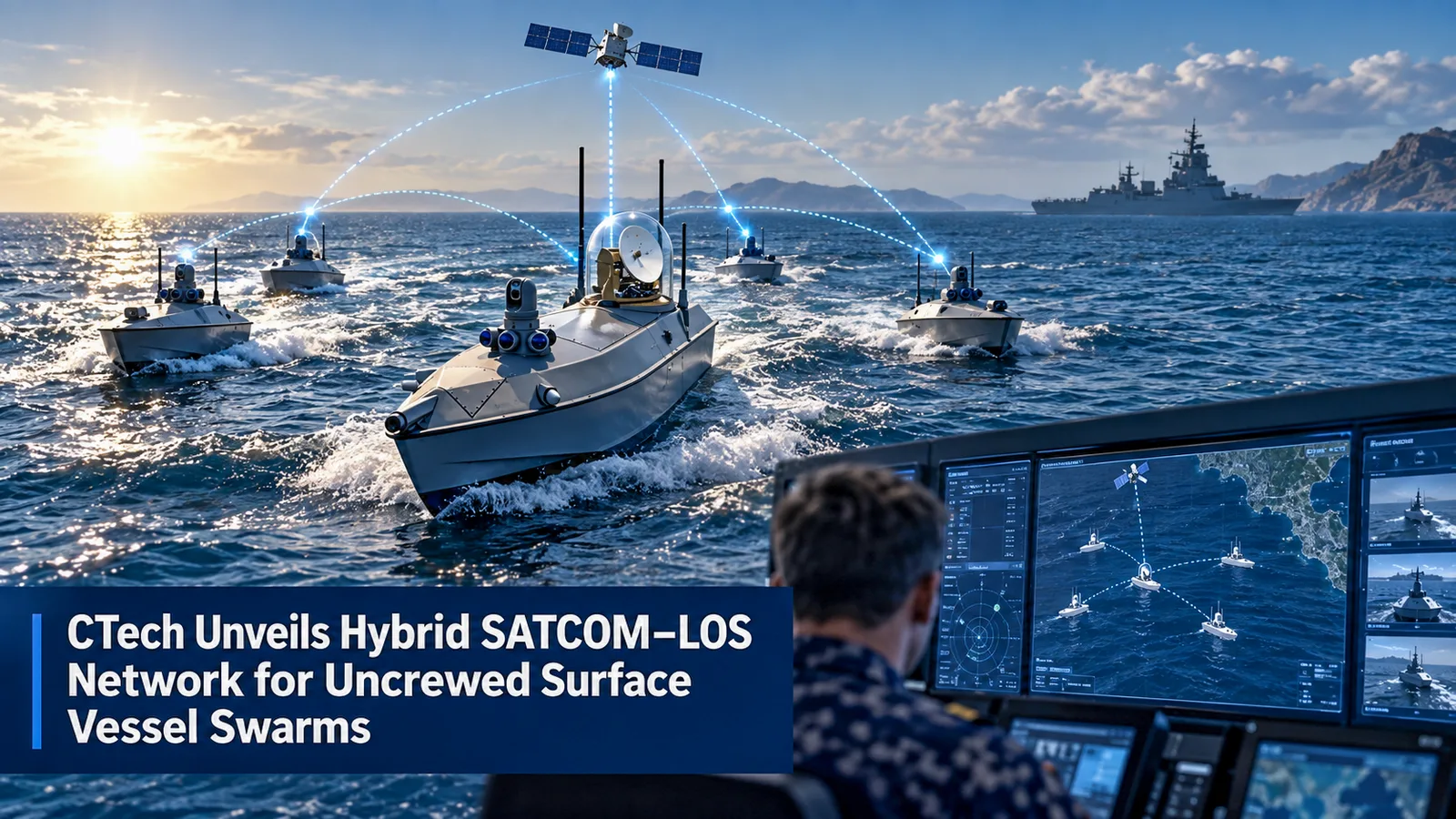
USV-12 supports layered communications that HAVELSAN says can include RF line-of-sight, LTE/5G, SATCOM and LEO-based links. The vessel can be controlled from land, a headquarters or a mothership, allowing the unmanned platform to act as part of a wider distributed maritime network.
That connectivity is central to the latest demonstration. A surface platform can only function as a useful airborne-drone carrier if mission data, launch authorisation, target information and platform status can be exchanged reliably across the force. The test therefore provides evidence of cross-platform mission integration rather than only vehicle autonomy.
SAGAN Adds a Low-Cost Airborne Effector
ASİSGUARD describes SAGAN as an FPV kamikaze-drone family available in multiple frame sizes. The company lists a maximum speed of 120 km/h, more than 25 minutes of endurance without payload and more than 10 minutes of endurance with a 1.5 kg payload.
In the HAVELSAN demonstration, SAGAN was used differently from the company’s standard one-way attack framing: it acted as an air-launched or sea-launched delivery platform for a 60 mm mortar. The public reporting does not disclose the exact SAGAN variant, the mortar interface, launch distance, target range or whether the aircraft was recovered after the mission. Those details should therefore remain unspecified.
Different Manufacturers, One Command Architecture
The broader significance lies in HAVELSAN’s stated interoperability approach. Anadolu Agency reports that the company’s solutions are being developed in line with NATO-compatible interoperability principles, allowing unmanned systems from different manufacturers to operate under a common command-and-control architecture.
That model is strategically important because armed forces rarely field unmanned systems from a single supplier. A useful autonomy architecture therefore has to abstract away platform-specific interfaces and provide shared mission planning, common operational pictures, task allocation and operator control across heterogeneous fleets.
The Concept Extends HAVELSAN’s Existing Maritime Autonomy Work
HAVELSAN has already demonstrated networked unmanned maritime operations through the SANCAR armed unmanned surface vessel, which completed live-fire trials integrated with ADVENT ROTA and the ADVENT combat management system in 2025. The company has also validated shipborne operation of multiple VTOL UAVs and is developing underwater autonomy technologies through AVISTA and ÇAKA-related work.
The USV-12–SAGAN demonstration adds another layer to that roadmap: a smaller, faster surface vessel functioning as a carrier for an airborne effect. In operational terms, this creates the possibility of distributed maritime nodes that can move sensors or effectors closer to a target area while reducing direct exposure of crewed ships.
Potential Missions Go Beyond a Single Mortar Drop
The 60 mm mortar delivery was a specific demonstration payload, but the underlying architecture could support a wider set of maritime-air missions. Depending on future qualification and payload integration, an unmanned vessel could act as a launch point for reconnaissance drones, communications relays, loitering munitions or other airborne systems while remaining under a shared mission-management framework.
Those are logical extensions of the demonstrated architecture, not confirmed operational configurations. Neither HAVELSAN nor Anadolu Agency has publicly stated that the USV-12–SAGAN combination has entered service, completed military qualification or been selected for procurement.
What the Demonstration Proves — and What It Does Not
The field activity demonstrates that USV-12 and SAGAN can be coordinated through HAVELSAN’s command-and-control and autonomy stack for a defined mission involving autonomous movement, drone launch and target engagement. It also demonstrates practical integration between products from VN Deniz Teknolojileri, ASİSGUARD and HAVELSAN.
It does not establish combat survivability, electronic-warfare resilience, communications performance under jamming, sea-state limits for drone launch, engagement range, operational fielding or serial production status for the integrated configuration. Those are the next areas that would need evidence before the concept can be assessed as a mature operational capability.