Hanwha Cheongwang laser development has reached another counter-drone milestone after South Korea's Army TIGER+ exercise on 14 October 2026, when Hanwha Systems said its fixed-site Cheongwang Block-I and a separate 30 kW-class vehicle-mounted laser intercepted all three drones used in the demonstration. The result, detailed in a 6 November Asian Military Review report, follows the Block-I system's entry into South Korean service in December 2024 and a domestic laser-oscillator breakthrough announced in June 2026. For defence planners, the development illustrates how laser air defence is moving from protected fixed sites towards mobile systems, although the demonstration does not prove a general 100% interception probability against every drone threat.
Cheongwang Block-I: Operational Laser and October Drone Trials
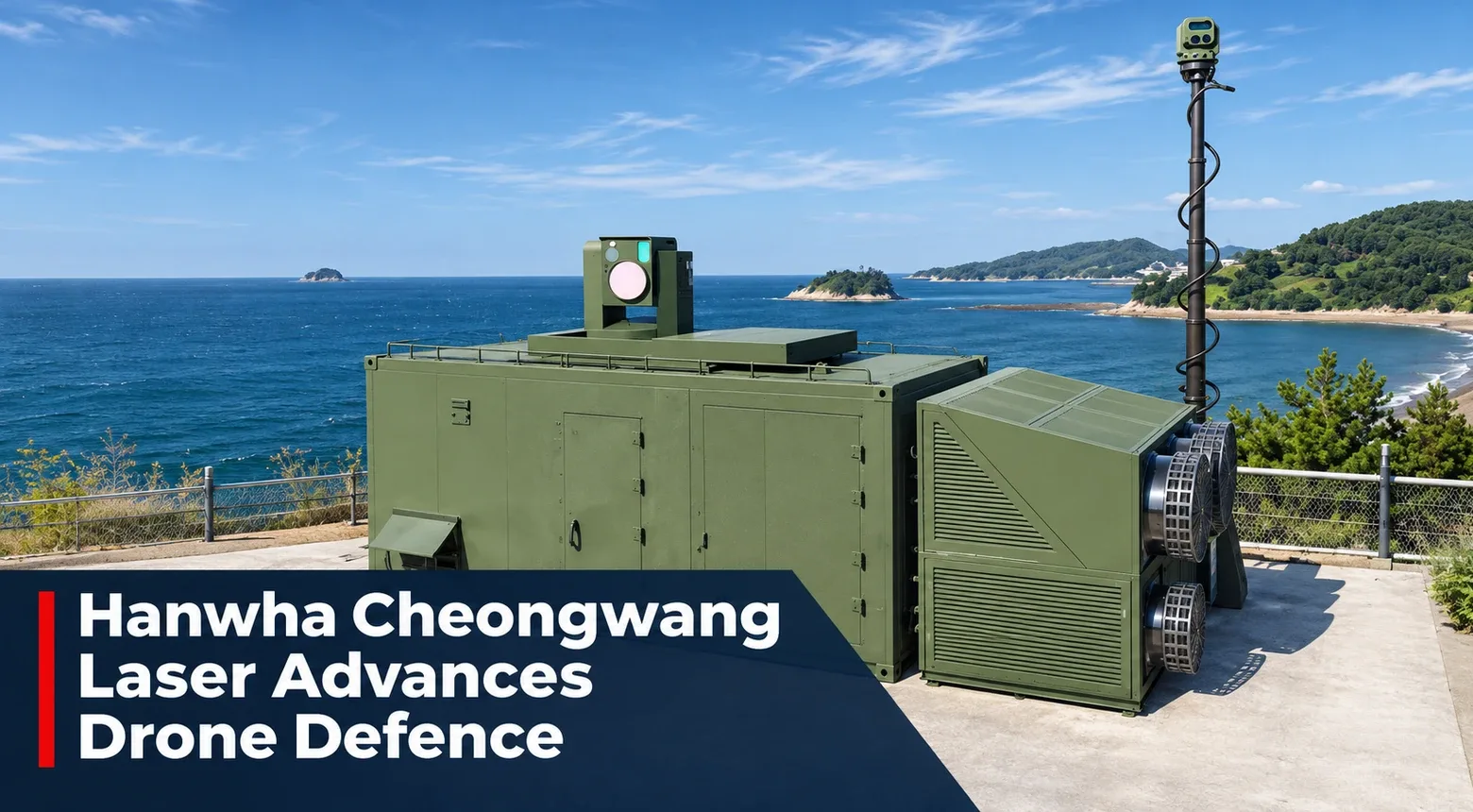
Hanwha Systems developed Cheongwang, translated as “light of the sky”, with South Korea's Agency for Defense Development under the country's Laser Air Defence Weapon Block-I programme. The 20 kW-class fibre-laser system is intended primarily to defend fixed installations against small unmanned aircraft. It was first fielded in December 2024. The manufacturer's laser-system product information describes precise engagements against small multirotors and fixed-wing drones, while distinguishing stationary and mobile configurations.
During the 14 October 2026 Army TIGER+ Future Warfare Integrated Combat Exercise, Hanwha reported using the fielded Cheongwang and a 30 kW-class vehicle-mounted laser in a demonstration observed by approximately 500 military, academic and industrial participants. The company says the systems collectively destroyed three target drones. These results were reported by Defense News and examined in greater technical detail by Janes. The publicly available reporting does not provide enough data to assign every intercepted target to a particular weapon, reproduce the test conditions or calculate a statistically meaningful probability of interception beyond those three engagements.
A previous demonstration on 16 September 2026 reportedly saw six uncrewed aerial targets neutralised in succession at the Defense Drone Technology Exhibition. The two events together offer evidence of repeated controlled demonstrations. They do not establish performance against every combination of weather, visibility, target speed, manoeuvre, obscurants or simultaneous threats. Describing the trials as complete operational qualification for every vehicle-mounted variant would therefore overstate what was made public.
Industrial localisation has also moved forward. South Korea's Defense Acquisition Program Administration (DAPA) stated on 1 June 2026 that the Agency for Defense Development and Hanwha Systems had developed a domestic laser oscillator for Block-I. According to DAPA's disclosure reported by Yonhap, the local component improved relevant performance measures by more than 50% and increased the domestic content share from 76% to 90%. The oscillator was intended for subsequent production batches; public reporting does not conclusively identify whether the equipment used in the October demonstration incorporated that new component.
Hanwha and DAPA have cited an estimated direct electricity cost of approximately KRW 2,000 (US$1.50) per firing. That is a useful illustration of the attraction of directed-energy weapons against relatively inexpensive drones. It is not the fully burdened cost of an interception: acquisition, sensors, power generation, cooling, maintenance, operator training, safety infrastructure and sustainment costs are not included in the per-shot figure. Laser weapons also retain physical limits, including the need for a suitable line of sight, sufficient energy and an operating environment that permits the beam to have the desired effect.
The operational distinction is equally important for estimating maturity. Cheongwang Block-I is an existing fielded fixed-site system, and the company is pursuing additional deployments. Figures in the 6 November report refer to approximately five units deployed and another ten planned, rather than a verified count of 15 already operational. Such reports provide a useful indication of scale, but do not specify every location, acceptance milestone or procurement contract term.
Mobile Laser Systems, Export Plans and Procurement Risks
Hanwha's mobile laser roadmap includes several programmes that should not be conflated. The 30 kW-class vehicle-mounted system involved in the October trials is a different configuration from fixed-site Block-I. Meanwhile, Hanwha is developing a 50 kW Laser Armored Vehicle aimed at export customers. At the September 2026 MSPO exhibition in Poland, the company displayed the higher-power concept and discussed a target of initiating production by the end of 2027. A future production target is not a delivered export order or a statement that the system is already deployed with a foreign military.
Hanwha's MSPO exhibition briefing described Cheongwang alongside several other directed-energy systems and proposed integrated air-defence products. The company's English product overview also distinguishes a mobile laser weapon combining radar and jamming with the company's anti-aircraft laser and laser-based explosive-ordnance disposal technology. The presence of multiple configurations in one product portfolio does not make their output levels, mission roles or development status interchangeable.
For procuring authorities, the potential advantage is a lower incremental cost per engagement and a reduced need to replenish conventional ammunition. But practical system value depends on several less visible metrics: target-detection and tracking performance, the time required to achieve an effect, reliability under representative environmental conditions, electrical and thermal support, and integration into an effective layered command-and-control architecture. Those indicators were not published as a full customer acceptance dossier with the October trial results.
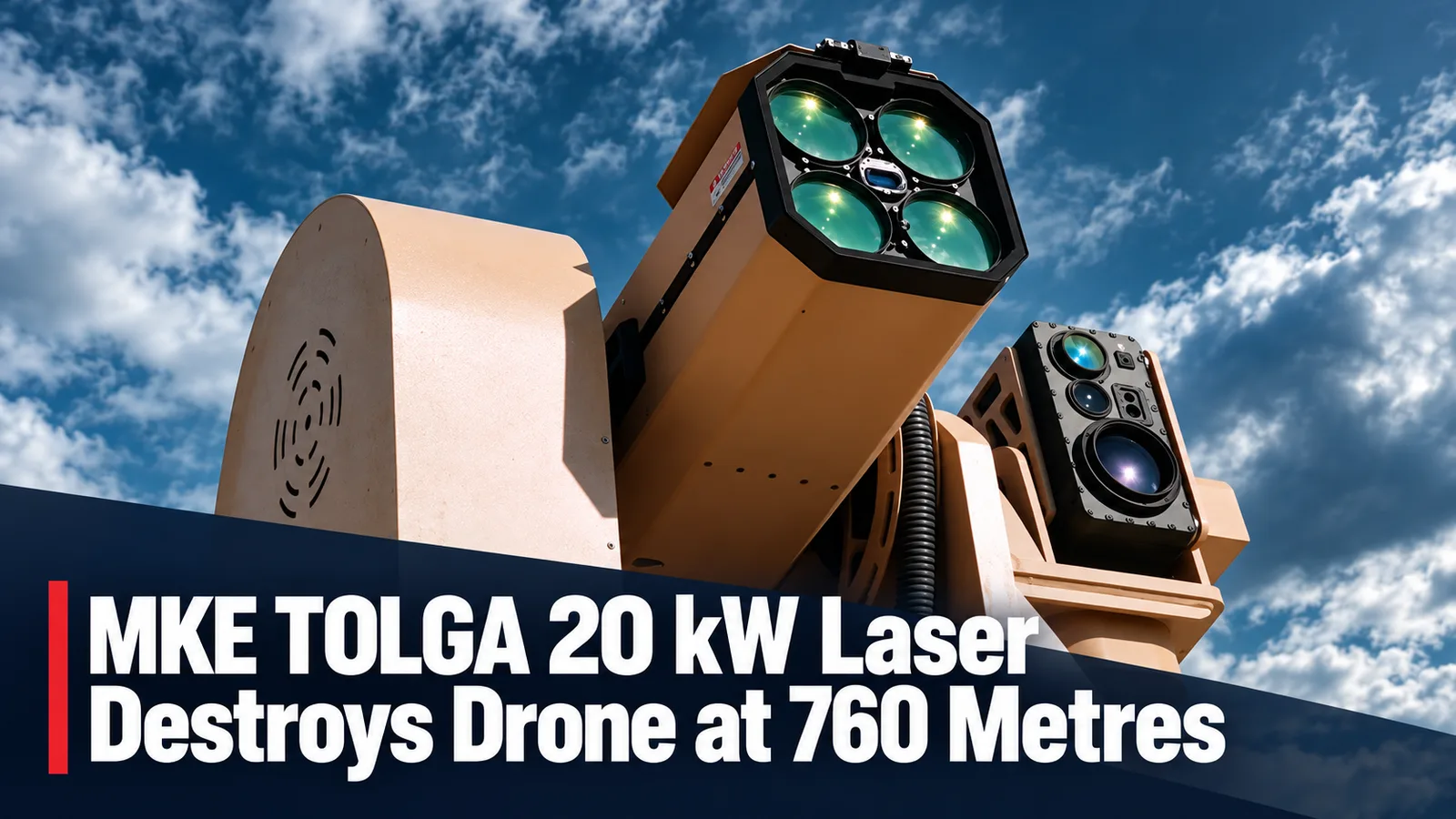
The competition is also broader than laser versus missile. Electronic countermeasures can defeat some drones but may be less effective against certain autonomous or electronically resilient targets. Gun-based systems and dedicated interceptor drones provide other engagement options, with their own cost and logistics characteristics. In Türkiye, MKE TOLGA demonstrated a 20 kW laser against a drone at 760 metres, while STM reported a TUNGA-X interceptor demonstration. These are relevant examples of alternative counter-UAS approaches, not matched tests under common conditions. Their performance figures should not be ranked against Cheongwang's without equivalent target, range, environment and acceptance criteria.
For Hanwha, the domestic oscillator development may reduce a critical external dependence and provide a more flexible production base. The 90% local-content ratio reported by DAPA, however, does not mean every part of the system is locally sourced, nor does it remove the need for supplier qualification, configuration control or long-term parts support. Potential export customers would also need to resolve rules governing controlled technology, maintenance support, training and integration with existing air-defence networks.
The headline result from October is therefore precise: Hanwha says its fixed and mobile demonstrators together defeated three target drones in a South Korean Army exercise. The fixed-site 20 kW Block-I is already fielded, the 30 kW vehicle system has been demonstrated, and the 50 kW export-oriented vehicle remains a development and proposed production programme. These are three different stages of capability maturity. Future announcements about orders, verified production start, customer acceptance and sustained operational performance should be assessed separately from the exercise result.
Further Reading
- Hanwha Systems laser weapon portfolio — product descriptions
- Asian Military Review — Hanwha laser counter-drone developments, 6 November 2026
- DAPA's domestic oscillator disclosure, reported by Yonhap, 1 June 2026
- Defense News — South Korean laser exercise results, 16 October 2026
- Defence Agenda — MKE TOLGA 20 kW laser demonstration
- Defence Agenda — STM TUNGA-X interception demonstration