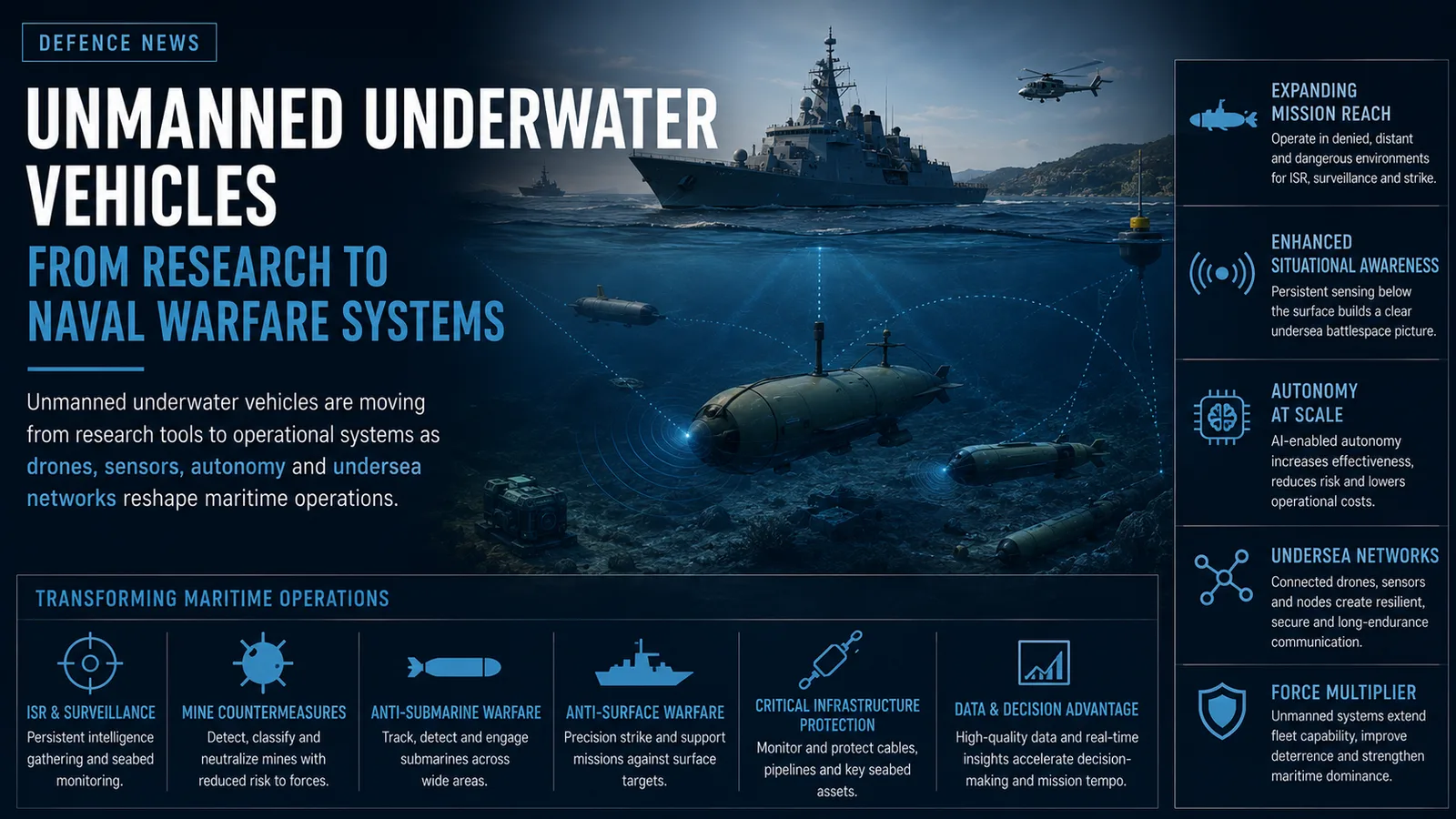
Unmanned underwater vehicles are extending drone warfare below the surface as navies look for autonomous systems that can scout, map, monitor, protect and strike in the undersea domain.
A SAHA Blog analysis argues that the success of unmanned aerial systems has opened the way for similar transformation across land and maritime platforms. The article focuses on autonomous underwater vehicles and their growing role in naval operations.
The shift matters because the underwater battlespace is becoming more contested. Submarines, mines, seabed infrastructure, underwater sensors, special operations routes and maritime chokepoints all create demand for persistent unmanned systems.
Airborne drones changed the way militaries think about surveillance, targeting and risk. Underwater drones may now change how navies think about endurance, mine warfare, seabed security and distributed undersea presence.
Unmanned Underwater Vehicles Are Part of a Wider Maritime Drone Family
Unmanned maritime systems are not a single category. They include remotely operated vehicles, autonomous underwater vehicles, underwater gliders, unmanned surface vessels, tethered systems, towed systems and profiling floats.
Each platform type serves a different operational need. ROVs are usually controlled by an operator and often remain connected by cable. AUVs can operate without continuous human control. Gliders prioritise endurance and low energy use. USVs operate on the surface and can carry sensors, payloads or communication relays.
This family structure is important. Future naval forces will not rely on one underwater drone. They will combine multiple unmanned systems into layered maritime networks.
AUVs Bring Autonomy to the Undersea Domain
Autonomous underwater vehicles are self-propelled robotic platforms that can perform missions with limited or no operator control. They can be programmed before deployment and then operate underwater using onboard sensors, computers and navigation systems.
The SAHA Blog article notes that AUVs are already used for seabed mapping and for collecting physical, chemical and biological data from the marine environment. Their military value comes from similar capabilities: persistent sensing, route survey, mine detection, seabed inspection and covert reconnaissance.
Their main advantage is access. AUVs can operate in waters that are too shallow for larger vessels, too deep for divers or too risky for crewed platforms.
Navigation and Communications Remain the Hardest Problem
Operating underwater is harder than operating in the air. Radio waves do not travel well through seawater, so underwater vehicles cannot rely on constant GPS or high-bandwidth radio links while submerged.
This changes the design logic. AUVs must use inertial navigation, acoustic communications, depth sensors, sonar and mission planning to complete tasks while disconnected from continuous control.
Depending on the mission, an AUV may surface periodically to receive GPS updates and transmit data. In more sensitive missions, it may remain submerged for the full task and store data onboard until recovery.
Energy and Endurance Define Underwater Drone Value
Power is one of the most important constraints for unmanned underwater vehicles. Propulsion, sensors, onboard computing and communications all consume energy.
Some underwater platforms use specialised batteries, while others explore fuel cells, energy harvesting or buoyancy-driven motion. Gliders can reduce energy demand by using changes in buoyancy to move through the water column, trading speed and manoeuvrability for endurance.
DARPA’s Manta Ray programme shows where the technology is heading. The programme seeks critical technologies for a long-duration, long-range, payload-capable class of UUVs, including energy management, low-power propulsion, underwater navigation, hazard detection and material durability.
Mine Countermeasures Are an Early Operational Driver
Mine warfare is one of the clearest use cases for unmanned underwater vehicles. Mines are dangerous, cheap compared with major warships and difficult to clear under pressure.
Unmanned systems can reduce risk to sailors by detecting, classifying and helping neutralise mines before crewed vessels enter an area. They can also support route survey, harbour access, amphibious operations and protection of sea lanes.
The Royal Navy is already moving in this direction. Its Mine Hunting Capability programme delivered uncrewed surface vessels and SeaCat uncrewed underwater vehicles, while sailors have begun training in mission planning, deployment, recovery, data exploitation and maintenance.
Anti-Submarine Warfare Moves Toward Hybrid Networks
Anti-submarine warfare is another major opportunity. Traditional ASW depends on ships, submarines, maritime patrol aircraft, helicopters, sonobuoys and fixed sensors. Unmanned systems can add persistence and distributed coverage.
In 2026, the Royal Navy described demonstrations of autonomous and crewless technology for the underwater battlespace under its Atlantic Bastion programme. The tested technologies included seabed acoustic detection systems, uncrewed surface vessels with acoustic arrays, towed arrays, remote operation centres, AI integrations, drones with sonobuoys, subsea robots, gliders and acoustic floats.
This points to a hybrid navy model. Crewed ships and submarines will remain central, but they will increasingly operate with unmanned sensors and autonomous platforms that extend detection range and reduce risk.
XLUUVs Could Change Undersea Presence
Extra-large unmanned underwater vehicles could change the economics of undersea presence. Larger UUVs can carry more payload, travel farther and stay deployed longer than small survey vehicles.
The U.S. Navy’s UUVRON 3 is building the foundation for extra-large unmanned undersea vehicle warfighting operations. The command supports XLUUV testing, fielding and employment for combatant commander requirements.
Australia is also institutionalising maritime autonomy. Its Maritime Autonomous Systems Unit will operate complementary systems including Ghost Shark XL-UUV, Bluebottle USV and Speartooth LUUV, with missions focused on persistent long-range ISR and strike.
Seabed Warfare Makes UUVs More Important
Critical seabed infrastructure is now a strategic vulnerability. Undersea cables, energy pipelines, offshore platforms and sensor networks are difficult to monitor and expensive to protect.
Unmanned underwater vehicles can help inspect, map and monitor these assets. They can also support anomaly detection, damage assessment and surveillance of approaches to sensitive maritime infrastructure.
This makes UUVs relevant beyond traditional naval warfare. They are becoming tools for national resilience, maritime security and protection of economic infrastructure.
Swarming and Networked Operations Are the Next Step
The SAHA Blog article argues that coordinated and swarm-capable underwater systems could create major operational advantages. This is one of the most important future directions for undersea autonomy.
A single UUV can map an area or inspect a route. A coordinated group of UUVs, USVs and aerial drones can build a wider operational picture across surface, subsurface, air and shore-based nodes.
This is where unmanned underwater vehicles become part of network-centric warfare. The value is not only the vehicle. The value is the system of sensors, communications, autonomy, command software and mission planning that links multiple platforms together.
Military Missions Are Expanding
The military mission set for unmanned underwater vehicles is expanding quickly. It includes mine detection, mine identification, mine neutralisation support, unexploded ordnance detection, underwater reconnaissance, port security, fleet escort, submarine rescue, wreck inspection and anti-submarine warfare.
Some missions are defensive. Others could become offensive as endurance, autonomy and payload capacity improve. In both cases, the undersea domain will become more automated and more data-driven.
This does not mean crewed submarines will disappear. Instead, crewed submarines, surface combatants and maritime aircraft will operate with a growing layer of unmanned systems that extend reach and reduce risk.
Commercial Technology Will Accelerate Naval Adoption
Commercial demand is also accelerating UUV development. Offshore energy, seabed mapping, scientific research, environmental monitoring, shipwreck location, hydrocarbon exploration and disaster assessment all require underwater robotic systems.
This dual-use market matters for defence. Commercial suppliers can help reduce cost, improve availability and speed up innovation. Navies can then adapt mature technologies for military tasks such as mine countermeasures, ISR and seabed security.
The challenge is militarisation. Defence users need rugged systems, secure data handling, cyber resilience, mission assurance and integration with naval command networks.
Türkiye Has a Clear Undersea Autonomy Opportunity
Türkiye’s defence ecosystem has a strong entry point into undersea autonomy. The country already has experience in unmanned aerial systems, naval platforms, sensors, software, command-and-control, electronic systems and indigenous mission software.
The same logic that made aerial drones strategically valuable can apply underwater: affordable platforms, modular payloads, national software, sensor integration and rapid operational learning.
For Türkiye, the opportunity is not only to build individual UUVs. It is to build a full undersea autonomy ecosystem covering vehicles, sensors, power systems, autonomy software, underwater communications, mission planning and fleet-level integration.
The Hardest Barriers Are Not Only Technical
Unmanned underwater vehicles face major technical barriers. These include navigation without GPS, limited underwater communications, power density, pressure resistance, corrosion, biofouling, launch and recovery, payload integration and autonomous decision-making.
However, the hardest barriers are also organisational. Navies must decide who operates UUVs, how missions are authorised, how data is exploited, how systems are maintained and how unmanned platforms fit into existing submarine, mine warfare and surface-force structures.
The Royal Navy’s minehunting training and the U.S. Navy’s UUVRON 3 show why this matters. Undersea autonomy requires not only technology, but also doctrine, trained operators, maintenance systems and operational command structures.
Procurement Will Reward Modular Designs
UUV procurement will likely reward modularity. Navies will need vehicles that can accept different payloads for mine warfare, ISR, seabed inspection, acoustic sensing, electronic support, mapping or strike-support missions.
Open architectures will also matter. Defence customers will want to update software, integrate national sensors, connect to command systems and modify payloads without redesigning the entire platform.
This creates opportunity for suppliers that can deliver platforms and mission systems together. The winning companies will not only build underwater hulls. They will build the autonomy, data and command layers around them.
Conclusion
Unmanned underwater vehicles are moving from research tools to naval warfare systems. Their value comes from persistence, access, reduced risk and the ability to operate in areas that are dangerous or difficult for crewed platforms.
The next phase of maritime autonomy will be shaped by mine countermeasures, anti-submarine warfare, seabed security, XLUUV operations, undersea ISR and networked swarms. DARPA’s Manta Ray, Australia’s maritime autonomy unit, the Royal Navy’s uncrewed minehunting work and the U.S. Navy’s UUVRON 3 all show that navies are taking the undersea drone shift seriously.
The lesson is clear. Drone warfare will not remain above the surface. As autonomy, sensors, energy systems and naval networks improve, the undersea domain will become one of the next decisive arenas for unmanned systems.
For further Defence Agenda coverage, read our naval warfare, drones and unmanned systems sections. Related analysis includes aircraft carrier drones and naval airpower, AUKUS and Indo-Pacific defence technology and 5G military communications and next-generation weapon systems.
Further Reading
- SAHA Blog: Dronların Havadaki Hakimiyeti Su Altında Da Sürecek
- DARPA: Manta Ray unmanned underwater vehicle programme
- Australian Defence: Maritime Autonomous Systems Unit
- Royal Navy: Minehunting course and uncrewed systems
- Royal Navy: Underwater battlespace autonomous technology demonstrations
- U.S. Navy: UUVRON 3 and XLUUV warfighting operations