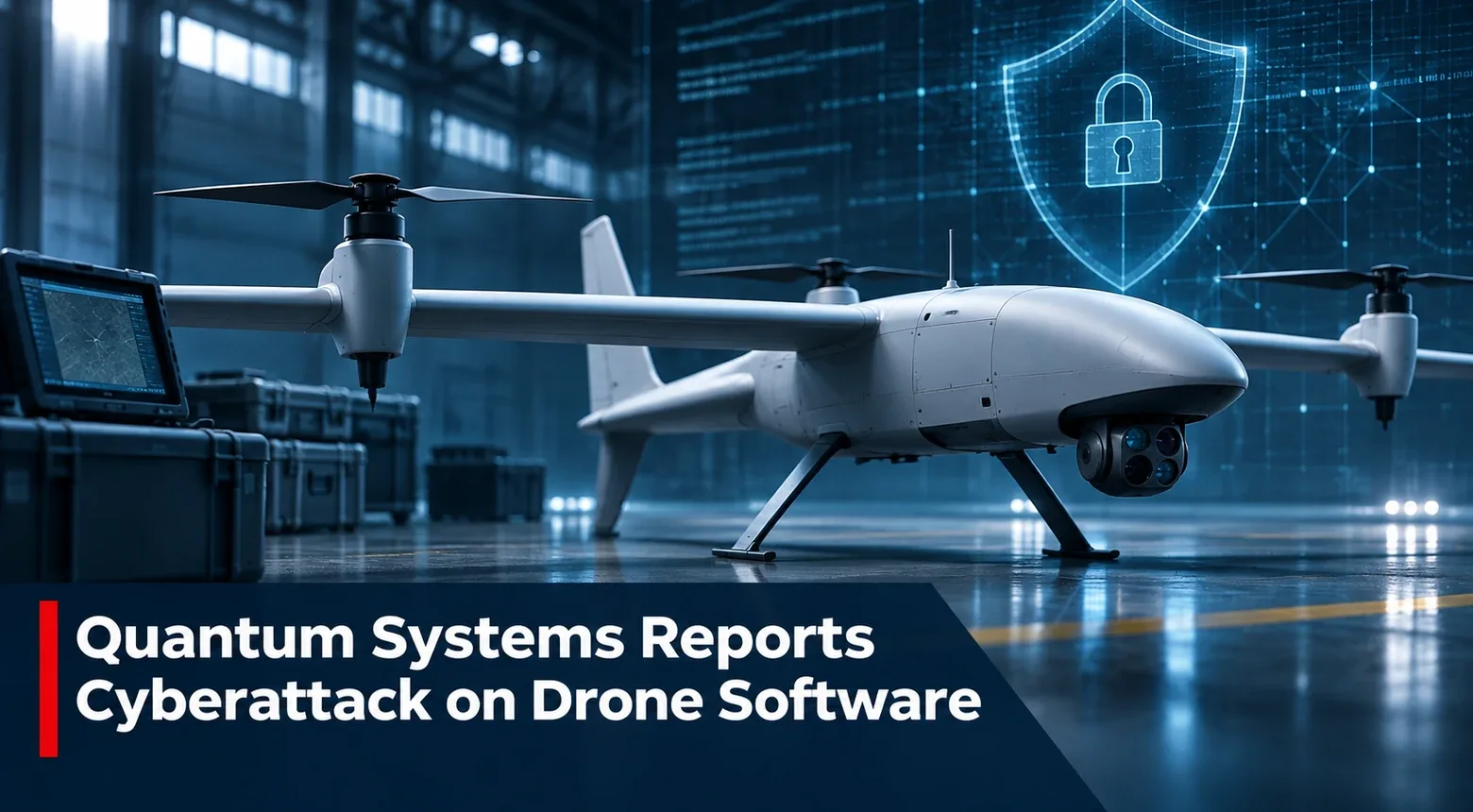
Quantum Systems has confirmed a cyberattack against its organisation, detected in late October 2026 and disclosed publicly on 12 November 2026, with German media and the Financial Times reporting a separate precautionary suspension of Bundeswehr drone operations. The company said its cyber teams contained the incident in coordination with authorities and maintains that its unmanned aircraft present no operating risk. Independent reporting, however, links the incident to a malicious file distributed through an update server associated with QBase ground-control and mission-planning software. The disclosure raises immediate questions for defence procurement offices about software supply-chain assurance, fleet availability and the evidence required before normal operations resume.
Quantum Systems Cyberattack: What Is Confirmed and What Is Reported
In a statement published on 12 November 2026, the Gilching-based manufacturer said it had identified a cybersecurity incident at the end of October. Its internal investigation found an active attack by unidentified hostile actors. Quantum Systems said its IT and security teams worked with government authorities to contain the threat, notified the relevant authorities under its obligations and continued an investigation involving internal and external cyber specialists.
The company also stated that its response and the characteristics of the incident meant there was no risk to end users and operators of its unmanned systems. This is Quantum Systems' own operational-safety assurance, not a publicly available independent forensic finding. Its statement did not identify the attacker, give a detailed intrusion timeline, quantify affected systems, name a compromised product or disclose an independently audited technical report.
The separate Financial Times account published on 13 November reported that a malicious update file was distributed through an update server for QBase, software used for drone ground control and mission planning. According to the FT's reporting, the German military temporarily grounded Quantum Systems aircraft as a precaution, preventing the company from taking part in a recent Bundeswehr exercise. Anadolu Agency's 13 November report, drawing on Der Spiegel, also describes malware allegedly placed into a QBase update and a temporary halt to military flights.
Those accounts should not be combined into a broader assertion that the drones themselves were remotely hijacked. The published reports concern a software-update and ground-system security issue. They do not demonstrate that malicious code executed on any aircraft, that a mission was diverted or that an attacker gained control of a deployed vehicle. Equally, the existence of a disputed or precautionary stand-down cannot be dismissed solely because the manufacturer says the fleet is safe.
Reporting about the extent of the German suspension is not completely uniform. The Financial Times describes a precautionary grounding, while Handelsblatt reported on 12 November that flights inside Germany had been suspended, citing the company, and that operations outside the country continued. Germany's defence ministry did not publicly confirm the operational-readiness details in the reporting reviewed for this article. Consequently, neither the exact fleet-wide duration nor the point at which every operator resumed flights can be treated as independently established.
A technical distinction also matters. Quantum Systems' Vector AI product documentation describes a VTOL intelligence, surveillance and reconnaissance aircraft supported by ground control, datalinks and software interfaces. A compromise of the software distribution channel poses a different class of risk from a confirmed compromise of an airborne flight-control system. What software was installed, which customer environments were exposed and what checking occurred are questions for the continuing investigation. The public evidence does not support assigning a number of infected aircraft or compromised customer computers.
The incident is significant because Quantum Systems supplies reconnaissance technology to military users and has a substantial international industrial and operational footprint. The company has expanded in the United States and supports Ukrainian military applications. Defence Agenda previously examined Quantum Systems' US market development and government customer relationships; that earlier business story offers background on procurement exposure but does not establish that any particular US customer was affected by this cyber incident.
Drone Software Security, Bundeswehr Readiness and Next Steps
For acquisition authorities, the first issue is software provenance. A mission-planning programme or ground-control workstation forms part of the operational system even when the aircraft is physically intact. If a supplier's distribution environment is suspected of delivering a malicious package, customers must determine the authenticity of that package and the integrity of the relevant equipment before deciding whether continued use is acceptable. This is a general programme-assurance implication; no public source establishes the precise remedial procedures used in this case.
A second issue is availability. Grounding aircraft temporarily can be a defensible precaution while an incident is investigated, but it also highlights the cost of uncertainty around software dependencies. A fleet need not have suffered a proven in-flight compromise for an operator to lose training or mission time. The Financial Times' report of a missed exercise therefore matters, although no independently confirmed figure for sorties, aircraft-days or financial impact has been released.
The third issue is industrial accountability. Modern defence UAV programmes depend on suppliers to maintain software, mission planning, cybersecurity patches, component support and documentation through the system's life. When an update pipeline is implicated, a procurement customer may need a clearer account of how affected versions were identified, when clean releases became available and how operational risk was assessed. The public statements available on 13 November 2026 do not provide a complete version-by-version forensic chronology.
This distinction is especially relevant as software-defined defence capabilities expand across European programmes. Defence Agenda's earlier report on Helsing's MissionOSBw software transfer to Germany examines a different programme in which software ownership, interoperability and government oversight are central to future unmanned systems. It is provided as industrial context only: there is no evidence linking Helsing or MissionOSBw to the Quantum Systems incident.
Attribution remains unresolved. Quantum Systems described the attackers as hostile actors and noted the persistent cyber pressure on European defence companies that support Ukraine. The statement did not name Russia, an intelligence service or any specific threat group. Analysts should therefore distinguish the general geopolitical environment from evidence connecting a particular actor to this intrusion. Neither a supplier's Ukraine involvement nor historical campaigns against defence contractors proves responsibility in this case.
The company has not announced a cybersecurity remediation contract, procurement delay, recall programme, loss amount or disclosed number of affected customers. The Bundeswehr has not issued a public statement in the reviewed sources setting out detailed flight-clearance conditions. It would therefore be premature to describe the episode as a confirmed permanent compromise of the Vector fleet or a demonstrated failure of individual aircraft autonomy systems.
There are also limits to what a corporate declaration can settle. A rapid statement that an incident was contained is useful to customers, but full confidence depends on what regulators, investigators and operators eventually establish. Conversely, an interim operational pause is not proof that a drone became technically unsafe to fly. Those propositions can both be true while the evidence is being assessed.
The next relevant milestones are a more detailed incident account from Quantum Systems, any official clarification by German authorities, the status of customer software validation and confirmed restoration of normal operations where restrictions applied. A public investigation result would also help determine whether the attack was limited to the distribution infrastructure or exposed additional data and systems. None of those outcomes should be assumed in advance.
As of 13 November 2026, the defensible conclusion is precise: Quantum Systems has confirmed and contained a cyberattack, while credible news organisations have reported a compromised QBase update path and precautionary German military drone grounding. The identity of the perpetrators, the full technical scope and the final impact on operational readiness remain open questions.
Further Reading
- Quantum Systems — Statement on Cyber Incident, 12 November 2026
- Financial Times — Bundeswehr drone grounding after Quantum Systems attack, 13 November 2026
- Anadolu Agency — German drone maker reports cyberattack, 13 November 2026
- Handelsblatt — Quantum Systems reports cyberattack, 12 November 2026
- Defence Agenda — Quantum Systems' US defence-market foothold
- Defence Agenda — Helsing transfers MissionOSBw software to Germany