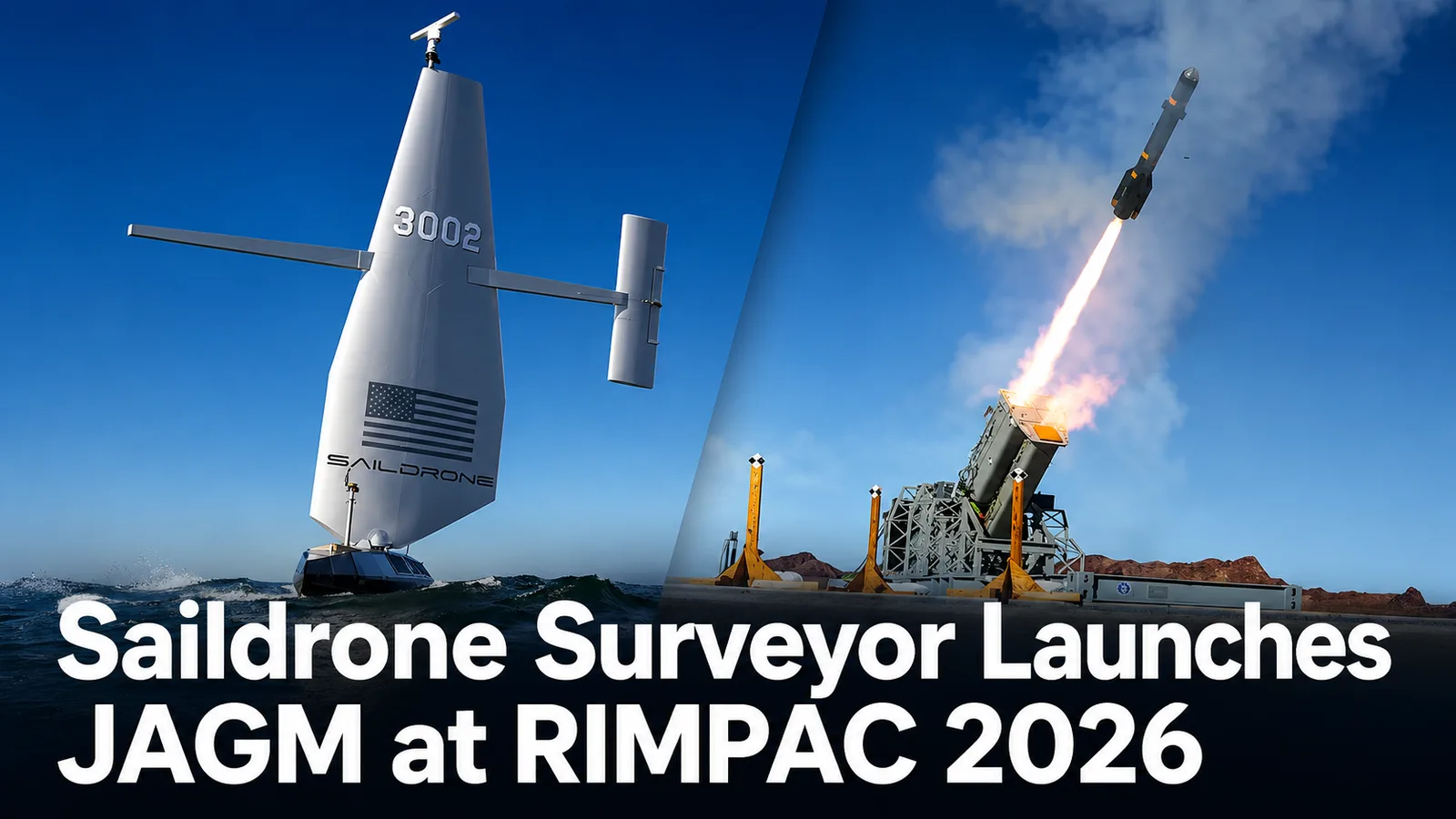
Saildrone Surveyor JAGM integration has reached a new milestone after Lockheed Martin and Saildrone demonstrated a missile launch from an autonomous uncrewed surface vessel, advancing efforts to give the U.S. Navy distributed, crew-free naval platforms capable of carrying operational effectors.
Lockheed Martin announced the demonstration on 20 August 2026. The event follows integration of the Joint Air-to-Ground Missile, or JAGM, launcher aboard the 20-metre Saildrone Surveyor and the deployment of missile-equipped Surveyor SD-3001 during Exercise Rim of the Pacific 2026.
The development matters because it moves Saildrone beyond persistent maritime surveillance into the armed-USV category. If the architecture progresses into operational deployment, the same autonomous hull family could distribute sensors and weapons across a wider battlespace without requiring a crew aboard every missile-carrying platform.
Key Facts
- Platform: Saildrone Surveyor, a 20-metre autonomous uncrewed surface vessel.
- RIMPAC vessel: Saildrone Surveyor SD-3001.
- Effector: Lockheed Martin Joint Air-to-Ground Missile, or JAGM, integrated through a compact maritime launcher.
- Milestone: Lockheed Martin announced a launch demonstration from the USV platform on 20 August 2026.
- Previous deployment: SD-3001 entered the RIMPAC 2026 sea phase with the missile launcher installed on 8 July 2026.
- Partnership: Lockheed Martin invested $50 million in Saildrone in October 2025 to integrate defence payloads and accelerate armed autonomous maritime systems.
- Next-generation path: The larger Saildrone Spectre is designed to support payloads including Mk 70 VLS, anti-submarine warfare arrays and electronic-warfare systems.
Saildrone Surveyor Moves From Sensor to Shooter
The missile-launch demonstration marks a fundamental change in the operational role of the Surveyor platform.
Saildrone originally developed its autonomous vessels around persistent ocean sensing, maritime-domain awareness and survey missions. Surveyor can remain at sea for extended periods while carrying radar, electro-optical systems, communications equipment and subsurface sensors.
The Lockheed Martin partnership adds a kinetic layer to that architecture.
Instead of detecting, classifying and transmitting a contact for another warship to engage, an armed Surveyor creates the possibility that the same distributed autonomous platform could also carry the effector required for selected engagements.
That compresses the sensor-to-shooter chain while keeping sailors off the forward platform.
SD-3001 Entered RIMPAC With a Missile Launcher
The armed configuration had already become visible before the latest launch announcement.
U.S. Navy imagery from 8 July 2026 showed Surveyor SD-3001 departing Joint Base Pearl Harbor-Hickam for the RIMPAC 2026 sea phase with the Lockheed Martin launcher installed.
Naval News subsequently identified the vessel as a JAGM-armed Surveyor and described the installation as capable of carrying four AGM-179 missiles.
The deployment was important because the system was no longer being evaluated only as a dockside integration prototype.
It had moved onto an operationally representative autonomous vessel participating in the world’s largest multinational maritime exercise.
The JAGM Integration Was Announced in January
The programme began publicly several months earlier.
Saildrone announced on 12 January 2026 that the 20-metre Surveyor would become the first platform to receive a Lockheed Martin JAGM launcher under the companies’ strategic collaboration.
The companies planned proof-of-concept integration and an on-water live-fire demonstration during summer 2026.
Saildrone later said the intended RIMPAC demonstration would involve a high-speed manoeuvring surface target.
Because the full 20 August Lockheed Martin release has not yet been consistently indexed across public web archives, Defence Agenda does not attribute additional engagement details from that planned scenario to the completed demonstration unless separately confirmed.
Lockheed Martin Put $50M Behind the Armed-USV Strategy
The integration is backed by a significant corporate investment rather than a one-off missile demonstration.
Lockheed Martin invested $50 million in Saildrone on 29 October 2025 to accelerate integration of military payloads across the company’s autonomous surface-vessel portfolio.
The stated mission areas include fleet defence, undersea surveillance, reconnaissance and attack.
Lockheed Martin is also investing in command-and-control enhancements and autonomous operation of its existing defence products so that weapons designed around crewed platforms can function inside increasingly automated maritime architectures.
This is one of the more important aspects of the partnership.
Putting a launcher onto an unmanned hull is relatively straightforward compared with developing the secure command, targeting, safety and weapon-release architecture required for an operational autonomous combat system.
JAGM Was Designed for More Than Air-to-Ground Missions
The Joint Air-to-Ground Missile designation can obscure how broadly Lockheed Martin is now positioning the weapon.
JAGM, designated AGM-179, was initially developed as a precision weapon replacing legacy HELLFIRE variants for rotary-wing and other aircraft.
Its dual-mode seeker combines semi-active laser guidance with millimetre-wave radar.
Lockheed Martin has since demonstrated JAGM against unmanned aerial threats and from ground-based launchers while promoting the missile for maritime applications.
The result is increasingly a multi-domain effector rather than an exclusively air-launched weapon.
Vertical Launch Has Expanded the Maritime Case
Lockheed Martin demonstrated a 90-degree vertical JAGM launch from its JAGM Quad Launcher at China Lake in January 2026.
The company argues that vertical launch is particularly useful for maritime platforms because it reduces the requirement for a clear forward firing arc.
A missile can instead be launched from a compact deck position and subsequently manoeuvre toward a target in different directions.
That architecture becomes increasingly attractive on small unmanned vessels where deck area and launcher orientation are constrained.
Lockheed Martin has also marketed JAGM as a potential counter-UAS effector for maritime platforms, although the precise role of the Saildrone demonstration should be described according to the specific test conditions released by the companies.
Surveyor Provides Persistence That Missile Boats Normally Lack
Saildrone’s strongest contribution is endurance.
The Surveyor was developed to conduct long-duration autonomous missions across open ocean rather than operate as a conventional high-speed missile boat.
Its existing mission set includes deep-ocean survey, maritime-domain awareness, undersea sensing and cable-route work.
In August 2025, the 20-metre Surveyor became the first uncrewed platform to receive full American Bureau of Shipping class certification under the applicable autonomous naval-craft standards.
This provides the programme with a relatively mature maritime platform onto which military payloads can be integrated.
The value proposition is therefore different from designing an entirely new weaponised USV from the keel up.
The U.S. Navy Wants More Distributed Shooters
The programme aligns with the Navy’s broader Distributed Maritime Operations concept.
Concentrating most offensive and defensive capacity aboard a relatively small number of major crewed warships creates operational and industrial limitations.
Distributed unmanned vessels offer another route.
They can push sensors and selected weapons further from destroyers, amphibious ships and aircraft carriers while increasing the number of operational nodes an adversary must detect and target.
Defence Agenda examined the same transition in USV Technology Drives the Navy’s Hybrid Fleet, where payload modularity and relatively inexpensive uncrewed hulls were identified as key enablers of distributed naval mass.
Armed USVs Change the Risk Distribution
An armed autonomous vessel creates a different risk calculation from a conventional patrol craft.
Sending a crewed ship toward a suspected missile, drone or fast-attack threat risks sailors and a comparatively expensive platform.
An uncrewed vessel can accept greater exposure.
This does not make Surveyor expendable in the strict sense; its autonomy, sensors and communications still give it substantial value.
But the absence of crew changes how commanders can position the platform and what loss calculations look like in contested waters.
Human Weapon Release Remains a Critical C2 Question
The most important unanswered operational question is not whether an autonomous vessel can physically launch a missile.
It is how weapons release is controlled under real operational conditions.
A distributed USV may autonomously navigate, detect contacts and maintain tracks, but military rules of engagement can require human authorisation before kinetic employment.
This places substantial importance on secure communications, positive target identification and resilient command links.
If communications are jammed or lost, the system needs clearly defined behaviour regarding continued surveillance, repositioning and weapon employment.
Lockheed Martin and Saildrone have emphasised secure command-and-control and open architecture, but the detailed operational weapon-release logic is appropriately not public.
The Next Step Is Much Larger Than Surveyor
The Surveyor integration is also being used to de-risk the companies’ larger autonomous naval architecture.
Saildrone unveiled the 52-metre Spectre in April 2026 as its largest and most combat-oriented platform.
The company describes Spectre as a naval USV designed for anti-submarine warfare, ISR and kinetic missions.
The Surveyor JAGM test therefore has value beyond the four-missile class of launcher installed on the smaller platform.
It validates interfaces, power, communications, command relationships and physical integration concepts that can inform a much larger unmanned combat vessel.
Mk 70 VLS Would Create a Different Class of USV
The Mk 70 represents a much more consequential future step.
Lockheed Martin’s Mk 70 Expeditionary Launcher adapts Mk 41 Vertical Launching System architecture into a containerised configuration.
Integrating that class of launcher with a large autonomous surface vessel could give a USV access to weapons far larger and longer-ranged than JAGM.
Saildrone says Spectre is designed to carry two Mk 70 launchers.
No operational U.S. Navy weapon loadout for an autonomous Spectre has yet been announced, and compatibility should not be interpreted as an acquisition commitment.
But the architecture points toward uncrewed vessels capable of contributing to genuine fleet-level missile capacity rather than only short-range self-defence.
Spectre Will Also Carry ASW Sensors
The companies are not designing the platform purely as a missile carrier.
Spectre is also intended to support active and passive anti-submarine warfare arrays.
Its planned payload compatibility includes Lockheed Martin TB-29 thin-line arrays and Thales CAPTAS-4 variable-depth sonar.
This creates a more interesting operational model: the same autonomous vessel family could be configured as a surveillance node, ASW sensor, electronic-warfare platform or shooter according to mission needs.
Payload modularity becomes the key attribute rather than one fixed weapons configuration.
RIMPAC 2026 Became a Major Unmanned Systems Laboratory
The Saildrone activity took place during a particularly technology-heavy RIMPAC.
The exercise ran from 24 June to 31 July around the Hawaiian Islands and included 30 nations, more than 30 surface ships, five submarines, over 206 aircraft and approximately 30,000 personnel.
U.S. Pacific Fleet said more than 35 experiments involving unmanned systems and emerging technologies were conducted during the exercise.
These included autonomous logistics, unmanned surface operations and other technologies intended to increase distributed fleet capacity.
This makes RIMPAC particularly useful for technologies such as armed Surveyor because they can be tested around a large multinational force rather than exclusively at a company proving ground.
The Pentagon Is Separately Seeking Drone-Launching USVs
The armed Surveyor is only one part of a broader U.S. push toward modular unmanned surface combatants.
The Defense Innovation Unit is also running the Suitable Warfighting Adaptive Payloads for Unmanned Surface Vessels challenge.
That programme seeks autonomous boats capable of carrying aerial reconnaissance and attack drones, with rapid forward fielding as an explicit objective.
Defence Agenda analysed the programme in Pentagon Seeks Drone-Launching Robot Boats.
The two approaches are complementary.
One places missiles directly aboard the USV. The other uses the USV as a mothership for aerial unmanned systems. Both distribute combat capability away from conventional crewed ships.
Commercial Autonomy Is Shortening Defence Development Cycles
The industrial model is also noteworthy.
Saildrone spent more than a decade proving long-duration autonomous maritime operations before moving heavily into military payload integration.
That means Lockheed Martin is not starting with an experimental naval hull that still needs basic autonomy and reliability development.
It is combining military effectors with a commercially matured autonomous platform.
This can shorten the path between integration and at-sea experimentation compared with developing both the vessel and weapon architecture simultaneously under a traditional defence programme.
The model reflects a broader Pentagon interest in combining commercial autonomy with mature defence payloads to field capability faster.
Saildrone Is Simultaneously Expanding Into Europe
The timing also coincides with rapid international industrial expansion.
On 18 August 2026, Saildrone announced European construction plans covering the Netherlands, Norway and Poland.
The first 52-metre Spectre is planned for construction at Van der Valk Shipyard in the Netherlands, while next-generation Surveyor production is planned at Umoe Mandal in Norway and Surveyor wing production in Poland.
This creates a potential European production pathway for the same platform families now being adapted for more demanding defence missions.
The extent to which U.S.-origin weapon integrations become available to European customers will depend on procurement choices and export approvals, but the industrial footprint substantially broadens Saildrone’s addressable allied market.
The Main Advantage Is Distributed Magazine Depth
The strategic argument for missile-armed USVs ultimately centres on magazine distribution.
A destroyer carries a large number of weapons but also concentrates those weapons, sensors and sailors aboard one expensive target.
Several autonomous vessels carrying smaller weapon loads distribute that capacity across more hulls.
An adversary then faces a more complicated targeting problem because destroying one USV removes only part of the overall sensor and weapons network.
This does not eliminate the requirement for major surface combatants.
Instead, autonomous shooters can extend and complicate the force around them.
Small Missile Loads Are Also a Limitation
The counterargument is magazine depth at platform level.
A Surveyor carrying a small JAGM launcher cannot replicate the sustained combat capacity of a destroyer or frigate.
Once its limited missile load is consumed, the vessel requires reload or must continue the mission as a sensor platform.
Reloading small autonomous craft at sea is itself an operational challenge.
The concept therefore becomes attractive primarily when platforms can be produced and deployed in sufficient numbers or when individual USVs perform complementary sensor and shooter roles.
Survivability Will Depend on Numbers and Autonomy
Surveyor is not designed with the armour, air defence and redundancy of a conventional warship.
Its survivability model is therefore likely to rely more heavily on dispersion, endurance, lower personnel risk and the ability to operate as one node among many.
Communications resilience is equally important.
An unmanned vessel operating over long distances may face degraded satellite communications, jamming or cyber attack.
Useful military autonomy requires the vessel to continue safe and tactically relevant behaviour even when direct operator connectivity is interrupted.
The Main Programme Risk Is Moving From Demonstration to Fleet Use
A successful missile launch is an important engineering milestone, but it does not by itself establish an operational armed-USV fleet.
Routine fielding requires weapon safety certification, secure command-and-control, tactics, training, maintenance procedures and clear rules governing employment of lethal force from an uncrewed platform.
Procurement is another issue.
Lockheed Martin and Saildrone have funded significant development activity ahead of formal Navy requirements, but a production programme or programme-of-record decision would represent a much stronger fielding signal.
The current demonstration should therefore be understood as technology and integration maturation rather than confirmation of fleet-wide operational deployment.
Implications / Next
The first issue to watch is publication of detailed test results from the 20 August launch announcement, particularly the launch configuration and the degree of autonomous versus remote control used during the event.
The second is additional Navy evaluation. Repeated live-fire events with operational users would move the architecture closer to a deployable fleet capability.
The third is Spectre. Construction and testing of the 52-metre USV will determine whether the integration lessons from Surveyor can scale into a platform carrying Mk 70 VLS, larger ASW sensors and electronic-warfare payloads.
The fourth is command and control. The military value of distributed armed USVs depends on whether operators can securely manage multiple vessels and weapons without creating a large manpower burden ashore.
The fifth is procurement economics. Navies will compare the cost of adding autonomous missile nodes with alternative ways of increasing magazine depth, including containerised launchers aboard crewed auxiliaries and conventional surface combatants.
Finally, European expansion could create another market. Saildrone’s new production footprint in NATO countries gives the platform family a stronger industrial position if allied navies pursue similar hybrid-fleet concepts.
Conclusion
The Lockheed Martin–Saildrone launch demonstration represents a clear transition in the role of commercial maritime autonomy.
The Saildrone Surveyor was already capable of persistent sensing, ocean survey and maritime-domain awareness. Integrating JAGM adds a kinetic option to that established autonomous architecture.
The result is not a replacement for a destroyer.
It is a different class of naval node: crew-free, persistent, modular and capable of carrying a small but potentially useful weapons load far from high-value crewed ships.
More importantly, Surveyor is serving as a technology bridge toward Saildrone Spectre, where Lockheed Martin and Saildrone plan to integrate significantly larger weapons and anti-submarine warfare systems.
The programme’s decisive test will therefore come after the launch itself. The U.S. Navy must determine whether armed USVs can be commanded securely, rearmed economically, operated under clear rules of engagement and deployed at enough scale to materially increase fleet combat power.
If that transition succeeds, the Saildrone programme could provide one practical route toward the distributed missile magazines and sensor networks envisioned in the Navy’s hybrid-fleet concept.
Further Reading
- Lockheed Martin: Lockheed Martin and Saildrone Demonstrate Launch from USV Platform
- Saildrone: Lockheed Martin Invests $50M in Saildrone
- Saildrone: Spectre USV for ASW and VLS Strike
- U.S. Navy/DVIDS: Saildrone Surveyor SD-3001 at RIMPAC 2026
- Defence Agenda: USV Technology Drives the Navy’s Hybrid Fleet
- Defence Agenda: Pentagon Seeks Drone-Launching Robot Boats
- Defence Agenda: Lockheed Martin Tests NVIDIA AI for Public Airspace
- Defence Agenda: Naval USV Autonomous Launch & Recovery Advances