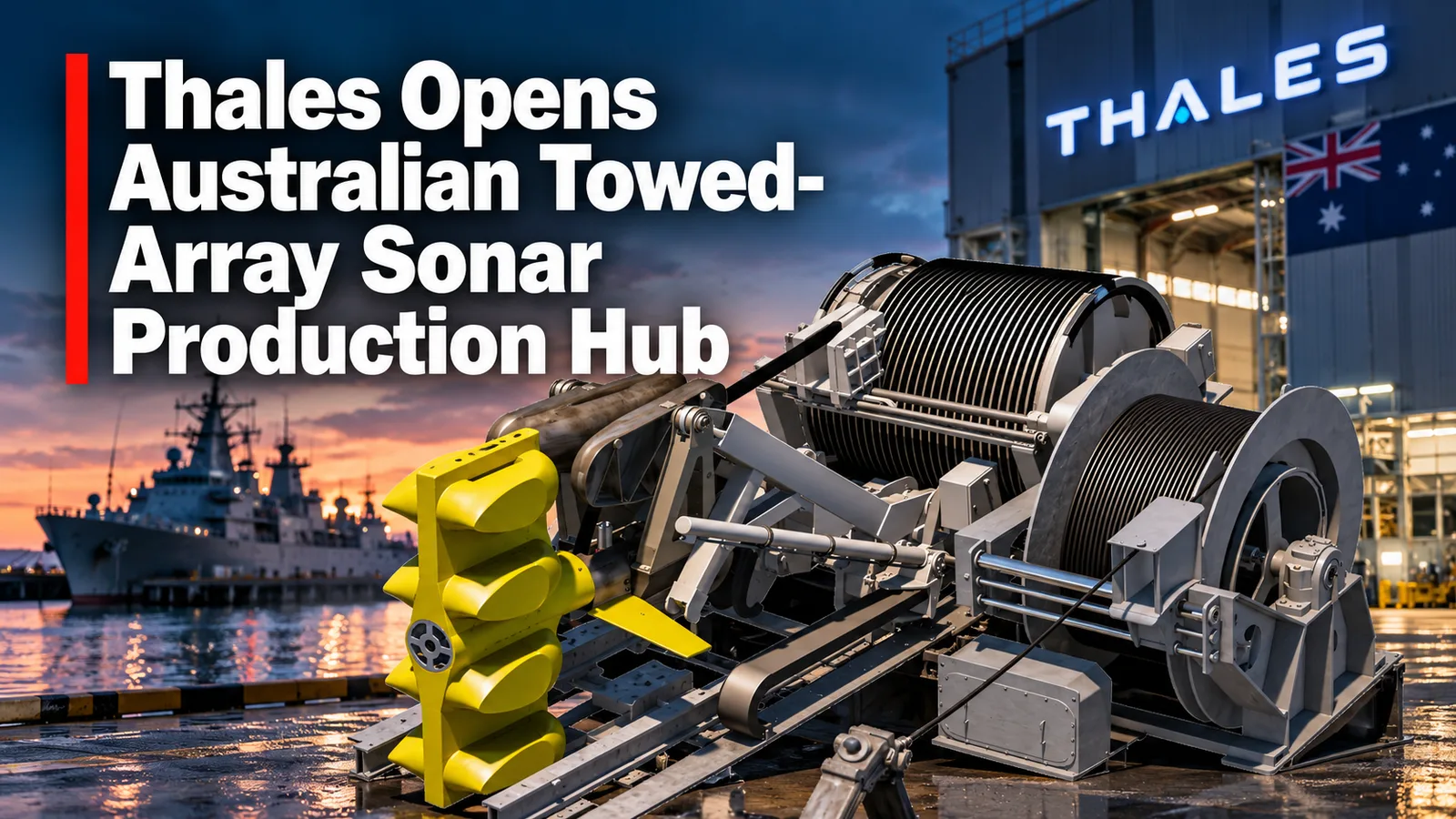
Thales Australia and the Commonwealth opened a co-invested sonar manufacturing facility at Rydalmere, Western Sydney, with a 100-metre production hall for towed-array systems. It is intended to support Hunter-class frigates, Collins-class submarines and autonomous maritime sensing. Domestic sonar manufacturing can reduce dependence on overseas sustainment and preserve acoustic-engineering capacity across crewed and uncrewed maritime programmes.
A 100-metre manufacturing hall for long arrays
Australia’s Defence Industry Minister Pat Conroy opened a new sonar production and sustainment facility within Thales Australia’s existing Rydalmere advanced-manufacturing complex. The 100-metre hall is designed to support end-to-end manufacture of long towed-array acoustic systems, which can be difficult to produce, inspect and handle within conventional industrial spaces. Public reporting describes the site as co-invested by Thales and the Commonwealth, but does not identify a complete contract-by-contract funding split. Opening a manufacturing hall is a measurable physical milestone. It does not mean every sensor for the named naval programmes has already been produced, accepted or delivered.
Hunter, Collins and autonomous-system connections
The announced scope spans towed arrays for the Hunter-class frigate programme, sonar support for Collins-class submarines and BlueSentry thin-line acoustic technology for uncrewed maritime vessels. These systems differ in deployment conditions, architecture and operating requirements, but share a dependence on advanced acoustic sensing, precision manufacture and specialised sustainment. A common national industrial base can help preserve expertise across those applications. It should not be assumed that all programme sensors are interchangeable or that autonomous BlueSentry arrays will be installed on every new Hunter frigate. The manufacturer’s descriptions identify broad product families and supply-chain intentions rather than a single standardised sonar fit for all platforms.
Why sovereign sustainment can affect readiness
Acoustic arrays require testing and repair long after initial delivery. Transporting a damaged system overseas can create shipping, handling and scheduling burdens, while local production enables closer contact between naval maintainers, designers and component suppliers. This matters because submarine surveillance is a continuous task and readiness depends on the availability of calibrated, serviceable sensors. Thales has operated an acoustic engineering presence in Rydalmere for decades; the new hall is an expansion of capability, not the first Australian involvement in undersea sensing. The opening also creates potential export capacity, but no new export order or fixed production volume was announced as part of the event.
Industrial output is the next test
Future evidence should address qualified production throughput, labour capability, defect rates, delivered arrays and the time needed to restore serviceable systems. Each of those measures will determine whether the facility materially reduces schedule risk for Australian naval programmes. Undersea sensing is often constrained by classified performance and exact configuration, so public evaluation will depend more on verified production and support milestones than on invented detection ranges. The site strengthens the local industrial pathway for acoustic systems, while the operational integration and acceptance of those systems must still be demonstrated separately aboard the ships or uncrewed platforms that will use them.
Industrial and programme assessment
This investment also has a knowledge-retention dimension. Sonar arrays involve specialised materials, underwater acoustics, signal processing, mechanics and integration, making a trained local workforce difficult to recreate after a production gap. The facility may give Australia greater discretion over repair priorities and future upgrades, subject to programme agreements and technical certification. It does not remove dependence on every overseas component or guarantee any particular detection performance. Those outcomes need individual supply-chain and naval test evidence.
A facility opening can be audited through its physical infrastructure and declared manufacturing scope, but throughput requires later evidence. The next useful reports will identify which sonar assemblies have entered fabrication, been tested and reached the naval platforms involved. Nor should the multimillion-dollar co-investment be interpreted as a single disclosed firm equipment order. Distinguishing plant capacity, product qualification and shipboard acceptance avoids overstating the maturity of Australia’s expanded undersea sensor industry.
Implications / Next
For procurement and industry stakeholders, the critical future evidence will be primary-source confirmation of funded work, validated technical progress and a demonstrable transition to delivered or operational capability. In this case the immediate checkpoint is specific: confirmed manufacturing throughput and accepted sonar deliveries. The disclosed milestone should be updated only when those events occur, not assumed from the present announcement.
Further Reading
Ocius Bluebottle Thales acoustic-system selection
Royal Navy Thales mine-warfare command award
Australian Defence Magazine, 26 October 2026