ASELSAN is set to bring an integrated counter-UAS, electronic-warfare, radar and autonomous maritime portfolio to MSPO 2026 in Kielce, Poland, from 8–11 September 2026, using the exhibition to emphasise how sensors, command systems and effectors can operate as a coordinated multi-domain architecture rather than as stand-alone products.
The planned display centres on the DRONEDEF counter-UAS architecture, KORAL AD and ANTIDOT electronic-warfare systems, the FULMAR radar family and the KILIÇ autonomous underwater strike family. The presentation comes as ASELSAN deepens its position in Poland following a December 2025 electronic-warfare export contract valued at approximately USD 410 million and a June 2026 visit to the company by Polish President Karol Nawrocki.
Key Facts
- Event: MSPO 2026
- Location: Kielce, Poland
- Dates: 8–11 September 2026
- Company: ASELSAN
- Primary themes: Counter-UAS, electronic warfare, radar, autonomous maritime systems and integrated air defence
- Counter-UAS architecture: DRONEDEF
- EW highlights: KORAL AD and ANTIDOT family
- Radar highlight: FULMAR family
- Maritime autonomy: KILIÇ family
- Poland relationship: Approx. USD 410 million EW export contract signed in December 2025
The Message Is Integration Rather Than a Single Flagship Product
The supplied SSBülten report and ASELSAN-backed MSPO material frame the company’s 2026 presence around an integrated battlespace architecture rather than a single new platform.
The portfolio spans air, land, electromagnetic and maritime domains. The common theme is that sensors, electronic-warfare systems, command-and-control software and multiple effector types can be connected and tasked according to the threat.
This is consistent with ASELSAN’s wider Steel Dome approach, which treats air and missile defence as a system of systems rather than a collection of independent weapons.
DRONEDEF Is the Main Counter-UAS Architecture
ASELSAN is positioning DRONEDEF as a layered counter-UAS architecture within the wider Steel Dome concept.
The MSPO material identifies İHTAR 100, GÖKBERK 10, KORKUT 100/25 SB, GÖKALP, EJDERHA/AD 200 HPEM and ŞAHİN DUAL as complementary elements of the architecture.
The operational logic is to combine detection, electronic attack, directed energy and kinetic defeat so that different classes of UAV can be engaged with an effector appropriate to the threat and cost equation.
İHTAR 100 Provides a Sensor-and-EW Foundation
ASELSAN’s official İHTAR 100 documentation describes a counter-UAS system combining Ku-band radar, electro-optical sensors, RF jamming, command-and-control software and sensor fusion.
The system supports multiple-target detection and tracking, automatic classification and integration with additional sensors and effectors.
ASELSAN also states that İHTAR 100 can work with systems such as the GÖKBERK laser weapon and ŞAHİN 40 mm hard-kill solution.
This makes İHTAR relevant not only as a stand-alone anti-drone system but also as a node inside a larger layered architecture.
GÖKBERK 10 Adds Directed Energy to the Layered Defence
GÖKBERK 10 represents the directed-energy layer in ASELSAN’s evolving counter-UAS portfolio.
Defence Agenda previously reported that the 10 kW-class mobile laser weapon was introduced as part of ASELSAN’s expanded Steel Dome counter-drone layer at SAHA 2026.
Laser systems are attractive against small UAVs because a successful engagement can avoid the need to expend relatively expensive missiles.
However, directed-energy performance remains dependent on line of sight, atmospheric conditions, dwell time, beam quality and target characteristics. ASELSAN’s MSPO material presents GÖKBERK as one element of a layered defence rather than a universal replacement for kinetic interceptors.
KORKUT 100/25 SB Adds a Gun-Based Hard-Kill Option
KORKUT 100/25 SB was introduced publicly as a counter-UAS weapon system combining soft-kill and hard-kill options against mini and micro UAV threats.
ASELSAN’s 2024 and 2025 reporting shows that the system progressed through development and live-fire testing before the 2026 MSPO presentation.
A gun-based layer provides an additional engagement option when electronic attack or directed energy is inappropriate, ineffective or unavailable.
GÖKALP and ŞAHİN DUAL Expand the Kinetic Menu
GÖKALP is positioned as an autonomous kinetic drone-kill system, adding an interceptor-drone concept to the architecture.
ŞAHİN DUAL adds a 40 mm hard-kill pathway.
The presence of multiple hard-kill approaches illustrates the programme’s attempt to avoid a single-effector dependency. Small FPV drones, larger one-way attack UAVs and more complex swarm threats can impose different requirements for speed, range, magazine depth and cost per engagement.
EJDERHA/AD 200 Extends the Electromagnetic Layer
The MSPO material also places EJDERHA/AD 200 HPEM inside DRONEDEF.
High-power electromagnetic systems are designed to disrupt or damage the electronics of UAVs without relying on a conventional projectile.
ASELSAN has publicly presented the EJDERHA family as a way to add an electromagnetic defeat layer to Steel Dome, particularly against massed small-UAV threats.
Public sources do not disclose detailed classified performance such as effective range against specific target electronics, waveform parameters or engagement capacity under operational conditions.
KORAL AD Moves Electronic Attack Into the Air-Defence Architecture
Electronic warfare is the second major theme of ASELSAN’s MSPO positioning.
KORAL AD is presented as a mobile radar electronic-warfare capability combining electronic support and electronic attack functions for air-defence operations.
The concept is to detect, identify and suppress hostile radar systems through jamming and deception, adding a non-kinetic layer to an integrated air-defence architecture.
ASELSAN’s broader KORAL family is already central to Türkiye’s land-based stand-off electronic-warfare capability, while the newer systems are being developed around updated threat libraries, processing and electronic-attack techniques.
ANTIDOT Takes Electronic Warfare Onto UAVs
The ANTIDOT family extends ASELSAN’s electronic-warfare approach into the airborne domain.
The company markets ANTIDOT payloads for integration with unmanned aerial platforms, where they can support electronic support and electronic attack missions against hostile emitters.
This has an important architectural implication: EW need not remain tied to large dedicated ground vehicles or special-mission aircraft. Smaller uncrewed platforms can carry sensors or effectors forward and contribute to a distributed electromagnetic picture.
FULMAR Represents the Multi-Mission Radar Layer
ASELSAN’s MSPO portfolio also highlights the FULMAR radar family.
The company positions FULMAR as a multi-mission surveillance and tracking family able to support maritime, airborne and ground-target awareness and to integrate with manned and unmanned platforms.
In an integrated architecture, radar families such as FULMAR matter less as isolated sensors and more as data sources feeding a broader command-and-control picture.
The MSPO material does not disclose a specific Polish FULMAR procurement or integration programme.
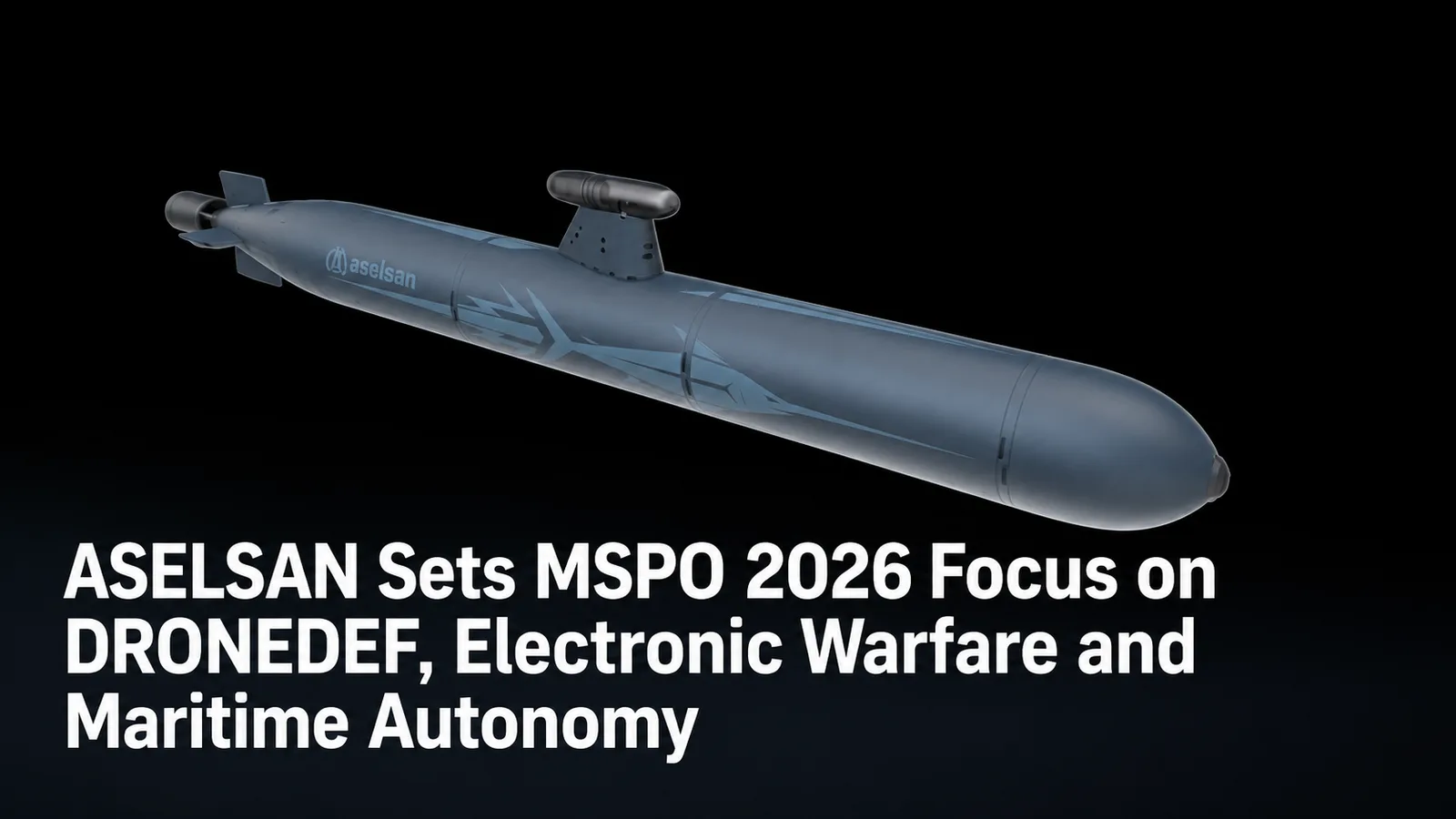
KILIÇ Adds an Autonomous Underwater Strike Dimension
The KILIÇ family broadens ASELSAN’s MSPO message beyond air defence and electronic warfare.
ASELSAN publicly introduced KILIÇ as a family of expendable autonomous underwater systems for asymmetric maritime operations, combining autonomy, sensing, communications and precision engagement.
Defence Agenda reported in August that KILIÇ 10 demonstrated navigation, sensing, communications and target-detection functions at TEKNOFEST Mavi Vatan 2026.
That places KILIÇ among the more recent members of ASELSAN’s portfolio and shows why MSPO is being used to present the company as a multi-domain systems integrator rather than only an air-defence or electronics supplier.
The Poland Relationship Gives the Display Commercial Weight
ASELSAN’s presence in Kielce is more commercially significant because it follows a major Polish electronic-warfare award.
Poland’s Ministry of National Defence confirmed on 19 December 2025 that the Armament Agency signed an agreement with ASELSAN for an Automated Reconnaissance and Jamming System intended for electronic-warfare operations.
Polish official reporting later described the order at approximately PLN 2 billion gross, with deliveries planned through 2035.
ASELSAN’s market disclosure described the corresponding NATO-member export contract as USD 410 million for the direct sale of electronic-warfare systems. Subsequent Polish and Turkish reporting identified the customer as Poland.
The Polish Contract Should Not Be Automatically Labelled KORAL
The exact configuration of the 2025 Polish electronic-warfare package is not fully public.
Some media have associated the system with KORAL-family technology, while Polish sources use the Kaktus codename and describe an Automated Reconnaissance and Jamming System.
ASELSAN’s original public market disclosure referred only to electronic-warfare systems and did not name KORAL.
Defence Agenda therefore treats the USD 410 million Polish contract as confirmed ASELSAN electronic-warfare business without assigning a specific KORAL variant unless a primary source does so.
Polish President Nawrocki Visited ASELSAN in June
The industrial relationship gained further political visibility in June 2026 when Polish President Karol Nawrocki visited ASELSAN in Ankara during an official visit to Türkiye.
Poland’s National Security Bureau said the visit followed the 2025 contract and placed the company inside a broader dialogue on defence cooperation.
ASELSAN and Turkish officials highlighted radar, electronic warfare, communications and electro-optics as areas with potential for deeper collaboration.
The visit did not itself announce a new procurement contract.
Poland Is Prioritising Local Production and Technology Transfer
ASELSAN’s MSPO strategy also needs to be viewed against Poland’s industrial policy.
Warsaw is increasingly demanding domestic production, local supply-chain participation, technology transfer and long-term industrial partnerships rather than relying only on direct imports.
Polish defence spending remains among the highest in NATO as a share of GDP, while local procurement has expanded sharply since 2022.
For ASELSAN, future growth in Poland is therefore likely to depend not only on system performance but also on the ability to structure local industrial cooperation, sustainment and technology-sharing arrangements acceptable to the Polish government.
MSPO Is a Logical Venue for European Expansion
MSPO in Kielce is one of Central and Eastern Europe’s most important defence exhibitions and is especially relevant for companies seeking access to Polish and regional procurement programmes.
SSB’s 2026 international-fair plan lists MSPO Poland among the events at which the Presidency would participate institutionally.
For Turkish companies, the exhibition therefore serves both as a commercial venue and as a platform for government-to-government defence-industrial engagement.
Integrated C-UAS Is Becoming a European Requirement
The focus on DRONEDEF aligns closely with current European demand.
Poland is building the SAN counter-drone air-defence system as part of its broader layered air-defence architecture. The Polish government says SAN will combine multiple effectors and sensors and that the first elements are intended to enter service in 2026.
ASELSAN is not identified in the public SAN consortium, which is led by Polish industry with Kongsberg and Advanced Protection Systems participation.
The relevance of DRONEDEF at MSPO is therefore competitive and architectural rather than evidence of an ASELSAN role in SAN.
Electronic Warfare Is Equally Relevant to Poland’s Eastern-Flank Priorities
Polish official statements around the 2025 ASELSAN contract emphasised electronic reconnaissance, jamming and integrated air-defence requirements.
That makes ASELSAN’s emphasis on KORAL AD and ANTIDOT at MSPO commercially coherent.
It also reflects a wider lesson from the war in Ukraine: control of the electromagnetic spectrum has become inseparable from air defence, counter-UAS, precision strike and uncrewed-system operations.
Industrial Impact: ASELSAN Is Selling Architectures, Not Only Boxes
The strategic value of the MSPO portfolio is the shift from equipment sales toward system-level integration.
ASELSAN’s product range now spans radar, command-and-control, electronic warfare, electro-optics, guidance, communications, air defence, autonomous systems and naval electronics.
That allows the company to compete not only for individual subsystem contracts but also for integration roles in which multiple sensors and effectors are connected into one operational architecture.
The commercial advantage is potentially higher programme value and deeper customer dependence on the supplier’s integration expertise. The counterpoint is that large integrated programmes require more extensive localisation, cyber assurance, interoperability testing and long-term support.
ASELSAN Enters MSPO With a Larger Export Base
ASELSAN’s current financial position gives the MSPO campaign additional context.
Defence Agenda’s analysis of the 2026 Defense News Top 100 ranked ASELSAN 40th globally based on 2025 defence revenue of approximately USD 4.46 billion.
ASELSAN reported a backlog of USD 23.2 billion in the first half of 2026, with air defence and integrated systems among the principal growth drivers.
The company’s export strategy has increasingly shifted from radios and electro-optics toward higher-value air-defence, EW and modernisation programmes.
Limitations and Counterpoint
The SSBülten and Defence Industry Europe MSPO articles are advance exhibition material published before the 8 September opening date. They describe what ASELSAN plans to present, not completed demonstrations at the 2026 fair.
The article therefore avoids stating that MSPO 2026 has already concluded or that all systems have been demonstrated live in Poland.
No new Polish procurement contract was announced in the supplied article.
The public Polish EW contract is confirmed, but its exact system configuration remains partly classified and should not automatically be labelled as a specific KORAL variant.
Likewise, DRONEDEF’s component list reflects ASELSAN’s integrated architecture, but public sources do not provide a single published engagement envelope or quantified system-level performance for the complete architecture.
KILIÇ and some directed-energy systems remain at different maturity levels from established products such as İHTAR or the broader KORAL family.
Implications / Next
The first indicator is whether ASELSAN announces new Polish or Central European contracts during MSPO 2026.
The second is localisation. Any agreement with Polish industry covering production, integration, maintenance or technology transfer would be strategically more important than a stand-alone export.
The third is the Polish EW programme. Further official disclosure could clarify the configuration, delivery structure and local industrial content of the 2025 contract.
The fourth is counter-UAS. Demonstrations or evaluations involving DRONEDEF elements in Poland would test the relevance of ASELSAN’s architecture against local requirements.
The fifth is maritime autonomy. KILIÇ’s appearance at MSPO broadens ASELSAN’s European pitch into undersea systems, where future customer interest would mark a new export segment for the company.
Conclusion
ASELSAN is using MSPO 2026 to present an integrated battlespace proposition built around counter-UAS, electronic warfare, radar and autonomous maritime systems.
DRONEDEF provides the clearest example: radar, jamming, laser, electromagnetic and kinetic effectors are being presented as layers of one architecture rather than independent products.
The commercial context is equally important. ASELSAN enters the Kielce exhibition after securing a major Polish electronic-warfare contract and receiving the Polish president at its Ankara facilities.
The next test is whether that relationship expands from a large direct export into broader Polish industrial integration and additional NATO-market programmes.