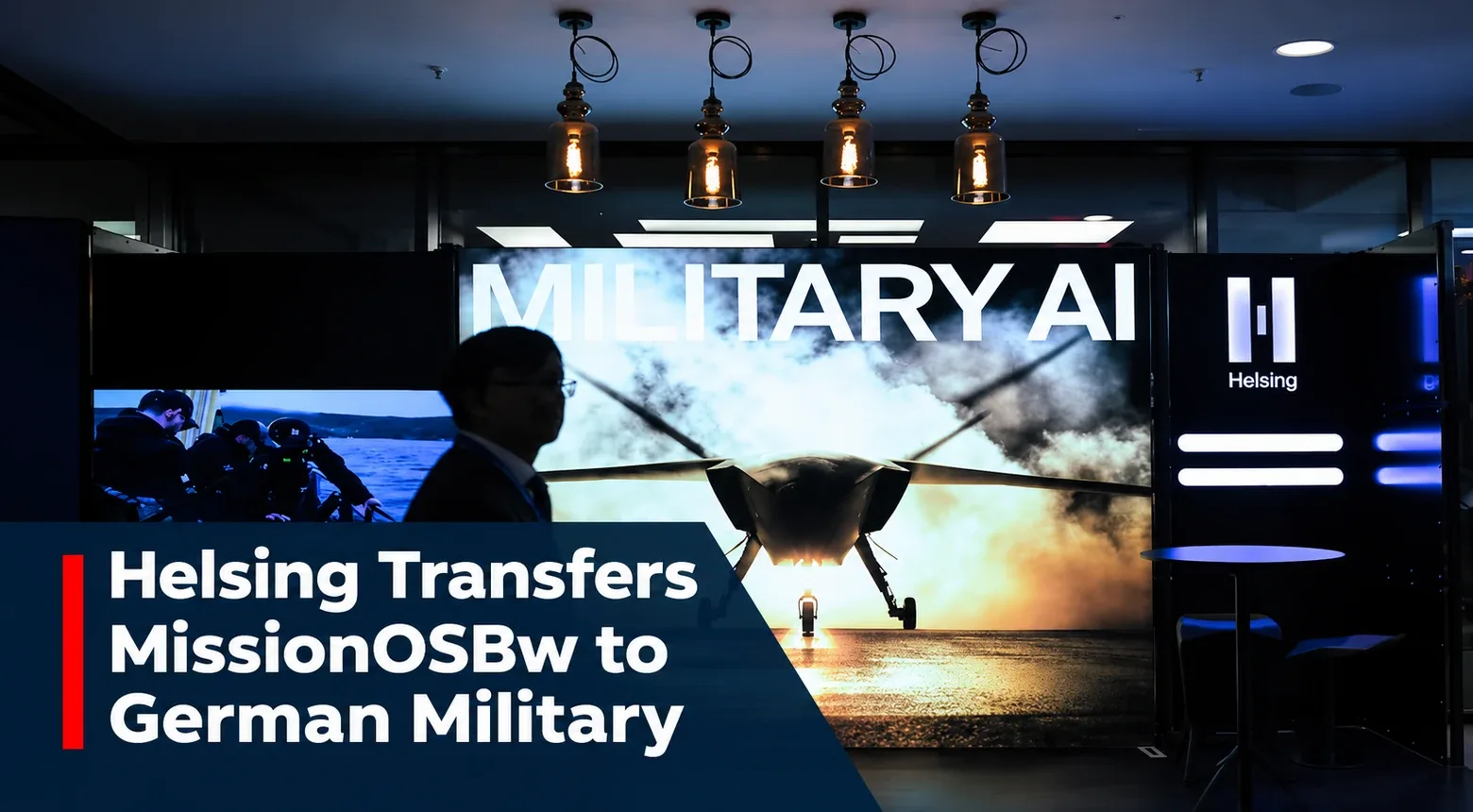
Helsing has transferred the source code of its Mission Operating System Bundeswehr (MissionOSBw) to Germany's military procurement authority, giving the state direct control over a software foundation intended for future combat aircraft and uncrewed systems. The handover, confirmed on 4 November 2026, is an early milestone in the Combat Fighter System of Systems Nucleus (CFSN) programme. It matters because software ownership and interoperable interfaces may determine how quickly Germany can integrate sensors, autonomy functions and new suppliers without relying on a single prime contractor.
Germany Receives the MissionOSBw Software Core
Germany's Federal Office of Bundeswehr Equipment, Information Technology and In-Service Support (BAAINBw) confirmed that it had received the software source code from Helsing. The authority's 4 November 2026 statement describes MissionOSBw as a key software element of CFSN, a research and technology programme cleared by the Bundestag's Budget Committee in July 2026.
The handover was not limited to an executive announcement about future intent. According to Reuters and Defence Industry Europe, the initial deliverable comprised source code, technical documentation and a software development kit. Those materials are intended to let the Bundeswehr and authorised development partners work with the mission system rather than depend exclusively on a supplier-controlled software environment.
BAAINBw says the government will hold the code and be able to adapt and reuse it for other military systems. Its description of Government Open Source Software should not be read as evidence that the code has been released publicly under a conventional open-source licence. The reported arrangement concerns government ownership and controlled extensibility; disclosure terms and third-party access rights were not specified.
What MissionOSBw Is Designed to Do
MissionOSBw is intended to supply a common mission-software foundation for air platforms, sensors, communications, mission functions and other effectors. Its purpose is not to replace every platform-specific application with a single programme. Instead, it aims to support components built by different suppliers through defined interfaces, so a capability can be improved or replaced without redesigning the entire architecture.
The reported design follows a Modular Open Systems Approach (MOSA). In procurement terms, this is significant because upgrading a radar-processing component, mission application or autonomy function can otherwise require extended integration work within a closed, proprietary stack. A modular reference architecture could make competing suppliers easier to introduce, broaden the industrial base and preserve government control of the integration roadmap.
That remains a design and acquisition proposition rather than a proven operational outcome. Compatibility standards, cyber accreditation, safety assurance, mission-data protection and the quality of published interfaces will determine whether the architecture actually reduces integration time. A source-code transfer alone does not demonstrate that multiple suppliers' mission modules already work together under combat conditions.
CFSN: BALU Demonstrators and Ground Stations
The wider CFSN programme involves experimental hardware as well as software. BAAINBw identifies two BALU platforms — Basisplattform für Autonomen Luftkampf Unbemannt, or a base platform for autonomous uncrewed air combat — and two ground control stations. The broader development effort is led by Helsing with German industry partners including Hensoldt, Rohde & Schwarz, MBDA and Diehl Defence, according to Reuters.
The demonstrators are intended to help examine how aircraft, autonomy software, sensors and control stations can function in a shared mission architecture. However, the first release of MissionOSBw should not be confused with aircraft qualification, a weapons-integration approval or the fielding of an operational uncrewed combat fleet. BAAINBw says the software will be further developed and tested with the experimental systems during CFSN.
The programme also fits a wider European move towards uncrewed aircraft operating alongside crewed fighters. Defence Agenda's analysis of wingman aircraft in European rearmament examined the growing importance of mission software and human-control arrangements alongside airframe performance. The German initiative adds a procurement-governance question: who can modify the software after the first contractor delivers it?
Why Two Different CFSN Budget Figures Appear
The financial picture requires a clear distinction. The official BAAINBw press release states that the CFSN research and technology undertaking has a volume of more than €220 million. By contrast, Reuters reports an estimated €580 million, attributing that figure to industry documents discussed in previous reporting. Both figures relate to CFSN, but the available material does not establish whether they measure identical contractual scope, phases or options.
The figures should therefore not be presented as interchangeable confirmed programme costs. Nor does the information demonstrate that €580 million has been obligated, paid to Helsing or spent on source code. The primary-source figure supports a programme worth over €220 million; the higher estimate remains attributed industry reporting pending a published reconciliation or contract breakdown.
The distinction matters to suppliers because a total programme estimate, a research-authorisation figure, contracted work packages and actual expenditure are different financial measures. Without a public award structure and milestones, drawing conclusions about the effective cost of individual BALU aircraft or a MissionOSBw software licence would be speculative.
Strategic Implications: Sovereignty Without Isolation
Germany's decision is noteworthy in a sector where proprietary source code and restricted interfaces can create decades-long dependence on a prime contractor. A state-owned software foundation may give procurement authorities greater negotiating leverage and permit mission applications to evolve without forcing every change through one supplier. For the Bundeswehr, that could be especially valuable as autonomy functions and electronic-warfare requirements develop more quickly than traditional aircraft acquisition cycles.
There is a counterargument. Government ownership does not automatically produce a sustainable software ecosystem. The state must fund integration laboratories, security testing, version control, documentation, configuration management and specialist staff. If these functions are under-resourced, the defence ministry could inherit technical maintenance responsibilities without securing the faster upgrade cycle envisaged in the original procurement case.
The CFSN model also differs from — and must not be conflated with — Europe's broader Future Combat Air System industrial dispute. Reuters highlights disagreements between Airbus and Dassault over the fighter element. Defence Agenda's FCAS programme hub tracks the European fighter, remote-carrier and combat-cloud strands separately. MissionOSBw is a German government-owned mission-software project; it is not evidence that the multinational FCAS aircraft programme has been resolved or replaced.
A related European approach can be seen in Airbus's U740 Valkyrie programme, which emphasises a sovereign European mission system. Such examples show that ownership, interface control and autonomy governance are becoming meaningful differentiators in the market for collaborative combat aircraft, alongside speed, payload and unit price.
Industrial and Procurement Consequences
For Helsing, delivering the first software baseline is a measurable step towards its role as the CFSN integration lead. For Hensoldt, Rohde & Schwarz, MBDA, Diehl Defence and other prospective suppliers, the open-interface approach could create routes to provide components that meet agreed government specifications. Yet the announcements do not document a competitive procurement process for each module, nor do they establish completed integrations by all listed companies.
For European defence programme offices, the central lesson is contractual: retaining the ability to inspect, maintain and evolve mission software should be considered at the design and award stage, not treated solely as a sustainment issue years after initial delivery. Appropriate intellectual-property rights and secure third-party integration can be as decisive to long-term readiness as aircraft availability.
The ultimate economic case will depend on evidence from future integration work. Programme managers will need comparative data on certification time, modification costs, cyber resilience, supplier participation and the percentage of applications that can genuinely be replaced independently. No such quantified savings were released with the 4 November handover.
Implications and Next Milestones
The next steps are further development of the MissionOSBw baseline, validation with the two BALU experimental aircraft and ground segment, and proof that independently developed mission modules can be integrated securely. Future procurement disclosures may also clarify the difference between the official budget description and the larger figure reported by Reuters.
For now, the verified achievement is the transfer of a government-owned mission-software baseline and associated development resources. Whether that structure delivers faster upgrades, more suppliers and operationally credible autonomy remains a question for the forthcoming demonstrator and qualification programme.