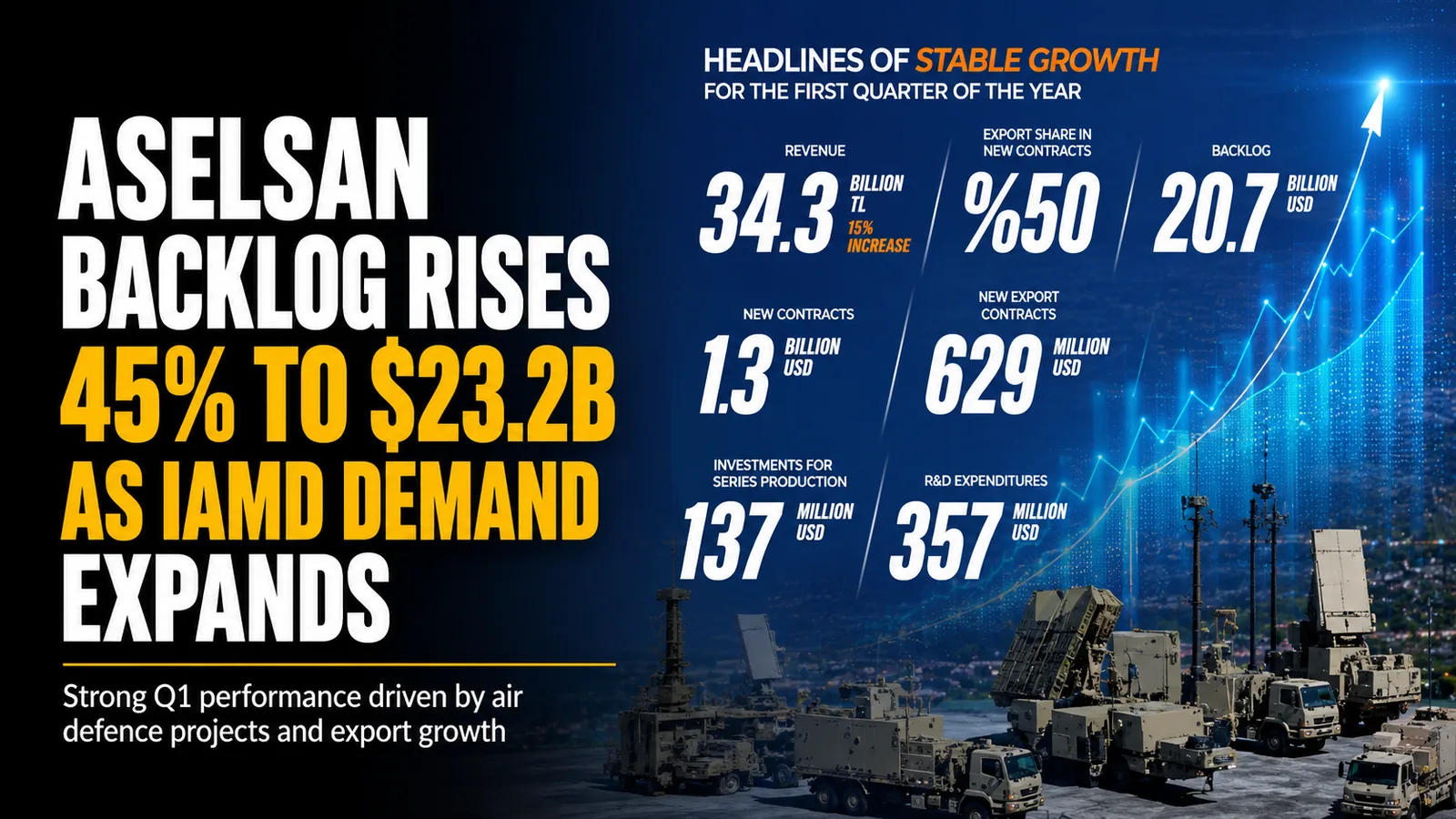
ASELSAN’s order backlog rose 45% year on year to $23.2 billion in the first half of 2026 as demand increased across air defence, radar, electronic warfare and other high-technology product lines, reinforcing the industrial pressure behind Türkiye’s expanding integrated air and missile defence architecture.
The company signed $4.9 billion in new contracts during the first six months of 2026, up 72% from the same period a year earlier, while inflation-adjusted revenue increased 25% to TL88.5 billion. Janes highlighted integrated air and missile defence as an important growth contributor, but ASELSAN’s official earnings material attributes the expansion to a wider mix that also includes radar, electronic warfare, naval systems, electro-optics, guided munitions and AI-powered urban-security systems.
Key Facts
- H1 2026 backlog: $23.2 billion, up 45% year on year
- H1 2026 new contracts: $4.9 billion, up 72%
- Revenue: TL88.5 billion, up 25% in real terms
- EBITDA: TL23.2 billion, up 31%
- EBITDA margin: 26.3%, up 120 basis points
- Book-to-bill: 2.5
- R&D expenditure: $804 million, up 41%
- Capacity and serial-production investment: $323 million, up 195%
The 45% Backlog Increase Is Broader Than Steel Dome
The Janes report places integrated air and missile defence at the centre of ASELSAN’s first-half growth story. That is directionally consistent with the company’s own statements, but it should not be interpreted as evidence that the entire 45% backlog increase came from ÇELİKKUBBE, or Steel Dome, contracts.
ASELSAN’s official first-half earnings release says revenue growth was supported by strong demand for Air Defence, Radar, Electronic Warfare, AI-Powered Urban Security, Naval Systems, Electro-Optics and Guided Munition Systems. The same presentation says significant new orders were received particularly for air defence, radar, electronic warfare and public-safety communication systems.
The backlog reached $23.191 billion at 30 June 2026 compared with $15.954 billion at the same point in 2025. ASELSAN had ended 2025 above the $20 billion backlog threshold for the first time, at approximately $20.4 billion. The June 2026 figure therefore represents both a 45% year-on-year increase and continued expansion from an already record year-end base.
The breadth of the order mix matters strategically because ASELSAN is not scaling a single product family. It is simultaneously increasing output across air-defence sensors and effectors, electronic warfare, naval electronics, electro-optics, guidance, secure communications and other systems.
Air Defence Is Becoming a Larger Industrial Driver
Integrated air and missile defence nevertheless has a growing weight in ASELSAN’s portfolio. Chief Executive Ahmet Akyol said during SAHA 2026 that the company planned to increase deliveries of Steel Dome-related products by roughly 50% in 2026 and aimed to deliver more than 150 components during the year.
Akyol also said ASELSAN held approximately $3.2 billion of contracts within a broader $6.5 billion package of Turkish defence-industry agreements supporting Steel Dome. Reuters reported that Steel Dome-related systems could account for nearly one-third of ASELSAN’s portfolio in coming years.
Those systems span more than surface-to-air missiles. ASELSAN’s contribution includes early-warning and fire-control radars, command-and-control infrastructure, electronic-warfare elements, counter-UAS systems, electro-optics and other payloads. This makes Steel Dome a system-of-systems industrial programme rather than a single missile production line.
That architecture also explains why air-defence demand can pull multiple ASELSAN business lines simultaneously. A new battery or defended area may require radar coverage, secure networking, command systems, jammers, electro-optical tracking and several kinetic or non-kinetic effectors.
Book-to-Bill of 2.5 Signals Backlog Is Still Accumulating
ASELSAN reported a first-half book-to-bill ratio of 2.5, compared with 2.0 in the same period of 2025. A ratio above one indicates that new orders are entering the book faster than recognised revenue is being delivered.
For a defence-electronics company, a high book-to-bill ratio creates long-term revenue visibility but also increases execution risk. A growing backlog is financially valuable only if production capacity, suppliers, test infrastructure and qualified labour can scale quickly enough to prevent delivery schedules from stretching.
ASELSAN is therefore investing at a pace that broadly matches its order growth. The company increased capacity and serial-production investment by 195% to $323 million in the first half and raised R&D expenditure by 41% to $804 million.
The strategic question is shifting from whether demand exists to whether industrial throughput can convert that demand into deliveries without sacrificing quality, margins or export responsiveness.
Oğulbey Is the Main Capacity Response
The Oğulbey Technology Base is the largest single element of ASELSAN’s capacity expansion. The company announced a planned $1.5 billion investment on a 6,500-acre site in Ankara, describing it as the largest single defence-industry investment in the history of the Republic.
ASELSAN says the site is intended to support higher-volume serial production of critical technologies, particularly the air-defence systems forming Steel Dome, while adding design, test and manufacturing infrastructure.
The H1 2026 earnings release says the first phase of Oğulbey is planned to become operational in the third quarter of 2026. CEO Ahmet Akyol said initial production activities would begin shortly.
The timing is important. If the first phase begins production in Q3 as planned, the site starts contributing capacity while the company is carrying a $23.2 billion backlog and preparing for higher Steel Dome delivery volumes.
ASELSAN Has Already Added Production and Test Capacity
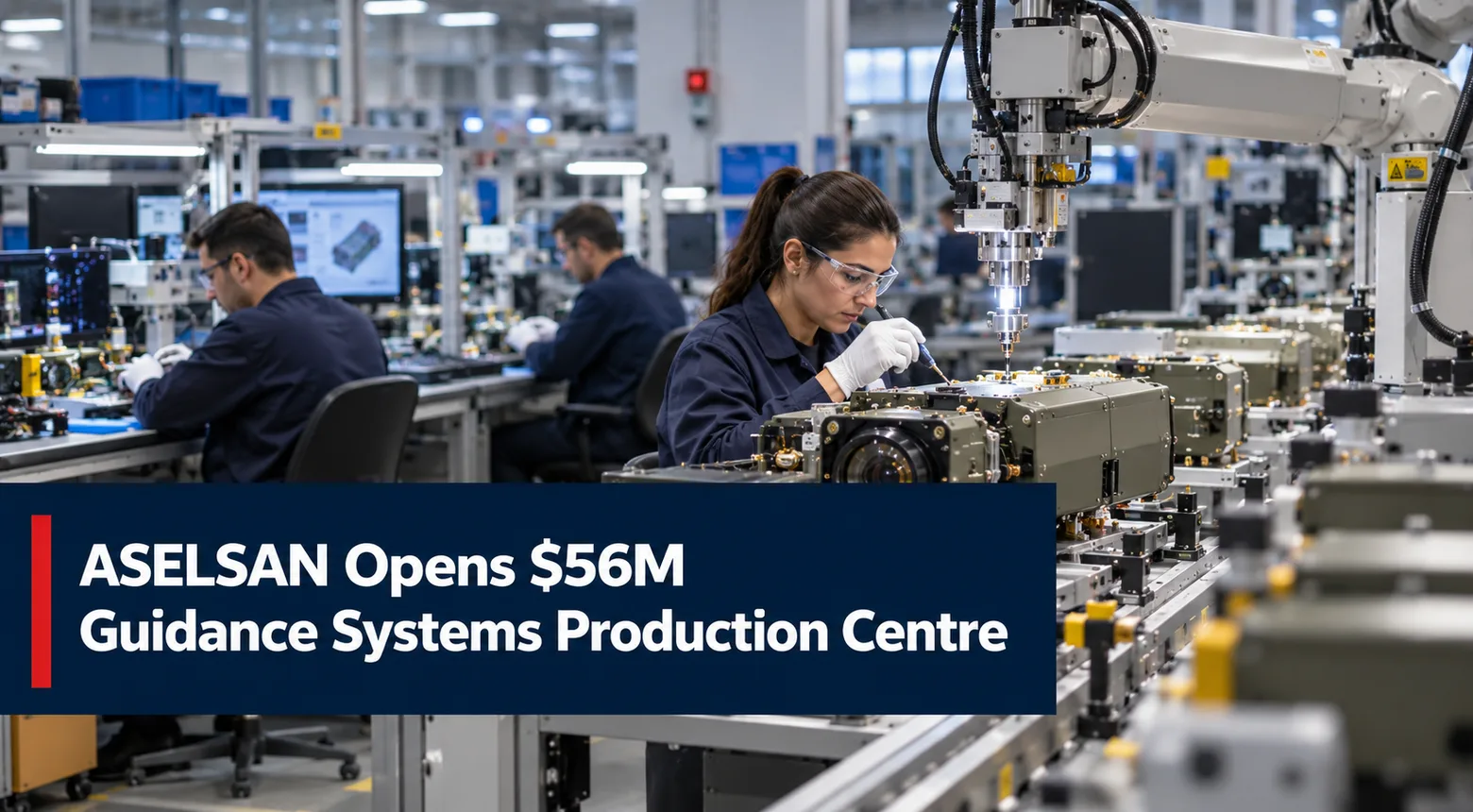
Oğulbey is not the only expansion project. During the first half of 2026, ASELSAN commissioned additional production and test centres covering 17,360 square metres for smart munitions, air defence and underwater systems. The company says those facilities represented a $40 million investment.
ASELSAN also installed 19 new robotic automation lines during the six-month period and strengthened automation infrastructure used in air and naval defence production.
Automation can improve throughput and repeatability, but its impact varies by product type. Missile electronics, AESA radar modules, electro-optical assemblies and naval systems do not all share the same production bottlenecks. Supplier qualification, environmental testing, software validation and customer acceptance can remain pacing items even after assembly lines expand.
The industrial value of the new investment will therefore be visible in delivery lead times, production yield and the company’s ability to support simultaneous domestic and export programmes.
Revenue Growth and Profitability Need Separate Measures
ASELSAN’s financial results show strong top-line and EBITDA growth, but the profitability picture depends on which metric is used.
The company’s official earnings release reports EBITDA of TL23.233 billion for the first half of 2026, up 31% from TL17.791 billion a year earlier. EBITDA margin increased by 120 basis points to 26.3%. Net Debt/EBITDA declined from 0.57 to 0.55 despite the acceleration in investment.
Janes separately reports operating profit of TL22.5 billion compared with TL23.1 billion in H1 2025, a decline of roughly 2%. Operating profit and EBITDA are different accounting measures and should not be treated as contradictory versions of the same figure.
The more relevant industrial takeaway is that ASELSAN is increasing capital expenditure and R&D while preserving a relatively strong EBITDA margin and controlled leverage. That provides financial room to fund capacity ahead of deliveries.
R&D Spending Is Moving Beyond Current Orders
ASELSAN’s $804 million in first-half R&D spending is not limited to products already generating backlog. The company says current investment priorities include low-Earth-orbit satellite technologies, quantum computing, underwater systems, propulsion, microelectronics, lasers and long-range guided munitions.
This matters because the backlog is a measure of contracted future revenue, while R&D is also aimed at creating product families that can generate later orders. A company focused only on executing its current order book risks becoming technologically static during a period of rapid change in drones, electronic warfare, sensing and precision strike.
The challenge is capital allocation. ASELSAN must fund current serial production, expand factories and test infrastructure, deliver contracted systems and simultaneously finance technology programmes that may not generate revenue for several years.
Major H1 Orders Show a Multi-Domain Portfolio
ASELSAN’s official earnings material lists several categories of major contracts signed during the first half of 2026.
First-quarter activity included international contracts for communication systems and uncrewed-surface-vessel payloads, air-defence and avionics systems, and electro-optics, as well as a domestic guidance-system procurement.
Second-quarter contracts included exports covering air defence, radar, electronic warfare, electro-optics, avionics and communications; another international package combining radar, air defence, electro-optics, communications and payloads for UAVs and USVs; additional domestic production of air-defence systems; public-safety communications and satellite/space systems; and AI-powered urban-security management systems.
The company does not publicly break down the $4.9 billion H1 contract intake by each product category. It would therefore be incorrect to assign a specific dollar share of the new orders to IAMD without a supporting disclosure.
Steel Dome Production Is Becoming a Long-Term Planning Anchor
ASELSAN’s management increasingly describes Steel Dome as a long-term national architecture rather than a finite procurement project. Following Exercise EFES-2026, Akyol told Janes that deployment of air-defence systems, radars and command-and-control elements across Türkiye would continue expanding and that production volumes would rise accordingly.
That model gives ASELSAN better production visibility than a sequence of isolated one-off contracts. A continuously expanding national architecture can support longer manufacturing runs, standardisation, sustainment infrastructure and iterative upgrades.
It can also create export leverage. Many components can be sold independently even when a foreign customer does not procure an entire Steel Dome-style architecture. Radar, counter-UAS, electronic warfare, close-in defence and command systems can enter overseas markets as modular subsystems.
Naval and Electronic-Warfare Demand Reduce Concentration Risk
Air defence is currently the most visible growth driver, but ASELSAN’s diversification matters financially. Naval AESA radars, GÖKDENİZ close-in weapon systems, electronic warfare, communications, electro-optics and guidance systems broaden the order base across different services and export customers.
Janes points to systems such as CENK-S naval AESA radar and GÖKDENİZ, while ASELSAN’s earnings release identifies naval systems and electronic warfare among important revenue contributors.
This reduces dependence on one national programme, but it also increases manufacturing complexity. A company supporting air-defence batteries, frigates, aircraft, drones and civil-security systems must maintain different qualification standards, supply chains and integration teams.
Employment Growth Adds Another Scaling Requirement
ASELSAN reported 17,024 employees at the end of June 2026, compared with 13,508 a year earlier. CEO Ahmet Akyol said more than 1,000 new employees joined during the first half alone, with approximately 15% of those hires returning to Türkiye from abroad.
Headcount growth is strategically important because advanced radar, electronic warfare and guided-weapon production remains engineering-intensive even when manufacturing becomes more automated.
The risk is organisational: rapid hiring can dilute experience if training, technical leadership and configuration-control processes do not expand at the same pace. The company’s ability to absorb new engineers and technicians will therefore be part of the same scale-up test as Oğulbey.
Limitations and Counterpoint
The 45% backlog increase should not be described as a 45% increase in sales, cash flow or profit. Backlog represents signed but undelivered contractual value and is recognised as revenue over future periods as performance obligations are satisfied.
The $23.2 billion backlog is also not entirely Steel Dome or IAMD. ASELSAN itself identifies multiple product groups behind revenue and order intake.
Likewise, management’s expectation that backlog could reach $30 billion from 2027 onward is forward-looking and not a current contracted total.
Steel Dome’s reported $3.2 billion ASELSAN contract share provides useful programme context, but it should not be assumed to represent the current remaining backlog associated with Steel Dome because contract value, deliveries and revenue recognition change over time.
Finally, accelerated capital expenditure creates execution risk. New facilities and robotic lines only add economic value if they become productive on schedule and are matched by qualified suppliers, workforce and customer demand.
Implications / Next
The first operational indicator is the third-quarter start-up of Oğulbey’s initial phase. Any delay would matter because the expansion is explicitly intended to support higher serial-production volumes in air defence and other critical technologies.
The second indicator is Steel Dome delivery tempo. ASELSAN’s target of more than 150 components in 2026 provides a measurable benchmark against the company’s production-expansion narrative.
The third is backlog conversion. Revenue growth, book-to-bill and delivery lead times will show whether the company is increasing throughput fast enough to prevent backlog growth from becoming an execution bottleneck.
Finally, the composition of new export contracts will matter. If radar, air defence and electronic warfare continue to expand internationally, ASELSAN can use the same capacity investments to serve both Türkiye’s national architecture and foreign customers, improving factory utilisation but increasing prioritisation pressure.
Conclusion
ASELSAN’s 45% backlog increase to $23.2 billion confirms that demand is outpacing current revenue recognition, with air defence and IAMD forming an important but not exclusive part of that growth.
The company’s response is equally significant: $323 million in capacity investment, $804 million in R&D, 19 new robotic lines, new production and test centres and the staged commissioning of the $1.5 billion Oğulbey Technology Base.
The central question for the second half of 2026 is therefore not demand. It is execution. If ASELSAN can convert its record order book into higher delivery volumes while maintaining margins, quality and export responsiveness, the current backlog growth will translate into a structurally larger defence-electronics production base. If capacity expansion lags, the same backlog can become a source of longer lead times and programme pressure.