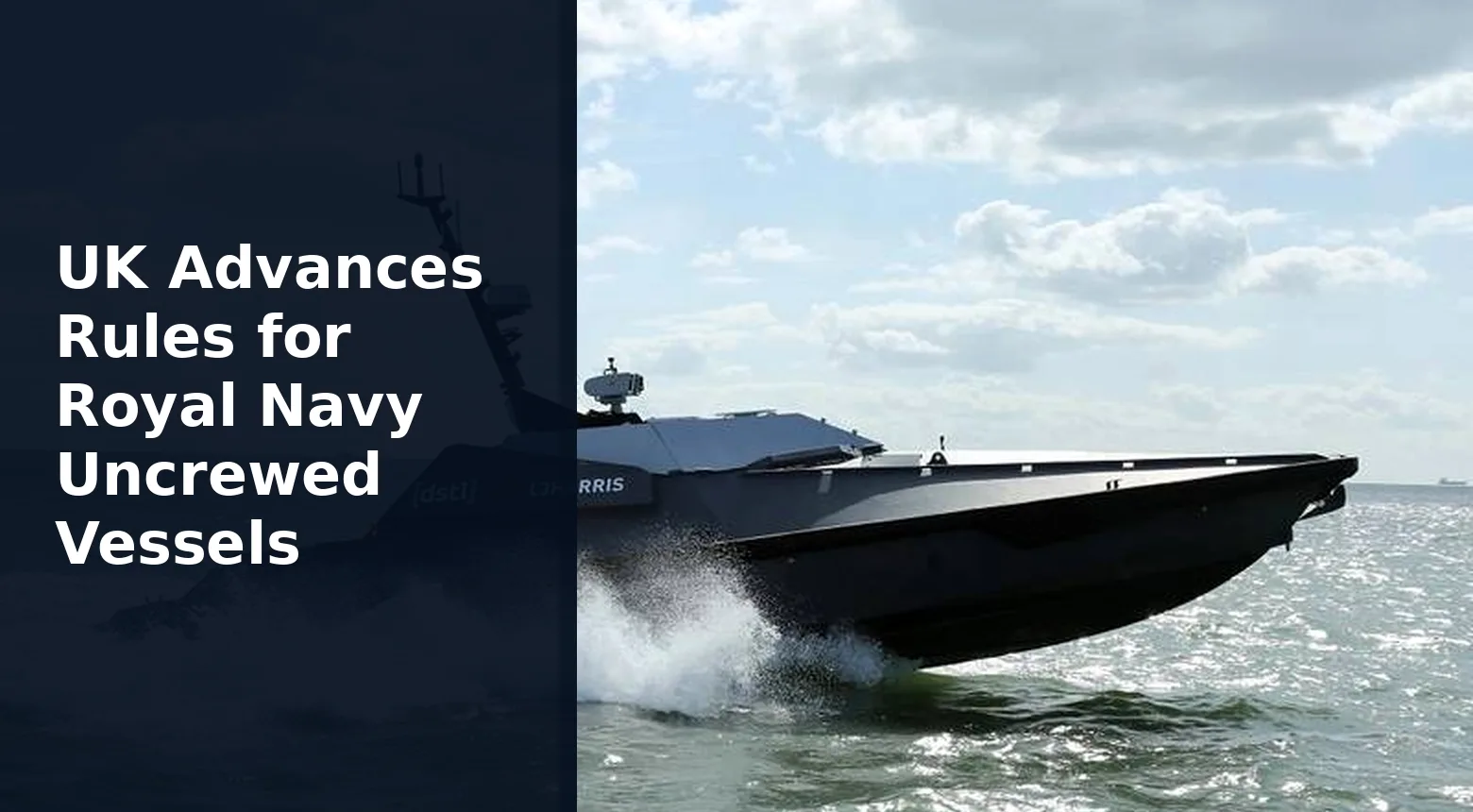
The UK Ministry of Defence and Defence Maritime Regulator are developing a framework to regulate and classify uncrewed surface vessels as the Royal Navy expands maritime-autonomy trials. The work is a regulatory and assurance milestone, not evidence that a particular vessel class has achieved unrestricted operational approval. Rules for responsibility, collision avoidance, certification and remote control are prerequisites for moving uncrewed vessels from demonstrations into routine naval service. A common framework can reduce programme-specific approval work while keeping commanders accountable for safety.
Classification must match how a vessel is controlled
A remotely piloted craft, a supervised autonomous vessel and a system operating with long communications gaps present different hazards. The framework must define control modes, minimum manning of shore stations and transitions after faults. A single label such as “uncrewed” is not precise enough for certification.
Civil maritime rules still shape naval safety
Royal Navy systems may operate near commercial traffic, ports and allied forces. Collision regulations, navigation-light requirements and radio procedures therefore remain relevant even for state vessels. Military exemptions must be bounded and supported by equivalent safety measures rather than assumed from mission status.
Software updates turn assurance into a continuing activity
Autonomy performance can change when perception models, navigation code or mission logic are updated. Regulators need configuration control, simulation evidence, cyber testing and a way to approve changes without restarting the entire process. This is a major difference from certifying a largely static hull.
A framework can accelerate programmes if it is reusable
Common evidence standards and risk categories can help project teams understand requirements early. That may shorten the path from experiment to fielding and make industry proposals easier to compare. The benefit will depend on whether the regulator provides clear, proportionate routes for different vessel sizes and missions.
Programme and procurement context
This development must be read at its exact maturity level. The UK Ministry of Defence and Defence Maritime Regulator are developing a framework to regulate and classify uncrewed surface vessels as the Royal Navy expands maritime-autonomy trials. The work is a regulatory and assurance milestone, not evidence that a particular vessel class has achieved unrestricted operational approval. Defence programmes pass through distinct stages: policy announcement, requirement definition, competition, contract, testing, production, delivery, acceptance and operational fielding. Collapsing those stages into a single claim can overstate both near-term military utility and industrial certainty.
For acquisition teams, the decisive evidence is funded scope, customer acceptance, integration responsibility and a supportable schedule. Rules for responsibility, collision avoidance, certification and remote control are prerequisites for moving uncrewed vessels from demonstrations into routine naval service. A common framework can reduce programme-specific approval work while keeping commanders accountable for safety. Public announcements rarely resolve every dependency. Training, secure data, range access, infrastructure, export approval and supplier capacity can delay useful capability even after a technically successful milestone.
Source discipline is equally important. Company releases naturally emphasise momentum; government notices may describe only funded scope; exercise reports show activity without proving full readiness. Values should be labelled as contract ceilings or estimates when appropriate, performance figures as manufacturer claims until independently demonstrated, and dates as targets unless a customer confirms completion. Later primary records should replace early reporting as the programme matures.
The operational question is not whether the technology can be shown once, but whether users can employ it repeatedly under representative conditions. That requires realistic testing, configuration control, trained personnel, spares and an accountable command chain. Industrial significance also depends on repeatable production and quality assurance rather than prototype output alone.
Implications / Next
Track publication of the classification framework, its relationship to DSA02 regulations, the first vessel approved under it and requirements for remote operators. Do not infer operational clearance for current demonstrators from regulatory progress alone.
This item remains a draft pending final image-rights review, CMS media assignment and canonical publication data. A later report should be treated as a separate update only if it materially changes the programme status described here.
Further Reading
HAVELSAN Unveils AVISTA Underwater R&D Platform