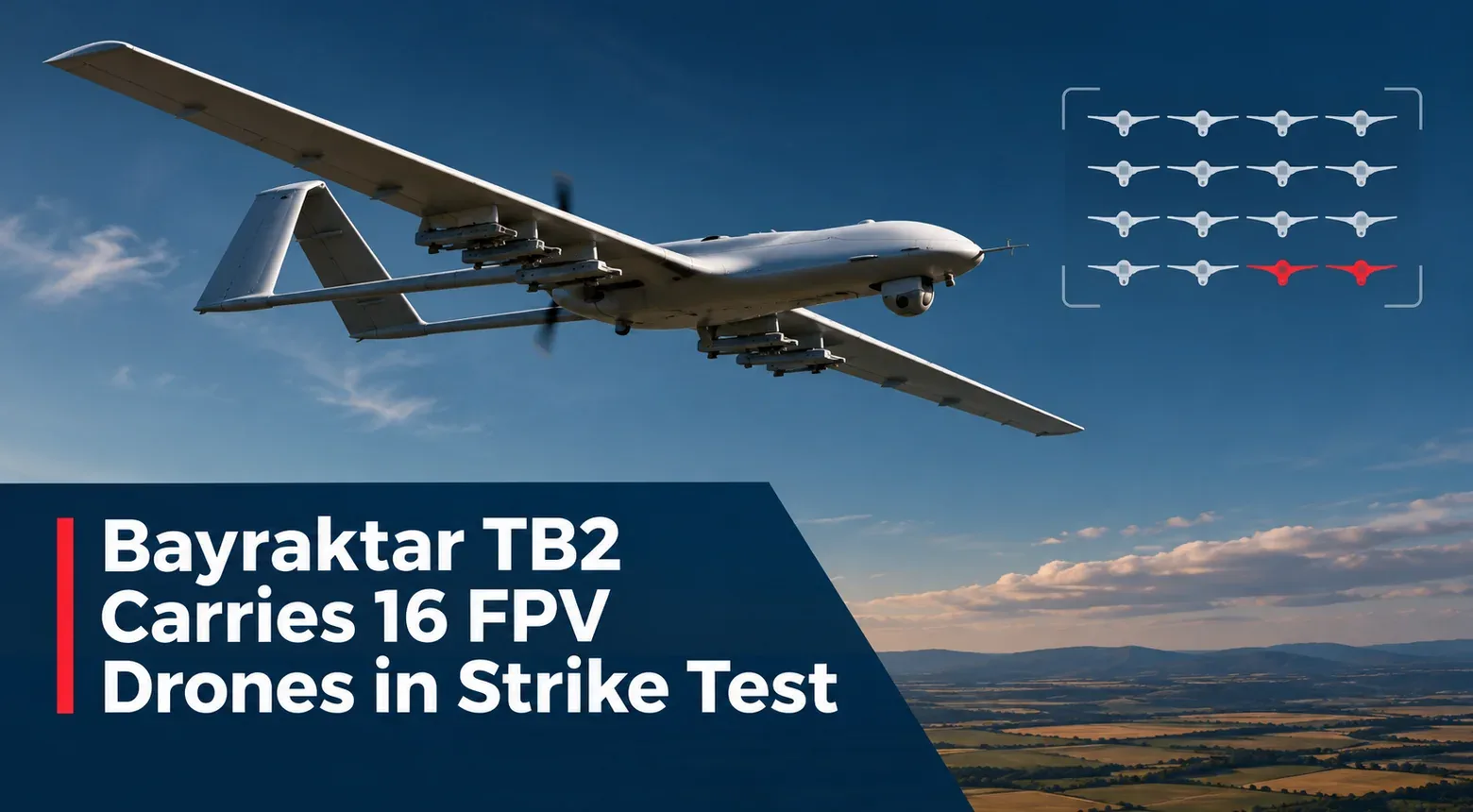
Baykar has demonstrated a new Bayraktar TB2 FPV drone carrier capability in north-western Türkiye, flying the uncrewed combat aircraft with 16 Skydagger attack drones and releasing two during a reported live strike trial. The company announced the result on 4 November 2026, saying the released drones were controlled using a connection supported by the TB2 and hit designated targets. The development matters because it recasts an established remotely piloted aircraft as an airborne carrier and communications node for smaller expendable systems. Crucially, 16 drones were carried, but only two were reported released; the announcement is not evidence of a simultaneous 16-drone attack.
What Baykar Actually Demonstrated
The Baykar statement identifies the Keşan Flight Training and Test Centre in Edirne as the departure point. The TB2 took off carrying 16 FPV drones developed by Skydagger, flew to a test area and released two of them. According to Baykar, a communications link through the carrier aircraft enabled operators to guide the smaller drones towards their assigned targets, which the company said they struck. The announcement does not provide unedited trial telemetry, target construction details, precise release altitude or the distance between the carrier and the targets.
Anadolu Agency's 4 November report independently confirms that Baykar made this announcement and repeats the distinction between the 16 carried air vehicles and the two actually released. That is a vital accounting point. Coverage describing the event simply as a “16-drone firing” can imply that every carried drone was launched; the publicly released company account supports only a two-drone release and engagement during the reported flight. It does, however, show that the larger vehicle was airborne with the full 16-drone load.
The Turkish specialist outlet gdh identifies the carrier-and-release equipment as DAGGER POD, developed by Skydagger. Its description of a modular system that could be adapted to other aircraft is relevant to the industrial design concept. Yet the latest disclosure does not establish which other platforms have completed integration tests, or whether a 16-drone release sequence has been demonstrated end to end.
An Airborne Mothership, Not a New Swarm Demonstration
The operational concept is often described as a “mothership”: a larger aircraft transports smaller drones closer to the mission area, allows them to be released in flight and may assist their control links. With the TB2, this approach combines a familiar medium-altitude, long-endurance platform with compact, expendable effectors that have a very different cost, size and flight profile from conventional aircraft-carried munitions.
The distinction from autonomous swarming is important. The Baykar announcement describes two FPV drones operated through a carrier-supported communications connection. It does not demonstrate that a group of 16 independently selected targets, coordinated routes or carried out collaborative autonomous behaviours. Guidance by human operators and autonomous swarm coordination are different technical capabilities, each with separate testing and control requirements.
There is also a difference between carrying an externally mounted drone and employing it effectively after release. Separation safety, stable communications, operator control, terminal effectiveness and repeatability form distinct test questions. The published event offers evidence of selected steps in that chain, but not a comprehensive qualification matrix for the whole load across different speeds, altitudes, weather conditions and electromagnetic environments.
Why the TB2 Communications Relay Matters
FPV attack drones have often been constrained by their limited endurance and the need for reliable communications. A larger airborne aircraft can change the geometry of an engagement by transporting small drones beyond the reach of their own launch sites and potentially providing a relay above terrain obstacles. This can make the concept operationally attractive, although its value depends on survivable connectivity and the carrier’s own exposure to air defences.
According to gdh's report, Baykar General Manager Haluk Bayraktar referred to a typical battlefield FPV range of around 15 km and argued that air-carrier integration could extend the distance at which such drones can reach targets. Those remarks describe a company assessment of the broader concept; the November test did not publish a measured thousands-of-kilometres FPV engagement, a verified datalink range or a sustained remote-control performance envelope. The carrier's possible transit distance should not be described as the FPV drone's independent flight range.
A relay introduces additional dependence as well as opportunity. If the main aircraft must remain within a useful communications geometry, it becomes part of the engagement chain rather than a simple launch platform. Electronic warfare, signal latency, terrain masking and the risk of losing the carrier would therefore affect mission outcomes. No independent resilience evaluation or electronic-attack test results were included in the announcement.
DAGGER POD and Platform-Integration Questions
The reported DAGGER POD system puts a modular carriage and release architecture at the centre of the demonstration. Skydagger’s claimed capacity to accommodate up to 16 FPV drones is materially different from a generic assertion that the TB2 can always carry 16 drones in any weather, fuel state or payload configuration. A complete aircraft integration must consider structural loads, drag, handling and launch safety alongside the communications system.
Neither Baykar nor the public reporting reviewed for this article supplies verified figures for the complete pod's mass, the exact FPV variants installed, individual warhead weights, unit cost or the specific carriage limitations that would apply under operational conditions. It would therefore be premature to claim a precise combat radius, all-up payload mass or target-effectiveness figure for the new configuration. Those values also determine whether the concept competes economically with established precision-guided weapons or complements them for a different class of target.
The test fits a wider period of Turkish uncrewed-system experimentation. Defence Agenda previously reported a TB2 demonstration combining ANTIDOT electronic-warfare equipment and FULMAR 200 radar, while its coverage of Skydagger’s TOYCA-10E examined another member of the company’s expendable strike portfolio. Those are separate developments, not evidence that either piece of equipment was used in the November carrier test.
Procurement and Industry Implications
The significance for prospective customers lies less in a single test result than in the prospect of extending the mission set of aircraft already in service. An operator with a TB2 fleet could, in principle, examine whether a modular FPV release package offers useful options for reconnaissance-supported or time-sensitive engagements. Such a conclusion would still require customer-specific integration, training, safety review and cost assessment. Baykar's release contains no buyer announcement, signed order, fleetwide modification schedule or operational acceptance decision for DAGGER POD.
The broader industrial question concerns the relationship between established airframe manufacturers and specialised expendable-drone suppliers. A system that allows a larger platform to carry multiple smaller vehicles potentially changes the economics of strike-mission packaging. However, no verified procurement price, replacement cost, success rate or life-cycle support estimate has been disclosed. A favourable cost-per-effect claim cannot be substantiated from this test alone.
Baykar's wider activity provides context without proving fielding of this particular configuration. Defence Agenda has covered the Baykar K2 kamikaze UAV's five-aircraft autonomy trials and MIZRAK loitering-munition development. These programmes illustrate different approaches to uncrewed strike capacity: long-range attritable systems, networked munitions and now a carried group of small FPV drones. They should not be combined into a single mature, operational architecture on the basis of development announcements.
Limits, Alternatives and Open Questions
A useful comparison is with conventional missile or glide-munition carriage. Such weapons may offer established qualification, stand-off reach and predictable handling, whereas small FPV drones may permit a larger number of individual taskings in a single aircraft sortie. The actual trade-off depends on defended airspace, target type, electronic attack, warhead effect, operator workload and the availability of the carrier aircraft. None of those mission-specific factors was measured in the publicly released material.
The new arrangement also creates a command-and-control burden. If multiple small drones are launched, planners must account for the number of simultaneous operator channels, sensor feeds, target authorisations and potential interference between systems. Because two drones rather than 16 were released in the reported test, it is not possible to infer reliable simultaneous employment of the full carried load. Equally, visible release and impact footage cannot independently establish performance against moving or defended targets unless the trial conditions are disclosed.
It is therefore appropriate to regard the programme as an integration demonstration with promising operational applications but important unknowns. The evidence supports carriage of 16 and successful engagement claims for two released drones, not proof of production readiness, combat use, a validated swarm weapon or guaranteed long-distance attack performance.
Implications / Next
The next meaningful milestones would be further flight tests disclosing release sequences for larger numbers of FPV drones, verified communications performance, the effects of electronic interference and repeated trials under representative operational conditions. Public documentation of the pod's configuration, aircraft integration restrictions and operator requirements would also help potential buyers assess how easily the capability could be adopted.
For defence suppliers, there is an opportunity to study how mission systems, modular carriage hardware and expendable air vehicles can be supplied and supported as a complete package. For armed forces, the key issue is whether the carrier-and-relay concept improves survivability and effectiveness without placing a valuable aircraft at disproportionate risk. Those questions require evidence beyond the video of one flight test.
As of 5 November 2026, the verified news is specific: the TB2 carried 16 Skydagger FPV drones in a flight test, two were air-released, and Baykar reported that the released drones hit their targets using communications supported by the TB2. Any claim that all 16 drones were fired, or that the configuration has been formally fielded, goes beyond what the manufacturer and cited reporting established.