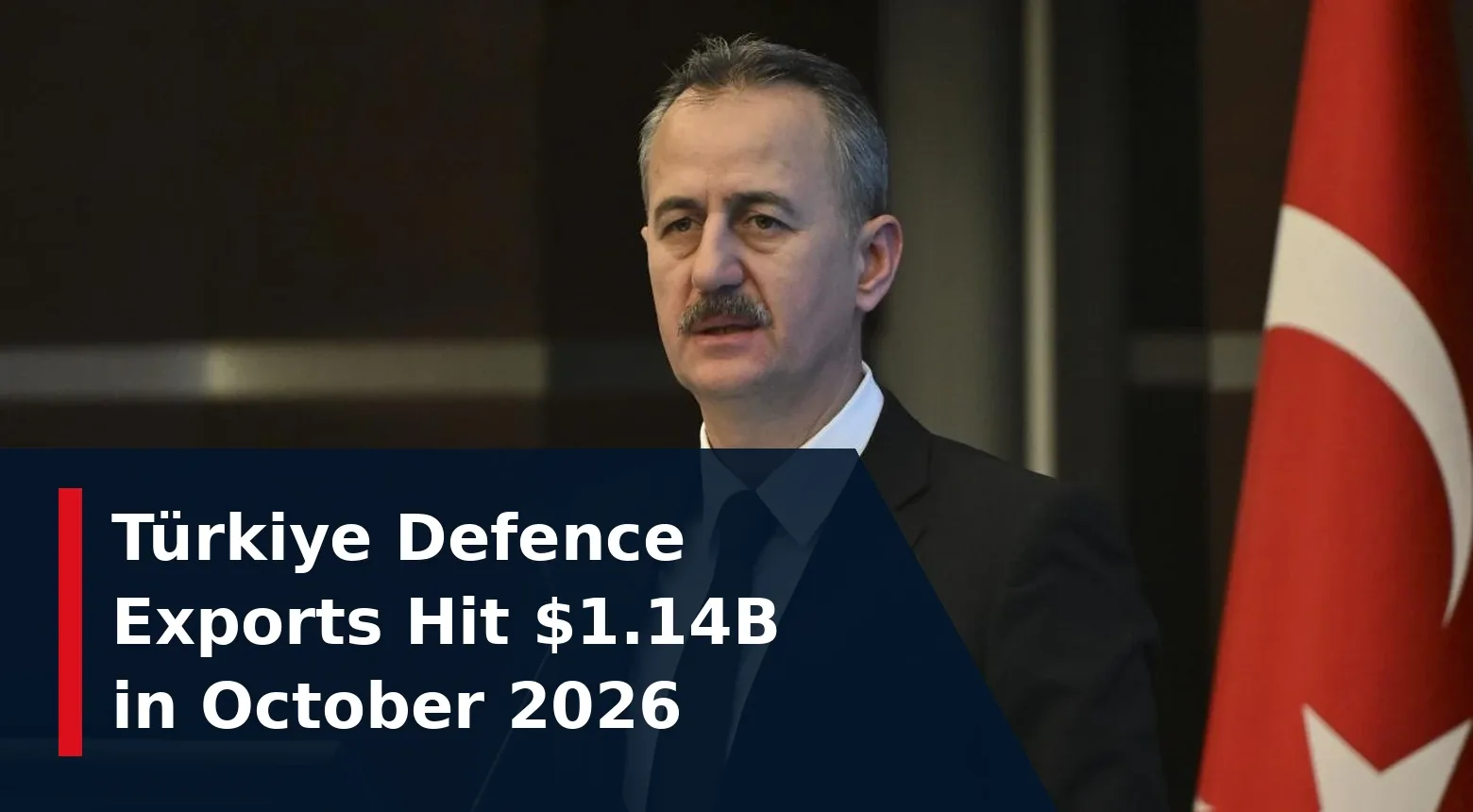
Türkiye defence exports reached US$1.14 billion in October 2026, a 61% increase on the same month in 2025, according to figures released by the head of Türkiye’s Presidency of the Republic of Türkiye Secretariat of Defence Industries on 3 November. Defence and aerospace exports for January–October reached $8.05 billion, while the rolling 12-month total rose to $11.357 billion. The result signals another substantial export month for a sector seeking to convert expanding international order books into manufactured, accepted and shipped products. It does not, by itself, identify which platforms, companies or destinations accounted for the increase.
October Defence Exports Rise 61% Year on Year
The October result was reported by SSB President Haluk Görgün and subsequently reported by Anadolu Agency and TRT Haber on 3 November 2026. The authorities put the value of defence and aerospace exports at $1,140 million, compared with an implied roughly $708 million in October 2025. That earlier-month estimate is calculated by dividing the rounded 2026 value by 1.61; it is not presented here as a separately published official October 2025 total.
The Türkiye Exporters Assembly (TİM) provided a useful cross-check. In its October national export announcement, TİM said defence and aerospace shipments increased 61.1%, slightly more precise than the SSB’s rounded 61% figure. TİM also reported total Turkish exports of around $25.9 billion for the month. On those published values, defence and aerospace would account for approximately 4.4% of the aggregate; that is an indicative share based on rounded figures and not a substitute for TİM’s underlying detailed sector table.
October’s growth rate demonstrates a sharp increase against a specific comparison month. It does not prove that defence production capacity increased 61% in the same period, nor that each company’s exports followed the aggregate. In defence trade, the timing of contractual milestones, dispatches and acceptance can cause unusually strong or weak monthly readings.
Three Export Periods, Three Different Measures
The announcement combines three reporting windows which should not be collapsed into a single annual result. The first is the October 2026 monthly flow of $1.14 billion. The second is January–October exports of $8.05 billion, representing a 21% increase over the corresponding ten months of 2025. The third is the most recent 12 months, for which SSB reported $11.357 billion, up 37% from the comparable rolling period.
The rolling figure spans November 2025 through October 2026, rather than calendar year 2026. Describing it as “2026 exports” without the rolling-period qualification would overstate what has been reported for the year to date. Equally, multiplying the October figure by twelve would not be a reliable full-year projection, because defence and aerospace shipments are typically uneven across months and programmes.
For procurement and industrial stakeholders, the ten-month and rolling measurements are particularly useful as checks against an isolated monthly surge. Both remain positive in the official release. However, neither establishes future shipment schedules or guarantees that the same pace will continue into November and December.
How October Compares With Earlier 2026 Results
The latest month can also be placed against Defence Agenda’s coverage of July 2026 defence and aerospace exports. July reached $1.12 billion, with reported annual growth of 14.4%. October’s $1.14 billion was approximately $20 million higher, based on the two published rounded monthly totals. This comparison illustrates the scale of the latest reporting month; it does not identify the equipment delivered in either July or October.
For September, Görgün previously reported $634 million in monthly exports and $6.926 billion for January–September. The change from September to October is therefore substantial in nominal monthly value. It would be unsound to describe that month-to-month increase as a sustainable underlying growth rate without a sufficiently long series and information about major delivery timings.
There is also a small reconciliation issue in the public rounded series. Adding the earlier reported $6.926 billion January–September figure to the October $1.140 billion flow yields $8.066 billion, whereas the new published January–October total is $8.050 billion. The difference is $16 million. The sources reviewed do not provide a reconciliation; revisions or differing reporting precision are possible explanations, but neither is confirmed. For this report, the latest directly announced ten-month total takes precedence over a reconstructed sum.
Recorded Export Values Are Not New Contract Awards
The distinction between contracted future business and recorded export activity is essential. On 23 October 2026, ASELSAN announced a $442.5 million overseas contract covering radar, counter-UAV and command-and-control systems. As Defence Agenda reported at the time, the buyer, equipment variants, quantities and delivery schedule were not disclosed. The contract is evidence of new international orders, not proof that the entire value was exported in October.
A company may receive a contract signature, an advance payment, an export licence, a factory acceptance milestone and a final delivery at different times. Such events must not be collapsed into a single performance figure. Nor can publicly announced orders from companies be added to the SSB monthly export total as though they belong to the same reporting period or accounting category.
For analysts examining Türkiye’s global footprint, more useful follow-up data would identify destination markets, the balance between complete platforms and subsystems, the number of export-active suppliers, and how much of the increase comes from deliveries under older agreements. Those details were not given in the cited October release.
Industrial Capacity, Supply Chains and the Wider Sector
A high export month is commercially relevant because sustained fulfilment depends on production capacity beyond final assembly. Defence products incorporate sensors, software, electronics, propulsion equipment, precision-machined parts, composite structures, test services and integration work. Large prime contractors depend on domestic and overseas tiers of suppliers, and the point at which a product is ready for export may be constrained by certification, supply availability or customer acceptance.
Defence Agenda’s earlier analysis of Türkiye’s defence-industrial transformation examined the sector’s long-term development, diversification and export ambitions. The October figures add new evidence of recorded international export activity, but do not specify which industrial segments captured the increased demand. A strong industry-wide result should therefore not automatically be assigned to particular air-defence systems, aircraft, warships or manufacturers.
There is also a strategic difference between short-term export value and recurring industrial participation. Customers buying advanced defence equipment may require software support, spares, overhaul, training, secure integration and long-term upgrade packages. These activities can affect the durability of supplier relationships. Yet the current monthly announcement does not isolate the proportion attributable to such services, so it cannot establish their contribution numerically.
Risks and Alternative Interpretations
The principal optimistic interpretation is that rising ten-month and rolling totals reflect a wider capacity to supply international customers. The figures are consistent with that interpretation, but a more cautious reading recognises the lumpy nature of major defence shipments. A few deliveries can materially influence a monthly number. Export values can also reflect changes in product mix and contract execution rather than a uniform increase in unit output.
Nor does the reported growth rate measure inflation-adjusted production volumes, profit margins, domestic value added or cash generated by individual manufacturers. The source announcement provides dollar-denominated export values and comparative growth rates, but no company-level breakdown or independently audited bridge between contracts, deliveries and income statements.
The sector is therefore better assessed through multiple indicators: monthly exports, order intake, operating backlog, delivery completions, export markets, supplier productivity and post-delivery support. Each answers a different question. Treating one strong month as proof of every dimension of industrial competitiveness would exceed the evidence.
Implications / Next
The next authoritative test will be the November and December 2026 export releases, followed by the reconciled full-year number. Together they can show whether the recent high monthly performance is accompanied by continued growth in cumulative exports. Future TİM sector tables, SSB updates and company financial disclosures may also clarify product categories and the principal markets underpinning the aggregate.
For procurement managers and defence suppliers, the central operational question is whether announced export wins translate into scheduled, qualified and accepted deliveries while maintaining domestic obligations. For policymakers, it is whether the supply chain and support ecosystem can keep pace without creating bottlenecks. Those assessments require considerably more evidence than the monthly headline alone.
The verifiable conclusion as of 4 November 2026 is narrower and significant: Türkiye’s defence and aerospace sector exported $1.14 billion in October, the first ten months totalled $8.05 billion, and the most recent 12 months reached $11.357 billion. Each figure describes a different period, and each should remain clearly labelled in subsequent reporting.