The United Kingdom will lead development of three AUKUS undersea payloads for uncrewed underwater vehicles (UUVs), with partner-wide availability targeted from 2027. The UK Ministry of Defence announced the plan on 27 October 2026, following multinational Maritime Big Play trials in San Diego. The announcement matters because AUKUS is seeking to move beyond individual autonomous-vehicle demonstrations towards interchangeable undersea mission equipment, shared control systems and a more persistent allied surveillance network.
Key Facts
- Announcement: 27 October 2026, UK Ministry of Defence; activity associated with Maritime Big Play-Pacific in San Diego, California.
- Programme: First AUKUS Pillar II signature project, initially announced on 30 May 2026.
- UK-led payloads: Synthetic Aperture Sonar; Deployable Anti-Submarine Warfare Sensor; Deployable Non-Kinetic Effector.
- Timing: Availability across Australian, UK and US UUV fleets targeted from 2027; no completed fleet deployment announced.
- UK contribution to testing: 13 uncrewed surface vehicles, two anti-submarine warfare targets and four underwater gliders from six industry partners.
- Exercise scope: Anti-submarine warfare, lethality, contested resupply, and subsea/seabed warfare.
- Industry: 12 UK companies participated; four Maritime Innovation Challenge suppliers share in £3 million of funding, according to the UK government.
The AUKUS Undersea Payloads Programme Moves Forward
The latest announcement is a delivery-leadership decision rather than the launch of an entirely new alliance initiative. The first AUKUS Pillar II signature project was announced by Australia, the United Kingdom and the United States on 30 May 2026. Its purpose is to create payloads and enabling systems that can be integrated across allied UUV fleets, even when the underlying vehicles are designed and produced nationally.
That approach changes the procurement problem. A UUV can have the endurance and autonomy required for an undersea mission but remain difficult to employ with allied assets if payload interfaces, control software, safety rules and communications are incompatible. Common mission equipment aims to reduce such barriers without requiring all three navies to acquire the same underwater platform.
Defence Agenda previously examined AUKUS undersea trials at RIMPAC 26, where American and Australian teams worked on underwater navigation, sensing and acoustic communications. The San Diego activity adds a UK-led sensor and effect programme to that broader experimentation cycle.
Three Payloads: Two Sensing Roles and One Effector
The UK's newly identified development responsibilities encompass three distinct mission functions. Synthetic Aperture Sonar (SAS) uses controlled movement and acoustic processing to produce detailed images of underwater objects and the seabed. In a UUV context, its value can include identifying anomalies, surveying infrastructure corridors and supporting seabed reconnaissance. Performance, however, depends on vehicle navigation accuracy, operating conditions and processing capability.
The Deployable Anti-Submarine Warfare Sensor would allow an autonomous underwater vehicle to place sensing equipment beyond the vehicle itself. The government describes its mission as detecting and classifying underwater threats. The release does not provide a specific sensor design, detection range, endurance, supplier model or demonstrated classification accuracy.
The third payload, the Deployable Non-Kinetic Effector, belongs in a different technical category. It is intended to generate an underwater effect without being described as a conventional explosive weapon. The ministry has not released its mechanism, output, target set or rules of engagement. Consequently, it should not be labelled a sonar sensor or represented as a fully qualified weapon system.
Taken together, these functions suggest an architecture combining detailed seabed observation, deployable sensing and a non-kinetic response option. The statement does not confirm that all three were demonstrated in fully operational form at San Diego. Development leadership, exercise participation and future fleet availability are separate milestones.
What Maritime Big Play Tested in San Diego
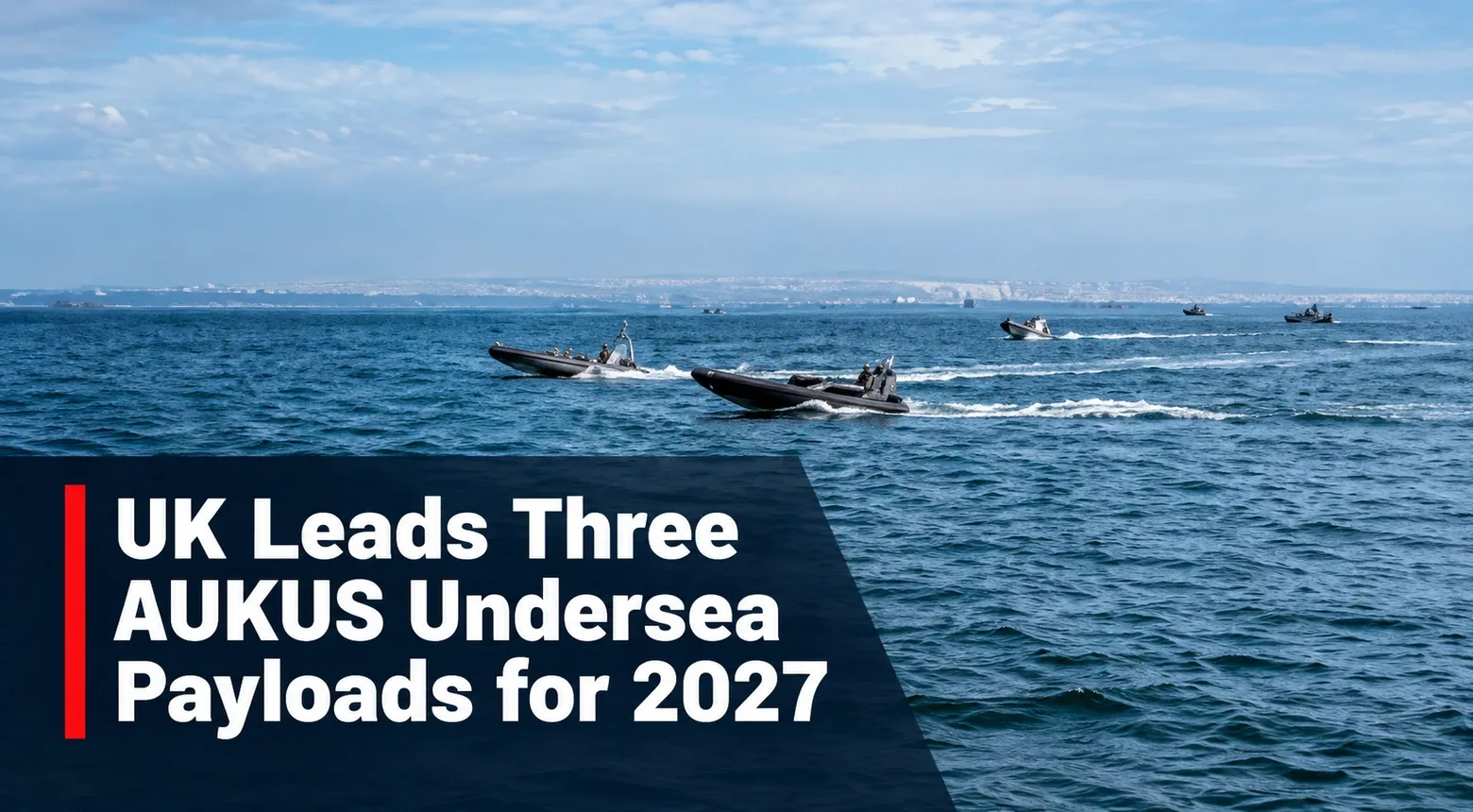
The 2026 Maritime Big Play-Pacific activity brought together crewed and uncrewed systems from Australia, Britain and the United States. According to the Royal Navy's 19 October briefing, more than 40 government and industry technologies were scheduled to be showcased throughout the month. Four operational strands structured the experiments: anti-submarine warfare, lethality, contested resupply and subsea/seabed warfare.
The UK led the anti-submarine warfare strand. The 27 October Ministry of Defence statement lists 13 uncrewed surface vehicles, two ASW targets and four underwater gliders provided through six industry partners. These are UK contributions to the activity—not confirmed orders for new Royal Navy equipment and not the numbers of the three UUV payloads due for development.
Testing allied systems side by side exposes problems that isolated trials may miss: whether data from one sensor can be interpreted by another nation's operators, how an autonomous vehicle responds to lost communications, and whether mission control remains reliable when different platforms share a crowded operating area. Those integration issues matter in undersea environments where bandwidth is limited and GPS signals cannot ordinarily be received while submerged.
The Australian government's 19 October announcement separately identified payload work on Ghost Shark, Speartooth and Bluebottle platforms, with some equipment planned for Maritime Big Play. This reinforces the multinational scope, but should not be read as evidence that each UK-led payload has already been fitted to each Australian platform.
Why Undersea Interoperability Matters
AUKUS Pillar II is distinct from the submarine acquisition arrangements usually associated with Pillar I. The UUV signature project seeks to improve the technologies carried by autonomous vessels and their ability to operate together. The official project fact sheet outlines a phased approach: nationally developed interchangeable payloads first, followed by jointly developed and produced trilateral technologies.
That separation offers industrial flexibility but creates technical demands. Navigation and time synchronisation must be accurate enough to align sensor observations. Operators must know whether a reported contact is an unclassified acoustic indication, a processed target hypothesis or a track corroborated by another asset. Secure information exchange and compatible mission interfaces are prerequisites for useful multinational coordination.
The operational rationale is wider than anti-submarine warfare alone. Offshore energy facilities, subsea cables and other critical infrastructure stretch across large areas that are difficult to monitor continuously with crewed ships. Autonomous systems could revisit known locations, look for changes and supply information to an allied maritime operating picture. For related technology, Defence Agenda has analysed distributed counter-UUV sonar and seabed sensing.
However, payload availability does not establish a verified detection probability, continuous coverage rate or operational response time. None of those metrics was disclosed for the three British-led systems.
Industrial Participation and Procurement Questions
The UK government says the 2026 exercise included 12 British industry partners. It also named SEA Ltd and Decision Analysis Services Ltd as two Maritime Innovation Challenge winners featured in San Diego; A2i and the American company MSI Transducers complete the four-company group sharing £3 million for technologies supporting underwater-system control and cooperation. That innovation funding should not be reported as the purchase price or development budget for the three newly identified UUV payloads.
Manufacturers and programme offices will need to resolve payload standardisation, power consumption, handling constraints, software certification, supportability and security controls before widespread cross-fleet use. Those issues could decide whether an interchangeable payload is genuinely plug-and-play or still needs bespoke qualification for each host vehicle.
The announcement provides no contract awards for the three payloads, unit costs, production totals or firm acceptance dates. It also does not identify a single supplier for each system. A delivery target beginning in 2027 therefore remains conditional on development, trials and procurement decisions.
The associated Royal Navy transition towards a Hybrid Navy likewise remains a multi-year process. In an earlier demonstration, British personnel controlled the experimental XV Excalibur undersea vehicle from Australia, illustrating progress in allied command arrangements without resolving every issue of submerged communication and autonomous coordination.
Assessment: Capability Potential Versus Programme Risk
A modular allied payload strategy could shorten integration cycles, widen access to specialist technology and allow common tactics to develop across different fleets. It could also strengthen supply-chain resilience if equipment can be supported in more than one AUKUS country. Those are programme objectives rather than independently verified outcomes from the latest trial.
The principal counterargument is that nominal interoperability can conceal substantial engineering work. Differences in vehicle dimensions, energy capacity, acoustic conditions, national security requirements and software assurance may complicate standard interfaces. Underwater testing is expensive and repeatability across regions is essential; a demonstration in Californian waters cannot by itself validate performance in the North Atlantic, High North and Indo-Pacific.
There is also a data-quality challenge. Better sonar imagery and more sensor nodes may increase the volume of observations faster than commanders can confidently interpret them. Classification standards, communications discipline and trained analysis remain as consequential as the sensors themselves. The public materials do not quantify these burdens or state how they will be distributed between operators and automation.
Implications / Next
The next meaningful milestones are identified development contracts, documented integrated payload trials on more than one national UUV type, publication of interoperability acceptance criteria and evidence of repeatable undersea detection or response performance. Updates on certification and delivery into operational units will be more meaningful than descriptions of exercise participation alone.
For now, the confirmed decision is that the UK will lead development of three AUKUS undersea payloads, while the alliance seeks availability across its UUV fleets from 2027. Maritime Big Play provides an experimental setting for that transition; it is not proof that the payloads are already in operational service.
Further Reading
- Defence Agenda: AUKUS Undersea Warfare at RIMPAC 26
- Defence Agenda: UK Sub Controlled from 10,000 Miles Away
- Defence Agenda: Counter-UUV Sonar and Seabed Sensing
- UK Ministry of Defence: 27 October 2026 AUKUS announcement
- AUKUS Pillar II: Official UUV Signature Project Fact Sheet
- Royal Navy: Maritime Big Play Demonstrations
- Australian Ministry for Defence: Undersea Warfare Payload Work