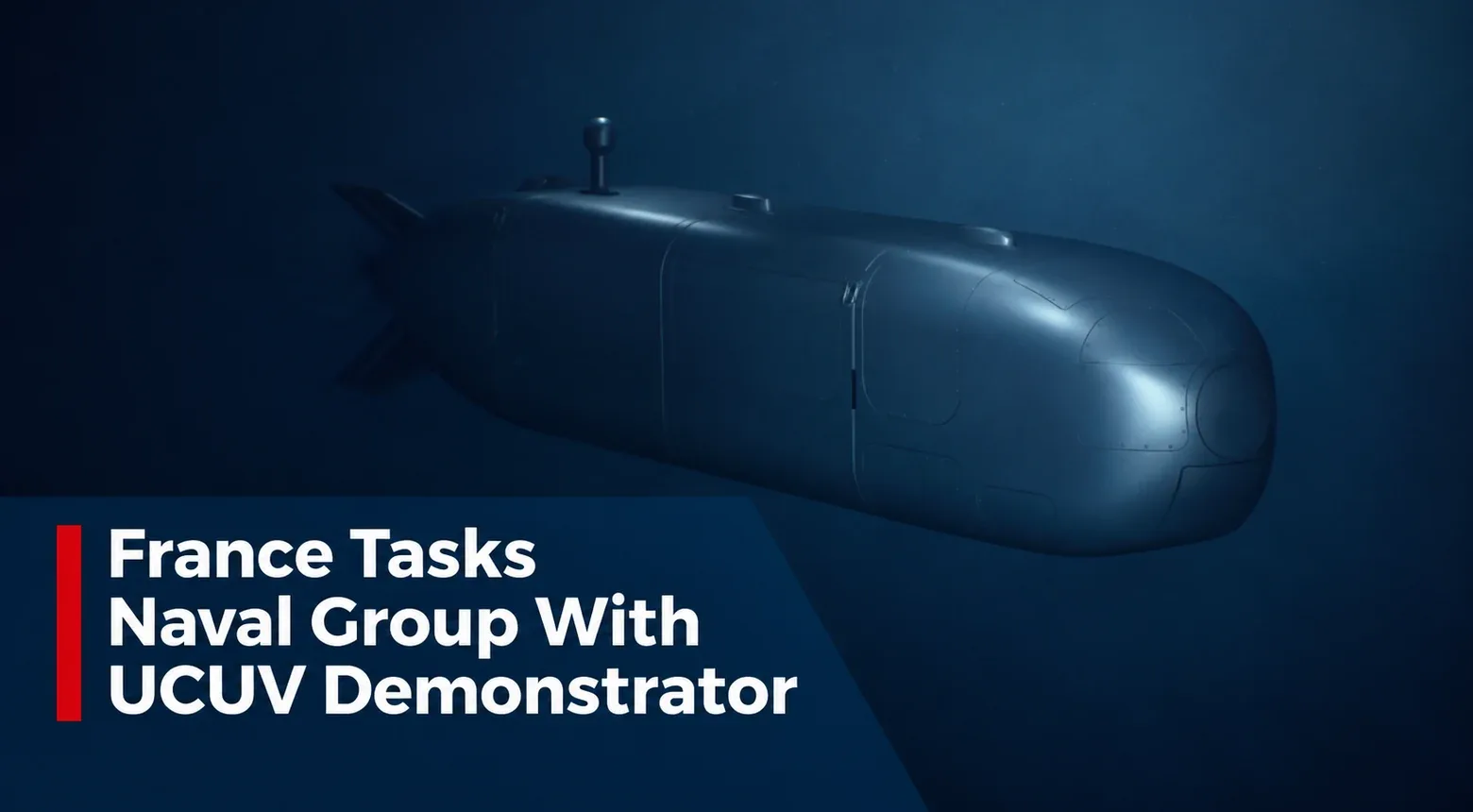
France has commissioned Naval Group to develop a UCUV demonstrator, a large oceangoing uncrewed combat underwater vehicle for the French Navy. The award advances the Unmanned Combat Underwater Vehicle (UCUV) programme from technology evaluation to integrated development. The Direction générale de l’armement (DGA) and the Defence Innovation Agency (AID) notified the agreement on 3 November 2026, with sea trials scheduled to begin in 2028. The decision moves a project supported by several years of research and industrial experimentation towards an integrated test platform, although no operational fleet order or delivery schedule has been announced.
France Moves UCUV from Research Towards an Operational Demonstrator
The French Armed Forces Ministry's announcement on 4 November describes an agreement between AID and Naval Group for a large uncrewed combat underwater vehicle. It follows early market and technology studies conducted with the DGA since 2023. Naval Group has already tested a privately funded extra-large underwater vehicle, providing a means of assessing individual technology elements before committing to the new military demonstrator. The 2026 decision is therefore a new construction and integration phase, not the beginning of France's interest in underwater autonomy.
The distinction is important for procurement reporting. France notified a framework agreement to Naval Group on 28 December 2023, as the DGA confirmed in January 2024. That earlier stage focused on design, energy endurance, autonomous sensors and processing technologies. The latest agreement concerns building the UCUV demonstrator that will put selected technologies together for maritime trials. Neither announcement establishes a production run of operationally fielded vehicles.
According to the Naval Group statement reported by Marine & Océans, the new production-stage notification took place at Euronaval 2026 in Paris. The company says its self-funded XL-UUV demonstrator qualified at sea in 2023 and was used to test secure underwater navigation, endurance, mission autonomy and selected payload concepts. Those historical demonstrations lower some technical uncertainties, but they do not establish that every subsystem has been qualified in the new UCUV configuration.
What the Naval Group UCUV Is Required to Demonstrate
The publicly stated requirement is deliberately broad. UCUV is expected to combine extended endurance with controlled decision-making autonomy, operate independently or with other systems and conduct missions ranging from intelligence, surveillance and reconnaissance (ISR) to prospective offensive neutralisation. The French ministry also specifies air transportability and deployment from a quay or surface vessel. These are programme objectives, not measured specifications from an accepted prototype.
Air transportability is a particularly consequential constraint. A large underwater drone must balance vehicle size, onboard energy, handling equipment and usable payload volume against transport and launch requirements. No public statement defines the aircraft it must fit, the handling envelope, the detailed weight budget or how the requirement will be demonstrated. Readers should not infer that an existing industrial vehicle's dimensions automatically apply to the new demonstrator.
Similarly, the UCUV label does not reveal the weapon system, payload mass, operating depth, speed, acoustic signature or endurance in days. France has identified offensive options as part of the envisaged mission set, but the November announcement does not describe an installed weapon or a completed weapons-release trial. Any eventual armed capability would require separate integration, safety and authorisation work.
Steeris OB and the Limits of Autonomous Underwater Operations
Naval Group identifies Steeris OB, its onboard controlled-decision autonomy system, as a technology planned for the UCUV. The company says the software is intended to support long-duration missions when communications are unavailable, intermittent or operationally undesirable, and to replan in response to environmental conditions, tactical changes and equipment problems. The public description emphasises adaptability and collaboration rather than constant remote teleoperation.
Underwater communication is a structural challenge. Radio links that are useful to aircraft and surface vessels do not provide the same reach beneath the sea; acoustic communications can have constrained data rates, latency and variable reliability. A vehicle operating over long distances must therefore manage navigation, hazards, energy and mission contingencies with limited external contact. Controlled autonomy can reduce dependence on uninterrupted communications, but public sources do not quantify the system's robustness in contested conditions.
It would be inaccurate to equate autonomy in navigation or mission replanning with permission to select and attack targets without human control. The ministry has not specified UCUV's rules for weapons authority, target validation or human intervention. Those governance questions are separate from the technical ability to adjust a route or react to a malfunction. Sea trials will need to demonstrate predictable behaviours within approved operating boundaries.
ISR, Seabed Security and Mission Flexibility
France links UCUV to a more contested undersea environment and concern about critical infrastructure. A large autonomous platform could support persistent collection, mapping or reconnaissance without tying up a crewed submarine throughout every phase of a mission. The case for such vehicles is strongest where dwell time, risk to personnel and the availability of crewed vessels impose practical constraints on naval commanders.
However, the degree of benefit depends on payload configuration and how collected data can be retrieved, analysed and disseminated. A platform suitable for surveillance is not automatically configured for mine countermeasures or offensive operations. Sensors, energy consumption, mission management and maintenance requirements can change substantially between tasks. The French project has not publicly announced its mission-payload inventory or a standardised multi-mission package.
A related but distinct trend is visible in Defence Agenda's coverage of Thales' US Navy mine-hunting award. That programme emphasises towed synthetic-aperture sonar, target recognition and mission management for mine detection; it should not be presented as equipment ordered for UCUV. Likewise, Australia's towed-array production investment concerns the industrial base for underwater sensing rather than proof of compatibility with the French demonstrator.
Programme Funding, Suppliers and Industrial Risks
The defence ministry says UCUV will involve French small and medium-sized enterprises, mid-sized companies and larger suppliers in regions including Var, Morbihan, Manche, Loire-Atlantique, Yvelines, Bouches-du-Rhône and Seine-et-Marne. For an integrated undersea demonstrator, the relevant industrial disciplines include propulsion and energy systems, pressure-tolerant components, autonomy software, navigation, acoustic sensing, command interfaces and launch-and-recovery support.
The contract value was not disclosed in the ministry's announcement. Defense News reported that France's 2026 budget allocated €30 million in commitment authorisations and €17 million in payment appropriations for an oceangoing underwater demonstrator. These are budget categories, not proof that the November agreement itself is worth €30 million or that the same amounts have been paid to Naval Group. A reliable contract-value comparison cannot be made from those figures alone.
Industrial execution will also determine programme credibility. A vehicle can meet individual laboratory or short-duration test goals yet struggle with continuous underwater operations, autonomous fault recovery, cyber resilience and maintainability. Suppliers must be able to qualify components across a demanding maritime environment, while the integrator must ensure that changes in hardware do not compromise the safety of the autonomy stack. The absence of a disclosed unit price or firm acquisition quantity limits any assessment of production economics.
How UCUV Fits into France’s Broader Naval Drone Strategy
The Ministry's Euronaval 2026 technology overview groups UCUV alongside surface-drone and other maritime technology projects, showing that France is considering uncrewed systems across more than one operating environment. In naval terms, a large autonomous underwater craft can complement—not replace—surface combatants, conventional submarines, seabed monitoring assets and mine-countermeasure vessels. The mission-specific trade-offs remain substantial.
Naval Group's SCX 26 drone-focused warship concept, covered by Defence Agenda, explores another part of the wider ecosystem: a large crewed ship with the facilities to operate uncrewed systems. SCX 26 is an exploratory surface-ship concept, while UCUV is a funded demonstrator development phase. The two should not be conflated as one procurement programme or treated as an announced integration pair.
International comparisons also have limits. Other navies are pursuing large autonomous undersea platforms, but disclosed dimensions, missions and test maturity differ widely. France's immediate benchmark is not whether a concept looks larger or more sophisticated than a competitor; it is whether the UCUV demonstrator can execute representative missions safely, repeatedly and within realistic support costs.
What the 2028 Sea Trials Must Prove
The next confirmed programme milestone is the start of sea experiments in 2028, rather than entry into operational service. The government says those trials are intended to validate technical choices and assess the system's relevance to evolving forms of naval combat. It has not announced a launch date for series production, the number of vehicles to be ordered or an operational acceptance target.
Credible trial evidence will need to distinguish navigation performance from mission effectiveness: the ability to maintain safe trajectories, manage energy consumption, handle intermittent communications, adapt to failures and return to a recoverable state. Testing could also assess how quickly crews can prepare the vehicle, launch it from different platforms and retrieve useful sensor outputs. The programme has not yet publicly reported thresholds for these measures.
The largest uncertainty is how much autonomy and flexibility can be delivered within the same supportable platform. An expansive mission list risks increasing payload integration and certification demands, while an overly narrow demonstration may not prove the value of a genuinely multipurpose vehicle. The phased test approach offers a way to reduce that risk, but it cannot eliminate it.
Implications / Next
The 3 November agreement gives France a defined industrial pathway to test an XL-UUV for the French Navy and makes 2028 sea trials the relevant near-term checkpoint. It also creates a meaningful opportunity for the French undersea supply chain, provided that the final architecture can be maintained and upgraded economically. The announcement is a development commitment, not evidence of an operational combat drone fleet.
Defence Agenda will monitor official progress on the demonstrator's construction, the qualification of Steeris OB, evidence of air-transport and shipboard handling, the first maritime trials and any subsequent procurement decision. Until the ministry publishes verified performance data, claims about range, endurance, weapons, price or service entry should remain provisional.