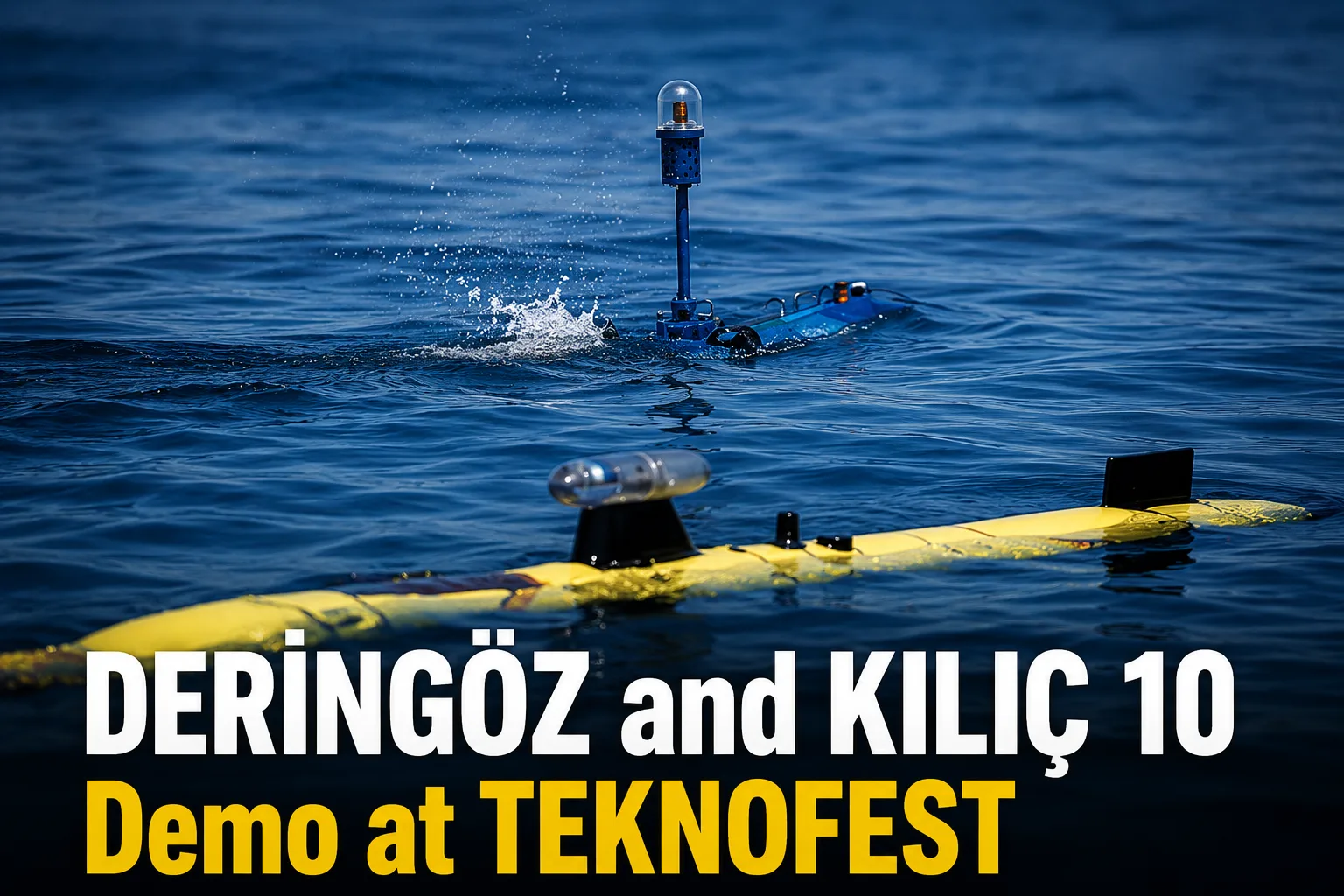
DERİNGÖZ and KILIÇ 10, two autonomous underwater systems developed by ASELSAN, demonstrated their navigation, sensing and autonomous mission capabilities during TEKNOFEST Mavi Vatan 2026 at Gölcük Naval Shipyard Command on 20 August 2026.
The demonstration highlighted two increasingly complementary elements of Türkiye’s emerging uncrewed undersea architecture. DERİNGÖZ performed a controlled dive and autonomous scanning mission, while the compact KILIÇ 10 demonstrated manoeuvring, sensing, communications and AI-supported target-detection functions associated with its expendable underwater strike role.
The event matters beyond the individual platforms. Türkiye is increasingly extending the autonomy, distributed sensing and lower-cost asymmetric concepts already established in the air and surface domains into underwater warfare, where communications, navigation and target identification remain substantially more difficult.
Key Facts
- Demonstration date: 20 August 2026.
- Location: Gölcük Naval Shipyard Command, Kocaeli, Türkiye.
- Event: TEKNOFEST Mavi Vatan 2026, held from 20–23 August.
- Developer: ASELSAN.
- DERİNGÖZ role: Autonomous underwater surveillance, scanning and modular payload missions.
- KILIÇ 10 role: Compact expendable autonomous underwater system designed to detect, track and neutralise surface and subsurface targets.
- Demonstrated functions: Autonomous navigation, underwater sensing, target detection, communications and precise underwater manoeuvring.
DERİNGÖZ Demonstrates Autonomous Underwater Scanning
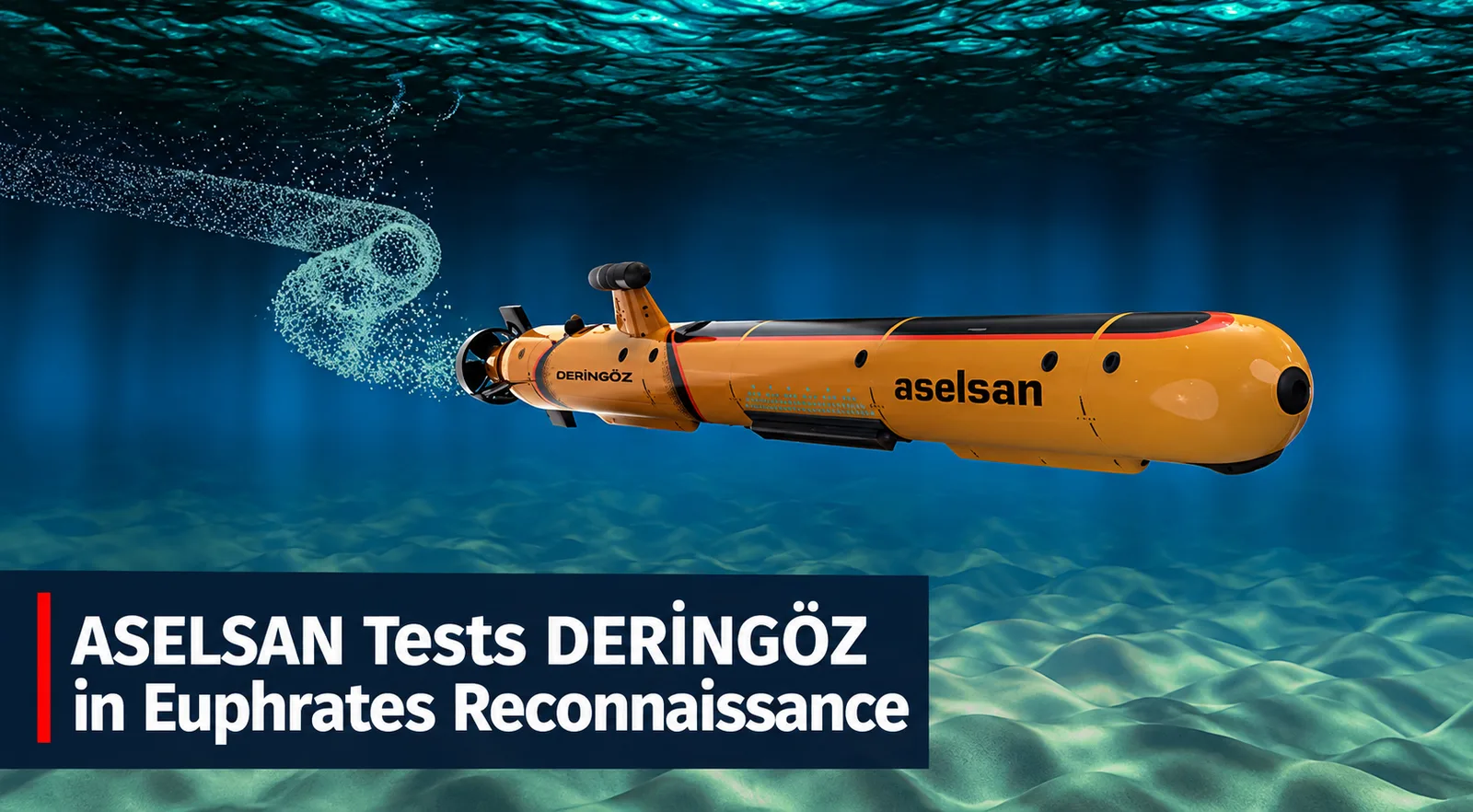
During the Underwater Unmanned Systems Navigation Demonstration, DERİNGÖZ entered the water first and conducted a controlled dive before demonstrating autonomous navigation and underwater scanning.
Anadolu Agency reported on 20 August 2026 that the vehicle used onboard sensors to control its depth, perceive its surroundings and autonomously complete a predetermined route.
The vehicle was equipped with payloads including sonar, cameras, an acoustic modem and wireless communications equipment.
AA also reported that DERİNGÖZ used synthetic aperture sonar to scan the underwater environment and collect data applicable to both military and civilian missions.
After completing its programmed route and operating its assigned payloads, the vehicle returned to its starting position.
ASELSAN Positions DERİNGÖZ as a Modular AUV Family
DERİNGÖZ is not intended to perform only one underwater mission.
ASELSAN has developed the platform around a modular payload architecture that can support underwater reconnaissance, surveillance, seabed mapping, mine-related missions and monitoring of critical underwater infrastructure.
ASELSAN’s published DERİNGÖZ 100M/600 product configuration lists payload options including a camera, side-scan sonar, multibeam echo sounder, synthetic aperture sonar and obstacle-avoidance sonar.
The same configuration includes INS, Doppler velocity log, USBL, GNSS and depth-sensor navigation components alongside acoustic, Wi-Fi and Iridium communications.
The significance of this architecture is flexibility. Different sonar and sensor packages can be selected according to whether the mission prioritises mapping, surveillance, inspection or another underwater requirement.
Published DERİNGÖZ 100M/600 Performance
ASELSAN’s current public brochure for the DERİNGÖZ 100M/600 lists:
- Up to 600 metres operating depth.
- Up to 24 hours endurance with additional battery configuration.
- Maximum speed of approximately 5 knots.
- Scanning speed of approximately 3 knots.
- Modular and expandable payload architecture.
- Wireless and acoustic communications.
These figures describe ASELSAN’s published 100M/600 configuration. The Anadolu Agency report did not explicitly identify the exact DERİNGÖZ variant used during the TEKNOFEST demonstration, so the specifications should not automatically be treated as confirmed performance data for the individual vehicle shown on 20 August.
DERİNGÖZ Has Already Passed Earlier Diving Milestones
The programme predates the latest demonstration.
ASELSAN’s 2024 Annual Report states that diving tests of Türkiye’s first DERİNGÖZ autonomous underwater vehicle had been successfully completed and that the first contract for the system had been signed.
ASELSAN also reported in early 2026 that different DERİNGÖZ variants had successfully completed assigned missions during further diving tests.
The TEKNOFEST Mavi Vatan activity therefore represents another visible demonstration of a programme that has already moved beyond an initial technology demonstrator.
KILIÇ 10 Adds an Expendable Underwater Strike Layer
The second system in the demonstration represented a different mission philosophy.
KILIÇ 10 is an expendable autonomous underwater vehicle developed for asymmetric maritime operations against surface and subsurface targets.
Rather than functioning primarily as a reusable surveillance platform, it combines navigation, sensing, communications and an integrated warhead within a compact one-man-portable architecture.
ASELSAN publicly introduced the KILIÇ family at SAHA 2026 in May, positioning KILIÇ 10 as the smaller member of a new underwater strike family.
ASELSAN leadership said during the launch that the system was designed around low detectability, precision engagement and asymmetric underwater operations.
KILIÇ 10 Demonstrates AI-Assisted Target Detection
During the Gölcük demonstration, KILIÇ 10 showed its ability to manoeuvre precisely underwater using four horizontal and one vertical thruster, according to Anadolu Agency.
The platform can perceive its surrounding environment, assess its position and transfer collected information to a ground-control station.
AI-supported software is used for visual localisation and target detection, while an operator can request continued tracking of a detected object through camera imagery.
This distinction is operationally important. Publicly described AI-based detection functions do not necessarily mean the platform independently makes every engagement decision. ASELSAN also provides communications and optional fibre-optic control paths that can retain operator involvement depending on mission configuration.
Official KILIÇ 10 Specifications
ASELSAN’s May 2026 KILIÇ 10 brochure lists the following characteristics:
- Mission range: 10 nautical miles.
- Length: 120 cm.
- Diameter: 28 cm.
- Portability: One-man portable design.
- Payload: Integrated warhead.
- Communications: Satellite, RF and acoustic links.
- Navigation: Dual GNSS antennas for heading.
- Sensors: Thermal/IR and subsea cameras.
- Control: Optional fibre-optic cable control.
- Other functions: Autonomous operation, swarm capability and AI-supported visual localisation and target detection.
The figures are manufacturer specifications and remain subject to the tolerances and configuration caveats stated by ASELSAN.
DERİNGÖZ and KILIÇ 10 Represent Two Different Undersea Roles
The value of displaying the systems together is that they illustrate two different layers of autonomous underwater operations.
DERİNGÖZ provides the reusable sensing and reconnaissance layer. It can survey an area, map the seabed, inspect underwater infrastructure or carry specialised sensors for intelligence and surveillance missions.
KILIÇ 10 represents the expendable strike layer. Its design prioritises compactness, low detectability, autonomous navigation and the ability to approach a designated maritime target.
That division is consistent with the wider system-of-systems approach outlined in Defence Agenda’s previous analysis, ASELSAN Underwater Systems Target Subsea Superiority.
In such an architecture, surveillance vehicles, surface and airborne sensors, sonobuoys and expendable underwater systems can potentially contribute to one distributed maritime picture instead of operating as isolated platforms.
Underwater Autonomy Is More Difficult Than Airborne Autonomy
The demonstration also highlights the engineering challenges unique to underwater autonomy.
GNSS signals do not provide normal underwater positioning, radio-frequency communications degrade rapidly below the surface and acoustic communications have limited bandwidth and different latency characteristics from conventional radio networks.
As a result, an underwater autonomous vehicle needs to rely more heavily on onboard navigation, sensor fusion and mission logic while submerged.
This increases the importance of inertial navigation, Doppler velocity measurement, acoustic positioning and onboard perception.
It also explains why the ability to complete a programmed route and return autonomously, as demonstrated by DERİNGÖZ, is a meaningful programme capability rather than simply a navigation convenience.
Critical Undersea Infrastructure Is an Expanding Mission
One of the strongest non-strike applications for autonomous underwater systems is protection and inspection of critical seabed infrastructure.
Subsea communications cables, pipelines, energy infrastructure, port approaches and naval facilities cover areas that are difficult to monitor continuously using divers or crewed vessels alone.
A reusable AUV such as DERİNGÖZ can potentially conduct repeatable inspection routes while carrying sonar and imaging sensors appropriate to the task.
This creates relevance beyond conventional naval combat and connects autonomous underwater technology with maritime-domain awareness and national infrastructure resilience.
Türkiye Is Building a Wider Underwater Sensor Architecture
DERİNGÖZ is also developing alongside a broader ASELSAN underwater portfolio.
That portfolio includes sonars, torpedo countermeasures, sonobuoys and autonomous surface and underwater systems.
Defence Agenda recently examined another part of this architecture in ASELBUOY P and POD Expand Türkiye’s UAV-Based ASW.
ASELBUOY adds distributed passive acoustic sensing that can be deployed from air platforms, while DERİNGÖZ can provide a mobile underwater sensor node.
The long-term operational significance will depend on whether these systems can exchange useful data through common naval command-and-control architectures rather than remain separate product lines.
TEKNOFEST Mavi Vatan Highlights Türkiye’s Naval Technology Push
TEKNOFEST Mavi Vatan 2026 is being held at Gölcük Naval Shipyard Command from 20 to 23 August under the main coordination of Türkiye’s Ministry of National Defence and the Turkish Technology Team Foundation.
The event places particular emphasis on maritime and underwater technologies and includes competitions in unmanned underwater systems, underwater rockets and unmanned surface vehicles.
For Türkiye’s defence industry, live water demonstrations are particularly useful because autonomous naval systems need to prove more than static exhibition specifications.
Navigation, communications, launch and recovery, environmental robustness and sensor performance all become visible programme issues once a vehicle enters the water.
Counterargument: Demonstration Is Not Operational Validation
The latest demonstration should not be confused with full operational qualification.
A controlled TEKNOFEST navigation demonstration verifies useful functions but does not publicly establish how either platform performs under contested communications, difficult acoustic conditions, strong currents, electronic attack or an operational adversary.
For KILIÇ 10 in particular, the decisive questions will concern target identification, command authority, communications continuity and integration into naval rules of engagement.
For DERİNGÖZ, endurance and sonar performance across different seabed, depth and acoustic environments will be more important than a single controlled mission.
The demonstration is therefore a technology and programme milestone, not evidence that every publicly advertised mission has already reached fleet-level operational maturity.
Implications / Next
The first milestone to watch is the operational status of DERİNGÖZ following ASELSAN’s earlier confirmation that its first contract had been signed. Public disclosure of the customer, quantity or delivery status would clarify the programme’s transition from development into operational use.
The second is KILIÇ 10 testing. Future demonstrations against representative maritime targets and additional information on operator control, swarm operation and naval-platform integration would indicate how mature the strike architecture has become.
The third is underwater networking. The long-term value of both platforms increases if they can operate with sonobuoys, surface vessels, UAVs, submarines and command centres as parts of a shared maritime sensing and tasking network.
The fourth is export potential. Türkiye has established a substantial international market for unmanned aerial and surface systems. Whether that model can be extended to autonomous underwater systems will depend on reliability, cost, payload flexibility and the willingness of customers to integrate Turkish systems into sensitive naval command architectures.
Finally, TEKNOFEST Mavi Vatan provides a useful indicator of where Türkiye is concentrating future naval technology investment: autonomy is moving below the surface, and the emerging portfolio spans both persistent sensing and expendable strike.
Conclusion
The DERİNGÖZ and KILIÇ 10 demonstration at TEKNOFEST Mavi Vatan shows two distinct directions in Türkiye’s autonomous underwater strategy.
DERİNGÖZ is developing as a modular reusable platform for underwater sensing, reconnaissance, mapping and infrastructure-related missions. KILIÇ 10 adds an expendable asymmetric strike capability built around compact dimensions, autonomous navigation, AI-supported perception and multiple communications options.
The strategic significance lies in connecting those roles.
If Türkiye can integrate autonomous underwater reconnaissance, distributed acoustic sensing, surface and airborne unmanned platforms and strike systems into one coherent command architecture, the result would be considerably more important than either vehicle in isolation.
The 20 August demonstration does not prove that this complete architecture is operational today. It does, however, show that several of its platform-level components are moving from exhibition concepts into increasingly realistic waterborne demonstrations.
Further Reading
- Anadolu Agency: DERİNGÖZ and KILIÇ 10 Demonstrate Their Capabilities
- ASELSAN: DERİNGÖZ 100M/600 Product Data
- ASELSAN: KILIÇ 10 Product Data
- TEKNOFEST: Mavi Vatan 2026 Programme
- Defence Agenda: ASELSAN Underwater Systems Target Subsea Superiority
- Defence Agenda: ASELBUOY P and POD Expand Türkiye’s UAV-Based ASW
- Defence Agenda: Türkiye’s Electronic Warfare USV