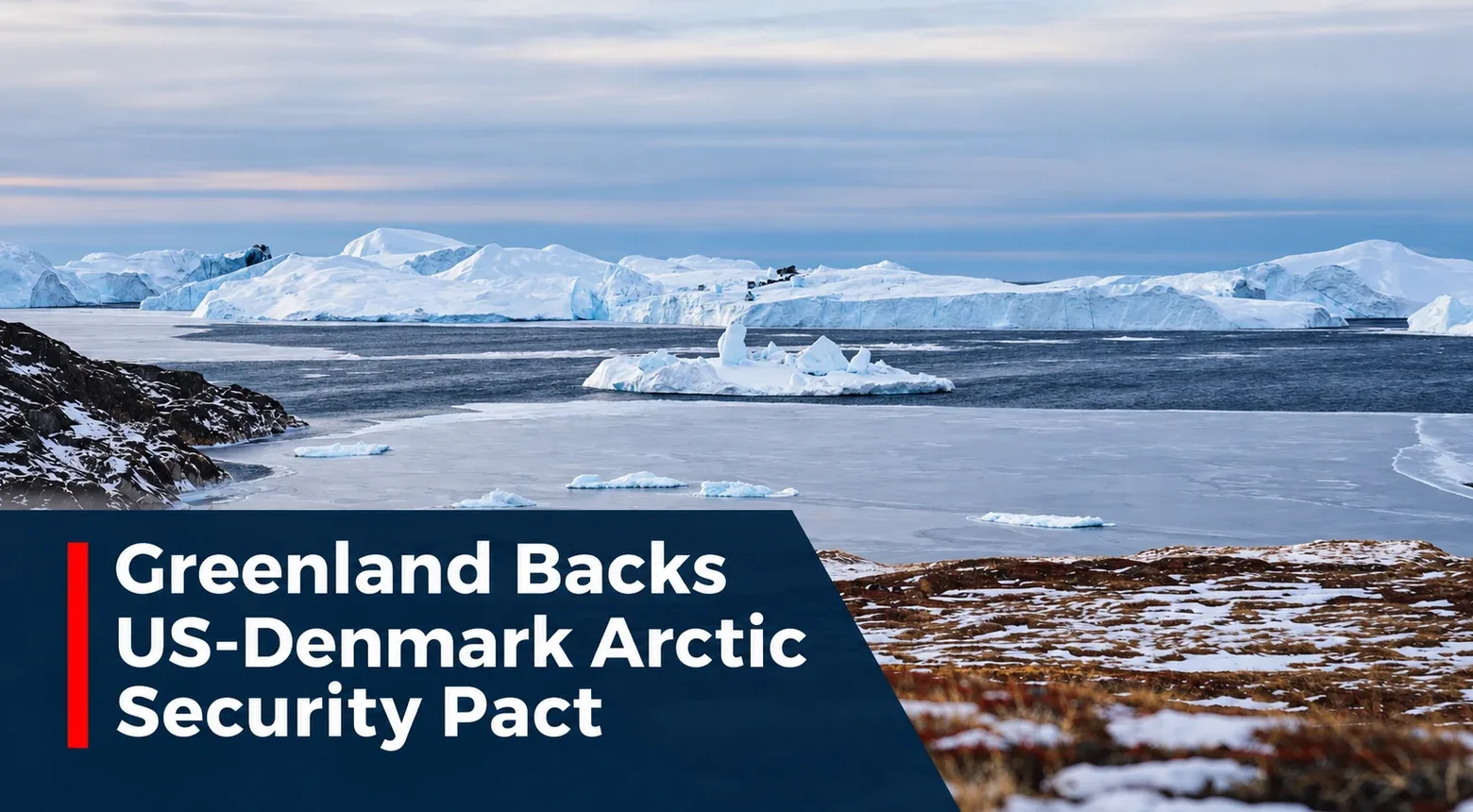
Greenland's parliament has approved a trilateral Arctic security agreement with Denmark and the United States, voting 16–0 with seven abstentions on 3 November 2026. The pact updates the longstanding US defence framework on the island, allows discussions on additional military facilities and protects Danish sovereignty and Greenlandic self-determination. For NATO, it could expand infrastructure available for missile warning, North Atlantic surveillance and High North operations, but the agreement is not yet in force and does not authorise immediate construction of new bases.
Greenland Parliament Approves the Arctic Security Pact
The decision by Inatsisartut, Greenland's parliament, is a significant procedural step in a security arrangement negotiated by the three governments. Associated Press reported the vote on 3 November, while the official Inatsisartut agenda records the agreement as adopted after its second reading. The tally—16 in favour, none against and seven abstentions—shows approval without a recorded vote against, although the abstentions also underline the absence of unanimity.
The new decision should not be confused with the signing of the agreement. Greenlandic Prime Minister Jens-Frederik Nielsen, Danish Prime Minister Mette Frederiksen and US President Donald Trump signed the accord at United Nations headquarters in New York on 22 September 2026, according to the Government of Greenland. The November vote advances ratification; it does not reopen the September negotiations or itself establish a new military base.
Reuters reported that the Danish parliament is scheduled to consider the legislation on 11 November and vote on 19 November. Those are planned parliamentary dates, not a guaranteed completion date. The agreement comes into effect only after the required national procedures are concluded, a distinction that matters to procurement, construction and operational planning.
What the Agreement Changes for US Forces
The signed agreement amends and supplements the 27 April 1951 defence agreement governing US military activity in Greenland. It preserves the existing legal foundation rather than creating a transfer of territory. The official English fact sheet expressly states that sovereignty remains with the Kingdom of Denmark and Greenland's people retain the right to self-determination.
Its most concrete military provisions concern access and facilities. The United States may modernise and expand activity at Pituffik Space Base, while Narsarsuaq and Mestersvig are identified as locations for potential additional defence areas. The precise arrangements, technical details, environmental safeguards and implementation measures remain subject to further agreement among the parties. Accordingly, the reference to two locations is not evidence that two operational American bases already exist or that construction contracts have been awarded.
The agreement also provides a pathway for further defence areas and uncrewed installations, including potential radar or weather stations. The Greenlandic government's fact sheet makes clear that new establishments require agreement from Greenland and Denmark and must address impacts on residents and the environment. Proposals would therefore move through consultation rather than proceed as unilateral US construction decisions.
Why Pituffik Matters for Missile Warning
Pituffik is already an important American Arctic military facility. According to the US Space Force's 12th Space Warning Squadron fact sheet, its Upgraded Early Warning Radar supports strategic missile warning, missile defence and space-domain awareness. The radar contributes to warning and assessment networks used by US and North American defence authorities.
Improved facilities, communications or supporting infrastructure at Pituffik could enhance the resilience of those established missions. However, neither the Greenlandic parliamentary vote nor the public agreement provides an operational performance specification for a newly built radar, nor do they verify the deployment of additional interceptors. A legal permission to expand is different from an approved engineering project, a funded acquisition or an operational capability.
The accord's preamble references the proposed Golden Dome defence architecture. That makes Greenland relevant to a larger US discussion about early warning, long-range sensing and layered homeland missile defence. Defence Agenda has separately examined the Golden Dome procurement programme and the importance of data networks connecting missile-warning sensors. Neither earlier programme description proves that a Golden Dome installation has been purchased or deployed in Greenland under this agreement.
The North Atlantic and NATO Dimension
Greenland's geography makes it important beyond homeland missile warning. The island lies along the northern transatlantic operating environment, including approaches to the Greenland–Iceland–United Kingdom Gap, commonly known as the GIUK Gap. Maritime patrol, submarine monitoring, logistics, search and rescue, air surveillance and communications all depend on usable infrastructure across the High North.
The agreement expressly supports stronger NATO engagement in the Arctic, including planning, presence, exercises and joint intelligence activity. These commitments indicate a framework for cooperation rather than a specified new NATO force package. Details such as aircraft rotations, basing levels, troop numbers or an associated alliance deployment schedule have not been publicly fixed by the parliamentary vote.
The operational backdrop can be seen in Defence Agenda's coverage of Northern Viking 2026, an exercise focused on defending Iceland and the GIUK Gap. The Greenland pact concerns a different territory and legal framework, but the underlying strategic requirement is related: maintaining early warning, reinforcement routes and resilient infrastructure across the North Atlantic.
Sovereignty, Independence and Local Consent
The agreement has an unusually important constitutional dimension because Greenland is self-governing within the Kingdom of Denmark and has a recognised route towards potential independence. The public text explicitly affirms Danish territorial integrity while recognising Greenlanders as a people entitled to self-determination. The Greenlandic government described itself as an equal signatory, rather than merely a territory covered by a bilateral US-Danish understanding.
The parties also say the arrangement should endure if Greenland later becomes independent, subject to the relevant legal and political processes. That should not be misread as a decision on Greenland's future constitutional status or its accession to NATO. Neither independence nor a new treaty of alliance has been approved by this vote.
The political context is contested. AP and Reuters reported that the agreement followed months of pressure from President Trump over the island's strategic future, including earlier comments about possible US control. The subsequent pact substitutes an agreed security framework for any sovereignty transfer. Some residents interviewed by AP welcomed a reduction in tension, while others voiced anxiety about the influence of larger powers. These views are not a substitute for a representative public opinion survey.
Procurement, Greenlandic Business and Environmental Safeguards
The text goes beyond basing permissions. Greenland's official explanatory document says eligible Greenlandic businesses will receive preferential treatment in relevant commercial contracts associated with US defence areas, replacing some earlier arrangements that permitted Danish or Greenlandic recipients. This is a legally relevant change for future supply-chain access but not a published contract award to any named company.
Potential opportunities could include construction, facility maintenance, logistics, transport, environmental services and infrastructure support, depending on future authorised projects. Those categories are an analytical illustration of what defence facilities typically require, not procurement notices issued under the pact. The agreement does not publish a dedicated project budget, a total economic benefit forecast or a list of selected contractors.
An opposition perspective also needs to be considered. Reuters reported that Naleraq, an independence-focused party, questioned whether the agreement brought adequate financial gains to Greenlanders. That objection highlights a central implementation test: whether expanded military access translates into measurable local economic participation rather than primarily external contracting.
The agreement includes safeguards for the environment and local ways of life, with special reference to hunting and fishing. In Arctic conditions, site preparation, transport and maintenance can have significant ecological and community effects. Actual environmental review requirements and consultation outcomes will need to be assessed when specific facilities are proposed.
What the Vote Does Not Establish
There is no disclosed number of additional US troops, no announced construction start date, no confirmed military procurement value and no completed new-base delivery resulting directly from this vote. Public reporting identifies two prospective locations, but that is not equivalent to two commissioned facilities. Similarly, reference to Golden Dome does not establish the installation, cost or readiness of missile-defence equipment on Greenlandic territory.
The agreement is best understood as a framework governing where and how further military cooperation may proceed. Its value for the US and NATO depends on subsequent national approvals, site-specific planning, practical infrastructure investments and whether systems can be integrated with wider command-and-control networks. Its legitimacy in Greenland will also depend on the operation of consent, environmental provisions and economic commitments.
Implications / Next
The immediate milestone is the Danish parliamentary timetable, reported by Reuters as a first reading on 11 November 2026 and a further reading and vote on 19 November 2026. Until the necessary procedures are completed, the agreement should not be described as fully effective.
After ratification, three questions will determine its practical significance. First, the parties must agree on the detailed modalities for Narsarsuaq and Mestersvig, including environmental and local consultation. Second, any Pituffik expansion or new sensor installation would require identifiable project approvals, funding and technical requirements. Third, Greenlandic companies and communities will be able to judge whether the promised preference in procurement produces material benefits.
For defence planners, the vote provides a clearer legal and political pathway towards an expanded US presence in the Arctic. For Greenland, it is a test of whether greater security cooperation can be pursued while preserving sovereignty protections, self-determination and meaningful local participation. The next evidence to watch is not another headline about territorial control, but the formal ratification record and specific, publicly documented implementation decisions.