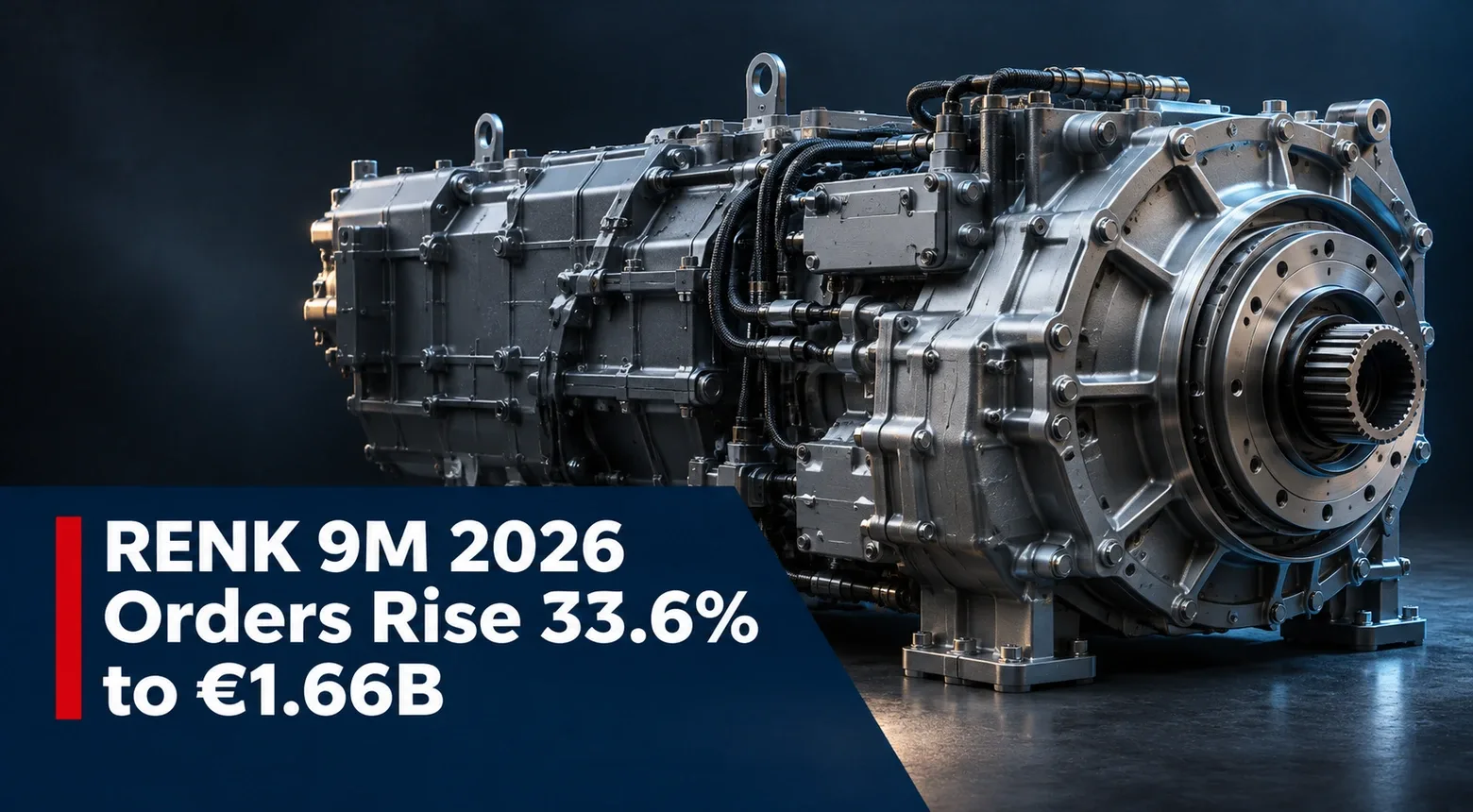
German propulsion specialist RENK Group reported a 33.6% rise in order intake to €1.66 billion for the first nine months of 2026 and a record €7.6 billion in its broader order backlog, as demand for military vehicle drivetrains outpaced recognised sales. Announced on 5 November 2026, the results point to growing European land-systems procurement, but also expose the challenge of turning framework business and future demand into qualified industrial output. The company reported €982.0 million in revenue and €158.8 million in adjusted EBIT for January–September, rather than for the third quarter alone.
Why RENK 9M 2026 Matters for Defence Industry
RENK is a specialist supplier of gearboxes, power-transfer equipment and propulsion systems for armoured vehicles and naval platforms. As European armies expand or recapitalise land fleets, drivetrain deliveries can become a pacing item alongside engines, hull fabrication, electronics and weapon-system integration. For programme managers, the relevant question is therefore not whether demand exists but how quickly highly engineered components can be produced, tested and delivered to vehicle assembly lines.
The German company’s 5 November financial release attributes the latest intake principally to defence customers, especially its Vehicle Mobility Solutions (VMS) business. That is a distinct result from a newly awarded government budget: order intake reflects business recorded during the period, while backlog includes different levels of commitment and may be fulfilled over several years. Reuters’ coverage also emphasised the gap between orders and revenue and the importance of subsequent execution.
RENK’s results can be read alongside Defence Agenda’s coverage of Rheinmetall’s first-half 2026 backlog and production guidance, although the two companies define reported backlog differently. An identical currency label does not make their orders, nominations and future framework quantities directly comparable.
Orders, Revenue and Earnings: Nine-Month Comparison
RENK recorded €1,664.4 million in order intake, compared with €1,245.8 million in the corresponding nine months of 2025. Revenue increased by a much smaller 5.8%, from €927.7 million to €982.0 million. This produced a 1.7x book-to-bill ratio, up from 1.3x a year earlier. The ratio shows the pace of new business relative to realised sales during the period; it is not a conversion rate for cash receipts.
Adjusted earnings before interest and tax (EBIT) rose from €141.0 million to €158.8 million, increasing the adjusted margin from 15.2% to 16.2%. The company attributes the margin improvement largely to operating leverage in VMS and production efficiencies from its modular manufacturing approach. The improvement in adjusted profitability should not be presented as the performance of all accounting measures: unadjusted EBIT moved in the opposite direction.
| Group metric | 9M 2026 | 9M 2025 | Change |
|---|---|---|---|
| Order intake | €1,664.4m | €1,245.8m | +33.6% |
| Revenue | €982.0m | €927.7m | +5.8% |
| Adjusted EBIT | €158.8m | €141.0m | +12.7% |
| Adjusted EBIT margin | 16.2% | 15.2% | +1.0 pp |
| Reported EBIT | €77.7m | €95.5m | −18.6% |
What the €7.6 Billion Order Backlog Actually Contains
RENK’s official 17-page earnings release specifies a total order backlog of €7,594 million on 30 September 2026, compared with €6,676 million at the end of 2025. Of the September total, €2,938 million was classified as fixed orders, €1,077 million as framework orders and €3,579 million as soft orders. The last two categories should not be described collectively as fully funded, irrevocable purchases.
The distinction materially changes the programme-risk interpretation. Fixed orders provide a more defined production foundation, while future business associated with frameworks and forecast demand depends on subsequent call-offs, customer budgets, contract terms and schedule adjustments. The headline €7.6 billion is therefore a wider commercial visibility measure, not revenue already earned or an amount guaranteed to convert at a fixed date.
That broader backlog grew by €918 million, or 13.8%, compared with 31 December 2025. The fixed portion alone grew 30.0%, from €2,260 million to €2,938 million. These two growth rates describe different denominators. Planners and investors should not use them interchangeably when assessing the durability of the order book.
| Order backlog component, 30 September 2026 | € million | Share of total (approx.) |
|---|---|---|
| Fixed | 2,938 | 38.7% |
| Framework | 1,077 | 14.2% |
| Soft | 3,579 | 47.1% |
| Total | 7,594 | 100% |
Leopard 2 and Patria Contracts Drive Land Mobility
VMS generated €1,321.8 million in nine-month order intake, a 46.2% rise from €903.9 million in 9M 2025. Its book-to-bill ratio reached 2.0x, while revenue grew 12.3% to €650.2 million. Adjusted EBIT advanced 23.4% to €129.3 million, producing a segment margin of 19.9% compared with 18.1% a year earlier.
Among the third-quarter awards was an approximately €130 million extension from KNDS Deutschland for HSWL 354 transmissions supporting the Leopard 2 tank and vehicle family. RENK stated that deliveries are due to begin in 2029 and finish in 2032. The length of that window helps explain why new orders can rise sharply without an equivalent immediate revenue increase.
RENK also announced a €30 million follow-on order from Patria for HSWL 076 transmissions associated with the TRACKX vehicle family, with deliveries expected from 2027. Neither contract announcement gives a complete vehicle procurement quantity, and the propulsion orders should not be treated as contracts for entire vehicles. They illustrate the continued role of specialised drivetrain companies within larger original equipment manufacturers’ supply chains.
The industrial implications extend beyond today's Leopard 2 fleet. Defence Agenda’s report on the Franco-German MGCS project-company structure provides context for future European armoured-vehicle development, but no direct MGCS award to RENK is established by the nine-month statement.
Türkiye Hisar OPV Shipsets and Marine Market Conditions
RENK’s Marine & Industry (M&I) division reported €256.9 million in order intake, marginally above the €254.7 million recorded in the first nine months of 2025. RENK specifically identified orders from Türkiye for four shipsets intended for Hisar-class offshore patrol vessels as one contributor in the third quarter. The source does not disclose the shipset contract price, named shipyard, delivery milestones or exact equipment configuration. Those details cannot safely be inferred from the division’s overall order figure.
The marine contribution did not prevent weaker segment revenue and profitability. M&I revenue fell 6.3% to €250.9 million, while adjusted EBIT declined to €25.8 million from €31.2 million. The adjusted margin contracted to 10.3% from 11.6%. RENK cites weaker industrial end markets, highlighting that naval procurement recovery and civilian industrial demand can move in different directions within a shared division.
For Türkiye’s shipbuilding ecosystem, the confirmed order demonstrates a European propulsion supplier’s position in the OPV value chain. It does not establish that the specified shipsets have already been installed or that the associated vessels have completed acceptance trials. Later shipyard and customer announcements will be needed to track installation and delivery.
Production Expansion and Operational Bottlenecks
RENK said three machining centres began operating at Rheine at the end of August 2026. It intends to invest more than €20 million at that site by 2030, while transferring elements of its modular production concept across the wider manufacturing network. Expansion is proceeding alongside existing series production rather than through a complete production shutdown and restart.
Such changes can improve throughput, but machining capacity is only one stage of delivery. Suppliers must also secure qualified materials, precision components, inspection capacity, skilled operators, final assembly time and customer acceptance. In regulated defence supply chains, the time needed for process qualification can limit the speed with which newly installed equipment turns into billable deliveries.
The wider context is an allied push to scale production. Defence Agenda covered NATO military chiefs’ September 2026 call for faster and more predictable industrial deliveries. RENK’s order-to-revenue gap illustrates why capacity announcements must eventually be judged against completed deliveries, quality and cash conversion rather than alone against machinery installed.
Adjusted Profit Growth Masks an EBIT Decline
The company's full earnings release shows a less favourable result on an unadjusted basis. Reported EBIT declined by 18.6% from €95.5 million to €77.7 million, even as adjusted EBIT increased. RENK identified €22.6 million of impairment related to the termination of Germany’s F126 frigate project, alongside purchase-price-allocation charges and higher merger-and-acquisition expenses, among the items affecting the reconciliation.
This does not invalidate the adjusted result, but it changes its interpretation. Adjusted EBIT aims to describe underlying operating performance excluding specified items; reported EBIT reflects the accounting impact recorded in the period. An authoritative industry report should show both rather than using only the figure with the strongest positive growth.
Free cash flow increased from €25.8 million to €53.1 million over the first nine months, according to the company report. Capital expenditure on property, plant and equipment and intangible assets was €31.2 million versus €16.0 million a year earlier. These are realised period measures, unlike the forecast production volumes implied by the extended order book.
Portfolio Reorganisation and 2026 Outlook
RENK completed its acquisition of David Brown Defence on 2 November 2026, following an earlier acquisition announcement, and reported that it had entered into a binding agreement on 22 October to sell its Slide Bearings division. The group intends to recognise the latter as a discontinued operation under IFRS 5 from the fourth quarter. The transactions affect how the year-end business perimeter and margins should be read.
RENK now expects approximately €1.4 billion in 2026 revenue and adjusted EBIT of €240 million–€255 million from continuing operations comprising VMS and M&I. This is a management forecast, not a result already achieved. It also should not be compared directly with a prior three-division outlook without adjusting for the change in business perimeter.
The acquisition strengthens RENK’s UK naval propulsion presence, while the disposal of Slide Bearings would concentrate resources on core mobility and marine products. However, transaction integration, industrial reorganisation and delivery schedules create execution risks; neither transaction demonstrates an immediate increase in delivered military equipment.
Implications / Next
The decisive indicators for the next reporting periods will be the conversion of fixed orders to revenue, the execution of KNDS and Patria transmission schedules, delivery progress for the Türkiye OPV shipsets, and whether newly installed equipment sustains higher production volumes without quality or working-capital deterioration.
RENK has scheduled a strategy update in London for 8 December 2026. Investors and defence procurement teams should look for clearer factory-output milestones, guidance for continuing operations, integration details for the UK acquisition and a measurable plan for reducing the gap between strong orders and slower revenue growth.
For now, the figures establish an expanding commercial pipeline and improving adjusted operating profitability, while the unadjusted earnings decline and mixed composition of backlog make a straightforward ‘record orders equal secured future sales’ conclusion inappropriate.