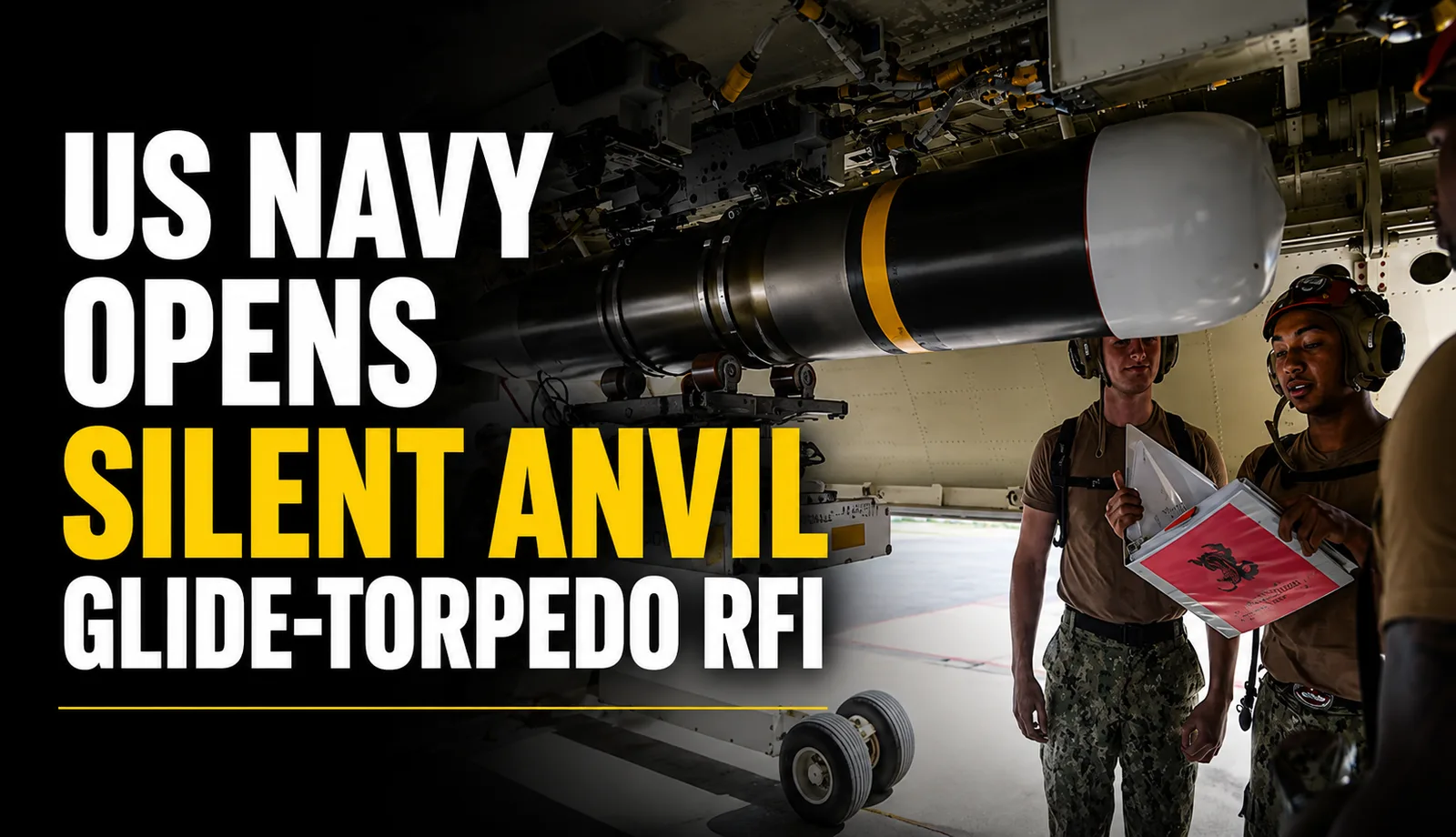
The U.S. Navy has opened an industry request for information for Silent Anvil Air-Launched Torpedo (SAA-LT), a next-generation anti-submarine warfare concept intended to give a wider range of crewed and uncrewed aircraft a compact standoff weapon that glides through the air before entering the water to attack a submarine.
Naval Air Systems Command posted the RFI on 25 August 2026 under solicitation number N00019-27-RFI-PMX201-SILENTANVIL. The Navy is examining two design paths: a complete integrated air-launched torpedo system, or an unpowered glide-wing kit able to carry a government-furnished torpedo. Industry responses are due on 29 September 2026. The notice is a market-research and rapid-prototyping step, not a production contract or a funded programme award.
Key Facts
- Programme: Silent Anvil Air-Launched Torpedo (SAA-LT)
- RFI posted: 25 August 2026
- Issuing command: Naval Air Systems Command (NAVAIR)
- Solicitation: N00019-27-RFI-PMX201-SILENTANVIL
- Industry response deadline: 29 September 2026
- Design paths: Integrated glide torpedo or unpowered glide kit for a government-furnished torpedo
- Maximum form factor: 268 lb, 70 in length and 7.5 in diameter
- Prototype objective: End-to-end demonstration within 18 months of an agreement award
Context and New Development
Silent Anvil is best understood as a requirements-shaping effort rather than a selected weapon. The RFI asks industry to identify technologies, design approaches and manufacturing capacity for a standoff air-launched anti-submarine weapon that can be carried internally or externally by multiple aircraft types.
The Navy wants the weapon to use a compact form factor comparable to the GBU-39 Small Diameter Bomb and to be compatible with the standard BRU-61/A bomb rack. The stated dimensional limits are no more than 268 lb in weight, 70 in in length and 7.5 in in diameter. Those constraints are significant because they move the concept away from a weapon designed around one maritime patrol aircraft and toward an effector that could potentially be integrated across a broader aviation inventory.
The public RFI does not identify a preferred prime contractor, specify a final torpedo model or commit the Navy to a production quantity. Potential follow-on agreements could use rapid-prototyping mechanisms, including Other Transaction Authority pathways through the Naval Air Systems Consortium, but the current notice itself does not commit funds.
Two Technical Paths
The first Silent Anvil option is an end-to-end integrated weapon. In this approach, the contractor would develop a complete torpedo and aerial delivery solution capable of separating from the aircraft, gliding to a designated area, entering the water and transitioning to the underwater terminal phase.
The second option preserves a government-furnished torpedo and focuses industry effort on an unpowered glide-wing kit. This path is closer in concept to the existing High Altitude Anti-Submarine Warfare Weapon Capability, or HAAWC, which attaches a Boeing Air Launch Accessory to the Mk 54 lightweight torpedo.
The two paths give the Navy different balances of risk, cost and integration complexity. A clean-sheet integrated weapon could be optimised around the dimensional and carriage limits from the beginning. A glide-kit approach could exploit an existing torpedo inventory and reduce development risk, but it would have to work within the geometry, centre of gravity, interfaces and water-entry requirements of the government-furnished weapon.
Air-Launch Envelope
The RFI tests the concept across a wide launch envelope. Defense News reports requested launch-speed points of Mach 0.25, 0.50 and 0.85, with altitude bands extending from 10 ft to 60,000 ft. The government is also asking industry to identify the maximum achievable standoff glide range rather than prescribing a fixed value at this stage.
That altitude range is wider than the normal operating envelope associated with the P-8A Poseidon and indicates that NAVAIR is evaluating the weapon as a multi-platform capability. The RFI itself should not be read as confirmation that a specific high-altitude unmanned aircraft, including the MQ-4C Triton, will carry Silent Anvil; the public requirement refers more generally to a range of crewed and uncrewed aircraft capable of anti-submarine warfare missions.
For the glide-kit option, Defense News reports a required water-entry angle of 45 to 90 degrees and an entry velocity between 40 and 120 ft/s. These parameters illustrate one of the core engineering challenges: a weapon that spends most of the engagement in aerodynamic flight must still transition into water at a geometry and speed compatible with reliable torpedo operation.
Why the Navy Wants More Time in the Air
The Silent Anvil concept places unusual emphasis on aerial endurance. The Navy wants the weapon to maximise time in flight while minimising the duration spent underwater before the terminal attack.
That logic reflects the geometry of anti-submarine warfare. A conventional air-dropped torpedo must be released close enough to a localised submarine contact to enter the water, acquire the target acoustically and complete the attack before the contact moves beyond its search volume. A standoff gliding weapon transfers part of that distance into the air, where aerodynamic flight is far more energy-efficient than torpedo propulsion underwater.
Reducing the underwater portion can preserve torpedo energy for acquisition, homing and terminal manoeuvre. It can also allow the launch aircraft to remain farther from the predicted target position, giving commanders more freedom in altitude, routing and platform employment.
HAAWC Provides the Existing Baseline
Silent Anvil does not begin from a blank sheet. Boeing’s HAAWC programme has already demonstrated the operational value of attaching a precision glide kit to a lightweight torpedo. The U.S. Navy declared HAAWC initial operational capability in November 2022 after awarding a full-rate production contract earlier that year.
HAAWC uses a modular Air Launch Accessory attached to the Mk 54 torpedo, allowing the P-8A Poseidon to release the weapon from higher altitude and greater distance than a conventional torpedo drop. Boeing describes the system as an all-weather precision glide capability and says the accessory separates before the torpedo enters the water.
Silent Anvil differs in three important ways. First, NAVAIR is seeking a substantially compact weapon envelope built around BRU-61/A compatibility. Second, the Navy wants carriage across a broader range of crewed and uncrewed aircraft rather than centring the requirement on the P-8A. Third, the Navy is explicitly considering both a new integrated torpedo and a modular glide-kit path.
Technical and Operational Impact
The most consequential aspect of Silent Anvil may be platform distribution rather than raw torpedo performance. If a compact ASW weapon can be carried on multiple aircraft classes, the Navy could separate submarine detection from weapon delivery more effectively.
A maritime patrol aircraft, surface combatant, sonobuoy field, seabed array or uncrewed sensor could contribute to detection and localisation, while another aircraft carries the weapon. That architecture is consistent with the wider move toward distributed anti-submarine warfare, where sensing and engagement are increasingly shared across networked crewed and uncrewed systems.
Defence Agenda has previously examined this transition through UAV-deployed sonobuoys, distributed acoustic arrays and autonomous underwater systems. Silent Anvil would address the kinetic side of the same problem: how to place an anti-submarine effector onto more aircraft without requiring every platform to carry a full-size traditional torpedo integration.
Programme and Procurement Dimension
The programme schedule is aggressive but remains conditional. The RFI describes an objective for an end-to-end prototype demonstration within 18 months after an agreement award. Following a successful demonstration, the Navy is considering delivery of approximately 180 prototype all-up-rounds within three years.
Those 180 weapons should not be described as an approved production order. They are part of the rapid-prototyping concept described in the market-research notice. No agreement has yet been awarded, no programme value has been published and no contractor has been selected.
The distinction is particularly important because the notice is classified as a Sources Sought / RFI. Its immediate purpose is to understand industrial capability, technical feasibility, achievable standoff range, schedule and manufacturing readiness before the Navy determines the next acquisition step.
Industrial Impact
Silent Anvil opens a potentially broad competition across torpedo manufacturers, guided-weapon companies, glide-kit specialists, autonomy and guidance suppliers, and aircraft-integration firms. The dimensional constraints also place a premium on miniaturised propulsion, acoustic processing, guidance electronics, power systems and folding aerodynamic surfaces.
The glide-kit route could favour companies with experience in precision air-delivered weapons and torpedo integration, while the integrated route creates space for a new architecture built specifically around air carriage and short underwater residence.
HAAWC also provides an industrial reference. Boeing has produced Air Launch Accessory kits for the Mk 54, and in February 2026 expanded HAAWC wing-kit production through Australian supplier Ferra Engineering. Silent Anvil could either extend that lineage or create a competing approach, depending on the Navy’s eventual requirements and industry responses.
Limitations and Counterpoint
Several headline-level conclusions would be premature. The U.S. Navy has not selected a Silent Anvil design, awarded a development contract or approved production. The weapon’s glide range, underwater range, seeker architecture, warhead, propulsion, unit cost, target set and final aircraft integrations are not publicly fixed.
The 60,000-ft requirement should also not be interpreted as evidence that the MQ-4C Triton will become an armed ASW platform. It demonstrates the altitude envelope NAVAIR wants industry to examine, but the RFI does not publicly name a specific unmanned launch aircraft.
Similarly, the 180 all-up-round figure is a prospective prototype quantity after a successful demonstration, not a current procurement order. The RFI remains a planning document and explicitly does not represent a commitment of government funds.
Implications / Next
The first milestone is the 29 September 2026 industry-response deadline. The quality and maturity of those responses will determine whether NAVAIR moves toward one technical path, continues both in parallel or revises the requirement.
If an agreement follows, the 18-month prototype objective will become the key schedule marker. A successful demonstration would then open the path toward the proposed 180 all-up-round prototype phase and potentially broader operational evaluation.
The most important technical data to watch will be achievable standoff range, torpedo type, launch-platform selection, water-entry performance, acoustic acquisition behaviour and the extent to which the weapon can share targeting information with distributed ASW sensors.
Conclusion
Silent Anvil is not yet the U.S. Navy’s new operational torpedo. It is a rapid-acquisition effort asking industry how to create a compact, standoff anti-submarine weapon that can glide from a much wider range of aircraft before transitioning to an underwater attack.
The programme builds on the logic proven by HAAWC but pushes it toward smaller dimensions, broader platform compatibility and potentially a clean-sheet torpedo. If NAVAIR can turn the RFI into a successful prototype within the proposed schedule, Silent Anvil could become an important link between distributed ASW sensing and distributed airborne weapons delivery.