The Royal Navy has commissioned its first autonomous squadron, establishing a permanent, Portsmouth-based organisation to operate uncrewed surface vessels (USVs) alongside conventional warships. The 1st Autonomous Squadron was formally commissioned on 5 November 2026, with the Navy announcing the milestone on 9 November. About 180 personnel will operate and develop Kraken K3 Scout and Rattler craft, giving Britain's Hybrid Navy strategy an institutional home for surface autonomy. The milestone is significant for fleet organisation, force protection and accelerated procurement, although the commissioning ceremony does not establish that every USV configuration is fully autonomous, combat-proven or operating at scale.
First Royal Navy Autonomous Squadron Commissioned in Portsmouth
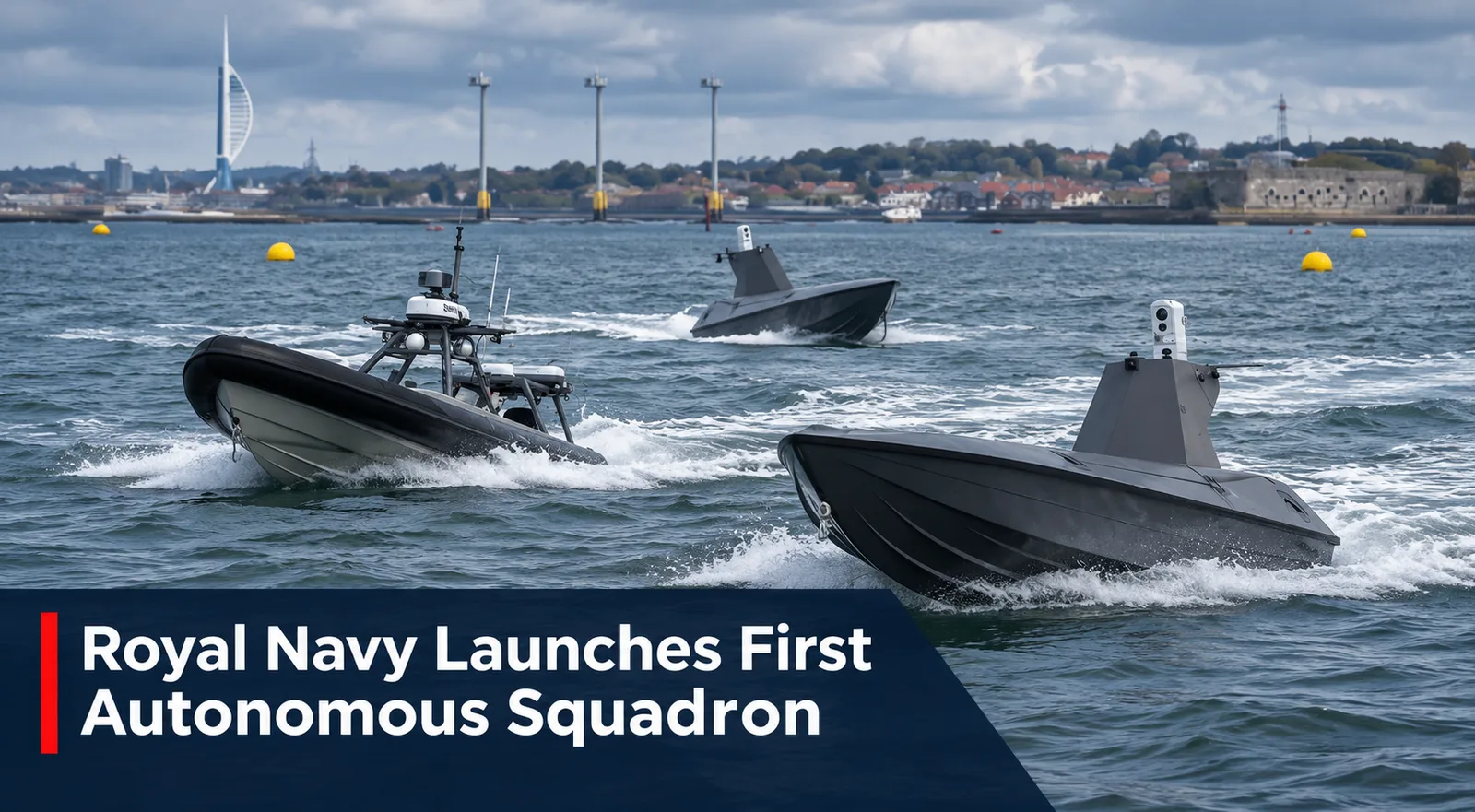
The Royal Navy's 9 November announcement confirms that the unit joined the service during a ceremony at His Majesty's Naval Base Portsmouth on 5 November 2026. More than 200 sailors, guests, families and dignitaries attended. Kraken and Rattler uncrewed craft were manoeuvred around Portsmouth Harbour from a control hub, demonstrating remotely operated activity during the event.
The public demonstration is important evidence of functioning vessels and shore-based command arrangements, but it should not be described as a completed, independent combat deployment. Remote control and autonomous navigation are related yet different capabilities. How much onboard autonomy is enabled, and which decisions remain with a human operator, can vary by vessel, mission and configuration. The Royal Navy did not publish an independently audited mission-availability rate or a comprehensive combat qualification report alongside the ceremony.
Vice-Admiral Steve Moorhouse, the Fleet Commander, presented the unit as a means of giving personnel additional operational reach and options. The Navy's concept is not to dispense with crewed ships but to integrate uncrewed craft with existing fleet formations. That distinction explains why the initiative is framed as a Hybrid Navy, rather than a replacement fleet consisting solely of robotic boats.
Around 180 Personnel and a Two-Watch Operating Model
The 1st Autonomous Squadron, commanded by Commander Helen Coxon, comprises approximately 180 personnel organised into two watches intended to sustain round-the-clock activity. The Navy compared that overall headcount with the complement of a Type 23 frigate. It is a useful organisational comparison, not an equivalence between the squadron's firepower and that of a frigate or a claim that 180 people are continuously controlling individual boats.
Those personnel are intended to conduct operations, develop procedures, train operators and introduce additional USVs to the fleet. The service described future deployments involving individual vessels or groups working with other units and international partners. These are a declared remit and development pathway; the Navy's 9 November statement did not list an already completed series of operational patrols under the squadron's new designation.
The organisational shift also creates requirements that are not obvious in a photograph of small vessels at speed. Operator training, technical support, mission planning, data analysis, maintenance, safety assurance and communications management must accompany any attempt to operate multiple craft for prolonged periods. The service has not published a breakdown of the squadron's 180 personnel by job category, equipment watch or deployment location.
In reporting from the commissioning, the Portsmouth News quoted senior officers describing a transition from experimentation to routine operational use. That is a statement of institutional direction, not a measured demonstration that all future task-group integrations have been completed.
Kraken K3 Scout and Rattler: What the New Unit Operates
The squadron's initial portfolio centres on the Kraken K3 Scout and Rattler uncrewed surface vessels, which the Navy displayed during the Portsmouth event. The craft provide a practical base for testing command arrangements, task-group integration, maritime surveillance and other roles. The US Naval Institute's 9 November report identifies surveillance, strike and logistic-delivery applications across the emerging fleet, but those mission categories should not be mistaken for formal qualification of every payload on both types.
Kraken K3 Scout has also featured in earlier Royal Navy demonstrations. On 8 July 2026, the service reported an air-delivery trial in which a K3 Scout was dropped by parachute four times from an A400M aircraft. The Navy said the same craft and delivery equipment were used during four live drops over six working days. This was an experimentation milestone in deployment flexibility, separate from the new squadron's November commissioning.
Public reports also describe Rattler vessels undergoing remote-control exercises, including activity monitored from a considerable distance. Such trials contribute to training and concept development; they do not establish continuous availability under all weather, electronic-warfare or communications conditions. The squadron will need to determine which tasks can be routinely conducted under approved procedures and when direct human intervention is required.
Programme Figures That Should Not Be Confused
| Programme or unit | Public figure | What the figure establishes |
|---|---|---|
| 1st Autonomous Squadron | Approximately 180 personnel | Unit staffing, not a vessel count |
| Squadron organisation | Two watches | Intended 24-hour manning model |
| Project Beehive Kraken procurement | 20 USVs | A March 2026 order, not confirmed as 20 boats exclusively assigned to the new squadron |
| Kraken procurement value | £12.3 million | The disclosed Beehive purchase agreement, not the total cost of the squadron |
| Wider Hybrid Navy investment | £1.5 billion over four years | A broader force-development programme, not a ring-fenced autonomous-squadron budget |
Project Beehive Becomes a Standing Naval Capability
The 1st Autonomous Squadron succeeds Project Beehive, which the Royal Navy used as a proving ground for its uncrewed surface fleet. Under a contract announced on 11 March 2026, the Navy planned to buy 20 Kraken USVs for £12.3 million. The announcement named the Coastal Forces Squadron and 47 Commando Royal Marines as intended users for operations, training and development activities.
That chronology matters. The November ceremony did not announce a fresh £12.3 million contract; the number and amount belong to the earlier March procurement. Equally, the public information does not show that all 20 craft from that award are exclusively transferred to, or permanently stationed with, the 1st Autonomous Squadron. Assigning an entire procurement lot to the new unit without an explicit allocation record would overstate what is known.
The Beehive model focused on acquiring usable systems, gathering experience and adapting them for military requirements. A commissioned squadron adds a standing command structure, training cycle and operational accountability around those lessons. It also brings new performance questions: how many boats are available at any given time, how quickly an operator can re-task them, and how well the unit can coordinate with ships, aircraft and other allied systems.
The procurement approach is relevant to suppliers because the Navy has stressed adaptation of commercially available technology rather than requiring every function to begin as a bespoke defence development. That can shorten initial acquisition cycles, but it does not remove cyber assurance, safety cases, support documentation or configuration-control obligations.
£1.5 Billion Hybrid Navy Investment Is Broader Than the Squadron
The Royal Navy linked the commissioning to a £1.5 billion investment over four years supporting its wider Hybrid Navy transformation. The amount covers a strategic effort to bring uncrewed and autonomous capabilities together with crewed ships, submarines and aircraft. It is not a disclosed £1.5 billion budget for 1st Autonomous Squadron alone, and the Navy did not publish an itemised allocation of that total in the commissioning statement.
An associated Capability Accelerator team, established in 2025 with partial funding from UK Defence Innovation, is intended to shorten the route from an operational requirement to usable equipment. The Royal Navy announced a hub at HMNB Portsmouth and described cooperation with Navy Develop and the Disruptive Capabilities and Technologies Office. This suggests that future changes in payloads, software and tactics may be evaluated within a more permanent organisational environment.
The main acquisition question is how successfully rapid procurement will scale while preserving military standards. Commercial components and flexible software can support faster iteration, but their use can also create difficulties with security testing, lifecycle support, interoperability and supply-chain visibility. A new unit can establish consistent processes, yet no published breakdown of costs, maintenance hours or fleet-wide software assurance was provided at the ceremony.
These issues parallel other areas of Royal Navy modernisation. Defence Agenda's coverage of Thales's remote mine warfare command-centre agreement describes the distinct challenge of integrating uncrewed mine countermeasures through remote command infrastructure. The new surface squadron and the mine-warfare command-centre effort are related elements of hybrid maritime operations, but they have separate procurement baselines and should not be presented as one contract.
Operational Roles: Surveillance, Force Protection and Task Groups
Small USVs can potentially extend maritime awareness around fleet formations, harbour approaches, coastal infrastructure and busy operating areas without requiring every sensor to be carried by a conventional warship. The Navy expects its squadron's craft to work alone and alongside other organisations and nations, including as part of task groups. This creates a possible path towards more distributed surveillance and force protection, although the scope of any specific deployment will depend on approved tasks and available equipment.
The UK government's 10 November 2026 naval speech identified coastal defence as the squadron's first task, with emphasis on monitoring approaches, protecting critical infrastructure and responding to hostile activity. That subsequent statement adds a concrete near-term mission priority beyond the 9 November commissioning account. It should not be backdated as if it were announced at the 5 November ceremony.
Interoperability with NATO partners will be another critical measure. Tactical coordination may require different navies' control systems to interpret vessel status, sensor observations and tasking instructions consistently. Communications links can be intermittent in maritime environments, so operators need clear responsibility for continuing, pausing or ending tasks when conditions change.
Defence Agenda's AUKUS undersea payloads report provides a separate example of the UK's work on common approaches to unmanned mission equipment. Its analysis of uncrewed underwater systems outlines how surface and subsea platforms may support different roles in a wider maritime network. Neither story demonstrates that the new Portsmouth squadron has already integrated those specific systems.
Personnel, Autonomy and Programme Risks
Calling the organisation an autonomous squadron does not establish that its craft undertake unrestricted autonomous decision-making. The Portsmouth demonstration used a human-operated control hub. Mission automation, remote piloting and independent onboard decisions occupy different points on an autonomy spectrum, and public descriptions of a platform's capabilities do not automatically define its operational authorisation.
Human accountability remains central to maritime safety and any future use of force. Decision-makers must establish clear operator responsibilities, vessel identification procedures, risk management and rules governing the integration of USVs with other traffic. The Navy has not disclosed detailed engagement rules, classified sensor configurations or the squadron's complete operating limits, so independent claims about such matters would be speculative.
The principal technical and procurement risks include data-link resilience, navigational reliability, endurance, onboard system maintenance, cyber security and the difficulty of expanding a small-vessel fleet without expanding support requirements. A demonstration in Portsmouth Harbour is one useful step, but it does not substitute for sustained operations in difficult conditions or evidence of acceptable whole-life costs.
There is also a strategic counterargument: multiplying smaller craft does not remove the need for large crewed platforms that can carry long-range weapons, aircraft and extensive sensors. Navy leaders have explicitly described hybrid operations as complementary. Defence Agenda's report on Leonardo's Proteus autonomous helicopter software illustrates a parallel development strand in naval aviation, but its maturity milestones are separate from those of uncrewed surface vessels.
Implications / Next: From Commissioning to Operational Output
For naval programme offices, the most useful next disclosures will be an order of battle showing operational vessels assigned to the squadron, confirmed readiness and deployment milestones, and evidence of routine task-group interoperability. Future announcements identifying how many of the 20 Beehive Kraken craft are actually assigned to the new unit would prevent confusion between an acquisition quantity and operational force structure.
The immediate organisational milestone is clear: 5 November 2026 marked the commissioning of the Royal Navy's first autonomous squadron, followed by a 9 November public announcement and a 10 November statement identifying coastal defence as the first task. Subsequent evidence should address what the squadron does at sea rather than treating the existence of a unit as proof that every proposed role is already operational.
The strategic importance lies in turning experimentation into a standing naval institution. With about 180 personnel, two watches and an initial mix of Kraken and Rattler craft, Britain now has a dedicated organisation to develop and operate uncrewed surface vessels. Its value will be determined by sustained availability, interoperability, safety and mission results—not solely by the commissioning ceremony or headline investment totals.