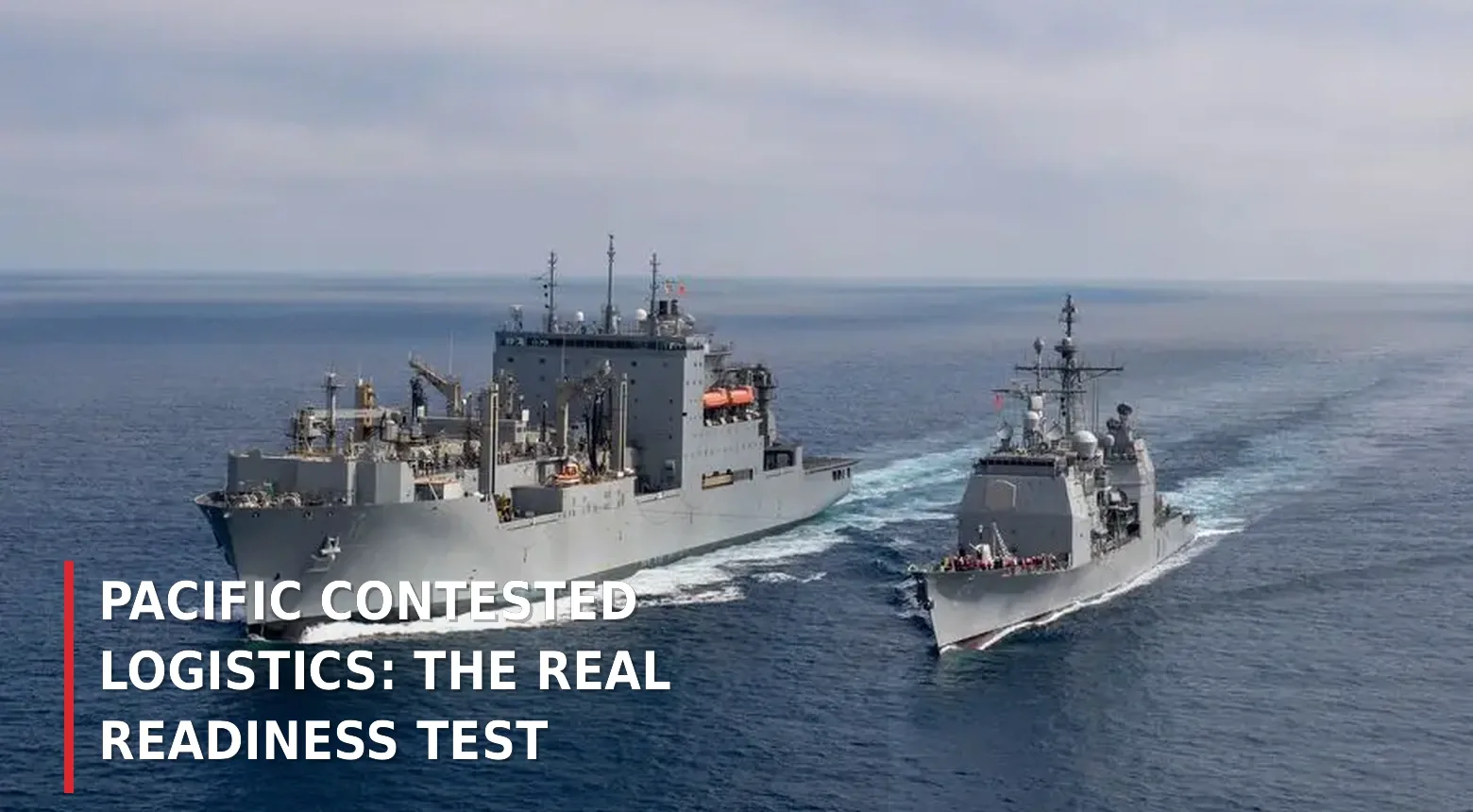
Indo-Pacific contested logistics are emerging as a decisive measure of military readiness, not merely a support function. In a 12 November 2026 RealClearDefense analysis, maritime operator and former US service member Richard Byno argues that keeping a sea lane nominally open is different from delivering the fuel, ammunition, people and repairs required for repeated operations. His example is the Strait of Hormuz, where shipping remained vulnerable in October despite military activity intended to protect or control maritime access. Official US Navy, Government Accountability Office (GAO), International Maritime Organization (IMO) and Maritime Administration records provide a basis to assess that wider claim—and to distinguish real capability from assumptions about future conflict in the Pacific.
Why Indo-Pacific Contested Logistics Cannot Be Measured by Open Sea Lanes Alone
The central point of Byno's essay is a distinction between freedom of movement and assured delivery. A vessel may physically be able to traverse a route while a cargo owner, insurer, port operator or crew decides that completing the voyage on the required schedule is impractical. Even a successful one-off movement does not establish a dependable flow of stores over weeks. These are commercial and regulatory constraints as well as military ones, and they can affect the readiness of forces that rely on civilian transportation.
The reported 5 October 2026 attack on the tanker On Peace illustrates the difference. The IMO's confirmed incident register records damage to the ship in the Strait of Hormuz and 12 injured seafarers. Its wider Middle East listing, updated to 11 November 2026, records 134 confirmed incidents and 25 seafarer fatalities. Those cumulative numbers cover the broader listed region and reporting period; they are not a count of incidents in one week or a measure of how many voyages failed to sail. They demonstrate the scale of exposure without establishing the performance of any particular naval protective measure.
The US Maritime Administration reinforced the operational significance in its 2026 advisory for the Persian Gulf, Strait of Hormuz and Gulf of Oman, which describes continuing hazards and the risks facing commercial shipping. The advisory's existence is evidence that maritime risk remained a live concern. It does not prove that every delay was caused by an adversary's direct attack: insurance terms, crewing choices, inspections, port access, route restrictions and commercial capacity may also shape a decision to sail.
Energy markets provide a related but narrower indicator. The International Energy Agency's September 2026 assessment found that bypass routes and adjustments to production and shipping had partially cushioned the loss of traffic through Hormuz. That is evidence of adaptation, not proof that all commercial and military cargoes could be delivered interchangeably. Pipelines designed for crude oil cannot carry packaged missiles or spare aircraft components. The nature of the cargo, available terminal equipment and onward transport still matter. The economic impact of the Gulf disruption also depends on the period and commodity measured.
Importing these observations directly into the Western Pacific has limits. Hormuz is not the First Island Chain: distances, partner nations, infrastructure, air threats and the make-up of shipping demand differ. A Gulf tanker incident cannot be used to predict the outcome of a future US–China conflict. What can transfer is the analytical method: separate the existence of a route from the number of militarily useful loads that actually arrive in time, and examine whether that delivery can continue after interruptions.
For US Indo-Pacific Command (INDOPACOM), the relevant network covers ports, airfields, commercial carriers, fuel distribution, maintenance locations, host-nation agreements and inland movement. A concentrated supply system may appear efficient in peacetime but expose forces to delays when a major node becomes unavailable. A distributed network may offer additional options, yet it can also increase the need for local facilities, transport coordination and support personnel. Neither arrangement guarantees resilience without evidence of completed deliveries and recoverable operating capacity.
Commercial shipping has an institutional role in that network. The US Maritime Administration's Voluntary Intermodal Sealift Agreement (VISA) is designed to provide the military with access to enrolled US-flag carriers and intermodal capacity during emergencies or war. Participation begins voluntarily, but an enrolled vessel's participation becomes mandatory upon activation under the programme's terms. The programme provides access to designated capacity; it does not eliminate ship maintenance requirements, available crews, port handling limitations or other practical dependencies. Capacity pledged in an agreement and cargo delivered to a military unit are therefore different measures.
The contrast is especially relevant for cross-theatre demand. An enrolled vessel or tanker cannot simultaneously satisfy competing requirements in different regions. A plan that assumes access to commercially contracted ships, suitable terminals and available crews should therefore be assessed against those dependencies rather than treating the nominal number of vessels as guaranteed wartime throughput. Publicly available sources do not provide enough detail to quantify how a particular Pacific campaign would perform under such conditions.
Readiness, Naval Reloading and the Procurement Test
The most persuasive evidence for a logistics-centred readiness approach comes from audits of existing equipment rather than speculative scenarios. On 10 June 2026, the US GAO reported that the Air Force's KC-135 and KC-46A tanker fleets had missed their availability and capability standards throughout fiscal years 2019–2025. More importantly, the standard aircraft metrics did not fully measure whether the aircraft could perform their primary aerial refuelling mission. A tanker could count as capable of some mission without necessarily being ready for fuel transfer. GAO did not publish the sensitive annual capability rates in its public report, so exact percentages should not be inferred.
This is the broader measurement problem. Knowing how many aircraft, ships or depot items exist is useful, but the figure becomes more operationally meaningful when tied to a defined task. The desired measure might be fuel transferred within a required period, ships returned to service after maintenance, or replacement components delivered and accepted on time. Public assessment should remain at the level of verified outcomes, without assuming that a high equipment-availability number automatically equals sustained combat capability.
Naval rearming offers another example. On 11 October 2024, USS Chosin and USNS Washington Chambers conducted an underway demonstration of the Transferrable Reload At-sea Method (TRAM), transferring an empty missile canister into the cruiser’s MK 41 vertical launching system while at sea. The Navy described the event as a major milestone towards replenishing ships without returning to port. But a successful empty-canister demonstration is not evidence that a fleet can repeatedly replenish operational missile loads at the scale, tempo and conditions required by a sustained campaign. Further testing and fielding are separate programme steps.
A distinction must also be made between an industrial production increase and weapons ready for delivery at a forward location. Factory production, stocks at a regional depot and usable ammunition arriving at the platform are separate stages of the same supply chain. A procurement announcement may improve one stage while leaving a transportation, handling or maintenance bottleneck elsewhere. Likewise, buying additional tankers does not automatically address refuelling equipment reliability or availability of qualified maintainers, as the GAO findings illustrate.
The following comparison summarises what the cited evidence actually establishes, and what it does not.
| Evidence or programme | Verified finding | What remains unproven |
|---|---|---|
| IMO commercial shipping register | On Peace was damaged on 5 October 2026; 12 seafarers were injured | Reliability of any specific military resupply route in the Pacific |
| MARAD VISA | Enrolled commercial shipping and intermodal resources are available through a defined activation mechanism | That every vessel, crew and port can meet a specified wartime delivery schedule |
| GAO-26-109154 | Tanker availability metrics did not fully capture the primary refuelling mission, FY2019–2025 | Mission-specific performance under a hypothetical future campaign |
| USS Chosin TRAM trial | Empty MK 41 canister transferred at sea on 11 October 2024 | Repeated combat-load replenishment at fleet-wide scale |
| IEA September 2026 analysis | Gulf oil trade adapted in part through bypass routes and altered flows | Equivalent resilience for mixed military cargo, munitions and repair parts |
There are reasonable counterarguments to viewing every logistical vulnerability as a deficit in readiness. Military logistics systems are deliberately redundant in some areas; commercial routes can adapt to changing demand; allies can offer alternative facilities; and prepositioned stocks reduce dependence on continuous ocean transport in the early stages of operations. None of those mitigations should be discounted. The question is whether their real usable capacity has been demonstrated under appropriate conditions and whether the costs of additional redundancy are proportionate to the assessed risk.
There is also an industrial trade-off. Diversifying ports and suppliers can reduce concentration risk while increasing inventory costs, maintenance burdens and coordination complexity. Over-investment in dispersed infrastructure that cannot be staffed or sustained may offer limited operational value. Conversely, relying on a highly efficient but fragile distribution network can undermine the usefulness of otherwise capable platforms. The best allocation cannot be derived from one historical incident; it depends on mission-specific demand, geography, allied access and validated sustainment performance.
Defence Agenda has previously considered the geography of deterrence in Indo-Pacific Extended Deterrence and Strategic Depth and examined future aircraft support concepts in USAF Explores Unmanned Next-Generation Tanker. These are relevant because a credible deterrent depends not only on combat platforms but also on fuel, basing and the ability to regenerate operations. Its coverage of remote mine hunting and naval access similarly shows why maritime routes can impose persistent operational costs even without the loss of a principal surface combatant. Additional local production tools, such as the INDOPACOM expeditionary foundry, address particular repair and supply problems but cannot substitute for the whole transport system.
For acquisition officials, the most defensible lesson is to evaluate mission-delivery outcomes along with platform performance. An assessment can ask whether a contracted capability has a credible support chain and how its sustainment assumptions are substantiated, without treating unverified exercises or manufacturer specifications as operational proof. Congress, auditors and programme offices can then distinguish acquisition milestones from sustained ability to regenerate capability.
The next public indicators to watch include mission-specific tanker readiness reporting, evidence of repeatable at-sea reloading beyond one-off demonstrations, sealift availability and port-access arrangements, and the way official exercises document assumptions versus completed physical events. Results should be interpreted with their stated scope and confidentiality limitations. The source article is an expert argument, not an official INDOPACOM decision or a newly funded programme.
Byno's argument can therefore be framed narrowly but meaningfully: access becomes strategically valuable only when it produces repeated, timely deliveries to the force. The available US government and international records support the importance of that distinction, while leaving the performance of a future contested Pacific logistics network an open question.
Further Reading
- Richard Byno — When Access Becomes the Fight, RealClearDefense, 12 November 2026
- IMO — Confirmed Middle East Commercial Shipping Incidents, updated 11 November 2026
- US GAO — Aerial Refuelling Tankers, GAO-26-109154, 10 June 2026
- US Navy — First Underway TRAM Reloading Demonstration, 15 October 2024
- MARAD — Voluntary Intermodal Sealift Agreement
- Defence Agenda — Indo-Pacific Extended Deterrence and Strategic Depth
- Defence Agenda — USAF Explores Unmanned Next-Generation Tanker
- Defence Agenda — Remote Mine Hunting Reshapes US Navy Operations