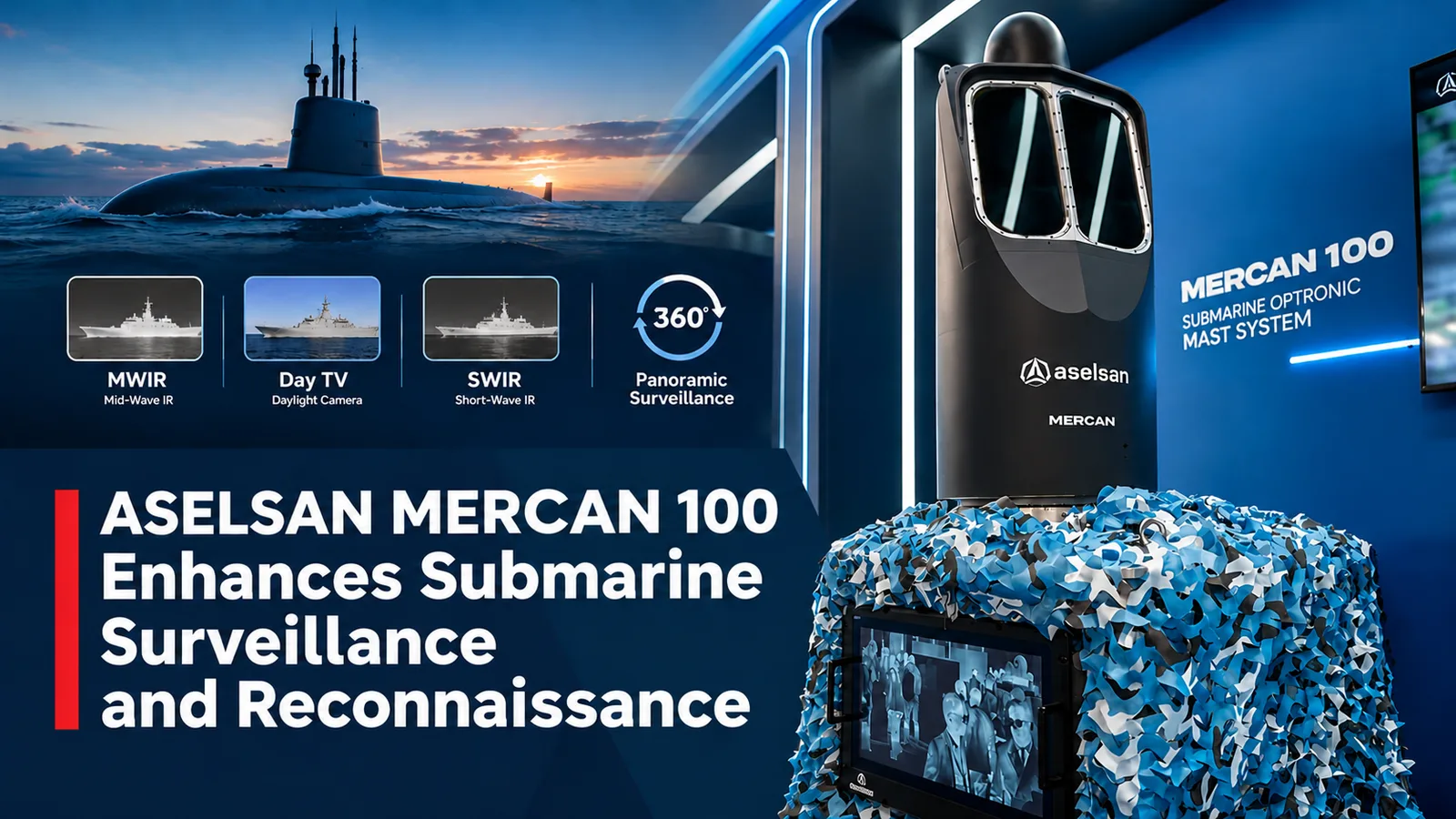
ASELSAN has detailed the capabilities of its MERCAN 100 submarine optronic mast, a multispectral reconnaissance and surveillance system combining mid-wave infrared (MWIR), short-wave infrared (SWIR) and daylight cameras with panoramic observation and rangefinding. The company’s specifications, highlighted in a 5 November 2026 Anadolu Agency report, point to a domestically developed optical sensor architecture intended to support submarine crews near the surface. Its significance lies in potential improvements to target identification and combat-system integration, although the latest disclosure provides no new delivery quantity, acceptance date or contract value.
Why ASELSAN’s MERCAN 100 Matters
The optronic mast is a small but operationally consequential part of a modern submarine. It allows crews to observe surface and air contacts and to collect imagery without relying exclusively on a conventional optical periscope. That information can support navigation, identification and maritime situational awareness, but it is only one element of a submarine’s wider sensor and decision-making architecture.
ASELSAN’s official MERCAN 100 profile identifies a package designed for electro-optical reconnaissance and surveillance rather than a standalone weapon or fire-control system. The new reporting provides useful detail on the imaging channels, scan modes and integration options. It does not establish that every submarine class can adopt the mast without redesign or qualification.
For Türkiye, domestic mast technology also has industrial significance. Maintaining and upgrading complex optronics can create long-term dependence on specialised foreign suppliers. Defence Agenda has previously examined ASELSAN’s naval investment and submarine-integration expansion, which addresses the manufacturing and testing infrastructure needed to support such subsystems. That wider investment should not be treated as a newly announced MERCAN 100 procurement budget.
Three Imaging Channels: MWIR, SWIR and Day TV
MERCAN 100 places mid-wave infrared (MWIR), short-wave infrared (SWIR) and daytime television (Day TV) cameras in a common optronic mast. The purpose of this architecture is to give operators different observation channels under different lighting and environmental conditions. A daylight channel provides conventional optical imagery, while infrared channels can add contrast that is not available from visible light alone.
These channels are complementary rather than interchangeable. The usefulness of each depends on atmospheric transmission, temperature contrast, background conditions, maritime haze and the target itself. Multi-band sensing does not guarantee continuous identification through fog, spray or heavy precipitation. Nor does a camera specification alone establish detection range or classification accuracy; the publicly accessible 5 November material does not provide standardised test curves or target-dependent ranges.
The Anadolu Agency’s English-language report also describes the three-camera configuration. The important capability claim is the ability to collect more than one type of image within the same observation system, not proof that the mast has achieved a particular performance threshold in operational trials.
360-Degree Quick Look Round and Sectoral Surveillance
ASELSAN lists Quick Look Round (QLR) and sectoral scanning among MERCAN 100’s operating modes. The company describes QLR as a rapid panoramic observation function covering 360 degrees around the submarine. Sectoral scanning allows attention to be concentrated on a selected direction or area rather than requiring an equally detailed examination of the entire horizon.
The distinction matters because an underwater platform has limited opportunities to obtain direct optical information from above the surface. A panoramic function can aid the initial survey of the surroundings, while targeted scanning can support closer observation of a contact. However, the public description does not state the time required for a full scan, the refresh rate, or the probability of detecting small targets against a cluttered sea background.
An eye-safe laser rangefinder and optical rangefinding provide additional positioning information once a relevant contact has been found. These features may help an operator correlate visual observations with navigation or tactical data, but they do not independently verify an engagement-grade targeting solution or a weapon-system qualification.
Combat Management Integration and the GPS/ES Interface
The manufacturer identifies an integration option with a combat management system (CMS), potentially enabling the mast’s output to contribute to a submarine’s wider recognised picture. Relevant functions can include the transfer of sensor information and contact observations to the ship’s command system, although the exact messages, protocols and automation level for a particular host submarine are not disclosed.
ASELSAN also specifies a GPS/electronic-support (ES) system antenna in its product material. The presence of that capability should not be confused with a confirmed complete electronic-intelligence or radio-frequency exploitation suite on every customer configuration. Earlier MERCAN family literature has described some options as configuration-dependent, so the integration baseline should be checked against the selected platform and contract.
The technical challenge for an integrator goes beyond connecting a data cable. Mast geometry, power and cooling requirements, environmental hardening, maintainability, electromagnetic compatibility and cybersecurity all affect installation. The latest public reporting confirms design intent and integration options, but does not publish a signed interface-control document or a complete qualification record for a named submarine class.
What the 2026 Disclosure Adds — and What It Does Not
MERCAN 100 is not a product that first appeared on 5 November 2026. Naval News reported on 28 March 2025 that ASELSAN had exhibited both MERCAN 100 and MERCAN 200 at UDT 2025 in Oslo. That coverage also reported a 2024 contract concerning the MERCAN family and Turkish Type 209 submarine modernisation. The public description of that family-level arrangement does not, by itself, establish delivery or acceptance of a specific number of MERCAN 100 units.
ASELSAN’s EURONAVAL 2026 announcement again identified MERCAN 100 within a wider portfolio of deployable naval and electro-optical solutions. The November news therefore expands public discussion of the sensor package rather than proving that a new serial-production programme started that day.
Neither the 5 November report nor the current product profile supplies a confirmed MERCAN 100 contract price, a customer-by-customer delivery schedule, a fleet-wide quantity, independently assessed recognition performance or an in-service acceptance date for this particular configuration. Those are material omissions for procurement analysis and should remain visible in coverage.
Operational Value and Its Limits
A multispectral mast could improve the range of information available to a submarine crew during visual reconnaissance, particularly when one imaging band is less useful than another. It could also simplify the operator’s workflow by bringing scan modes, image channels and ranging functions into a coordinated station. The magnitude of any improvement, however, depends on the host platform and the way the system is used, not simply on the presence of three cameras.
Submarines must balance the value of optical observation against the tactical implications of exposing a mast near the surface. A high-performance sensor does not remove that operating constraint. Bad weather, heavy sea states, obscuration and mechanical or electromagnetic integration issues can reduce the benefits of any advertised sensing capability. The public announcement does not provide operational reliability statistics, sea-trial hours or measured mast-exposure times.
The distinction between optical and acoustic sensing is equally important. MERCAN 100 is not an anti-submarine acoustic sonar. It complements, but does not replace, underwater acoustic systems. Defence Agenda’s coverage of ASELSAN’s broader underwater product portfolio and the AKSUNGUR–aselBUOY submarine detection trial illustrates other parts of the undersea surveillance architecture; neither programme proves a specific integration with MERCAN 100.
Industrial and Procurement Implications
For navies evaluating submarine upgrades, a domestic optronic mast could support longer-term maintenance autonomy and greater control over software, obsolescence management and component replacement. These factors can be as important as the initial purchase price because submarine equipment may remain in service through lengthy modernisation cycles. A credible lifecycle case would nevertheless require data on mean time between failures, test and inspection procedures, spare parts, configuration control and training.
ASELSAN’s expansion into naval electronics provides a plausible industrial backdrop, but it is not proof of a MERCAN 100 export sale or a completed transition to high-rate production. There is no disclosed production ramp, firm export backlog or named new November customer in the reviewed announcement. Any estimate of global addressable market or unit economics would therefore be speculative.
The distinction is also relevant when comparing technologies. A submarine optronic mast handles above-water optical surveillance, whereas Thales’ Australian towed-array sonar expansion concerns acoustic sensing and sustainment. Both fit a broad maritime sensor industrial base, but their functions and qualification pathways differ substantially.
Implications / Next: Watch Integration and Acceptance
The next useful milestones would be public identification of specific host submarines receiving MERCAN 100, completion of installation and environmental qualification, integration testing with the applicable combat management system, and a documented customer-acceptance or service-entry decision. Where ASELSAN or a naval customer identifies a unit quantity or contract value, that information should be compared with the earlier family-level reporting rather than assumed to be a new deal.
Further technical disclosure could also make the system easier to assess: measurement methodology for sensor performance, scan-cycle timing, image-processing options, maintenance requirements and installation interfaces would be more revealing than general descriptions of enhanced situational awareness. Until such evidence is available, the defensible conclusion is narrower: ASELSAN has detailed a domestically developed, multispectral submarine observation system with panoramic scanning and CMS integration options, while programme-specific delivery and qualification data remain unpublished.