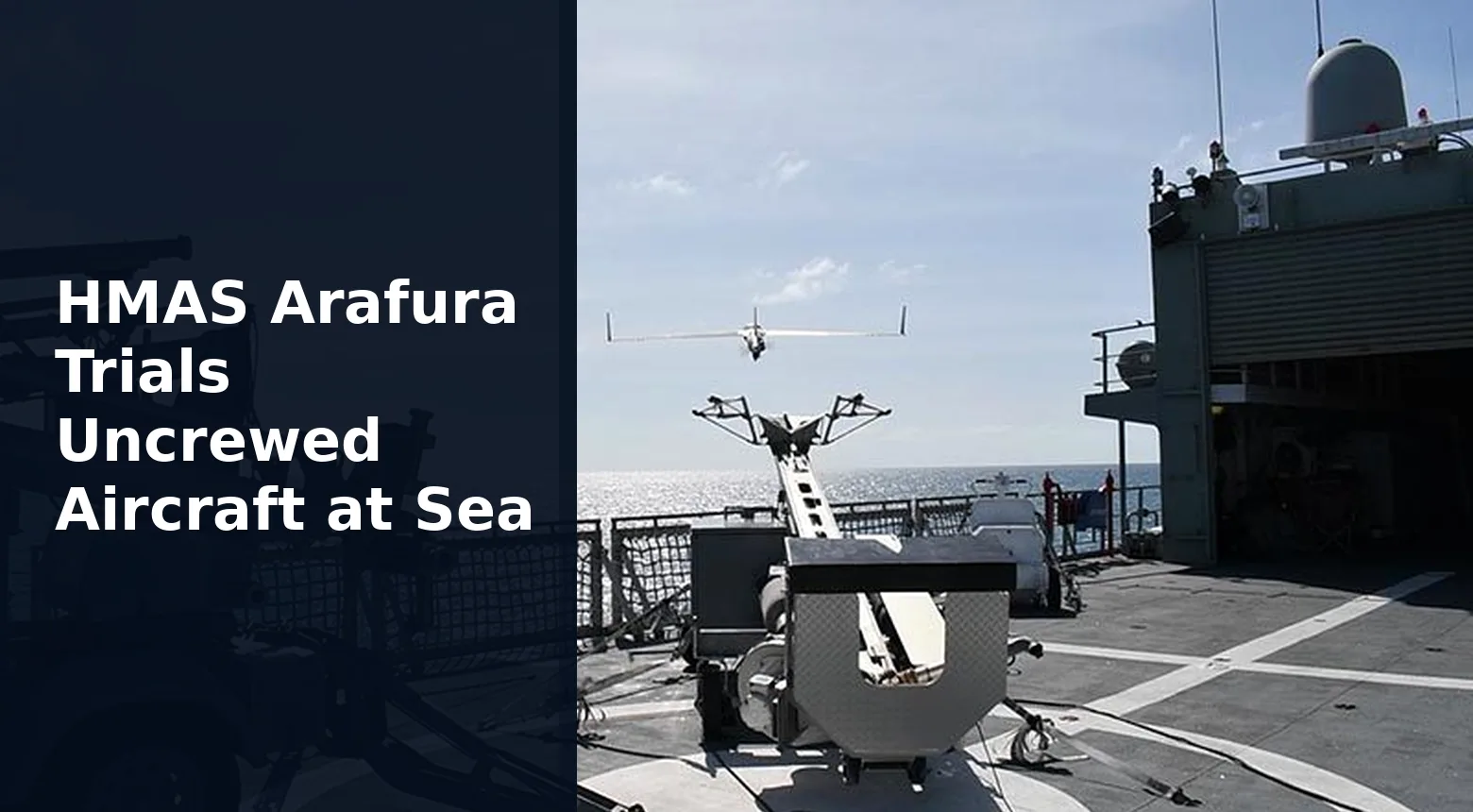
HMAS Arafura has completed Royal Australian Navy trials of remotely piloted aircraft systems in Cockburn Sound, Western Australia, examining surveillance and logistics support from an offshore patrol vessel. The activity is a trial milestone and does not establish fleet-wide fielding or a final production selection. The test addresses how a relatively small patrol ship can extend its sensor reach and move light payloads without a crewed helicopter, while exposing deck-handling, communications and command-system integration requirements.
The Navy tested missions rather than only airworthiness
Operating an RPAS from a ship requires more than proving that the aircraft can fly. Crews must manage launch and recovery, deck safety, datalinks, payload tasking and deconfliction with ship operations. Surveillance and logistics sorties also impose different payload, endurance and handling demands.
Arafura offers a relevant offshore-patrol-vessel test bed
The ship’s patrol role makes persistent observation valuable, but space and aviation support are more constrained than on a frigate or amphibious ship. Compact uncrewed systems can extend the horizon without a conventional hangar-based helicopter detachment. The trial should therefore inform both equipment selection and operating procedures.
Integration will determine operational utility
Video or sensor tracks must reach watchkeepers in a usable form, while logistics payloads need predictable delivery and recovery. Secure communications and electromagnetic compatibility are especially important at sea. A successful flight demonstration does not automatically prove safe operations in higher sea states or contested spectrum.
Australia is building a broader maritime-autonomy pathway
The trial sits alongside Australian investment in uncrewed air, surface and underwater systems. Common control standards and data interfaces could allow ships to operate several vehicle types without creating separate command chains. Procurement decisions should nevertheless follow defined requirements and acceptance evidence.
Programme and procurement context
This development should be assessed through its exact maturity level. HMAS Arafura has completed Royal Australian Navy trials of remotely piloted aircraft systems in Cockburn Sound, Western Australia, examining surveillance and logistics support from an offshore patrol vessel. The activity is a trial milestone and does not establish fleet-wide fielding or a final production selection. Defence and aerospace programmes move through distinct stages including announcement, evaluation, contracting, production, delivery, acceptance and operational fielding. Treating these as interchangeable can overstate near-term capability and industrial certainty.
For programme managers, the central questions are funded scope, schedule, integration responsibility, supportability, workforce and test evidence. The test addresses how a relatively small patrol ship can extend its sensor reach and move light payloads without a crewed helicopter, while exposing deck-handling, communications and command-system integration requirements. Supplier capacity, secure data access and customer training can delay usable capability even after a public milestone. Later primary documentation should replace assumptions with confirmed quantities, obligations and acceptance results.
Independent confirmation is also important because company releases naturally emphasise programme momentum while omitting commercially sensitive limits. Government contract notices, budget documents, test reports and customer acceptance statements provide different parts of the evidence chain. Where those records are absent, values should be labelled as ceilings or reported estimates, performance figures as manufacturer claims, and schedules as targets. This evidence discipline is especially important when several organisations contribute to one system, because a milestone for one supplier may not represent readiness of the complete operational capability.
Implications / Next
Look for the RPAS types involved, sea-state limits, payload results, command-system integration and any follow-on acquisition. No IOC or fleet quantity is yet supported.
The item remains a draft pending final image-rights review, CMS media assignment and canonical publication data. A later report should be treated as a new story only if it materially changes the programme status described here.
Further Reading
Bayraktar KALKAN DİHA Operates From TCG Anadolu
HAVELSAN Unveils AVISTA Underwater R&D Platform