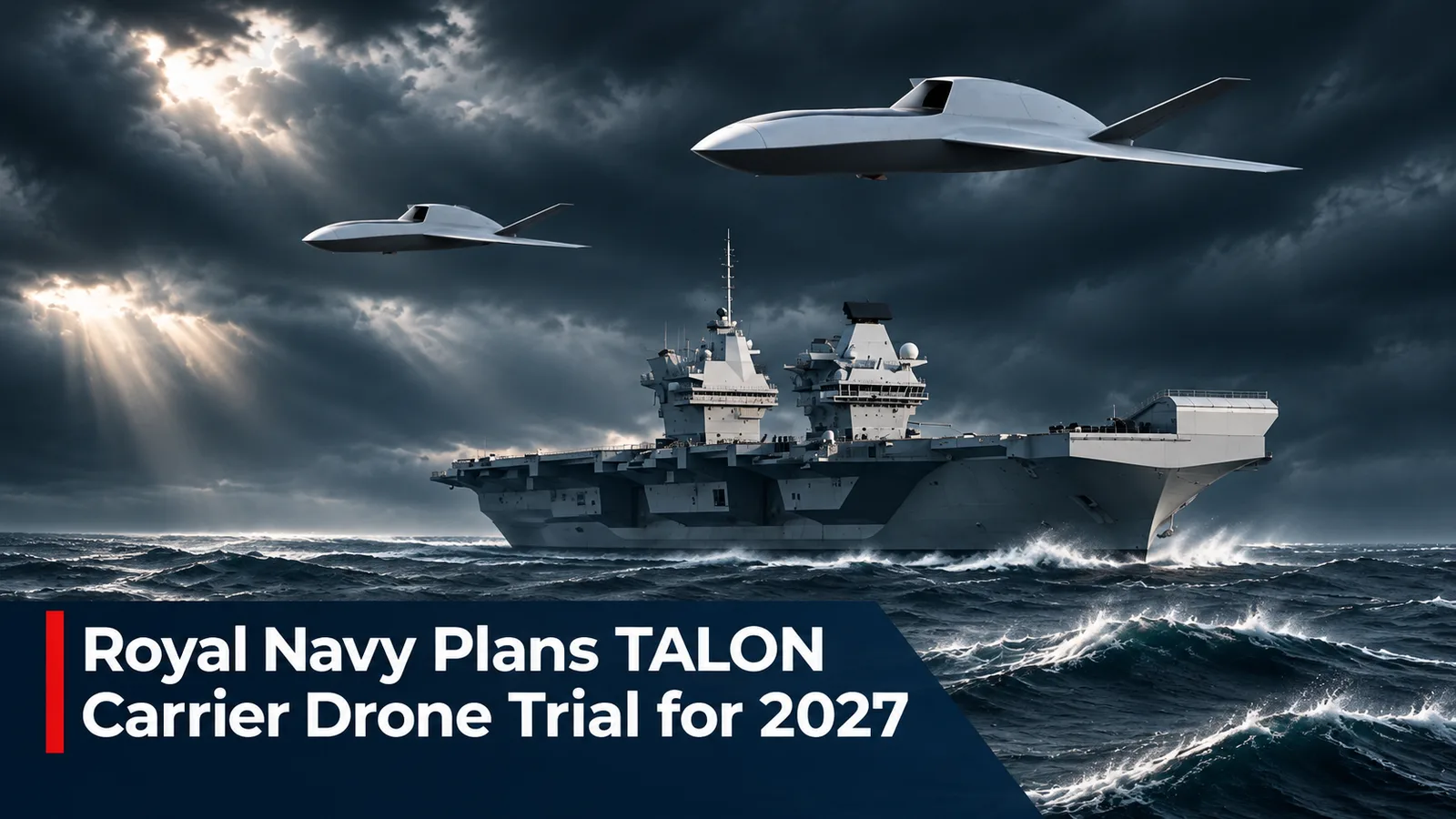
The Royal Navy TALON carrier drone trial is moving towards a 2027 flight demonstration after First Sea Lord General Sir Gwyn Jenkins announced plans to work with Northrop Grumman on its jet-powered YFQ-48A Talon Blue aircraft. Speaking aboard HMS Prince of Wales in Oslo on 10 November 2026, Jenkins said he intended to sign a statement of intent on 12 November under Project VANQUISH, with trials in UK waters including a launch from a Queen Elizabeth-class carrier. The decision matters because it offers Britain a near-term way to examine how autonomous combat aircraft could join an F-35B-led air wing. However, the agreement had not yet been signed and no TALON carrier launch had taken place at the time of the announcement. The official speech sets out the intended sequence.
Royal Navy TALON Carrier Drone Trial: What Was Announced
At the International Sea Power Conference in Oslo, Jenkins identified Northrop Grumman's TALON demonstrator as the candidate for a Royal Navy carrier trial under Project VANQUISH. A physical demonstrator was present at the event, but its presence was not a flight demonstration from HMS Prince of Wales. The First Sea Lord described a statement of intent to be signed on 12 November 2026; reporting on 10 November therefore supports an announced intention, not a completed agreement.
The planned 2027 activity is to be conducted in UK waters and includes a carrier launch. Jenkins said the trials are intended to provide evidence about the safe and effective integration of uncrewed combat aircraft with the carrier's existing F-35B fighters and helicopters. He did not disclose a signed procurement contract, a unit price, a fleet quantity or an operational service-entry date. The 2027 demonstration is accordingly a technical and programme milestone, not an announcement that a combat-ready TALON squadron is about to enter service.
The UK Defence Journal report of 10 November framed the move as Britain's planned Talon carrier test. The official speech provides the stronger primary evidence for the date, participants and stated objective. It is important to preserve the difference between a proposed bilateral statement of intent, any later funding contract and a future military purchase: none is automatically the same as the others.
Project VANQUISH: A Jet-Powered Short-Deck Requirement
The UK's Project VANQUISH market-engagement notice, published on 3 October 2025, set out a requirement for a fixed-wing, short take-off and landing autonomous collaborative platform. It described a jet-powered aircraft capable of high-subsonic flight, carrier embarkation, autonomous operation and credible payload and endurance, with launch and recovery from a Queen Elizabeth-class carrier without catapults or arrested-recovery systems. The target missions were framed as potential future intelligence, surveillance and reconnaissance (ISR), strike and air-to-air refuelling contributions alongside F-35B Lightning aircraft.
Those terms are the programme's published demonstration objectives, not independently established specifications of TALON in naval configuration. In particular, a requirement for an aircraft to recover without arresting gear does not prove Northrop Grumman's demonstrator has already done so at sea. The 10 November speech explicitly refers to a planned launch, while the longer-form VANQUISH requirement includes both launch and recovery. These are distinct verification points that should be measured separately.
The original notice sought information from industry and warned that it was not the launch of a procurement. The programme aims to use technical evidence to shape a prospective collaborative-aircraft capability from the early 2030s. Its initial documentation therefore provides useful context for naval-aircraft requirements but should not be treated as evidence that a specific system was awarded the project at that stage.
Why the 2027 Date Matters
The 2025 VANQUISH notice initially gave the end of 2026 as its nominal demonstration target while allowing delivery options extending beyond that window. Jenkins's 10 November 2026 announcement instead identifies 2027 as the year of the planned UK-waters carrier demonstration. The adjustment is material to the timeline, although the available public information does not establish a specific cause or a contractual delay.
The new target also means several programme steps remain ahead: finalising the intended cooperation, agreeing the demonstration baseline, preparing a naval test configuration, evaluating carrier compatibility and recording the outcome of the trial. Public information does not provide a test calendar, named carrier for the future sortie or an approved operational flight envelope. The fact that Jenkins spoke aboard HMS Prince of Wales does not by itself confirm that this particular ship will host the 2027 launch.
A successful launch would represent an important first milestone, but it would not alone show that the aircraft can safely operate through a complete carrier cycle or deploy in a mixed combat air wing. The project’s technical scope should therefore be assessed against documented results, not inferred from a planning date.
YFQ-48A Talon Blue: US Origins and Development Status
Northrop Grumman describes the YFQ-48A Talon Blue as a company-funded semi-autonomous collaborative combat aircraft intended to operate alongside crewed fighters. The US Air Force assigned the YFQ-48A designation on 22 December 2025, according to its official announcement. That designation recognises the design as a CCA prototype within an open and competitive acquisition environment; it does not amount to a production contract or a decision to field the aircraft in the UK.
Northrop Grumman reported a successful first autonomous flight in its third-quarter 2026 investor presentation. That establishes progress in its broader development programme, but an autonomous land-based flight does not demonstrate compatibility with a moving flight deck, maritime weather, deck handling or shipboard mission-control arrangements. The Royal Navy's proposed participation would be a separate evaluation of those naval requirements.
Public product communications emphasise autonomy, modular development and industrial affordability. They do not provide a fully disclosed naval version specification or a certified carrier-launch performance envelope for the proposed British demonstration. Comparing the aircraft with a conventional F-35B on declared capability alone would therefore be premature: the platforms have different design purposes, maturity levels and intended acquisition economics.
The Hybrid Air Wing: Working Alongside F-35B Aircraft
The TALON demonstration sits within the Royal Navy's wider Hybrid Air Wing and Maritime Aviation Transformation (MATX) ambitions. Britain's Queen Elizabeth-class carriers already operate F-35B Lightning II aircraft and helicopters such as Merlin and Wildcat. A future jet-powered uncrewed aircraft could supplement those platforms with additional sensing, endurance, electronic support or other missions, if its performance and interoperability are proven.
The operational value of such a system depends on how it integrates with established flight-deck procedures, aircraft control, mission planning, maintenance and the carrier group's information network. Merely operating an uncrewed aircraft from the deck would not demonstrate the full manned–unmanned teaming concept. Trials need to generate evidence about safe coexistence with the crewed wing and about how reliably the uncrewed aircraft can deliver a defined task.
Defence Agenda previously analysed the broader trend in Aircraft Carrier Drones Reshape Naval Airpower, including US Navy tanker programmes and the Royal Navy's earlier Mojave test. That work helps place TALON in a larger carrier-drone evolution, but a US-developed platform tested at sea under VANQUISH should be judged against Britain's particular requirements rather than equated with other programmes.
Earlier Royal Navy Carrier Drone Trials Are Not TALON Tests
The Royal Navy has already taken practical steps towards mixed crewed and uncrewed carrier aviation. On 5 November 2026, the service announced that British-built Nyan Maritime one-way strike drones had been launched from HMS Queen Elizabeth during North Atlantic trials in mid-October. A Tekever AR5 also participated in separate carrier activity, demonstrating a surveillance and logistics-related role. These were officially reported trials involving different aircraft and objectives.
These results are relevant because they show that the service is incrementally developing procedures and experience with different uncrewed vehicles from large-deck warships. They do not demonstrate that TALON has already flown from a British carrier. Nyan is a smaller one-way effector, while the planned TALON activity centres on a reusable jet-powered collaborative combat aircraft. The integration demands, flight characteristics and desired mission sets are materially different.
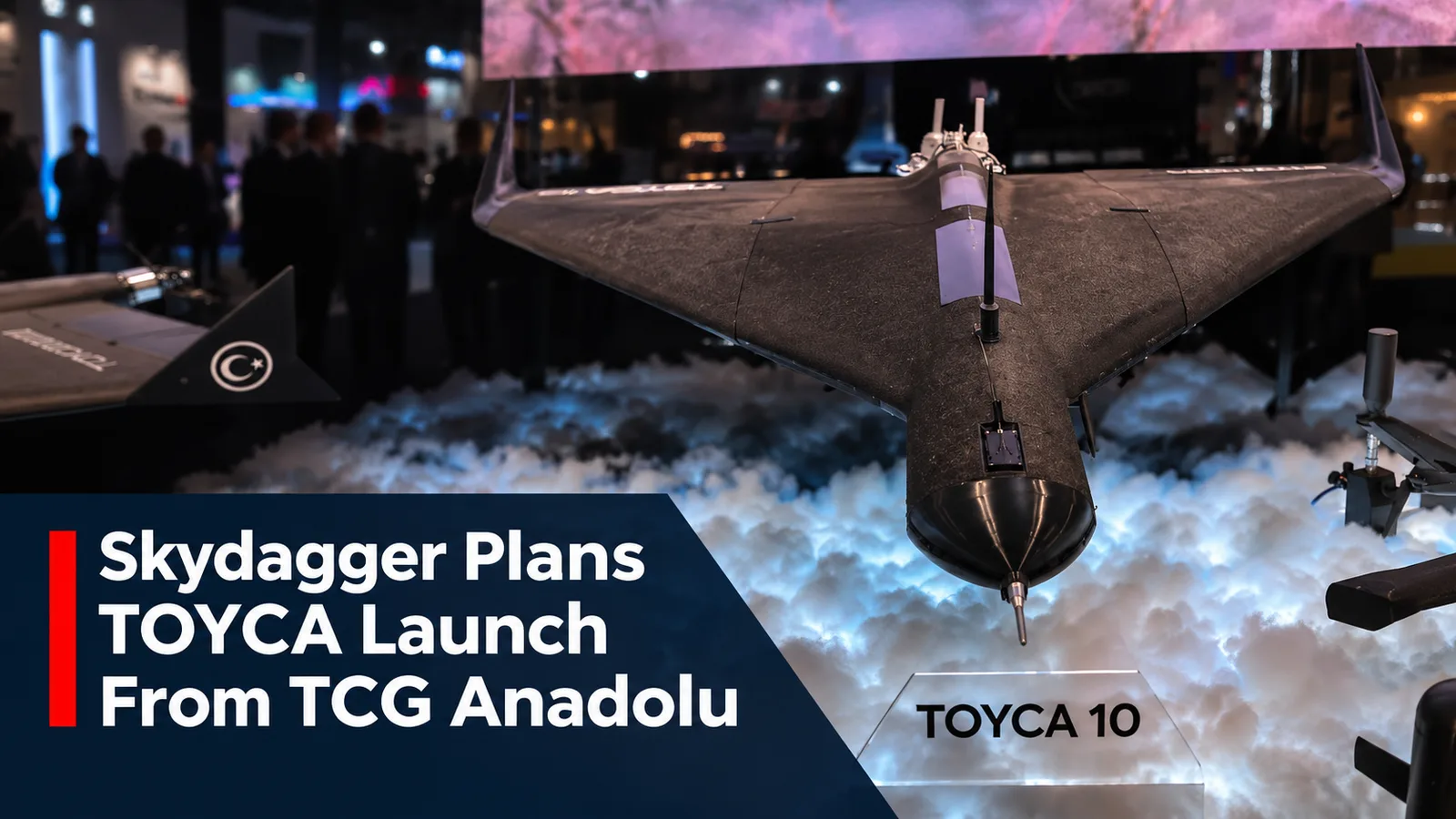
The distinction is also relevant internationally. Türkiye's Bayraktar TB3 operations from TCG Anadolu show a separate short-deck approach to naval UAV operations. That programme provides useful evidence of an alternative carrier-uncrewed-aircraft architecture but should not be mistaken for proof that UK VANQUISH requirements have been satisfied.
Procurement Position: The £10 Million Estimate Is Not a TALON Award
The 2025 UK procurement notice listed an indicative £10 million value excluding VAT for the VANQUISH technical demonstration market-engagement context. It expressly warned that its published dates and values were subject to governance and were not a firm procurement commitment. It therefore would be incorrect to report that Northrop Grumman has won a £10 million TALON contract on the basis of this notice.
Likewise, the UK government's 29 June 2026 announcement of more than £5 billion for drone transformation covers initiatives across the Royal Navy, Royal Air Force and Army. The investment framework includes the wider hybrid carrier-air-wing effort, but it is not a disclosed purchase price for TALON or Project VANQUISH. The Navy separately outlined almost £250 million for Project PANTHEON and related hybrid carrier developments; that aggregate must not be presented as the price of a single demonstrator.
Three different financial stages must therefore remain distinct: an early-stage estimate in a market-engagement notice, broad government investment commitments and any later negotiated agreement for a specific technical demonstration. As of 11 November 2026, the public statements examined here do not provide a confirmed TALON contract value, procurement quantity or production timetable for the Royal Navy.
Integration Risk: From Flight Demonstrator to Naval Capability
The main risk is not whether a jet-powered prototype can fly from a land airfield, but whether it can achieve the maritime demonstration objectives in repeatable, safely managed conditions. Aircraft-carrier operations impose constraints on launch, recovery, aircraft movement, maintenance arrangements and interaction with other embarked aircraft. These aspects must be assessed as a complete operating system rather than isolated flight-performance figures.
Autonomy adds requirements for predictable behaviour, human supervision and integration with safety procedures. The level of autonomy supported by a particular development version does not remove the need for command responsibility or a validated framework for mixed flight operations. The government's programme documents are concerned with demonstrating practical feasibility before committing to future capabilities.
Another constraint is the separation between an attritable demonstrator and an operationally supported aircraft. Production quality, spares, training, software assurance, sustainment cost and mission-system integration all matter to a future purchasing decision. None of those elements has a comprehensive UK service baseline in the public TALON announcement. A successful 2027 sortie could reduce technical uncertainty but would not, on its own, remove programme or procurement risk.
International Comparison: Different Paths to Carrier Airpower
The UK is pursuing a hybrid carrier wing in which F-35Bs remain central while experimental uncrewed systems broaden future mission options. The approach is distinct from the United States' MQ-25 carrier-refuelling model, from Türkiye's smaller-deck TB3 operating concept and from proposed future crewed carrier-aircraft development. Each path involves different deck architectures, operating costs and technical maturity.
Defence Agenda's Naval HÜRJET development coverage illustrates how a crewed jet designed for carrier operations requires its own structural and recovery qualifications. The MUGEM carrier programme similarly shows a STOBAR concept involving arrested recovery. By contrast, VANQUISH's published objective is for a jet-powered uncrewed platform to operate from Queen Elizabeth-class ships without catapults or arresting wires. These architectural differences are central when comparing the programmes.
This does not demonstrate a superior national approach. The UK's proposal trades on adapting an existing carrier platform and leveraging a company-funded prototype; the business and operational benefits still depend on what the 2027 demonstration actually shows. Northrop Grumman's US development progress can lower some technology uncertainty, but naval integration is a new and independently important challenge.
Implications / Next: Milestones for 2027 and Beyond
The most immediate event to verify is whether the 12 November 2026 statement of intent is signed as proposed. Its final wording will matter: a declaration of cooperation is not equivalent to a funded demonstration contract, and subsequent procurement decisions should be reported separately.
The next public milestone is identification of the carrier, test sequence and aircraft configuration for the 2027 demonstration in UK waters. Reporting should distinguish a successful first launch from any recovery, repeated shipboard operation, integration with F-35B mission systems or customer acceptance. Future Royal Navy announcements may reveal the scope of the evidence collected and any later plan for additional trials.
The longer-term question is whether VANQUISH provides enough evidence to support a UK collaborative-aircraft requirement during the early 2030s. That decision will depend on technical performance, affordability, industrial responsibilities and the ability to integrate an uncrewed element into a demanding mixed carrier air wing.
The verified position on 11 November 2026 is therefore precise: the Royal Navy has selected a path towards a TALON demonstration and announced its intention to formalise preparations with Northrop Grumman. The carrier launch remains a 2027 plan, and operational fleet introduction remains a future decision rather than an accomplished fact.