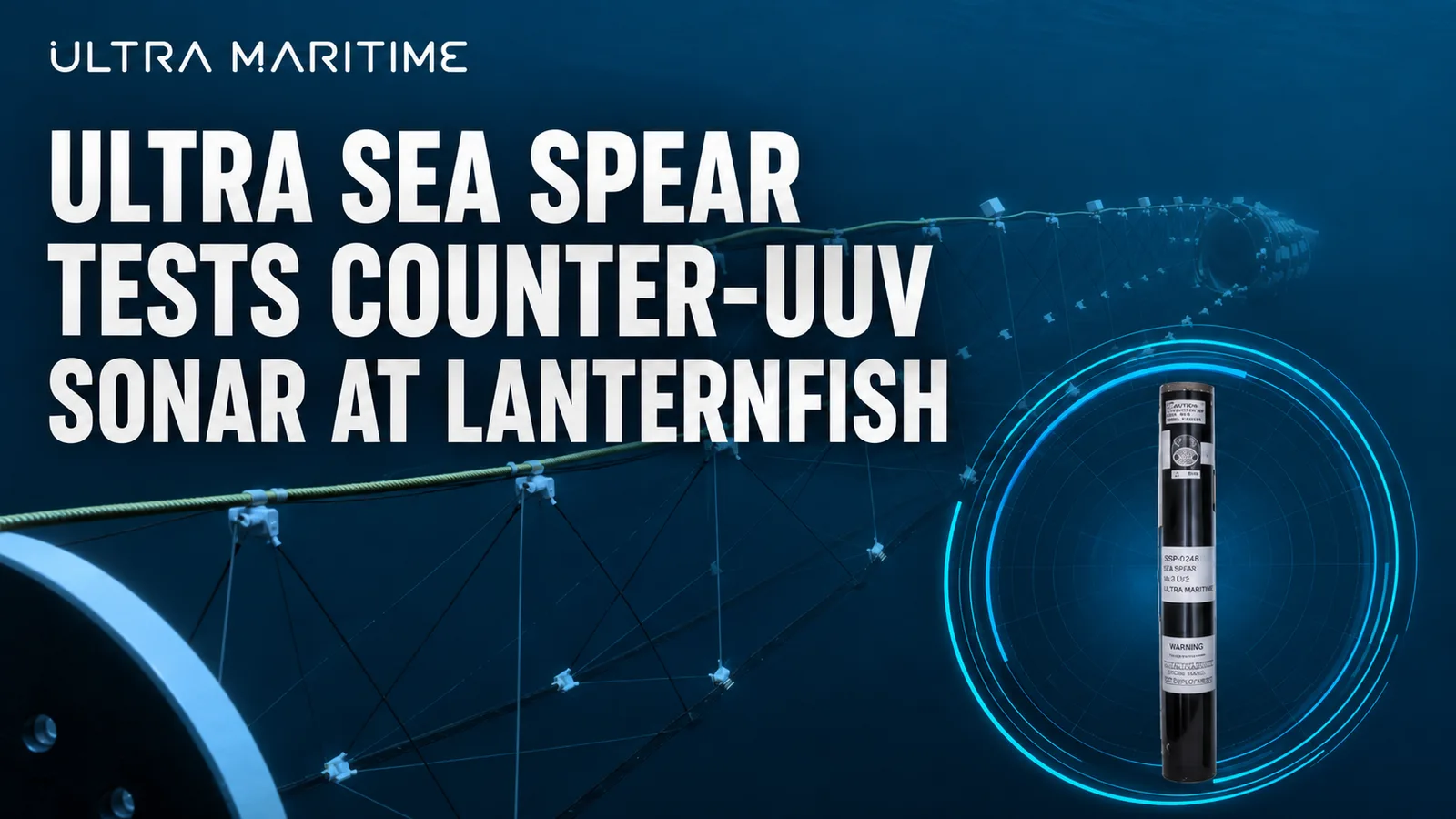
Ultra Maritime Sea Spear has demonstrated an integrated counter-UUV sensing capability during the U.S. Navy’s Lanternfish 2026 exercise, detecting, tracking and classifying medium- and large-diameter uncrewed underwater vehicles while feeding target information into a wider autonomous command network.
The demonstration combined Ultra Maritime’s deployable Sea Spear acoustic array with Anduril’s Seabed Sentry undersea node and Lattice software. The resulting architecture pushed underwater tracks into the U.S. Navy’s command-and-control environment without requiring an operator to manually relay each detection.
The significance extends beyond harbour defence. The same distributed acoustic architecture is being positioned for anti-submarine warfare, critical undersea infrastructure protection and surveillance of strategically important maritime chokepoints, illustrating how conventional ASW and the emerging counter-UUV mission are beginning to converge.
Key Facts
- Exercise: U.S. Navy Lanternfish 2026, a multinational undersea experimentation activity involving Australia, the United Kingdom and the United States.
- Primary sensor: Ultra Maritime Sea Spear deployable acoustic array.
- Demonstrated targets: Medium- and large-diameter uncrewed underwater vehicles.
- Performance demonstrated: Detection, tracking and classification of UUV contacts during a realistic port-protection scenario.
- Integration: Sea Spear fed tracks into Anduril Seabed Sentry and Lattice, which passed the operational picture into the U.S. Navy’s cUxV command-and-control system.
- Automation: Anduril says the detection-to-alert sequence operated without a human manually relaying the contact.
- Wider role: Ultra Maritime is positioning the system for counter-UUV, critical-infrastructure protection and covert distributed anti-submarine warfare.
Ultra Maritime Sea Spear Detects UUV Threats
The core of the Lanternfish demonstration was Sea Spear, Ultra Maritime’s compact deployable sonar array.
Ultra Maritime said on 23 July 2026 that Sea Spear repeatedly detected, tracked and classified medium- and large-diameter UUVs during the exercise at Keyport, Washington.
The system operated in a representative port-protection environment, allowing Navy and industry personnel to evaluate the technology under more operationally relevant conditions than a laboratory sonar test.
No publicly released detection ranges, probability-of-detection figures or acoustic target signatures were provided. Those metrics should therefore not be inferred from the successful demonstration.
What the exercise did establish publicly was that the system could maintain acoustic surveillance and generate usable tracks against representative autonomous underwater threats.
Sea Spear Is Designed as a Deployable Sonar Array
Sea Spear differs from a conventional sonar permanently installed aboard a frigate or submarine.
Ultra Maritime describes Sea Spear as a compact deployable acoustic array intended to provide sensitivity associated with much larger towed-array architectures from a package that can be delivered by crewed or uncrewed platforms.
The company integrates AI-enabled processing at the tactical edge, allowing acoustic information to be processed close to the sensor rather than requiring all raw acoustic data to be transmitted to a distant command centre.
This is particularly relevant underwater, where communications bandwidth is substantially more constrained than in air or surface networks.
Processing the acoustic picture locally allows the system to transmit tracks, classifications and alerts rather than attempting to move continuous high-volume raw sonar data through limited undersea links.
Anduril Seabed Sentry Turns the Sonar Into a Network
The more important development at Lanternfish was therefore integration rather than sonar performance alone.
Sea Spear was paired with Anduril’s Seabed Sentry, a modular autonomous undersea sensor node designed for persistent deployment.
Anduril unveiled Seabed Sentry in April 2025 as a cable-less distributed seabed network capable of carrying different sensors and processing information locally.
The architecture is intended to operate for extended periods and can be deployed across ports, maritime chokepoints, infrastructure corridors or wider ocean areas.
Sea Spear provides the acoustic sensing layer while Seabed Sentry provides deployment, power, communications and network integration.
Lanternfish Demonstrated an Automated Detection-to-Alert Chain
The exercise demonstrated how those components could operate as an end-to-end system.
Anduril’s account of the exercise describes Sea Spear detecting an autonomous underwater contact and passing the resulting track into Seabed Sentry.
Seabed Sentry then published that information into Anduril’s Lattice software platform.
Lattice passed the common operating picture through the U.S. Navy’s cUxV system, allowing operators in the Navy Unmanned Operations Center to view subsea and surface contacts in real time.
According to Anduril, this detection-to-alert sequence did not require a human operator to manually relay the contact between systems.
That automation is potentially as important as the acoustic sensor itself because it shortens the chain between detection and command awareness.
Counter-UUV Is Becoming a New Naval Defence Layer
The requirement reflects the rapid spread of autonomous underwater platforms.
UUVs are increasingly capable of surveillance, mine warfare, reconnaissance, infrastructure inspection and other long-duration missions without placing personnel aboard the platform.
The same characteristics that make them useful to friendly navies also create a defensive problem.
Small electrically powered UUVs can have comparatively limited acoustic signatures and may operate close to the seabed, inside ports or around commercial infrastructure where conventional open-ocean submarine tracking methods are not always optimised.
Defence Agenda previously examined this trend in Autonomous Underwater Systems and Swarming Drones, where the expansion of autonomous underwater fleets was identified as a driver for a parallel counter-AUV warfare requirement.
The U.S. Coast Guard Is Also Looking for Counter-UUV Technology
The emerging requirement extends beyond the U.S. Navy.
On 24 July 2026, the U.S. Coast Guard issued a sources-sought notice for Counter Uncrewed Underwater Vehicle defeat technologies.
The notice states that UUV proliferation creates risks including intelligence collection, surveillance, smuggling, sabotage of critical infrastructure and kinetic attack.
It also makes an important distinction between sensing and defeat.
The Coast Guard says effective UUV detection and tracking technologies already exist, while comparatively few tested and fielded systems are available to complete the defeat or mitigation portion of the kill chain.
Sea Spear addresses the detection and tracking side of that problem. The Lanternfish demonstration did not publicly establish Sea Spear itself as a UUV-neutralisation weapon.
Counter-UUV and ASW Are Beginning to Converge
The technology becomes more strategically significant because Ultra Maritime is not positioning Sea Spear only as a harbour-security sensor.
The company describes the system as applicable to covert anti-submarine warfare as well as broader maritime defence.
The underlying acoustic problem is related: a distributed sensor network must detect, classify and track objects moving through the underwater battlespace.
The targets, however, can vary dramatically in size and behaviour, from large crewed submarines to increasingly capable autonomous vehicles.
A distributed network capable of adapting processing and classification to both categories potentially allows navies to avoid building completely separate surveillance architectures for submarines and UUVs.
Distributed Sonar Changes the Traditional ASW Geometry
Traditional anti-submarine warfare depends heavily on mobile sensors.
Frigates tow sonar arrays, maritime patrol aircraft deploy sonobuoys, helicopters use dipping sonar and submarines perform covert surveillance.
Each capability is effective but requires a platform, crew or expendable sensor inventory to maintain coverage.
Distributed seabed arrays introduce another model.
Rather than continuously moving the sensor toward a potential submarine, a navy can pre-position multiple acoustic nodes across strategically important areas and allow the target to move through the sensing field.
This is particularly attractive around harbour approaches, straits, submarine operating areas and critical infrastructure corridors where geography constrains likely underwater routes.
Sea Spear Can Be Permanent or Attritable
Ultra Maritime says the system can support both permanent and attritable deployment concepts.
A permanent node can contribute persistent surveillance around a fixed high-value location.
An attritable system creates another option: deploying sensors temporarily into a contested area where recovery may not be guaranteed.
That changes the economics of undersea sensing.
High-value crewed platforms can remain further from the most dangerous waters while comparatively lower-cost autonomous platforms place sensors forward.
The operational value therefore depends not only on sonar range but on how cheaply and rapidly a navy can establish a sufficiently dense acoustic network.
Uncrewed Platforms Can Deploy the Sensor Covertly
Ultra Maritime and Anduril have designed the architecture with autonomous deployment in mind.
The companies’ April 2025 partnership envisaged Anduril Dive XL autonomous underwater vehicles carrying Seabed Sentry nodes fitted with Sea Spear into the operating area.
Once deployed, the sensor can process acoustic contacts at the tactical edge while the wider network distributes detections to command systems.
This approach reduces the requirement for a surface ship to remain near each surveillance position.
It also gives commanders the option of repositioning or adding sensors as the tactical situation changes.
Critical Undersea Infrastructure Is a Major Use Case
Lanternfish was closely connected to another rapidly expanding mission: protection of critical undersea infrastructure.
The Royal Navy said on 28 July 2026 that Lanternfish brought together British, Australian and U.S. teams over six weeks in locations across the United States and waters off southwestern Australia.
The activity examined technologies for detecting and investigating threats to undersea infrastructure, with Royal Navy teams operating remotely controlled and autonomous underwater systems alongside U.S. and Australian personnel.
Submarine communications cables, pipelines and offshore energy infrastructure are particularly challenging to protect because they extend across enormous underwater areas.
Defence Agenda’s analysis of Threats to Undersea Infrastructure in Seabed Warfare identified persistent autonomous sensing as one of the technologies most likely to reshape this mission.
Lanternfish Is Also an AUKUS Interoperability Testbed
The multinational structure gives the exercise additional relevance to AUKUS Pillar II.
Australia, the United Kingdom and the United States are investing in common undersea autonomy, communications and payload technologies while retaining separate national platform programmes.
The objective is increasingly interoperability rather than forcing all three countries to purchase identical UUVs.
A deployable sensor that can feed information into different command architectures potentially supports that model.
The critical technical question is whether allied platforms can deploy, task and exploit common sensing payloads without building a unique integration architecture for every national vehicle.
The Underwater Kill Chain Still Needs a Defeat Layer
Lanternfish demonstrated a strong sensing and command-and-control chain, but detecting a hostile UUV is not the same as neutralising it.
Once a contact is detected and classified, commanders still need an appropriate response.
That could involve a crewed platform, another UUV, an explosive ordnance disposal system or a future dedicated autonomous interceptor, depending on the threat and operating environment.
This distinction matters particularly around civilian infrastructure and ports, where uncontrolled underwater weapons effects could create additional risk.
The U.S. Coast Guard’s current technology search specifically highlights this gap between effective UUV detection and comparatively immature defeat solutions.
AI Processing Is Important but Acoustic Performance Remains Fundamental
AI-enabled processing can help identify patterns in sonar data, classify contacts and reduce the information transmitted back to human operators.
It does not remove the physics of underwater acoustics.
Detection performance remains influenced by target signature, water depth, temperature, salinity, ambient noise, seabed conditions and sensor geometry.
Small UUVs operating in shallow or noisy environments may create a substantially different sensing problem from a large submarine moving through deeper water.
The operational value of Sea Spear will therefore ultimately depend on how reliably it performs across different acoustic environments rather than on one successful exercise alone.
Distributed Sensors Create Their Own Survivability Problem
Persistent seabed networks also introduce vulnerabilities.
Fixed or semi-fixed sensors can potentially be located, avoided, deceived or physically attacked once an adversary understands their deployment pattern.
Communications nodes can also become targets for electronic, cyber or physical disruption.
Scalability and attritability therefore matter because a distributed network needs to tolerate the loss of individual nodes without losing the entire surveillance picture.
A system that can be deployed rapidly from several classes of crewed or uncrewed vehicle is inherently easier to regenerate than a single highly specialised fixed array.
The Architecture Fits the Hybrid-Fleet Model
Sea Spear is part of a wider Ultra Maritime effort to move ASW sensors away from dependence on large crewed combatants.
The company is developing containerised towed sonar for crewed and uncrewed surface vessels, miniaturised sonobuoys for unmanned aircraft and deployable arrays for underwater platforms.
The common logic is that future ASW will consist of more numerous distributed sensing nodes connected to fewer high-value command and engagement platforms.
Defence Agenda has tracked the same transition in USV Technology Drives the Navy’s Hybrid Fleet, where distributed sensors and modular mission payloads increasingly allow autonomous craft to extend the reach of conventional warships.
The Main Opportunity Is Affordable Persistent ASW
The largest strategic opportunity is cost-effective persistence.
A frigate equipped with a high-performance towed array remains an exceptionally valuable ASW asset, but it cannot remain permanently stationed at every harbour approach, cable route or maritime chokepoint.
Distributed autonomous sensors can supplement those platforms by maintaining awareness in areas where continuously deploying a crewed combatant would be inefficient.
When a network detects a contact of interest, higher-value assets can then be directed toward the relevant area.
That creates a tiered ASW architecture: persistent low-footprint sensing for broad coverage, followed by specialised crewed or uncrewed systems for classification, localisation and potential engagement.
The Main Risk Is Demonstration-to-Fleet Transition
Lanternfish validates important elements of the architecture, but it remains a technology demonstration rather than evidence of fleet-wide operational deployment.
Future naval adoption will require reliability over significantly longer deployments, cybersecurity certification, integration with operational combat systems and sustained performance in difficult acoustic environments.
Production cost will also matter.
The argument for distributed sensing becomes much stronger if navies can deploy large numbers of nodes without approaching the cost of the high-value platforms they are intended to supplement.
The attritable model therefore needs to be validated economically as well as technically.
Implications / Next
The first milestone to watch is whether the U.S. Navy moves Sea Spear and Seabed Sentry from Lanternfish experimentation into additional fleet or harbour-protection trials.
The second is counter-UUV defeat integration. The Lanternfish architecture produced automated detection and alerting, but a complete defensive system requires an appropriate effector after classification.
The third is AUKUS integration. Future multinational trials should show whether common deployable sensors can operate through Australian, British and U.S. UUVs and command systems with minimal bespoke engineering.
The fourth is scale. Sea Spear’s strategic value will increase substantially if multiple nodes can cooperate across a wide area while maintaining manageable communications and operator workload.
Finally, navies will need data on performance against a wider target set. Medium- and large-diameter UUV detection is an important result, but smaller vehicles and quieter military submarines create different acoustic challenges.
Conclusion
Ultra Maritime’s Lanternfish demonstration shows how rapidly the boundaries between traditional anti-submarine warfare and counter-UUV defence are disappearing.
Sea Spear supplied the acoustic sensing. Seabed Sentry provided the distributed undersea node. Lattice fused and moved the information. The U.S. Navy’s cUxV architecture delivered the track to military operators.
The result was not simply another sonar trial. It demonstrated an automated sensing chain in which an underwater contact could move from acoustic detection to the Navy’s operational picture without a person manually transferring information between each system.
That architecture has direct relevance to ports and critical undersea infrastructure today, while the same technology could eventually support much wider distributed ASW networks.
The next challenge is to prove that the system can scale across larger areas, more difficult acoustic environments and a broader range of targets — and then connect detection to a credible counter-UUV response.
For further Defence Agenda coverage, read Autonomous Underwater Systems and Swarming Drones, Threats to Undersea Infrastructure in Seabed Warfare, REPMUS/Dynamic Messenger 2025 and Underwater Optical Links Unlock Tactical UUV Networks.
Further Reading
- Naval News: Ultra Maritime Tests Integrated ASW and Counter-UUV Sonar System
- Ultra Maritime: Sea Spear Counter-UUV Demonstration at Lanternfish 2026
- Seapower: Anduril Tracks Underwater Threats at Lanternfish
- Royal Navy: AUKUS Allies Test Technology to Protect Critical Seabed Infrastructure
- Defence Agenda: Autonomous Underwater Systems and Swarming Drones
- Defence Agenda: Threats to Undersea Infrastructure in Seabed Warfare
- Defence Agenda: REPMUS/Dynamic Messenger 2025
- Defence Agenda: Underwater Optical Links Unlock Tactical UUV Networks