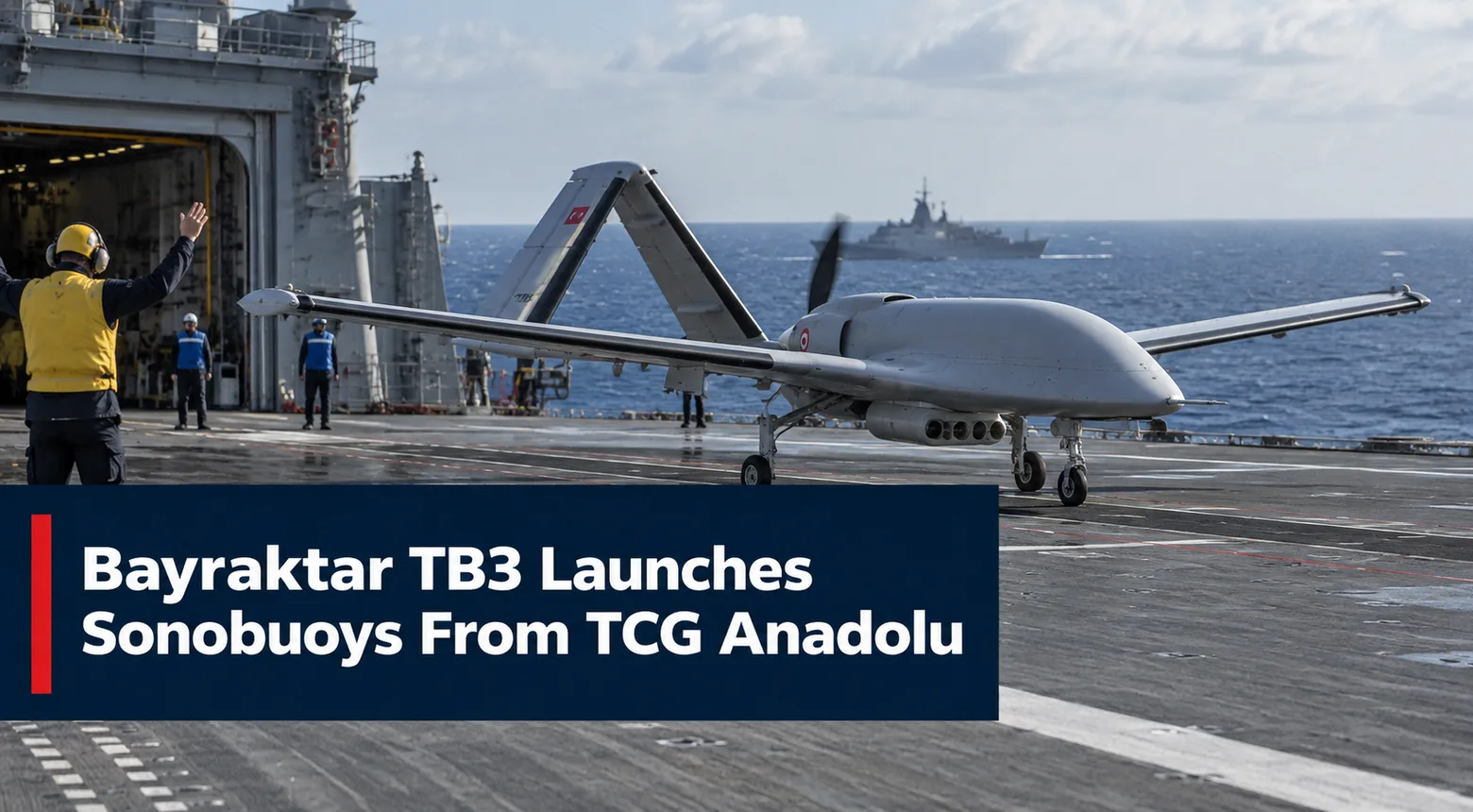
Bayraktar TB3 launched two sonobuoys from TCG Anadolu during Denizkurdu-I/2026 using Baykar’s SAS POD and operated alongside a maritime patrol aircraft. Baykar says the aircraft processed underwater-acoustic data during the mission, demonstrating a new unmanned contribution to the anti-submarine warfare sensor chain.
TB3 has demonstrated a new maritime sensing mission
Bayraktar TB3 has launched sonobuoys from TCG Anadolu during Türkiye’s Denizkurdu-I/2026 exercise, extending the carrier-capable uncrewed aircraft into an anti-submarine warfare support role. Baykar said the mission took place in the Eastern Mediterranean on 22 September 2026 and involved the release of two sonobuoys using the company’s Sonobuoy Dispenser System, or SAS POD.
The aircraft also operated alongside a maritime patrol aircraft. Baykar states that TB3 processed underwater information collected from the sonobuoys and displayed the data in real time through an onboard sonobuoy-processing function. Naval Today independently reported the two-sonobuoy release and the cooperative mission profile. The event therefore goes beyond carriage alone and demonstrates at least part of the sensing and data-processing chain.
The important step is distributed ASW from a short deck
Anti-submarine warfare normally depends on a network of ships, maritime patrol aircraft, helicopters, sonobuoys, towed arrays and other acoustic sensors. A short-deck uncrewed aircraft adds a different layer: it can deploy expendable sensors away from the host ship and remain on station to relay or process information without tying up a crewed helicopter for every task.
TCG Anadolu is particularly relevant because it gives TB3 a mobile maritime base. The ship can reposition the air vehicle and its sensor payload closer to the area of interest, while TB3’s endurance can provide persistence beyond the immediate horizon. That does not make the drone a complete submarine-hunting system on its own; its value depends on how well the data is fused with other aircraft, ships and command systems.
Sonobuoy deployment is a test milestone, not operational fielding
Baykar describes the sortie as a successful test during a major naval exercise. That wording should be preserved. Public sources do not provide acoustic detection ranges, probability-of-detection data, sonobuoy types, operational load-out quantities or evidence that Turkish naval units have adopted the configuration as a routine fielded capability.
The next level of maturity would involve repeated exercises, integration into formal ASW tactics, sustainment of the payload and processing system at sea, and evidence that data can be distributed reliably across the naval command network. Those are different milestones from a first successful release and processing demonstration.
The test deepens the TCG Anadolu–TB3 system-of-systems model
TB3 has already demonstrated autonomous short-deck operations from TCG Anadolu, and HAVELSAN has reported bidirectional data exchange between the aircraft and the ship’s ADVENT combat-management architecture. The sonobuoy mission adds another payload and mission type to that evolving system-of-systems model. Instead of treating the UAV as an isolated aircraft, the Turkish Navy can increasingly experiment with it as a remote sensor and effect node connected to the task group.
For industry, the development also expands demand beyond the airframe. Sonobuoy launch hardware, acoustic processing, data links, mission planning and combat-system interfaces all become part of the capability package. That is the industrial significance of the test: a new mission can create a wider chain of integration work even before it becomes an operational requirement.
Programme maturity and verification
For acquisition and programme-management teams, the milestone is most useful when separated from the claims that usually surround it. The confirmed event establishes technical or contractual progress, while production scale, operational availability, unit adoption and future performance still require their own evidence. That distinction keeps the programme baseline stable as new announcements arrive.
Implications / Next
Watch for repeat sonobuoy missions, identification of the acoustic payload family, integration with ADVENT and other naval sensors, and formal Navy acceptance or fielding language. Until then, the Denizkurdu event should be described as a successful capability demonstration from TCG Anadolu.