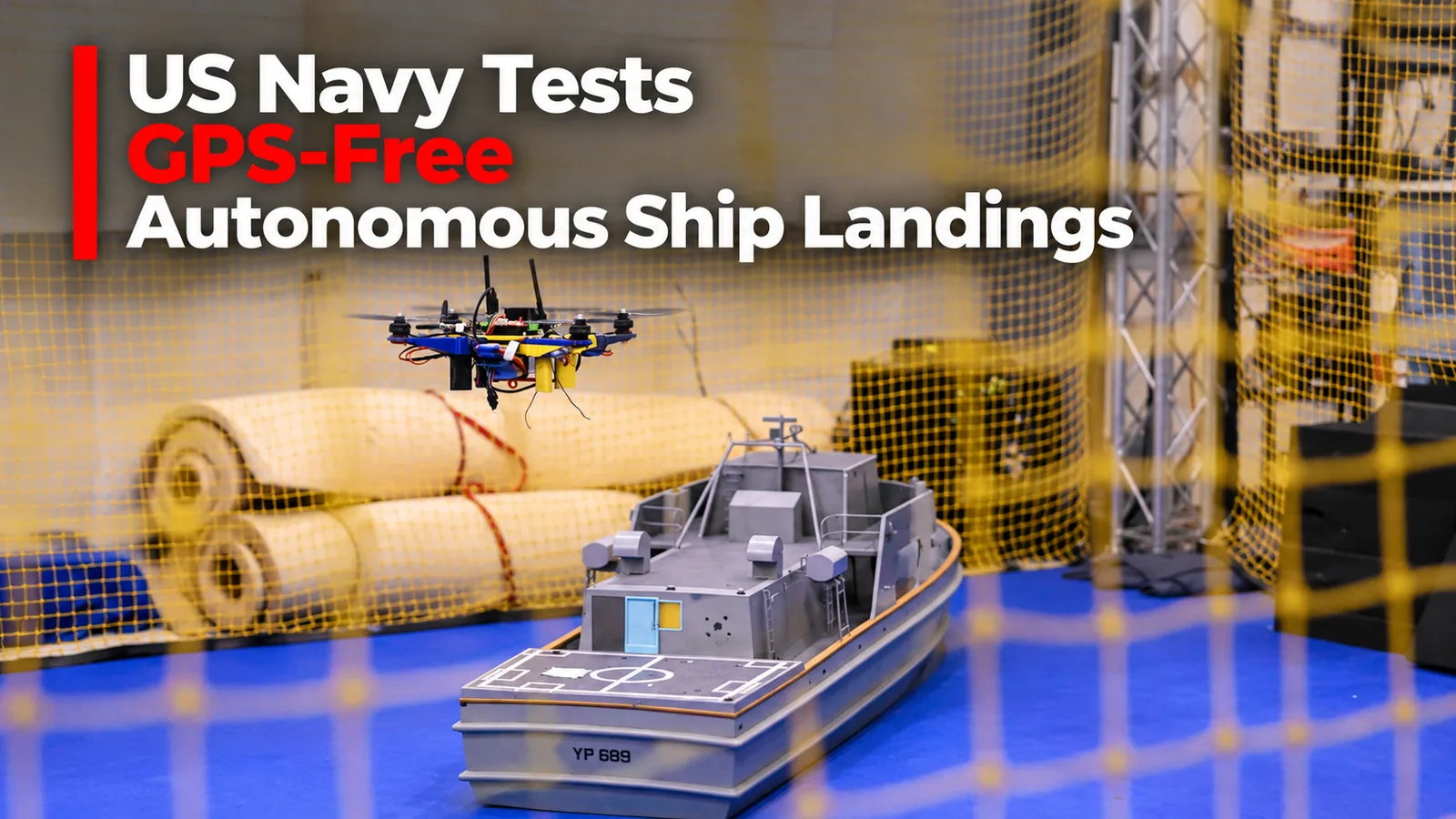
The U.S. Naval Air Warfare Center Aircraft Division reported successful research demonstrations of unmanned aircraft navigating and landing on moving ship platforms without GPS or direct pilot control on 14 October 2026. The results advance visual-navigation and autonomous-recovery technology for contested maritime operations, but the Navy says fleet operational testing remains a next step.
The Research Demonstration Addresses a Maritime Navigation Problem
Shipboard unmanned aviation becomes difficult when satellite navigation is jammed or unavailable and a landing deck is moving in pitch, roll and heave. The Naval Air Warfare Center Aircraft Division, or NAWCAD, says its software uses onboard cameras to identify a ship and visual cues, estimate the platform's relative motion and guide an aircraft towards touchdown. It also predicts deck movement in real time to manage the final landing sequence.
The Navy has described laboratory and flight testing as part of the development route. Published imagery includes an aircraft operating over a scale ship model in a controlled test facility, which is useful evidence of algorithm development but must not be mistaken for a photograph of a full-size warship landing. The service reports that initial demonstrations have been completed and identifies operational testing on fleet platforms as the next maturity gate.
Why GPS Independence Is More Than a Convenience
A satellite-independent landing capability can reduce reliance on vulnerable navigation signals during naval operations close to adversary electronic-warfare systems. Visual relative navigation does not necessarily require the aircraft to know its absolute latitude and longitude with high accuracy at the final landing point. Instead it can estimate position and motion relative to the ship that it must reach.
That does not remove all vulnerabilities. Cameras can be affected by weather, lighting, spray, obscurants and visual clutter, while the underlying flight controls must remain reliable as the deck moves. A complete maritime autonomy architecture also needs safe abort logic, obstacle avoidance, cyber resilience and behaviour for a lost communications link. The public announcement does not supply a quantified performance envelope for those conditions.
A Reusable Software Architecture Could Matter Across Aircraft Classes
NAWCAD says the approach is designed to work across a range of unmanned air-system computers and could scale from small tactical aircraft to larger types. The breadth of that ambition is strategically important because separate, proprietary landing solutions for every vehicle can slow procurement and impose different training and maintenance requirements on fleets. Common methods for deck recognition and relative navigation could simplify future integration if they survive platform-specific qualification.
The Navy identifies possible transition routes involving small tactical unmanned aircraft, collaborative combat aircraft and other research efforts. Those pathways describe prospective adoption opportunities, not announced serial-production quantities or a fixed deployment schedule. The physical landing task becomes more demanding as aircraft mass, rotor or wing configuration, downwash and deck-handling requirements change, so a successful small-aircraft demonstration does not automatically certify a larger vehicle.
The Remaining Test Questions Are Operational, Not Just Algorithmic
For fleet users, the decisive criteria will include repeatable approaches from multiple headings, recoveries in realistic sea states, safe handling around crewed aircraft and integration with ship command systems. Operators also need clear authority to pause or redirect a landing during deck emergencies. A technically autonomous landing manoeuvre does not remove the ship's responsibility for airspace management or the aircraft's software assurance requirements.
Acquisition offices must judge whether the autonomy package can be maintained, upgraded and independently verified over its life. The difference between a laboratory algorithm, a successful controlled sea trial and an approved fleet capability is substantial. The published programme record supports progress through demonstration, while field performance and wider fleet acceptance remain unverified.
Implications / Next
The next meaningful milestones are documented trials on operational vessels, repeated landings in degraded-navigation environments, integration on named airframes and transition decisions by a Navy programme office. If successful, the technology could open more ship classes to uncrewed logistics and reconnaissance missions without demanding continuous remote piloting. The October result is therefore a significant test achievement, not yet a fleet-wide operational capability.