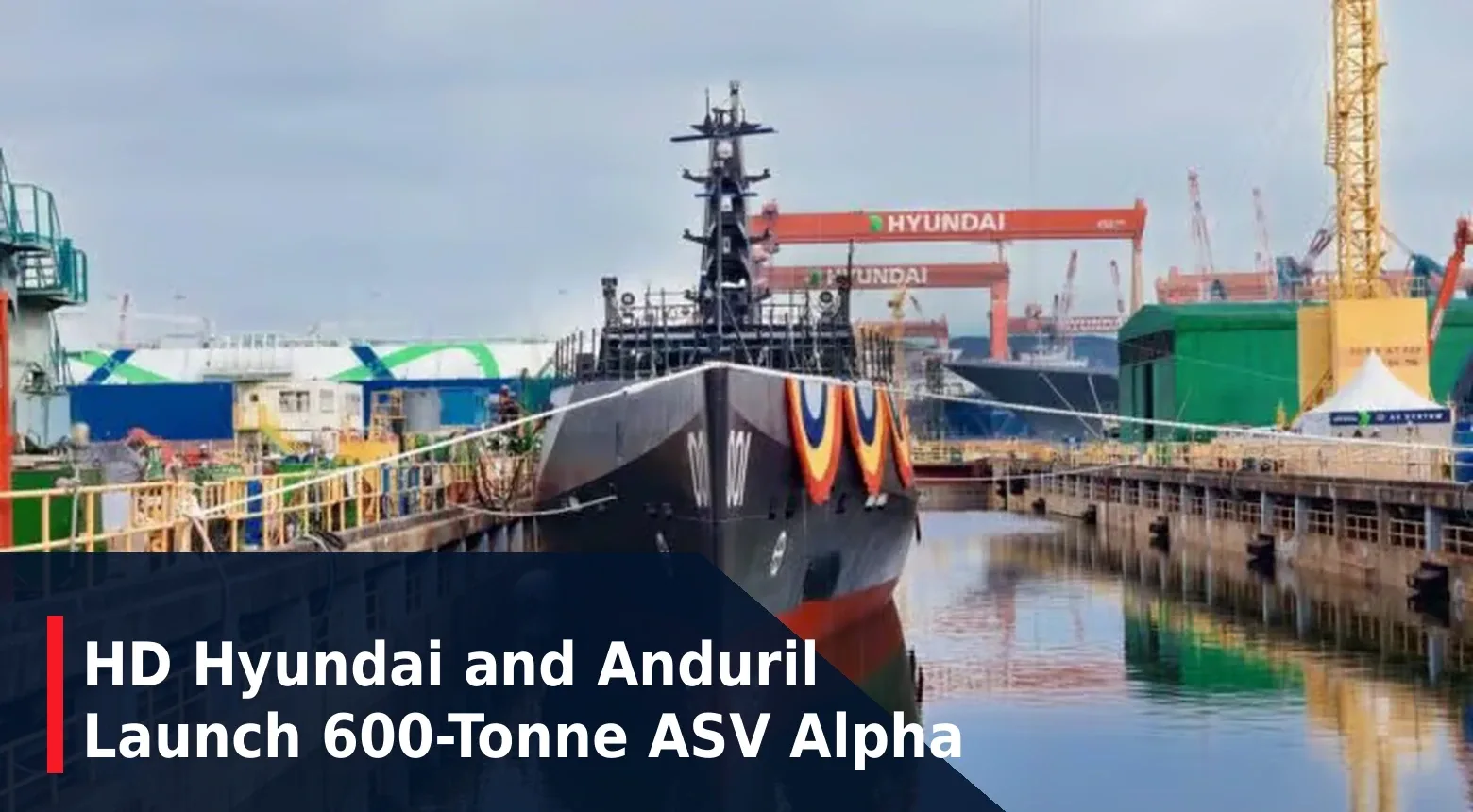
HD Hyundai Heavy Industries and Anduril Industries launched the ASV Alpha unmanned surface vessel at Ulsan, South Korea, on 12 November 2026, unveiling a 600-tonne light-displacement prototype developed roughly one year after the companies began their partnership. The vessel combines HD Hyundai’s VAone ship-autonomy architecture with Anduril’s Lattice mission-management platform. Although it is being positioned for future US Navy requirements, Alpha has not secured a disclosed naval customer or production order. Its next milestone is sea testing in South Korea, followed by further planned trials in the United States in early 2027. The Korean government’s report and Asian Military Review’s 18 November coverage establish the launch and procurement context.
ASV Alpha Combines Ship Autonomy and Mission Software
The 12 November launch took place at HD Hyundai Heavy Industries’ shipyard in Ulsan. The companies had entered into a co-development arrangement in November 2025, making the approximately 12-month period to flotation a central feature of their industrial pitch. The formal announcement was reported on 15 November 2026, with the South Korean government publishing an account on 16 November. Those are separate dates: the vessel entered the water on 12 November, rather than on the date the latest trade-press report appeared.
The hull is described as having a light displacement of approximately 600 tonnes, not a verified full-load displacement. Published images show an austere, low-profile design suited to an unmanned platform. The partners are targeting missions including reconnaissance, surveillance and maritime intelligence collection. Neither a certified maximum speed nor a measured operational endurance has been publicly established in the cited launch disclosures. Claims about mission range, payload performance or an operational weapons fit therefore require additional test evidence.
The core integration task is to make two categories of autonomy work together. VAone, developed within HD Korea Shipbuilding & Offshore Engineering, handles vessel functions such as autonomous navigation, ship-system monitoring and responses to equipment abnormalities. Lattice, developed by Anduril, is intended to provide higher-level mission coordination, information fusion and control of payload-related functions. The distinction is significant: reliable navigation and damage-control automation are not the same as proven mission-level autonomy under contested operating conditions.
The Republic of Korea’s official public information service confirms the VAone–Lattice combination. Naval News adds that the platform is intended to accommodate modular mission equipment, while Asian Military Review describes a multipurpose deck configured for containerised payloads. These are design and integration propositions; the launch itself does not demonstrate that every mission module has been qualified for fleet deployment.
The programme follows a smaller autonomy demonstration near Long Beach, California, in October 2026. According to Yonhap and Naval News, HD Hyundai and Anduril tested the integration of their technology on a modified 368-tonne test vessel. That earlier trial was a software-integration milestone on another hull; it should not be described as a completed sea trial of the newly launched 600-tonne Alpha.
The speed of construction also needs careful interpretation. South Korean reporting attributes the accelerated schedule in part to purchasing long-lead propulsion equipment while design work continued, reducing the time between component selection and ship completion. This may illustrate a repeatable industrial approach, but a one-year prototype build does not yet prove the cost, repeatability or delivery rate of a future multi-vessel production programme. Acceptance trials, reliability data and contracting terms still determine whether the industrial claim can translate into fleet capacity.
The design eliminates the need for crew accommodation in the conventional sense and is intended to provide extended unmanned operations. Nevertheless, the stated absence of an onboard crew does not mean zero human involvement. Remote supervision, maintenance, deployment support and decisions about the use of force remain important elements of an operational system, particularly when autonomous navigation and mission software are combined.
US Navy Procurement, Trials and Programme Risks
The American market provides the rationale for the partnership. On 29 September 2026, the US Navy announced a plan to procure 30 medium unmanned surface vessels following the first phase of its at-sea testing. Production Other Transaction Authority agreements were awarded to Galliano Marine Services, Huntington Ingalls Industries (HII) and Saronic Technologies, each for ten vessels, with an announced average procurement cost of US$40 million per vessel.
HD Hyundai and Anduril were not among those three awardees. The US$40 million average is a figure associated with the Navy’s separate 30-vessel initiative, not an announced unit price for Alpha. Nor does the US Navy release establish an order for Alpha or a commitment to acquire a specific number of Hyundai-built ships. The companies are pursuing future opportunities within a market that is expanding its procurement methods and testing competing designs.
The US Navy’s earlier MUSV marketplace announcement of 29 May 2026 identifies a wider field of competitors and explains the phased testing approach. That competition is relevant because a new entrant must demonstrate more than autonomous steering. It must satisfy requirements for safe navigation, operating reliability, payload integration, maintenance and command links in a military environment.
For the Alpha programme itself, the reported next step is roughly three months of sea trials off Ulsan, followed by further testing in the United States in early 2027. These are scheduled activities, not completed milestones. Sea trials should provide evidence about vessel handling and machinery reliability; US demonstrations are expected to inform the assessment of operational utility and market suitability. No public test results for the new hull had been published by 18 November 2026 in the sources reviewed.
A key risk is the gap between demonstrations and an accepted, scalable fleet. Combining shipboard automation with a separate mission-management stack requires consistent data exchange, dependable behaviour when systems malfunction and clear procedures for human intervention. A modular payload arrangement may offer flexibility, but it also adds interface, power, weight, testing and certification demands. None of those issues is resolved merely by launching the platform.
There is an industrial dimension as well. South Korean yards can bring high-volume construction experience, while US defence procurement introduces domestic manufacturing, security, integration and sustainment requirements. Reporting on the separate HD Hyundai–Kiewit Maritime joint venture raises the possibility of future US-based construction, but no disclosed agreement assigns Alpha production to that shipyard. Such possibilities should be treated as options, not contracted work.
The broader significance is the search for more distributed maritime capacity without proportionally increasing crew requirements. Defence Agenda has previously examined the use of an autonomous Saildrone Surveyor to launch JAGM and the Pentagon’s drone-launching robot-boat challenge. Those programmes follow different technical and acquisition paths, but they show the increasing emphasis on reconfigurable unmanned naval systems. Defence Agenda's account of Türkiye's TUFAN surface vehicle sea debut provides another regional example; it is not a like-for-like performance benchmark for Alpha.
The decisive milestones for HD Hyundai and Anduril will be verified sea-trial performance, successful integration of operational payloads, evidence that the autonomy stack can operate reliably with appropriate human oversight and a competitive procurement decision. Until then, ASV Alpha is a launched prototype with a planned test campaign, not an operational US Navy combatant.
Further Reading
- HD Hyundai and Anduril launch a co-developed USV — Asian Military Review, 18 November 2026
- Korean government: Joint venture with US produces 600-ton autonomous surface vessel — 16 November 2026
- US Navy: 30 Medium Unmanned Surface Vessels procurement announcement — 29 September 2026
- Naval News: HD HHI and Anduril Launch ASV Alpha — 16 November 2026
- Defence Agenda: Saildrone Surveyor Launches JAGM at RIMPAC 2026
- Defence Agenda: Pentagon Seeks Drone-Launching Robot Boats
- Defence Agenda: TUFAN Kamikaze USV Makes First Sea Debut