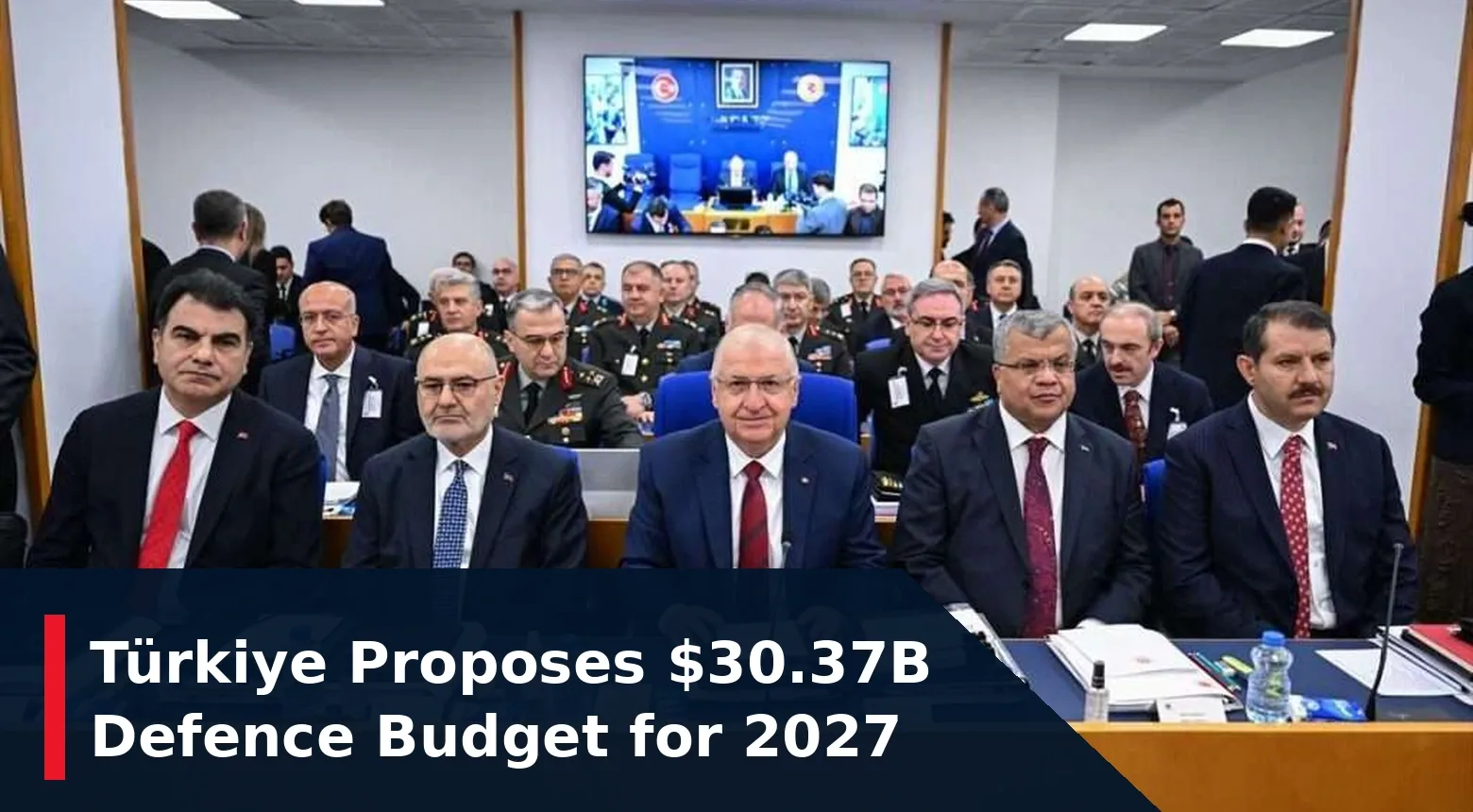
Türkiye’s 2027 defence budget proposal for the Ministry of National Defence has reached TL1,532,647,499,000, equivalent to approximately US$30.37 billion using a 19 November 2026 USD/TRY rate of 50.4695. Defence Minister Yaşar Güler presented the figure to the Grand National Assembly of Türkiye (TBMM) Plan and Budget Commission on 18 November 2026. The proposal represents an 86.24% nominal rise from the ministry’s approved 2026 allocation of TL822.93 billion. It is significant for force readiness, maintenance and defence-industry capacity, but it is a proposed departmental budget—not a final appropriation, a single procurement contract or Türkiye’s total defence and security spending.
Türkiye’s 2027 Defence Budget: Parliamentary Proposal and Dollar Comparison
In his 18 November statement published by the Ministry of National Defence, Güler submitted the 2027 ministry budget proposal alongside the 2025 final accounts. The TBMM’s record of the committee presentation independently documents the amount and the legislative setting. The discussion occurred during scrutiny of the 2027 central government budget bill; it did not mark the enactment of that bill. The proposal may still be affected by the parliamentary budget process.
The dollar conversion is provided for the benefit of international readers, not because the Turkish budget was drawn up in US dollars. Bloomberg HT reported a USD selling rate of TL50.4695 at 09:30 Türkiye time on 19 November 2026. Dividing the proposed TL1,532,647,499,000 by that rate yields US$30,367,796,372, rounded to US$30.37 billion. This is a dated spot-rate equivalent, not a 2027 exchange-rate assumption, a conversion at the budget planners’ own rate or an approved US-dollar appropriation. The equivalent will change when the lira moves.
The comparison with 2026 is similarly precise but requires context. The TBMM’s 2026 budget proceedings identify a ministry allocation of TL822,930,177,000. The difference between the two annual headline figures is TL709,717,322,000, or 86.24% in nominal lira terms. That calculation does not measure purchasing power after inflation and should not be described as an 86.24% increase in real military capability. It also cannot be used to infer identical growth in procurement, personnel or maintenance without a breakdown of the relevant budget lines.
A wider budgetary distinction is essential. The Ministry of National Defence’s departmental request is not interchangeable with the government’s larger defence and security envelope, which can include other public institutions and the Defence Industry Support Fund. The 2027 national budget presentation reported by Anadolu Agency put broader defence and security funding, including the support fund, at approximately TL3.454 trillion. That aggregate has a different coverage and must not be added mechanically to the ministry figure or equated with the $30.37 billion conversion.
Defence Agenda’s earlier report on Türkiye’s 2026 defence and security budget used a broader cross-government allocation rather than the single ministry appropriation under discussion here. Readers comparing the two articles should therefore keep the scope and year of each figure in view. The same principle applies to NATO spending metrics: a national contribution measured under NATO methodology is not necessarily identical to the ministry’s budget-law line. Defence Agenda’s coverage of Türkiye’s NATO spending policy provides the distinct Alliance framework.
Industrial Capacity, Modernisation and Budget Execution Risks
Güler placed the proposal against a security environment characterised by heightened military readiness requirements and wider European defence investment. According to the TBMM account of his remarks, the minister highlighted specially assigned resources for 2026, 2027 and 2028 intended to reinforce serial-production capacity in the defence industry and speed the introduction of urgently required equipment. The statement explains policy priorities; it does not make the entire TL1.533 trillion proposal a dedicated industrial-procurement account.
The ministry also described the continuing role of military factories in repair, overhaul, replacement and domestic manufacture where supplies are difficult to obtain. In maritime programmes, it cited the construction, maintenance and modernisation of nationally developed ships and submarines, including the planned Tepe-class air-defence destroyer. These activities point to potential requirements for manufacturing, engineering, test capacity and lifecycle support. However, no contract-by-contract allocation for the Tepe-class programme or other individual platforms is established by the headline budget figure.
Military aviation adds another layer to expenditure planning. Güler discussed continuing work across combat-air and transport-aircraft acquisition programmes, while procurement, training, infrastructure and sustainment remain distinct spending stages. Defence Agenda has separately reported Turkish pilots’ Eurofighter training preparations in the United Kingdom. Such coverage provides programme context but does not prove that any particular aircraft contract is financed entirely by this ministry proposal. Specific funding instruments, payment schedules and authorised orders must be verified independently.
For suppliers and programme offices, a larger proposed nominal allocation may improve visibility of the state’s intended demand. Yet turning budget authority into fielded capability depends on procurement approval, contracting, financing, qualified labour, long-lead components, domestic supply-chain performance and acceptance testing. Cash expenditure, committed contract value, manufactured hardware and operational readiness are different measures. A significant allocation can support more production capacity without yielding a proportional near-term rise in accepted deliveries.
There is also a competing fiscal interpretation. In a high-inflation environment, substantial nominal growth may partly preserve real purchasing power rather than represent a comparable expansion of capability. Exchange-rate volatility adds uncertainty to imported equipment and components, while domestically sourced systems still depend on materials, electronics, energy and financing costs. Neither the 86.24% nominal increase nor the US$30.37 billion spot conversion is sufficient to calculate an inflation-adjusted or purchasing-power-comparable defence budget. Any such assessment would require an explicit deflator and consistent definitions.
The parliamentary debate also raises questions about transparency and priorities. Members of the TBMM scrutinised the proposed increase, the allocation of resources to equipment and services, and the relationship between ministry spending and separate defence-industry financing mechanisms. This is normal legislative oversight rather than evidence that a specific acquisition has been cancelled or approved. The policy test is whether annual allocations, multi-year commitments and acceptance schedules are sufficiently aligned to maintain operational readiness and avoid production bottlenecks.
Implications / Next: The next verifiable milestone is the outcome of the parliamentary budget process, followed by the final enacted line items and any programme-specific procurement or delivery announcements. Defence Agenda will distinguish the ministry’s approved appropriation from the broader national defence/security envelope and revisit the dollar equivalent only with a stated date and exchange rate. As of 19 November 2026, the established development is a TL1.533 trillion ministry proposal, worth approximately US$30.37 billion at the quoted spot rate, not a completed defence acquisition or a guarantee of future dollar-denominated spending.
Further Reading
- Ministry of National Defence — Güler’s 2027 budget presentation, 18 November 2026
- TBMM — Ministry of National Defence budget commission presentation, 18 November 2026
- TBMM — Minister’s detailed budget remarks, 18 November 2026
- Bloomberg HT — 19 November 2026 USD/TRY quotation
- Defence Agenda — Türkiye’s 2026 defence budget
- Defence Agenda — Türkiye’s NATO defence spending policy
- Defence Agenda — Türkiye’s Eurofighter pilot training