Rosoboronexport presented a portfolio of Russian air-defence systems, uncrewed aircraft and long-range strike products to representatives of the Collective Security Treaty Organization (CSTO) at the International Collective Security Forum in Moscow on 10–11 November 2026. The Russian state arms exporter highlighted a proposed layered ‘Anti-Drone Dome’, the Pantsir-S1M missile-gun system and a loitering munition advertised with a range of up to 1,000 kilometres. The presentation matters for regional defence procurement because Russia is positioning counter-uncrewed-aircraft capabilities and local industrial cooperation as potential offers to partner countries. The published material describes a sales showcase, not a newly concluded weapons contract or independently verified combat test.
Russia's CSTO Showcase: Layered Counter-Drone Defence and UAVs
The forum, held at Moscow's World Trade Center, was part of a broader series of CSTO security meetings during Russia's 2026 chairmanship. The CSTO secretariat confirmed the 10 November ministerial meetings and said delegation leaders participated in the International Forum on Collective Security. It also recorded a plenary session on 10 November. These notices independently establish the setting and dates; they do not independently validate the performance of the equipment being marketed.
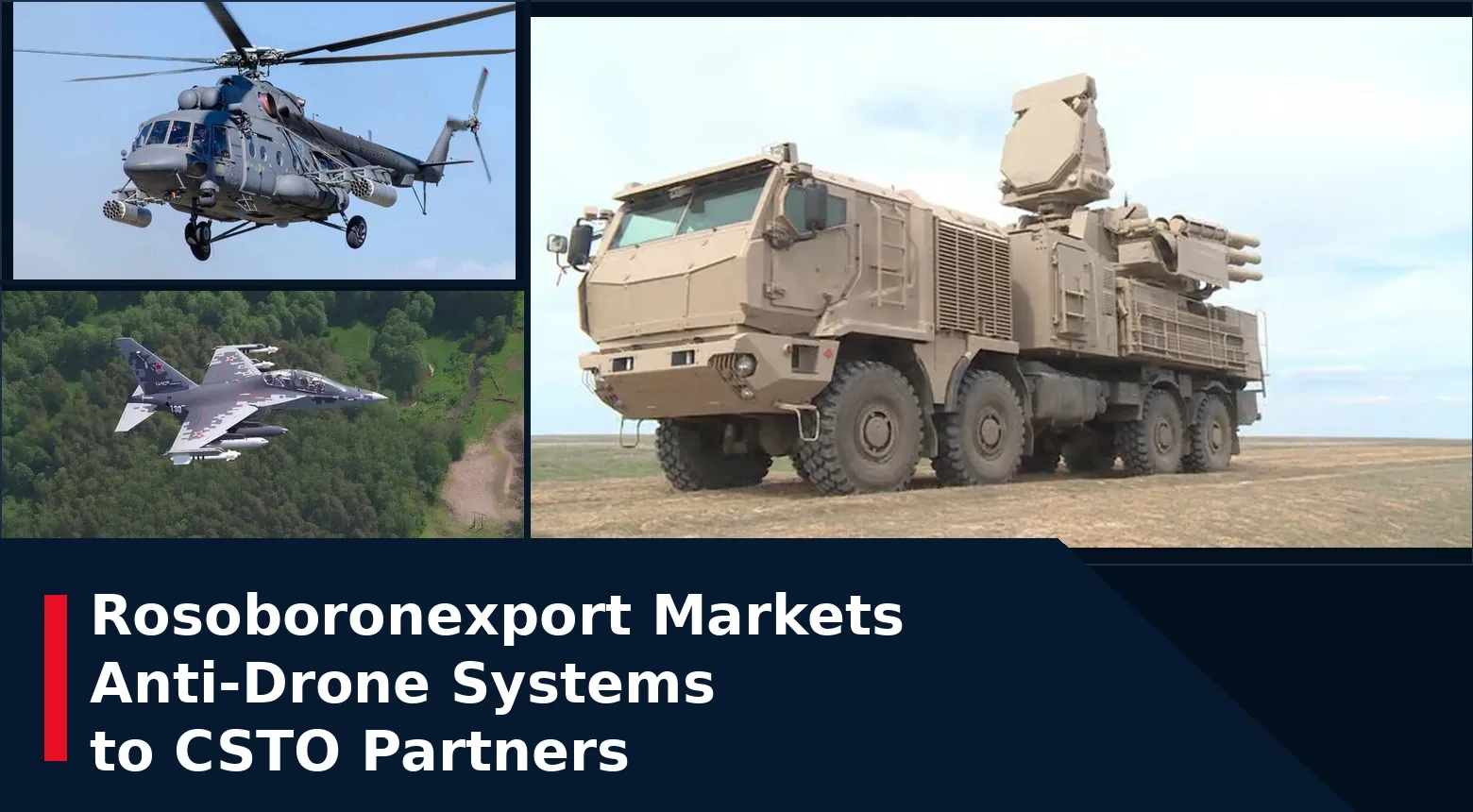
According to Rostec's manufacturer-side announcement, Rosoboronexport's central proposal was an ‘Anti-Drone Dome’ intended to combine different methods of detecting and countering uncrewed aircraft. The company named the Pantsir-S1M short-range anti-aircraft gun/missile system, Citadel anti-aircraft artillery and Silok anti-drone electronic warfare equipment. In acquisition terms, this is a proposed combination of effectors rather than a verified, standardised turnkey architecture with a disclosed command-and-control baseline.
The systems do not all operate in the same way. Missile and gun interceptors physically engage a target, whereas electronic warfare attempts to disrupt the communications or navigation functions on which some uncrewed systems depend. Integrating them can potentially offer different engagement choices across a range of targets. Yet effectiveness depends on detection coverage, identification quality, rules of engagement, electromagnetic conditions, ammunition availability and the UAV's control method. A stand display cannot establish performance against saturation attacks or low-cost autonomous drones.
The Pantsir-S1M named in the current pitch must also be distinguished from the separate Pantsir-SMD-E missile-only configuration discussed in Defence Agenda's earlier coverage of the export SHORAD system. Similar branding across the family does not establish identical weapons, sensors or engagement envelopes. Export customers would need variant-specific technical documentation and acceptance evidence before making a direct comparison.
The long-range segment centred on the Garpiya-A1 (E). Rosoboronexport described the Almaz-Antey product as having a range of up to 1,000 km and characterised it as distinctive in the loitering-munition market. That figure is an exporter's published claim: no independent performance-trial record, payload–range breakdown or customer acceptance document was provided with the forum announcement. A claimed maximum range alone does not establish operational effectiveness, accuracy, survivability or an available production rate.
For tactical reconnaissance and strike, the exhibitor listed Lancet-E, KUB-2-2E and the Skat 350M reconnaissance UAV. The latter was described as paired with KUB-2-2E for a reconnaissance-to-strike package. That association indicates an intended operational concept, but the published forum materials did not specify verified detection-to-engagement times, export prices or a common interoperable battle-management system covering all displayed aircraft. The event also featured small arms, optics and personal-protection products; the Yak-130M combat trainer and Mi-171Sh military transport helicopter were presented digitally, not demonstrated in flight.
| Product or proposal | Publicly described role | Evidence and acquisition limitation |
|---|---|---|
| Anti-Drone Dome | Layered counter-UAV protection of facilities and territory | Supplier proposal; no unified deployed configuration or contract disclosed |
| Pantsir-S1M, Citadel, Silok | Kinetic air defence, artillery and electronic interference | Different effectors; no event-specific comparative intercept data |
| Garpiya-A1 (E) | Long-range loitering munition | Up to 1,000 km stated by exporter; not independently confirmed |
| Lancet-E, KUB-2-2E and Skat 350M | Tactical strike and reconnaissance | Marketed systems; no forum-related delivery announcement |
| Yak-130M and Mi-171Sh | Air-force training/combat support and helicopter transport | Digital presentations rather than live flight demonstrations |
Defence Export Strategy, Constraints and Next Milestones
The event served two linked purposes: to signal the range of Russian technology available to CSTO partners and to open discussions on possible local manufacture of Russian-designed equipment. Rosoboronexport said it would review technical cooperation, existing projects and industrial production opportunities with delegations. However, neither its statement nor the independently accessible CSTO forum records identified a signed new manufacturing licence, a named receiving factory, specific contract quantities or an agreed programme schedule for the systems on show.
That distinction matters because a defence exhibition and a procurement programme have materially different evidentiary thresholds. A model, brochure or digital product presentation can establish a manufacturer's declared capabilities and marketing priorities. A binding order usually requires a named contracting entity, quantity, price or contractual mechanism and an implementation schedule. Operational capability, in turn, requires fielding, integration, training, testing and sustainment evidence. None of those later milestones can be inferred from this forum presentation alone.
A second distinction concerns the purchasing environment. Russia's arms industry continues to operate under sanctions and technology-export restrictions imposed by several jurisdictions following its full-scale invasion of Ukraine in 2022. The European Commission's sanctions overview identifies restrictions on dual-use technologies and selected defence-related trade. The exact legal effect on any prospective CSTO transaction depends on counterparties, components, financing routes and applicable jurisdictions; it cannot be assumed from the existence of a sales display.
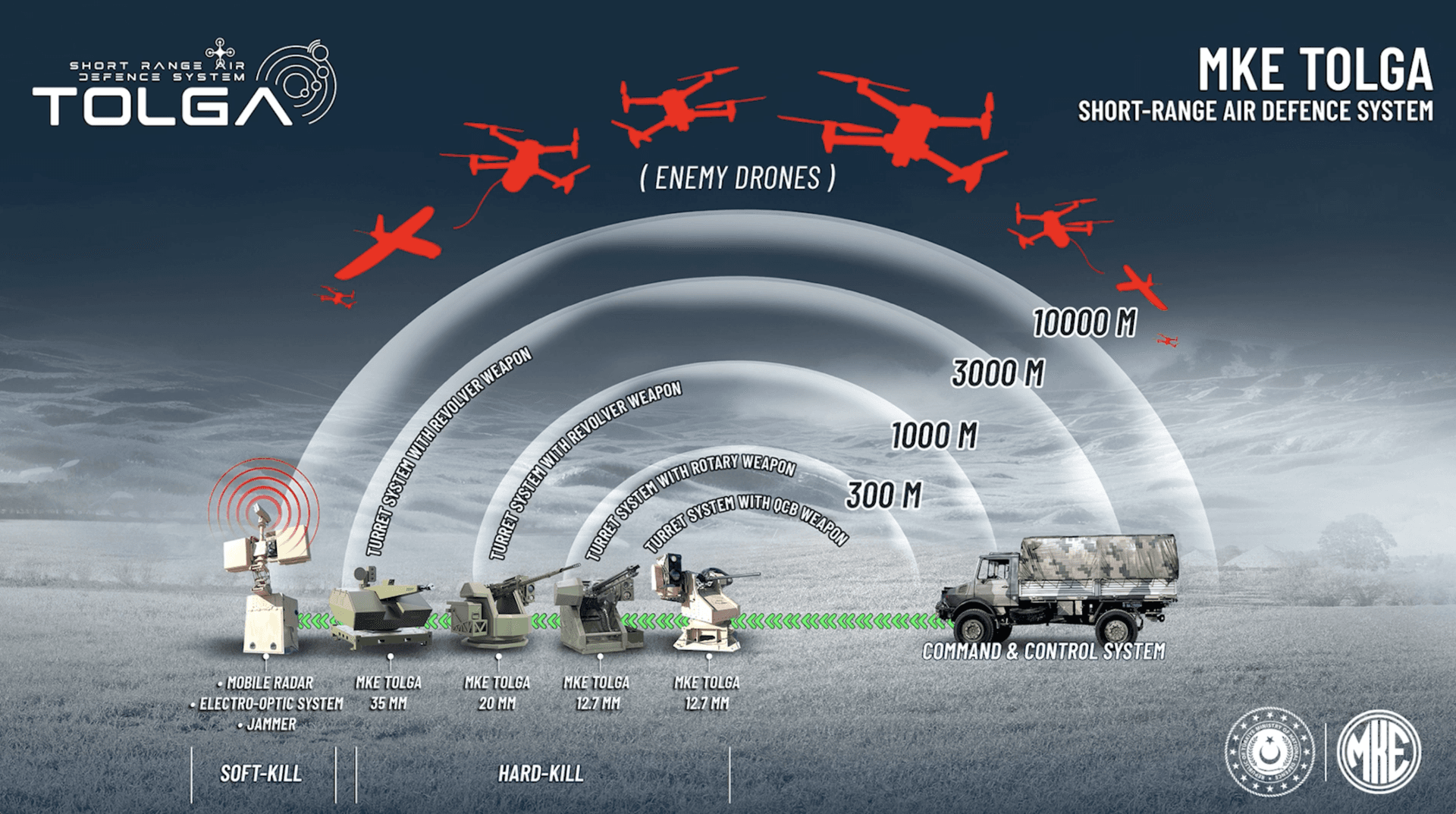
For prospective buyers, the most consequential unanswered questions concern delivery timelines, spare parts, electronics supply, integration with inherited command networks and long-term support. A layered counter-UAV system is only as useful as its ability to assign targets correctly and maintain an adequate mix of effectors under real operating conditions. The relative economics of guns, missiles and electronic warfare also differ according to target type. Defence Agenda's review of Türkiye's KORKUT counter-drone export activity and ASELSAN's KORKUT 35 international demonstration provides examples of how separate suppliers are approaching this requirement, not validated head-to-head performance results against Russian equipment.
Russian forces' evolving use of long-range unmanned strike systems is another relevant background factor. Earlier Defence Agenda reporting on Russian drone-launch infrastructure near Ukraine demonstrates why launching capacity, platform capabilities and operational effects should be considered separately. A manufacturer's range statement is one part of a wider capability chain, not proof of a deliverable end-to-end strike service.
The next observable milestones will be published equipment configurations, named customer agreements, export licensing or local-production arrangements, delivery schedules and — where disclosed — acceptance testing. The 10–11 November 2026 Moscow forum demonstrates Rosoboronexport's priorities in counter-UAV defence, tactical uncrewed aircraft and technology cooperation, but there is no substantiated basis in the reviewed sources to report new CSTO arms sales resulting from the event.
Further Reading
- Rostec — Rosoboronexport's CSTO forum equipment announcement
- Asian Military Review — CSTO export showcase, 12 November 2026
- CSTO Secretariat — Ministerial meetings in Moscow, 10 November 2026
- CSTO Secretariat — International forum plenary, 10 November 2026
- European Commission — Sanctions and export restrictions concerning Russia
- Defence Agenda — Pantsir-SMD-E counter-drone SHORAD
- Defence Agenda — Türkiye's KORKUT counter-drone export activity
- Defence Agenda — ASELSAN KORKUT 35 demonstration