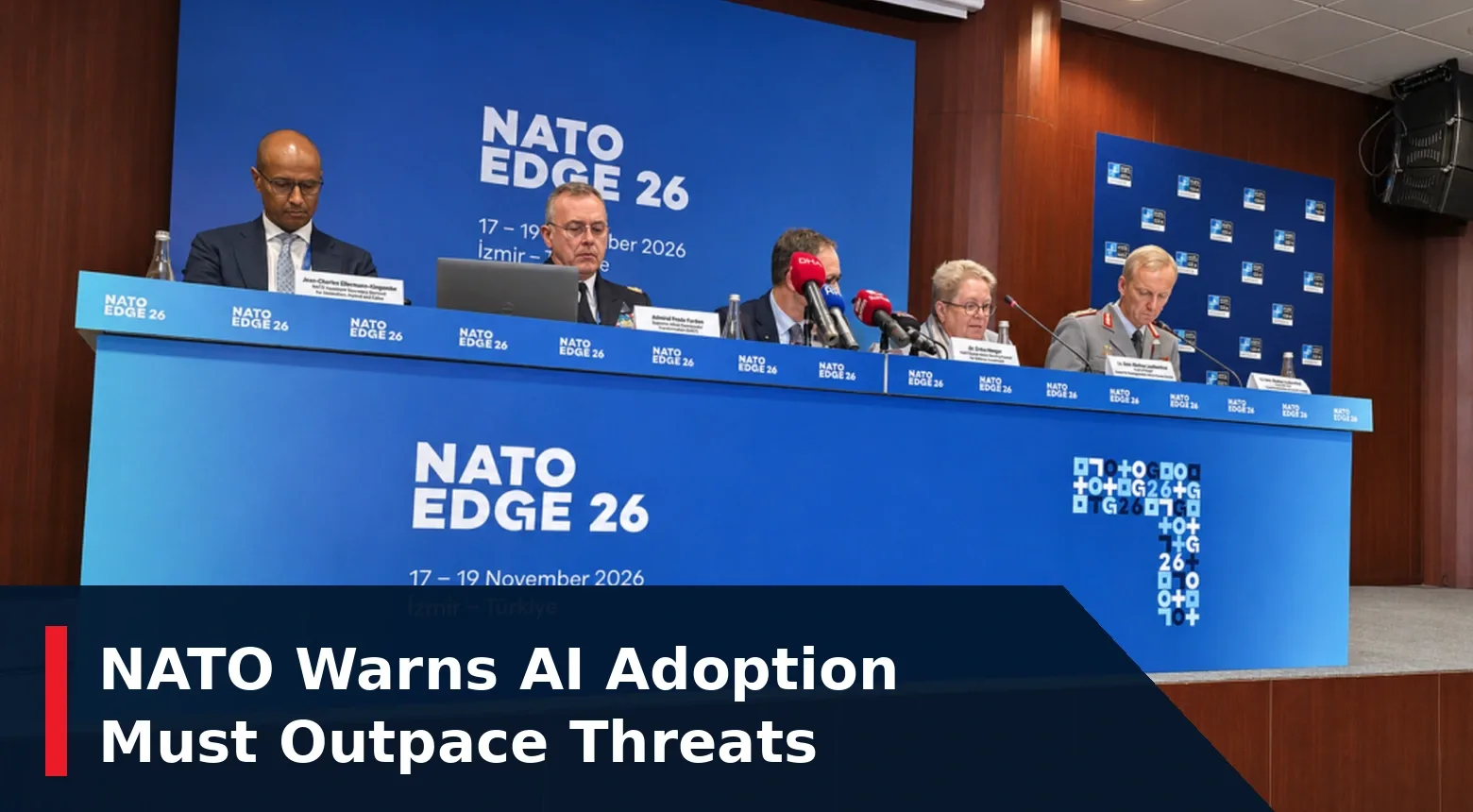
NATO AI adoption has become an urgent military-readiness challenge, senior Allied officials argued during NATO Edge 26 in İzmir, Türkiye, on 17–19 November 2026. Admiral Pierre Vandier, NATO’s Supreme Allied Commander Transformation, warned that the 32-member Alliance must adjust to the pace of technological and battlefield change or risk becoming obsolete. At a press engagement covered by UK Defence Journal, Vandier cited an experiment in which AI agents reportedly reduced a complex system-integration task from roughly six weeks to two hours. That was a commander’s account of a specific demonstration, not a verified NATO-wide performance metric or a new production contract.
NATO Edge 26: A Race to Adapt AI and Allied Networks
Vandier described the challenge in evolutionary terms. NATO must respond simultaneously to rapid changes in how wars are fought and to accelerating developments in artificial intelligence. His “Darwin moment” analogy, reported by UK Defence Journal, frames innovation as an operational problem, rather than as a competition to acquire the most advanced software. Hardware fleets are designed for years of service, while software tools can evolve substantially between programme milestones. The result is a widening gap between procurement planning cycles and the tempo at which digital functionality can change.
The specific integration example involved NATO experimentation in Latvia, where software agents and large language models were reportedly used across different systems supplied by companies participating in a test environment. Vandier said a task that previously took around six weeks could be completed in approximately two hours. The comparison is consequential because interoperability work is often slowed by incompatible data models, separate interfaces and manual integration. However, the available public reporting does not provide a controlled baseline, detailed test protocol, system-security results or independently audited productivity measurements. It should not be extrapolated to operational command networks without further evidence.
The wider message was reinforced by additional reporting from the NATO Edge press engagement. Officials described technical possibilities that NATO already possesses but has not consistently deployed across the Alliance. The decisive question is whether demonstrators can be scaled into supported services that work across national systems, classification boundaries and high-threat environments. Admiral Vandier’s remarks concerned the ability to adapt institutions and processes; they did not announce that every NATO command has adopted the same AI agents, or that previous multinational integration problems have been eliminated.
NATO Edge 26 took place in İzmir between 17 and 19 November, with the NATO Communications and Information Agency (NCIA) organising a programme centred on delivery, readiness, partnership and innovation. The NCIA description of the redesigned event says the format was intended to give suppliers greater insight into capability needs and bring operational users into more direct contact with industry. Türkiye’s Ministry of National Defence separately announced 284 participating technology companies, including 30 domestic firms, before the event. That is a stated attendance figure, not a count of contracts signed or systems fielded.
The NCIA’s event programme announcement pointed to more than €1 billion in prospective NATO procurement opportunities being discussed in business workshops covering cloud, AI, cyber security, space, air command and control and satellite communications. These were upcoming opportunities for industry engagement, not an award to any one provider. NATO’s Assistant Secretary General for Cyber and Digital Transformation, Jean-Charles Ellermann-Kingombe, separately identified slow organisational adoption as a major obstacle, according to press reporting. This distinction between the availability of technology and the rate at which it becomes operational capability is central to understanding the conference.
Military Integration, Procurement and the Limits of AI Speed
NATO’s Alliance Digital Strategy, adopted on 13 January 2026, provides the formal policy framework behind the debate. It calls for a federated digital environment, more interoperable data and network services, better cyber resilience and responsible use of AI. The strategy also envisages AI-supported decision-making at the tactical edge. Policy ambition, however, is different from accreditation of a particular application in a specific operational environment. Systems used for planning or analytics face different assurance questions from software that influences targeting or mission-critical command functions.
The difference matters for procurement and test authorities. Connecting applications in a controlled exercise can validate the feasibility of a workflow; operational acceptance requires repeatable tests, access controls, resilience to communications degradation, interoperability with legacy equipment, cyber assessment and clear responsibility for outputs. AI agents can make software integration faster, but poorly governed automation may also propagate errors, generate misleading conclusions or create a shared dependency on tools that Allies cannot sustain independently. System owners need traceability, human oversight and procedures for recovering from incorrect or unavailable AI outputs.
The NATO Edge agenda also drew on Ukraine’s wartime experience. In its 18 November account, NCIA described how Ukrainian defence and technology representatives discussed adapting capabilities under operational pressure, the use of AI and the need for resilient communications. These lessons are relevant to NATO’s efforts to shorten feedback loops between operators, developers and procurement offices. Still, a country adapting equipment under immediate combat pressure and a multinational Alliance seeking common operational standards face different legal, certification and governance constraints. Those differences affect how fast experimental tools can be deployed.
For industry, the clearest implication is that software-defined capability will require more than a demonstration and a sales presentation. NATO customers will examine whether products can connect to open interfaces, exchange data reliably with other Allied tools, undergo security testing and operate without constant vendor intervention. Earlier engagement through NCIA workshops may improve the precision of requirements and reduce later rework, but it can also expose suppliers to new demands for documentation, export approvals, data assurance, support capacity and intellectual-property clarity. Small technology companies may benefit from greater access while still facing significant qualification costs.
The counterargument to an exclusive focus on speed is that rapid procurement can create avoidable security exposure or vendor lock-in. An impressive two-hour integration demonstration has limited battlefield value if it cannot be replicated on classified infrastructure, updated safely or supported for years. Conversely, excessively rigid acquisition processes may prevent Allied units from benefiting from useful innovations. The workable approach is a staged pathway: rapid experimentation, transparent technical evaluation, controlled pilot deployments and incremental expansion when performance and governance evidence justify it. Such an approach does not assume that either speed or caution is sufficient by itself.
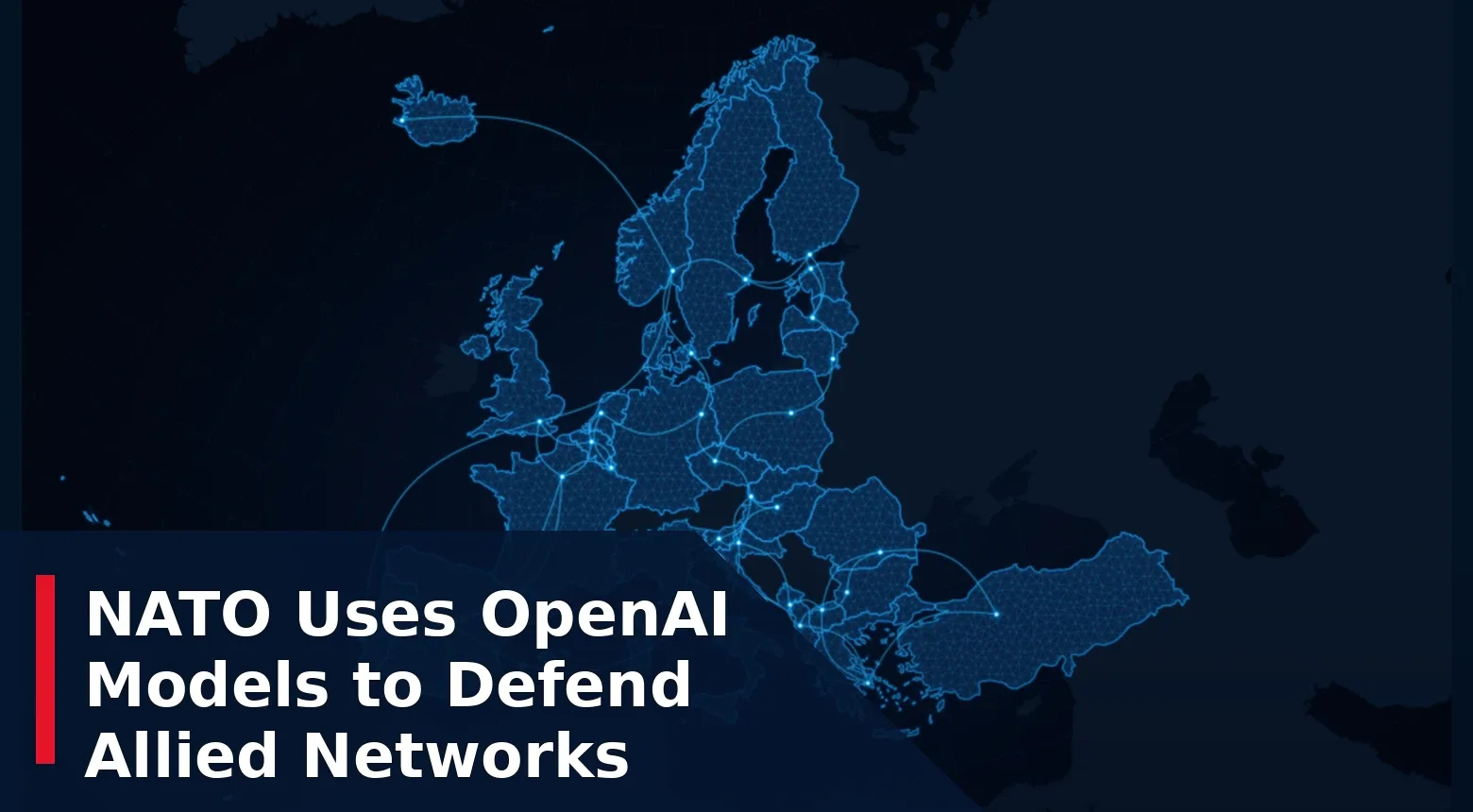
Defence Agenda previously examined NATO Edge’s crisis-ready networks, Shekerinska’s call for government–industry cyber cooperation and the use of OpenAI models in Allied cyber defence. Those developments concern related but distinct programmes and statements. In particular, a cyber-security model deployment does not prove that NATO has fielded the AI integration techniques discussed by Vandier across combat systems. Similarly, the launch of an event or market engagement is not evidence of a completed procurement, a platform delivery or a declared initial operational capability.
Implications / Next: The next verifiable milestones will be published experiment results with clearly defined baselines, security and interoperability evaluations, procurement notices linked to funded requirements, pilot-user acceptance and evidence that AI-enabled workflows remain effective during multinational exercises. Industry should watch whether NCIA and Allied Command Transformation establish repeatable integration interfaces and whether national acquisition authorities recognise common test evidence. As of 19 November 2026, NATO Edge 26 demonstrates leadership demand for faster adoption, but the available public record does not establish a NATO-wide two-hour integration standard, a single new AI procurement award or universal operational deployment.
Further Reading
- UK Defence Journal — NATO leaders warn of slow adaptation (supplied report)
- UK Defence Journal — AI agents now fix in hours what took NATO weeks
- UK Defence Journal — NATO must scale and overcome adoption delays
- NATO — Deputy Secretary General keynote at NATO Edge 26, 17 November 2026
- NATO — Alliance Digital Strategy, 13 January 2026
- NCIA — NATO Edge 26 mission-driven event format
- NCIA — Ukraine shares battlefield lessons at NATO Edge 26
- NCIA — NATO Edge 26 speakers and industry workshops
- Defence Agenda — NATO Edge 2026 crisis-ready networks
- Defence Agenda — NATO calls for cyber defence industry unity
- Defence Agenda — NATO uses OpenAI models to defend Allied networks