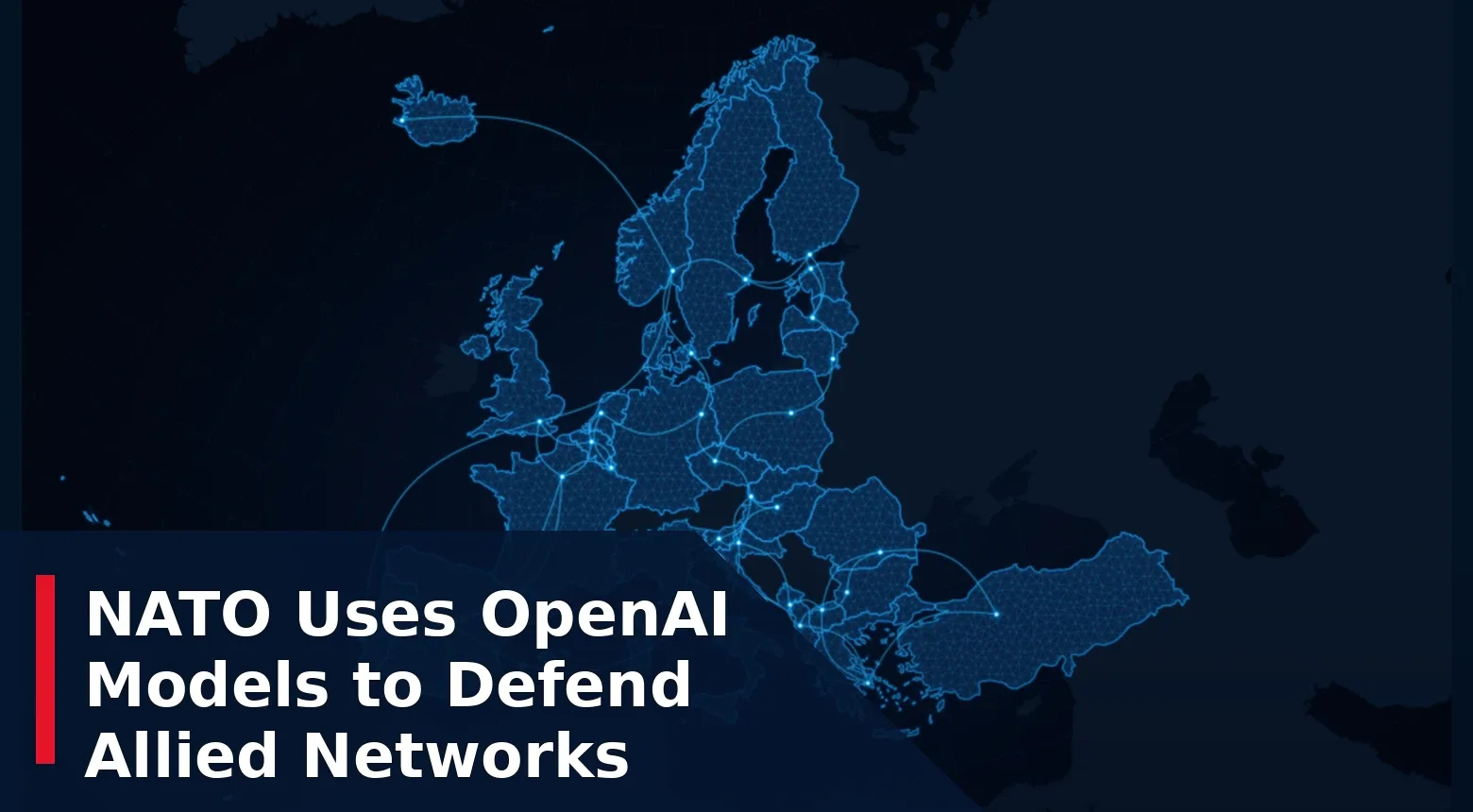
NATO has begun using OpenAI cybersecurity models through its Communications and Information Agency (NCIA) to help protect Allied networks, with reported usage reaching up to 300 billion raw input and output tokens in a month. OpenAI disclosed the collaboration on 17 November 2026, as industry and military officials gathered for NATO Edge 26 in İzmir, Türkiye. The deployment is a significant example of frontier AI entering institutional cyber defence, but the publicly disclosed token count measures AI usage—not thwarted attacks, verified detection accuracy or the value of a procurement contract. The announcement was also covered by UK Defence Journal.
NATO, NCIA and OpenAI Daybreak: What Has Been Disclosed
In its 17 November announcement, OpenAI said it is working with NCIA to give NATO's core institutions access to advanced cybersecurity models through Daybreak, a programme intended for trusted defenders carrying out authorised security work. The stated tasks include reviewing software, investigating suspicious activity, validating suspected vulnerabilities, and developing and testing fixes. These activities belong to defensive cyber engineering and incident response; the announcement does not identify a newly commissioned autonomous offensive cyber operation.
The company reported a monthly usage figure of up to 300 billion tokens, combining raw model input and output. Tokens measure the amount of material processed or generated by AI models. They are not numbers of user accounts, attempted intrusions, detected vulnerabilities or completed defensive actions. OpenAI did not disclose the particular month in which the high-water mark occurred, the number of participating NATO users, the split between input and output, a price per token, or the total spend. It would therefore be unsound to derive a programme contract value or an operational effectiveness rate from the headline figure.
Dr Dylan Browne, General Manager of NCIA, characterised AI-assisted cyber defence as an important improvement in the ability to identify software weaknesses and emerging threats. His comments in the OpenAI release also emphasised the need to understand consumption patterns and the economic implications of competing models before future procurement decisions are made. The comments support a picture of ongoing use and assessment; they do not amount to a disclosed exclusive supplier award or a fully costed multiyear acquisition programme.
NCIA already acts as NATO's technology and cyber-defence delivery agency. Its Cyber Defence overview describes the protection of NATO's digital backbone, while the NATO Cyber Security Centre operates continuously to defend Alliance networks. AI models are being introduced into that existing organisational framework, rather than replacing the agency's security responsibilities, incident-response procedures or established technical teams.
The deployment is also consistent with NATO's Alliance Digital Strategy, adopted on 13 January 2026. That strategy calls for stronger cyber resilience, zero-trust security practices, interoperable information systems and governed data access. The strategy provides policy context, but it does not itself identify the commercial terms, data-handling architecture or security classification of the present OpenAI arrangement.
One operationally important distinction concerns the scope of the network. Public reporting confirms that NATO's core institutions have access to cyber models; it does not establish that those models inspect every classified NATO network or operate autonomously inside every mission system. Data boundaries, information handling, independent evaluation and the authority to implement fixes remain material assurance questions. The availability of a powerful analysis model does not remove the need for controlled change management and human approval.
AI Cyber Defence: Crossed Swords, Allied Agencies and Procurement Risks
OpenAI also reported supporting Crossed Swords 2026, a cyber exercise organised by the NATO Cooperative Cyber Defence Centre of Excellence (CCDCOE). Participants built, deployed and evaluated AI agents in a technical training environment using Daybreak, working alongside human operators. The CCDCOE's own 2026 exercise announcement separately confirms that AI agents were introduced into the exercise workflow. A training demonstration provides evidence of experimentation and skills development, not proof that the same configuration has passed qualification for unsupervised live-network operations across NATO.
The broader adoption effort extends beyond NATO. OpenAI said it has provided access to its cyber models to the European Union Agency for Cybersecurity (ENISA) and national agencies in France, Germany and Poland. It also identified Ukraine's Ministry of Digital Transformation as a Daybreak user working to strengthen the protection of civilian infrastructure. Each agency has its own legal mandate and operating environment; those arrangements should not be treated as components of a single NATO-wide contract.
The company gave several concrete examples of vulnerability work. According to OpenAI, ENISA used its models to identify four software vulnerabilities in systems used across EU institutions, with fixes published for all four. OpenAI also referred to a November 2026 ENISA–CERT-EU assessment of 27 software projects involving multiple frontier models and related tools. In that exercise, maintainers judged 95% of 88 assessed potential issues to be genuine. This is a bounded confirmation rate within a particular set of reviewed findings across models; it is not an independently established NATO detection rate or a claim that OpenAI alone found all those issues.
In another case, CERT Polska used OpenAI models to help identify six vulnerabilities in MikroTik RouterOS, with coordinated disclosure and vendor fixes. OpenAI said Polish researchers directed the research and verified the findings against real systems. This human-led workflow illustrates one plausible strength of AI-assisted analysis: the model can accelerate triage and exploration while specialists remain accountable for validating results and coordinating remediation. The public account does not quantify the exact labour hours saved or establish that equivalent results would occur in every environment.
For NATO programme managers, the adoption raises several industrial and governance questions. Large usage volumes create variable costs and demand careful monitoring of model efficiency. Access arrangements must also account for security boundaries, data retention, traceability, vendor dependence, output quality and the possibility of incorrect recommendations. False positives may waste scarce analyst time; false negatives may leave vulnerabilities unresolved. A model's apparent productivity in a training environment therefore has to be distinguished from measured improvements in real defensive outcomes.
These considerations are especially relevant as NATO separately examines future cyber infrastructure requirements. In October 2026, NCIA undertook pre-competitive market engagement concerning technology for the NATO Integrated Cyber Defence Centre. That notice is a market-research activity, not evidence that OpenAI secured the centre's acquisition or that the two initiatives are contractually identical. Understanding where existing model access ends and future procurement begins will be important for technology suppliers and programme offices.
There is a counterargument to assuming that ever-higher token consumption necessarily signifies stronger cyber protection. Output volume may reflect wider adoption, but without comparable measures of confirmed vulnerabilities, recovery times, quality assurance, cost per validated finding and system availability, it remains an activity metric. Vendors and operators also need to show how AI-generated findings fit within established security controls. The best indicators will combine outcomes with operational safeguards, rather than relying on a single volume statistic.
This distinction matters to defence suppliers outside the AI sector as well. Defence Agenda's report on Quantum Systems' cyberattack examines the operational importance of trusted software distribution and assurance. Its EUCOM vigilance coverage addresses a separate security-awareness initiative. Neither is a reported consequence of NATO's Daybreak use, but both show why cyber resilience spans software, people, suppliers and procedures. The broader technology context is covered in Defence Agenda's assessment of AI-enabled military capabilities.
Implications / Next. The immediate milestones to watch are any independently reported effectiveness benchmarks, clearer information about governance and approved deployment boundaries, and NCIA's future assessment of model costs and alternative products. No purchase value, definitive service-wide deployment count, or specific procurement timetable has been disclosed for this arrangement. As of 17 November 2026, the verified development is that NCIA is enabling NATO institutions to use OpenAI cyber models, with the company reporting a peak monthly consumption of up to 300 billion tokens. The impact on NATO's actual cyber-defence outcomes remains to be assessed using measures beyond usage volume.
Further Reading
- OpenAI — Strengthening NATO and allied cyber defenses with AI, 17 November 2026
- UK Defence Journal — NATO using OpenAI models to defend allied networks, 17 November 2026
- NATO CCDCOE — Crossed Swords exercise and AI agents, 2 November 2026
- NATO — Alliance Digital Strategy, 13 January 2026
- Defence Agenda — Quantum Systems cyberattack
- Defence Agenda — EUCOM vigilance campaign