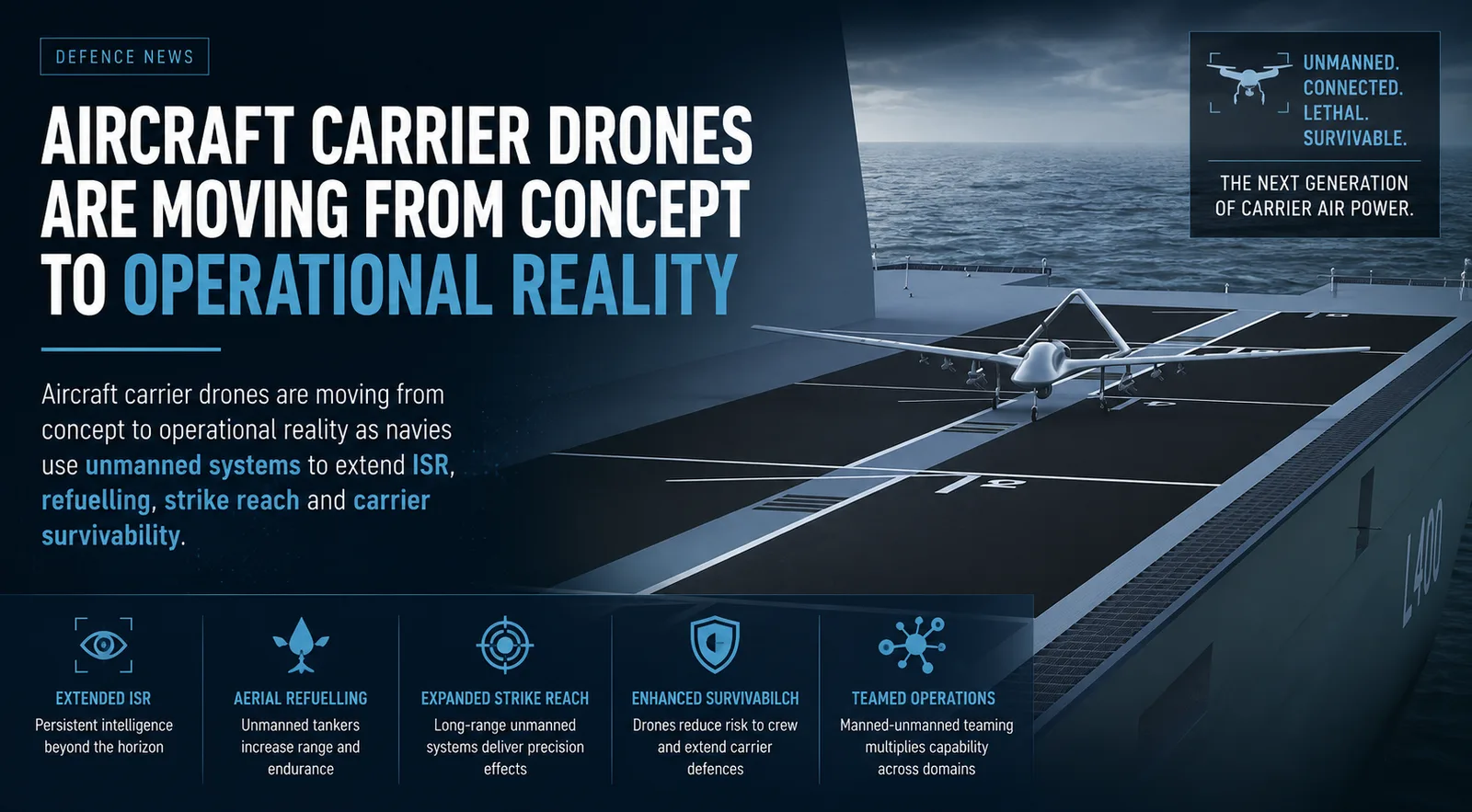
Aircraft carrier drones are becoming central to the future of naval aviation as navies seek longer-range ISR, lower operating costs and more flexible airpower from the sea.
The shift reflects a wider transformation in defence technology. A SAHA Blog analysis argues that aircraft carriers are trying to preserve their strategic role by integrating unmanned aerial systems into carrier operations. The article links this change to ISR demand, pilot-training costs, manned-aircraft sustainment pressure and the rise of autonomous systems.
The core question is no longer whether drones can operate at sea. They already can. The more important question is how quickly carrier strike groups can absorb unmanned aircraft into deck operations, command networks, air-wing planning and combat doctrine.
Aircraft Carrier Drones Address the ISR Gap
Aircraft carriers are mobile air bases. They provide strike, air defence, surveillance and command functions far from national territory. However, modern naval operations require persistent intelligence, surveillance and reconnaissance across wider maritime areas.
Traditional carrier-based ISR depends on crewed aircraft, airborne early warning systems, helicopters and off-board sensors. These assets are powerful, but they are expensive to operate and limited by crew endurance, maintenance cycles and aircraft availability.
Carrier-based UAVs can help close that gap. They can support longer missions, reduce risk to pilots and provide persistent sensing over sea lanes, littoral zones and contested maritime approaches.
MQ-25 Shows the Refuelling Role Comes First
The U.S. Navy’s MQ-25 Stingray shows how aircraft carrier drones may enter service first through support missions rather than strike missions. The Navy describes MQ-25 as the world’s first operational carrier-based unmanned aircraft and says it will provide aerial refuelling and ISR capabilities for the carrier air wing.
This is strategically important. Refuelling extends the range of crewed fighters such as F/A-18E/F Super Hornet and F-35C. It also reduces the need to use strike fighters as tankers, freeing them for combat missions.
In this model, the drone does not replace the crewed air wing. Instead, it increases the reach, tempo and flexibility of the carrier strike group.
X-47B Proved Carrier Autonomy Was Possible
The X-47B was an earlier demonstration of what unmanned carrier aviation could become. Northrop Grumman and the U.S. Navy completed the first arrested landing of a tailless unmanned aircraft aboard an aircraft carrier in 2013.
That milestone mattered because carrier aviation is one of the most demanding environments in aerospace. Aircraft must launch, recover and operate safely on a moving deck under tight time pressure, weather constraints and complex traffic conditions.
The X-47B showed that autonomy could be integrated into this environment. The MQ-25 now takes that concept closer to operational service.
Türkiye’s TB3 and TCG Anadolu Create a Different Model
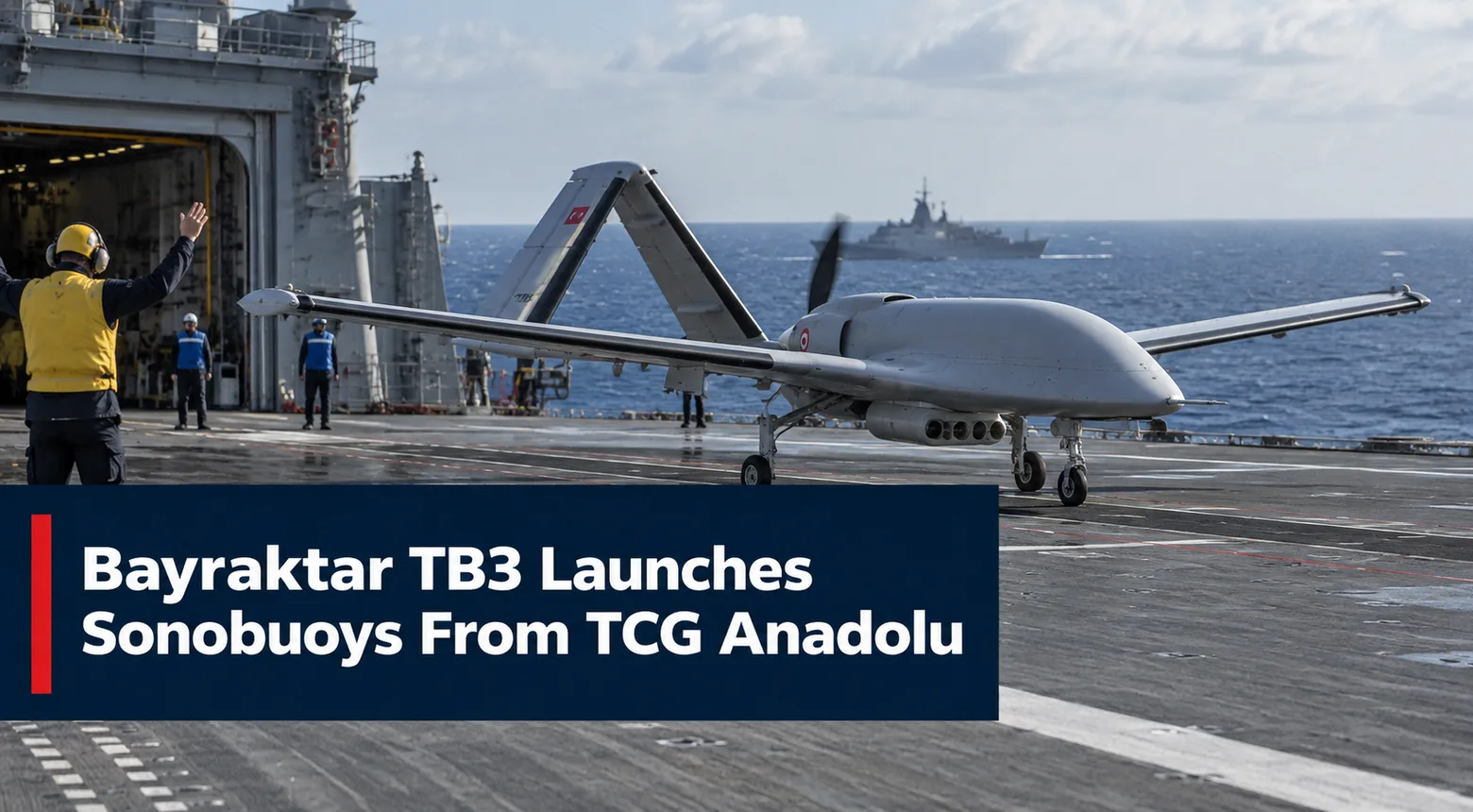
Türkiye is developing a different path through Bayraktar TB3 and TCG Anadolu. Baykar says Bayraktar TB3 completed fully autonomous takeoff and landing tests from the short-runway vessel TCG Anadolu and later continued successful shipboard sorties.
This matters because TCG Anadolu is not a conventional CATOBAR aircraft carrier. It is a short-runway amphibious platform adapted for unmanned aviation. Therefore, the TB3 concept points to a lower-cost way of adding airpower, ISR and strike options to a naval task group.
The strategic logic is clear. A navy that cannot operate a large nuclear aircraft carrier may still field a meaningful unmanned air wing from a smaller deck. That changes the economics of naval airpower.
Royal Navy Trials Point to Carrier Adaptability
The Royal Navy is also experimenting with unmanned systems from its Queen Elizabeth-class carriers. In 2023, a Mojave remotely piloted aircraft took off from and landed back on HMS Prince of Wales during trials off the U.S. East Coast.
The test showed that large-deck carriers can expand beyond fixed-wing crewed fighters and helicopters. It also supported the wider idea that future air wings may include a mix of F-35B aircraft, helicopters, crewless aircraft, autonomous systems and support drones.
For the United Kingdom, this could help increase carrier utility without requiring every additional aircraft to be a high-end crewed fighter.
Cost Pressure Is Driving the Drone Shift
Aircraft carrier drones are attractive because cost pressure is rising across naval aviation. Crewed combat aircraft require long pilot-training pipelines, large maintenance teams, expensive sustainment systems and complex upgrade cycles.
Modern fighters remain essential, but not every mission requires a crewed aircraft. ISR, communications relay, electronic support, decoy operations and refuelling can often be assigned to unmanned aircraft if the technology is mature enough.
This allows the carrier air wing to preserve high-value crewed aircraft for missions where human decision-making, survivability and payload capacity are still decisive.
Unmanned Systems Could Reduce Escort Burden
Carrier strike groups normally require escorts for air defence, anti-submarine warfare, surface protection and logistics. Drones will not remove that requirement. However, they can help improve situational awareness around the carrier and reduce some operational pressure on crewed platforms.
Persistent UAV patrols can widen the surveillance bubble. Unmanned systems can also support early warning, maritime patrol, targeting and communications relay. In a contested environment, that additional sensing layer can give commanders more time to detect threats.
Therefore, the value of aircraft carrier drones is not only strike. Their main early value may be better information, more endurance and a wider operational picture.
The Technical Challenge Is Still Significant
Carrier-based UAV operations are technically demanding. Drones must handle moving decks, crosswinds, ship motion, electromagnetic interference, deck-cycle timing and crowded airspace.
They must also integrate with naval command systems. A carrier drone is not only an aircraft. It is part of a system that includes sensors, datalinks, mission-control stations, launch-and-recovery procedures, weapons integration and safety rules.
This is why autonomy, flight-control software and deck-handling concepts are as important as the aircraft itself.
Drone Carriers Could Change Naval Power Projection
The rise of aircraft carrier drones could create new categories of naval power projection. Large nuclear carriers will remain unmatched for high-intensity operations. However, smaller drone-enabled ships could give more countries access to maritime airpower.
This could be especially important for regional navies. A short-runway vessel operating UAVs may support surveillance, precision strike, maritime patrol and deterrence at a lower cost than a traditional carrier air wing.
As a result, the future naval aviation market may split into several layers: high-end supercarriers, conventional carriers, amphibious UAV carriers, unmanned support ships and distributed drone-launch platforms.
Conclusion
Aircraft carrier drones are reshaping the future of naval airpower. They respond to three pressures at once: the need for persistent ISR, the rising cost of crewed aviation and the operational risk of sending pilots into contested environments.
The U.S. Navy’s MQ-25, Türkiye’s Bayraktar TB3 and TCG Anadolu concept, and the Royal Navy’s Mojave trials show that unmanned carrier aviation is moving beyond theory. The next phase will be about integration, scale and doctrine.
Aircraft carriers are not disappearing. Instead, their air wings are changing. The carrier that survives the next era may be the one that can combine crewed fighters, drones, sensors, electronic warfare and autonomous systems into a single maritime combat network.
For further Defence Agenda coverage, read our naval warfare, drones and air warfare sections. Related analysis includes the UK Storm Fighter CCA programme, wingman aircraft and European rearmament and Bayraktar KIZILELMA’s JET-230 missile test.