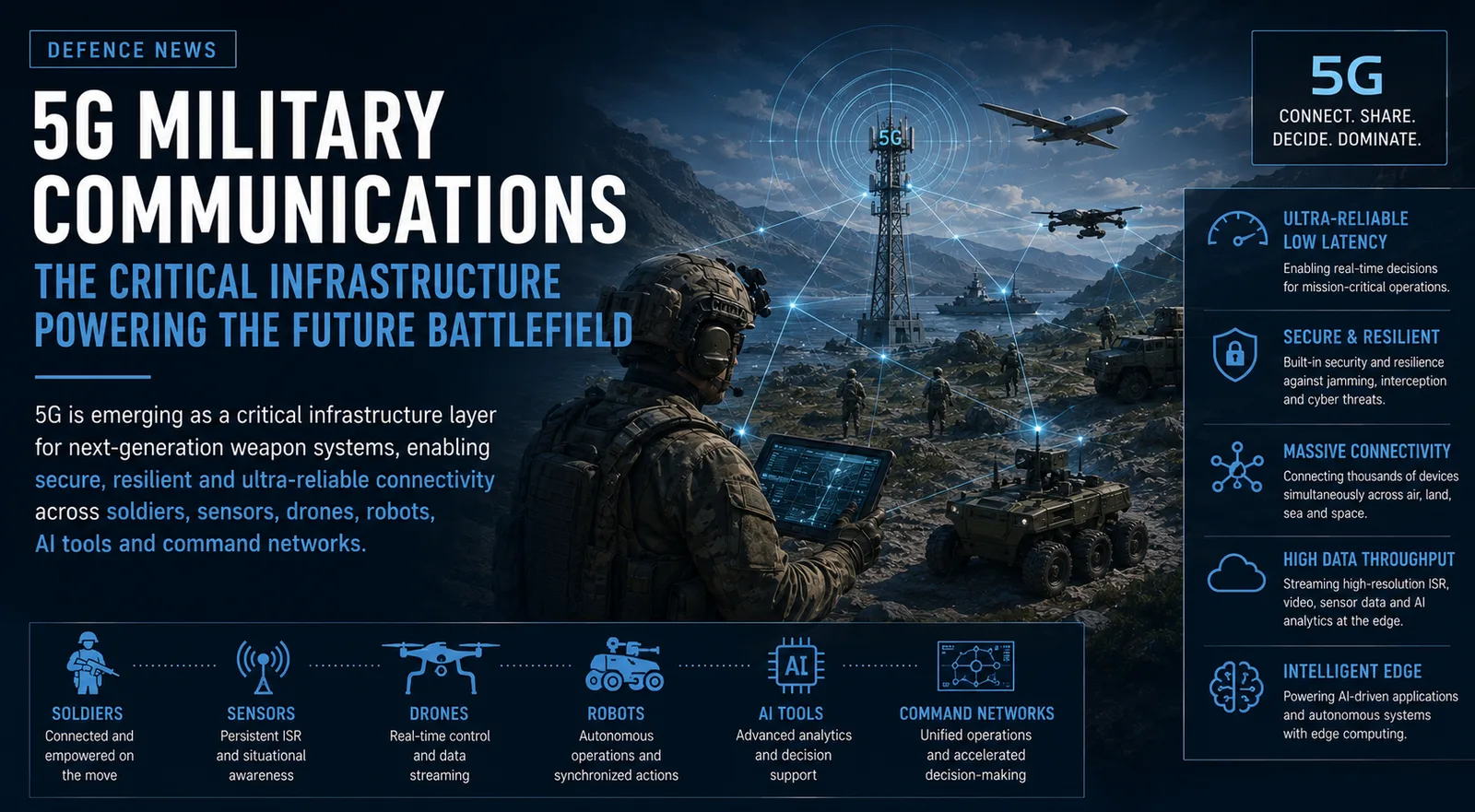
5G military communications are becoming a critical infrastructure layer for next-generation weapon systems, linking soldiers, sensors, drones, robots, AI tools and command networks into faster combat architectures.
A SAHA Blog analysis argues that 5G should not be seen only as a civilian telecom technology. Its high bandwidth, low latency and ability to connect large numbers of devices could make it one of the foundations of future warfare.
The logic is simple. Future weapons will generate and consume more data. Autonomous platforms, electronic warfare systems, augmented-reality displays, sensor grids and AI-enabled command tools all require fast, secure and resilient connectivity.
Therefore, 5G is not only about faster mobile internet. In defence, it is about building the communication layer that allows next-generation systems to operate together.
5G Military Communications Turn Data Into Combat Power
Modern warfare is becoming a contest of data speed. The force that can collect, process, share and act on information faster will gain decision advantage.
5G military communications can support this shift by moving larger volumes of data between sensors, command posts and battlefield systems with lower delay. That matters for missions where seconds can decide whether a target is found, tracked or lost.
This is especially important for air defence, drone operations, electronic warfare, precision fires and autonomous systems. These missions depend on fast information flow across many nodes.
Low Latency Supports Autonomous Weapons and Robots
Low latency is one of the most important military features of 5G. Lower delay can improve the control of autonomous systems, unmanned vehicles, robotic platforms and remote sensors.
The SAHA Blog article highlights the connection between 5G, IoT, robotics and automation. This relationship is central to future force design because unmanned systems will operate in larger numbers and closer coordination with human units.
For example, a 5G-enabled unit could use small UAVs for reconnaissance, unmanned ground vehicles for logistics or route clearance, and robotic sensors for perimeter defence. The value comes from connecting these systems into one operational picture.
The Internet of Battlefield Things Needs 5G-Class Connectivity
The Internet of Battlefield Things, or IoBT, describes a battlefield where soldiers, sensors, vehicles, weapons, drones and command systems are connected. This environment requires a communication layer that can handle many devices at once.
5G was designed for dense device connectivity. In a military context, that can support distributed sensors, smart logistics, health monitoring, battlefield tracking and machine-to-machine communications.
However, IoBT also increases risk. More connected devices create more attack surfaces. Therefore, 5G military communications must be built with cyber defence, identity management, encryption and zero-trust principles from the beginning.
5G and AI Create a Defence Cloud at the Edge
5G becomes more valuable when combined with AI and edge cloud. Instead of sending every piece of data to a distant data centre, forces can process information closer to the battlefield.
This supports faster target recognition, sensor fusion, route planning, predictive maintenance and mission decision support. It also reduces the burden on long-distance communication links.
The SAHA Blog article links 5G with AI, machine learning and defence cloud concepts. This is where 5G becomes more than a network. It becomes part of an operational data architecture.
AR, VR and Simulation Become Operational Tools
5G military communications can also support augmented reality, virtual reality and high-fidelity simulation. These tools are useful for training, maintenance, mission rehearsal and remote expert support.
In training, 5G-enabled simulation can connect soldiers, vehicles and command posts in realistic digital environments. In the field, AR displays can help troops receive navigation cues, threat alerts, targeting data or equipment-repair instructions.
The military value depends on reliability. AR and VR tools must work under stress, with secure connectivity and without overwhelming the user.
Military 5G Must Survive Cyber and Electronic Warfare
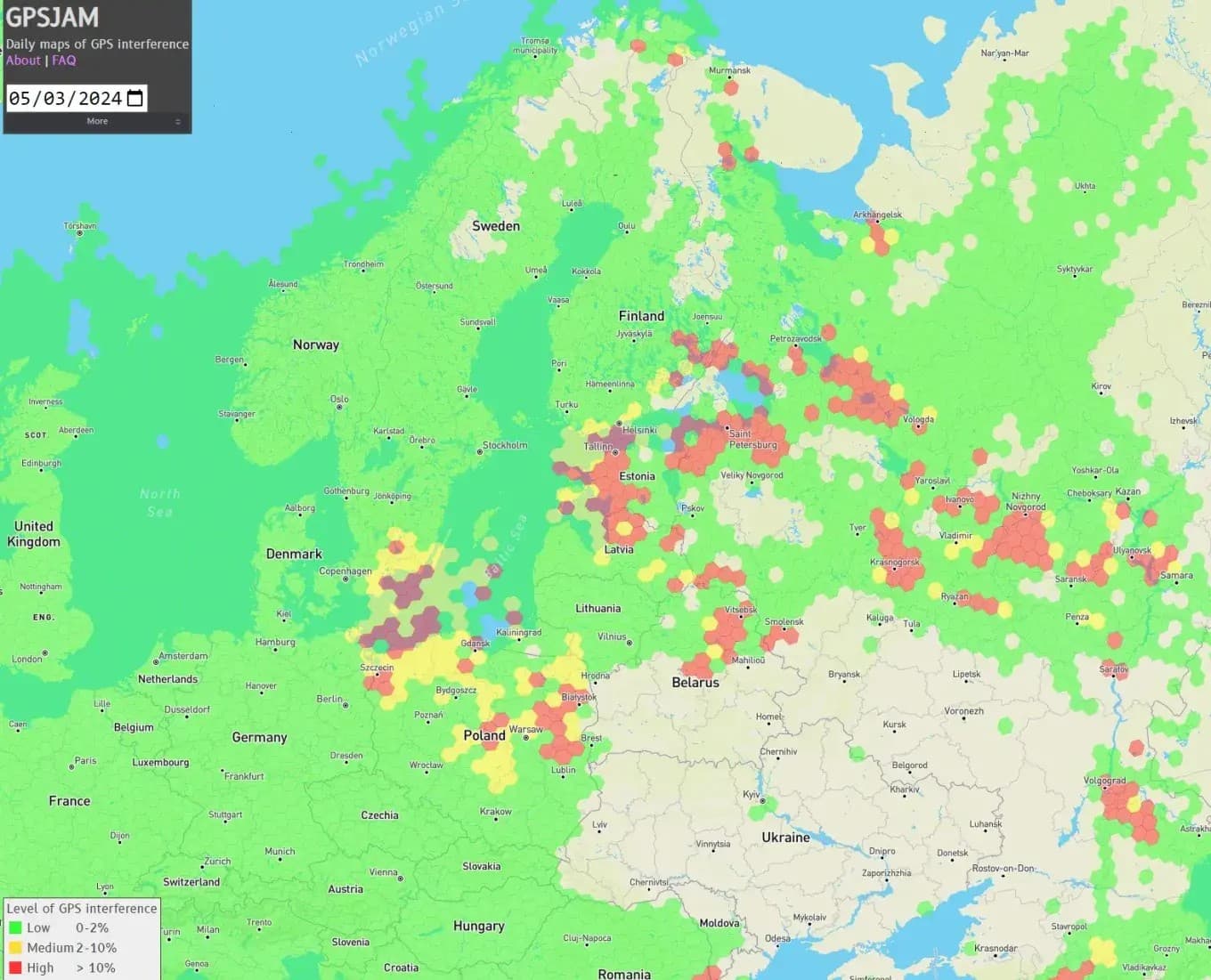
The biggest challenge for military 5G is survivability. A network that performs well in a civilian environment may fail in a battlefield shaped by jamming, spoofing, cyber intrusion, physical attack and spectrum congestion.
This is why 5G cannot simply replace tactical radios, line-of-sight communications or SATCOM. Instead, it must integrate with them. Future military networks will likely combine 5G, tactical radio, mesh networking, satellite communications and resilient edge nodes.
The key requirement is graceful degradation. Units must still operate when bandwidth falls, nodes are lost or an adversary attacks the electromagnetic spectrum.
NATO Sees 5G as Part of the Digital Backbone
NATO’s work on next-generation networks shows how 5G fits into allied defence transformation. NATO Allied Command Transformation has explored 5G use cases such as enhanced communications, real-time control applications, autonomous transport and emergency services.
NATO’s wider digital transformation agenda also links secure digital services, cloud, edge services and multi-domain operations. This matters because 5G is not a standalone capability. It is one layer of a larger digital backbone.
For allied operations, the most important requirement is interoperability. A 5G-enabled system must connect with national networks, NATO command structures, coalition data environments and existing military radios.
DoD’s 5G and FutureG Work Shows the Direction of Travel
The U.S. Department of Defense has treated 5G and FutureG as critical technologies for future forces. Its 5G and FutureG cross-functional team was established to accelerate adoption of 5G and future wireless networking technologies, including for contested networks.
This direction is important for allies. U.S. military adoption often shapes standards, interoperability requirements and supplier behaviour across NATO and partner markets.
As defence organisations move toward 6G research, the lesson from 5G will remain relevant: future wireless networks must be designed for military resilience, not only commercial performance.
Türkiye Can Build Around Tactical 5G and Unmanned Systems
Türkiye has a strong entry point into 5G-enabled defence because its defence ecosystem already works across unmanned systems, C4ISR, electronic warfare, tactical data links, command software and secure communications.
5G can strengthen these areas by supporting drone coordination, robotic systems, mobile command posts, smart bases, digital troops, AR training and edge-cloud processing.
The opportunity is not only to use 5G. It is to build defence-specific 5G architectures that are secure, modular, interoperable and resilient against electronic attack.
Smart Bases Could Be the First Practical Step
The first defence use cases for 5G may not appear in front-line combat. They may emerge in smart bases, ports, depots, shipyards, test ranges and training centres.
In these environments, 5G can support autonomous vehicles, digital logistics, perimeter security, predictive maintenance, connected sensors and immersive training. These applications are easier to control than a high-intensity battlefield.
Smart-base deployment can also help militaries test security, spectrum management, device authentication and network resilience before expanding into tactical operations.
The Main Risk Is Dependency on Infrastructure
5G military communications create a strategic risk: infrastructure dependency. 5G often depends on dense network architecture, base stations, antennas, power supply and software-defined infrastructure.
In a war zone, that infrastructure can be attacked or degraded. This means tactical 5G must be deployable, mobile and redundant. It must also work with disconnected or intermittently connected operations.
The best military 5G architecture will therefore be hybrid. It will combine private 5G cells, tactical radios, SATCOM, mesh networks, edge computing and cyber-hardened command systems.
5G Will Not Replace Doctrine
Technology alone will not create advantage. 5G military communications must be matched with doctrine, training, spectrum discipline, cyber hygiene and command procedures.
A poorly designed network can create data overload, cyber exposure and operational dependence. A well-designed network can improve speed, coordination and survivability.
The difference will depend on integration. Militaries must decide which data should move over 5G, which systems should remain isolated, and how commanders will fight when the network is degraded.
Conclusion
5G military communications are becoming part of the foundation for next-generation weapon systems. They can support AI, drones, robotics, AR/VR, simulation, edge cloud, tactical data links and multi-domain command networks.
However, military 5G must be built differently from civilian 5G. It must survive cyberattack, jamming, spoofing, spectrum congestion, physical disruption and intermittent connectivity.
The future battlefield will not be connected by one network alone. It will require a resilient communications architecture that combines 5G, tactical radios, SATCOM, mesh networks, edge computing and secure command systems. Countries that master this architecture will gain a decisive advantage in the next phase of digital warfare.
For further Defence Agenda coverage, read our defence technology, C4ISR and cyber defence sections. Related analysis includes digital troops and battlefield command, ITAR-free defence products in Europe and the UK Storm Fighter CCA programme.
Further Reading
- SAHA Blog: 5G, Yeni Nesil Silah Sistemlerinin Altyapısı
- NATO ACT: 5G and next-generation networks across NATO
- NATO: Digital Transformation Implementation Strategy 2.0
- U.S. Department of Defense: 5G and FutureG Cross-Functional Team
- U.S. Department of Defense: Secure 5G mobile telecommunication network strategy