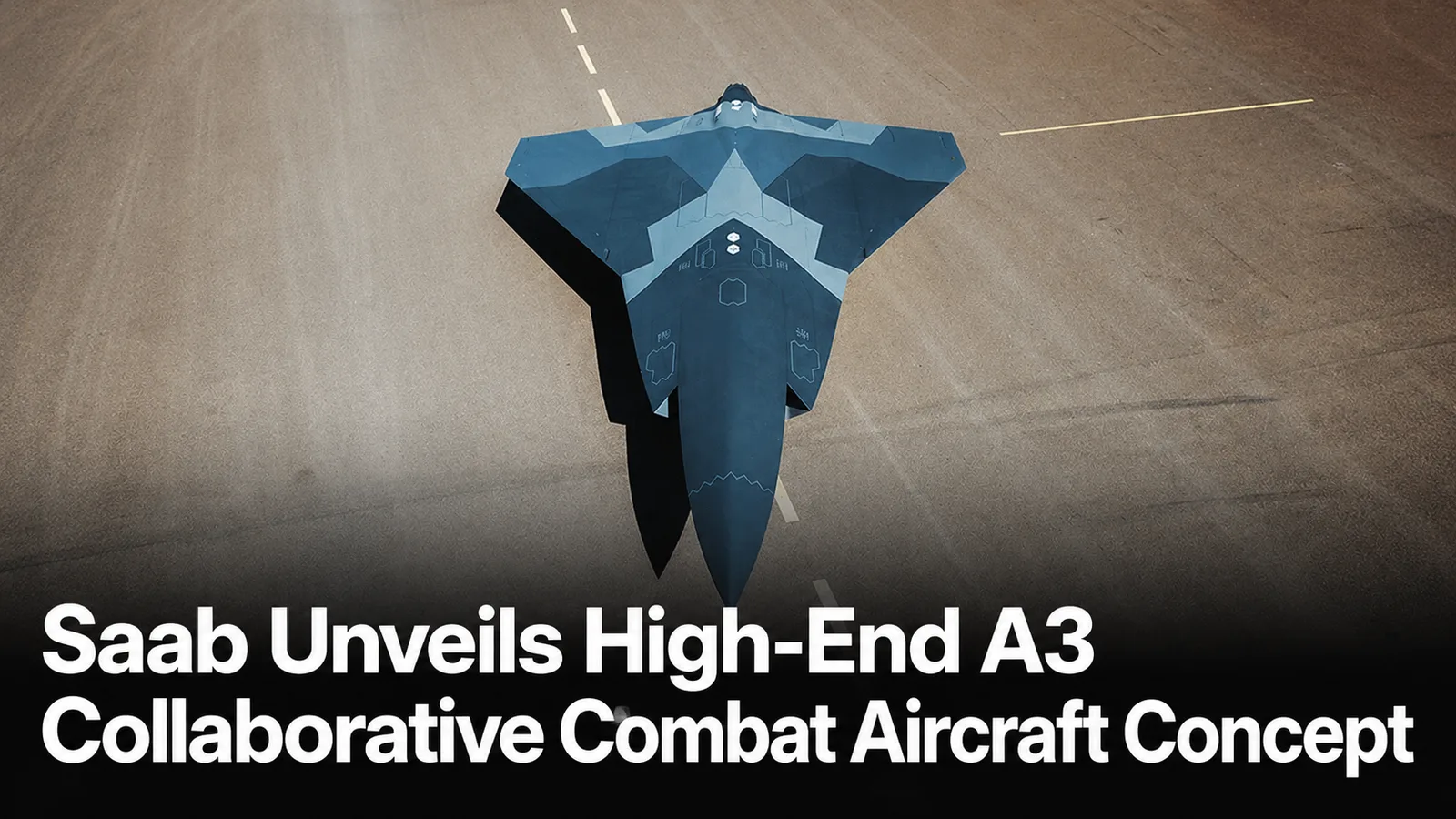
Saab has unveiled the A3-001, a full-scale concept for a high-end collaborative combat aircraft designed to operate alongside Gripen E and future crewed combat aircraft in highly contested airspace.
The tailless, supersonic, low-observable concept represents a different interpretation of the collaborative combat aircraft market from lower-cost attritable designs. Saab sees A3 as a survivable autonomous combat aircraft able to conduct electronic warfare, suppression and destruction of enemy air defences, forward sensing and precision strike. However, A3 is currently a Saab-funded concept rather than a Swedish procurement programme, and Sweden has not approved or funded operational introduction of the aircraft.
A3 Is Saab’s High-End Answer to the CCA Debate
Saab’s A3 differs from the lower-cost collaborative combat aircraft concepts currently shaping much of the U.S. and European market.
Aviation Week describes the aircraft as a supersonic, autonomous, tailless double-delta design intended to provide what Saab calls a peer-capable complement to Gripen E. Rather than treating the uncrewed aircraft as a relatively inexpensive and potentially attritable adjunct, Saab is designing A3 around survivability, high performance and mission-system capability.
The concept is closer in philosophy to a recoverable uncrewed combat aircraft than to a disposable drone. Saab identifies electronic warfare, suppression of enemy air defences, deep precision strike and forward sensing among the potential missions.
The Airframe Revives Saab’s Double-Delta Heritage
A3’s planform recalls Saab’s J 35 Draken, although the similarity is architectural rather than evidence of direct aerodynamic lineage. The aircraft uses a tailless blended body with a double-delta wing, a configuration compatible with the low-observable and high-speed goals described by Saab.
Saab’s official release confirms low observability and a high degree of autonomy but does not publish dimensions, maximum take-off weight, payload, endurance, combat radius or radar-cross-section data. An engine has also not been selected. Aviation Week reports that Saab is in discussions with several propulsion providers.
A3 Is Not Sweden’s Future Fighter Decision
The most important programme distinction is that A3 is not Sweden’s selected future fighter or an approved replacement for Gripen.
Sweden is conducting studies on the combat-air capability that will follow the current Gripen family. Saab says A3 is its own concept for what could follow in the mid-2030s if Sweden chooses to build on the technologies now being explored.
Aviation Week reports that Sweden is expected to decide by 2030, potentially as early as 2028, whether to continue with a sovereign fighter-development route, join an international programme or acquire a foreign combat aircraft. That decision has not been made.
A1 and A2 Are the Government-Backed Demonstrator Path
A3 sits alongside a more concrete technology-demonstrator programme funded under Sweden’s future combat-air studies.
In October 2025, Saab received an approximately SEK 2.6 billion order from the Swedish Defence Materiel Administration covering continued conceptual studies, technology development and demonstrators during 2025–2027. FMV describes this work as part of Sweden’s future fighter choice and the Concept Programme for Future Combat Air Systems.
Saab is building two fighter-like uncrewed demonstrators, designated A1 and A2 in Aviation Week reporting.
The A1 is a supersonic autonomous low-observable demonstrator powered by a GE Aerospace F414. Aviation Week says it is planned to be slightly larger than Gripen E but considerably lighter, with a conventional delta wing and canted V-tails. Components are already in assembly, and wind-tunnel testing has been conducted in the Netherlands.
A2 Adds an Internal Weapons Bay
The A2 is intended to follow toward the end of the decade and is also expected to use the F414. Its configuration is broadly similar to A1 but adds an internal weapons bay.
Internal weapons carriage is important because it allows Saab to test the structural, thermal, aerodynamic and weapon-separation challenges associated with low-observable combat aircraft. A2 therefore addresses an engineering area that a future stealth-oriented Swedish combat-air system may require.
Saab has not publicly committed to conducting a live weapon release from the A2 bay.
The Demonstrators Are Testing Development Speed
A1 and A2 are not only aerodynamic test vehicles. Saab is using them to prove that Swedish industry can move from concept to first flight on compressed timelines.
Aviation Week reports that Saab is targeting approximately 36 months from concept to first flight. That is strategically important because future combat-air programmes are increasingly dominated by long development cycles and very high non-recurring engineering costs.
If Saab can demonstrate rapid low-observable airframe development, software-defined mission systems and autonomy on A1 and A2, those capabilities could feed either a sovereign Swedish aircraft or a multinational programme.
A3 Could Become a Bridge to a Future Crewed Fighter
Saab views A3 as more than a standalone wingman concept.
Peter Nilsson, head of Saab’s Advanced Programs unit, told Aviation Week that even if Sweden does not procure A3, developing the aircraft could serve as a steppingstone toward the country’s future fighter.
Saab’s conceptual roadmap moves from A1 and A2 demonstrators to A3 and potentially later A4/A5 configurations before a future core-fighter development phase in the 2040s.
This allows Sweden to mature low observability, autonomy, internal weapons integration and advanced manufacturing before committing to a much larger crewed-aircraft programme.
Saab Expects Part of the CCA Market to Move Upmarket
Saab argues that collaborative combat aircraft will become more sophisticated as users assign them more demanding missions.
A lower-cost aircraft may initially be designed as a sensor, decoy or weapons carrier. Operational users may subsequently demand better sensors, electronic warfare, self-protection, range, speed, survivability and weapons capacity. Each added requirement raises cost and complexity.
Saab believes this mission growth will push at least part of the CCA market toward higher-end aircraft rather than leaving the entire segment centred on attritable platforms.
European Airspace Creates a Different Certification Problem
Saab also points to European geography as a reason for pursuing a mature reusable system.
Large parts of the United States offer military ranges suitable for uncrewed combat-air testing with limited civil-airspace interaction. European military aviation operates in more congested controlled airspace.
Aviation Week reports that Saab expects operational CCAs in Europe to require certification and routine integration with controlled airspace rather than being systems used only in wartime.
Gripen Would Command Rather Than Remotely Fly A3
Saab’s concept does not require a Gripen pilot to manually fly the uncrewed aircraft.
A3 is intended to operate autonomously while receiving high-level commands from the crewed fighter. Aviation Week reports that Saab is developing voice and hands-on-throttle-and-stick control methods that allow the pilot to direct the uncrewed aircraft at mission level.
This distinction is central to scalable crewed-uncrewed teaming. A pilot cannot continuously fly multiple additional aircraft while also conducting a combat mission. The autonomy system must therefore manage basic flight, navigation, formation behaviour and much of mission execution.
Saab Is Building an AI Fighter Pilot Academy
To support that autonomy, Saab has established what Aviation Week describes as an AI fighter pilot academy.
The programme uses mission scenarios to train autonomous agents for different tactical behaviours. This work builds on Saab’s wider experimentation with fighter AI.
In 2025, Saab and Helsing flew the Centaur AI agent in Gripen E under Project Beyond. The AI was given control of the aircraft during beyond-visual-range combat scenarios and autonomously executed manoeuvres while cueing the human pilot for weapons employment.
Arexis Could Support A3 Electronic Warfare
Electronic warfare is one of A3’s core proposed missions, and Saab is examining self-defence systems derived from its Arexis technology.
Aviation Week reports that Saab is exploring a lower-size, weight, power and cost version suitable for collaborative combat aircraft.
Such a system could allow an A3-type aircraft to act as a forward jammer, escort or electronic-support node while reducing exposure of crewed aircraft. No final A3 electronic-warfare configuration has been selected.
A3 Is Intended to Be Cheaper Than Gripen, But Not Disposable
Saab’s cost concept places A3 between a crewed fighter and a low-cost attritable drone.
Nilsson told Aviation Week that acquisition cost could be approximately half that of a Gripen, with lifecycle cost potentially around one-third as high. These figures are conceptual estimates rather than contract prices.
Saab also suggests a possible force ratio of approximately two or three A3-class aircraft for each crewed fighter.
Saab Is Not Abandoning the Low End
The high-end A3 concept does not mean Saab has rejected lower-cost autonomous aircraft.
The company’s Rainforest technology incubator is developing Ruby, a low-cost fixed-wing uncrewed demonstrator intended to explore alternative airframe manufacturing and use of commercial electronics.
The result is a two-tier philosophy: sophisticated recoverable CCAs for high-threat missions and much cheaper aircraft for missions where quantity is more important than survivability.
How A3 Compares With Other CCA Approaches
Saab’s concept enters a rapidly expanding international market.
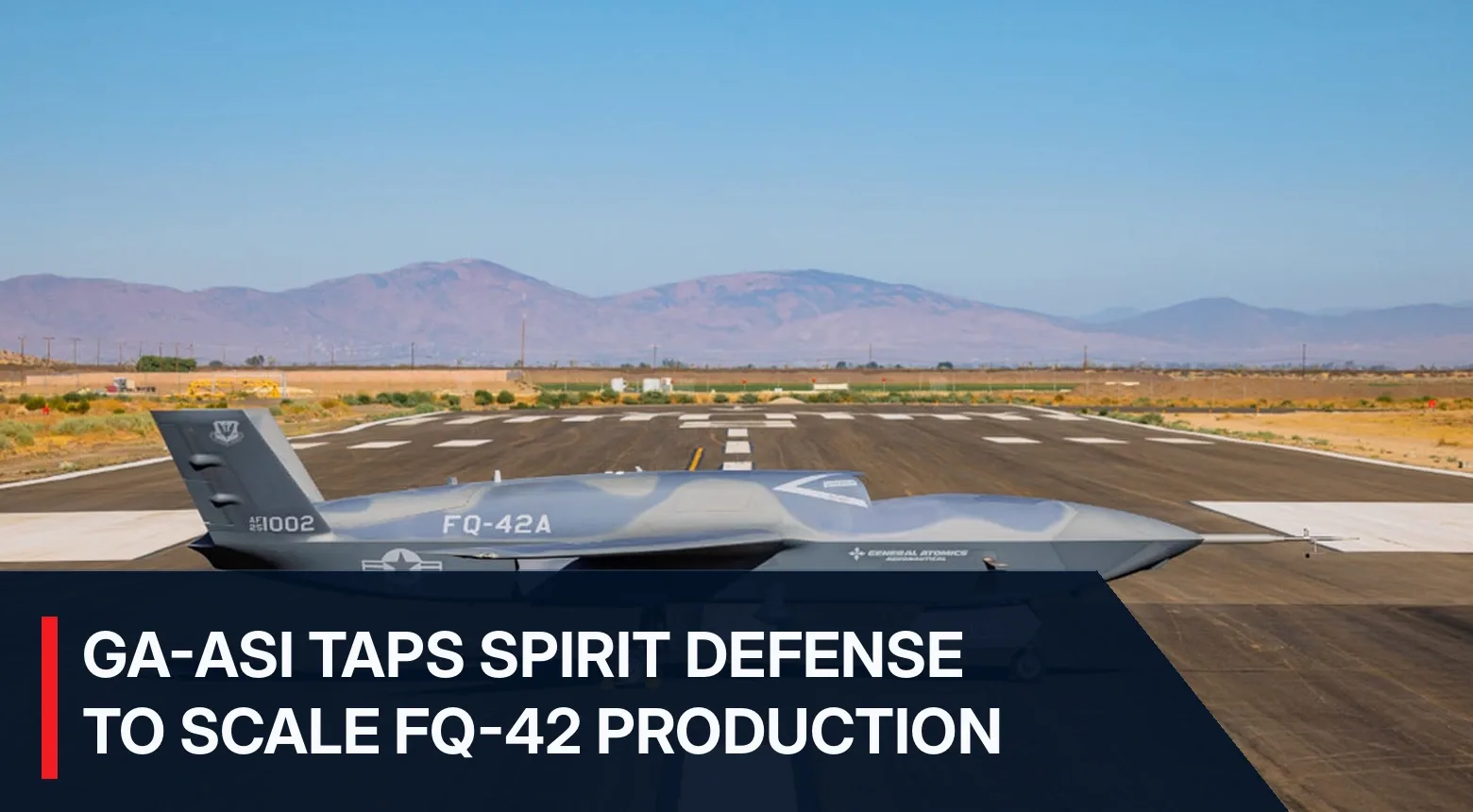
The U.S. Air Force’s CCA programme has focused on aircraft such as General Atomics’ YFQ-42A and Anduril’s YFQ-44A, with affordability and production scale central to the acquisition model. Australia’s MQ-28 Ghost Bat similarly emphasises collaborative operations and modular payloads.
France’s future Rafale F5 architecture is expected to include a stealthy uncrewed combat aircraft derived from nEUROn, a conceptually closer comparison to A3’s high-end approach. The UK’s Storm Fighter programme is also intended to integrate autonomous combat aircraft with Typhoon, F-35 and future Tempest.
The market is therefore likely to fragment into several classes rather than converge around one universal collaborative aircraft.
Industrial Significance for Sweden
The A3 concept reflects Sweden’s effort to preserve national combat-air design capability while it evaluates long-term options.
FMV’s SEK 2.6 billion continuation contract keeps engineering teams active across aerodynamics, structures, propulsion integration, low-observable design, software and autonomy.
Maintaining that competence gives Sweden more bargaining power whether it ultimately develops a national aircraft, joins an international programme or chooses a hybrid solution.
Limitations and Counterpoint
A3 is not currently an operational programme of record. The full-scale model is a concept, and Saab is funding the work internally.
The Swedish Air Force has not approved introduction of an A3 fleet and has not allocated operational procurement funding for the aircraft.
There is no selected engine, final payload, production configuration, weapons suite, combat radius or schedule for A3.
Saab’s cost and force-ratio estimates are conceptual company projections, not negotiated programme values.
The A1 and A2 demonstrators are more concrete because they form part of government-funded technology work, but they should not be treated as prototypes of a guaranteed production aircraft.
Implications / Next
The most immediate milestone is the first flight of A1. That will show whether Saab can meet its compressed demonstrator-development timetable and validate the basic autonomous supersonic architecture.
The second is A2, particularly internal-weapons-bay testing before the end of the decade.
The third is Sweden’s future combat-air decision. A sovereign route would increase the importance of A3/A1/A2 technology, while participation in another programme could turn those demonstrators into national technology contributions instead of direct product precursors.
The fourth is autonomy. Further Gripen-to-uncrewed command demonstrations and maturation of Saab’s AI pilot architecture will determine whether the company can convert airframe technology into an operational human-machine team.
Conclusion
Saab’s A3 places Sweden firmly inside the emerging collaborative combat aircraft market but rejects the assumption that every uncrewed fighter adjunct must be low-cost and attritable.
The company is proposing a supersonic, low-observable and autonomous aircraft capable of operating in the same high-threat environment as Gripen and undertaking electronic warfare, SEAD, sensing and strike missions.
The concept remains unapproved and company-funded, while Sweden’s more concrete investment is currently in A1/A2 technology demonstrators and wider future-fighter studies.
The strategic importance of A3 therefore lies less in near-term procurement than in the roadmap it exposes: Sweden is using uncrewed combat aircraft, low observability and AI autonomy as steppingstones toward the post-Gripen combat-air system it must choose before the end of the decade.