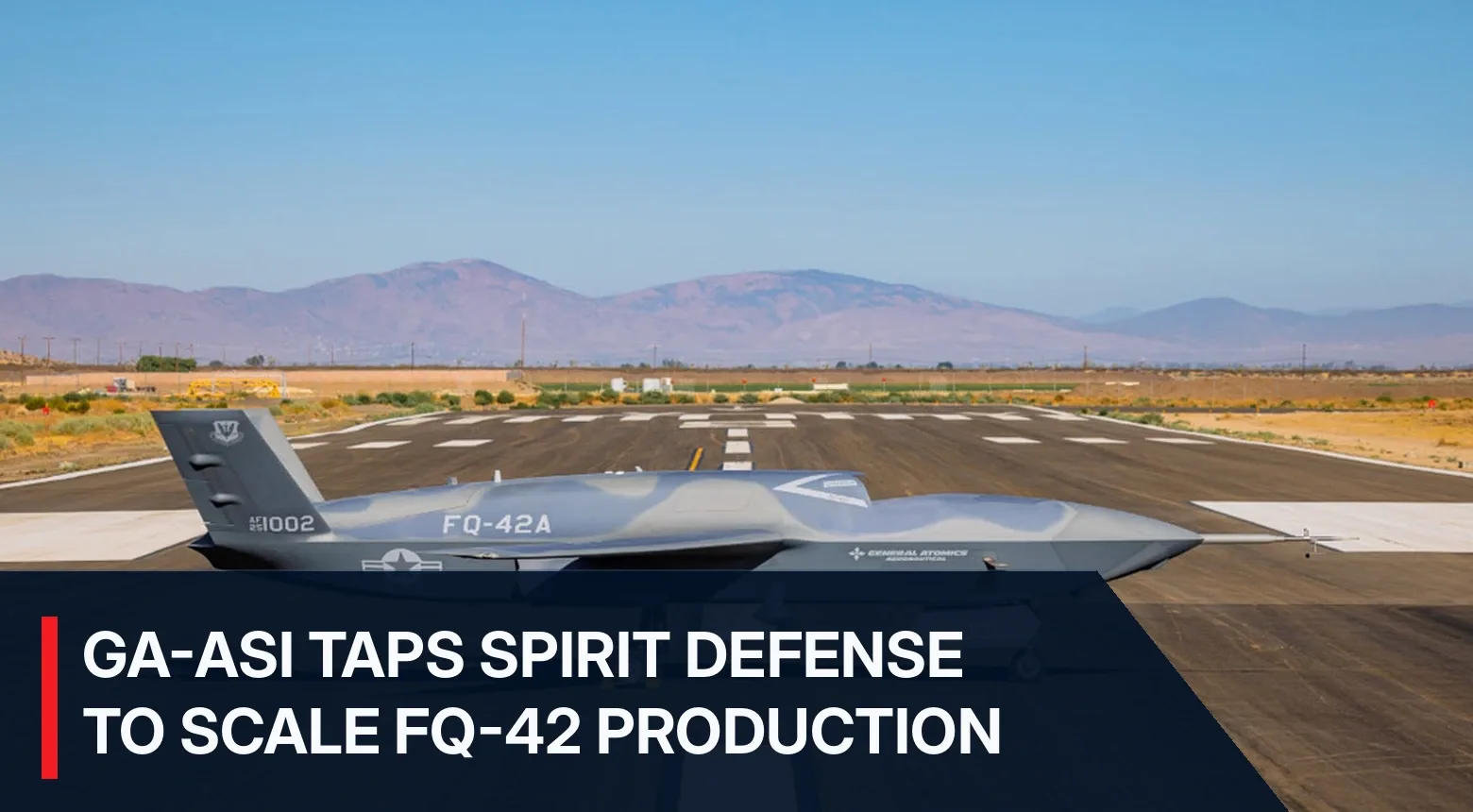
General Atomics Aeronautical Systems (GA-ASI) announced on 23 October 2026 that Spirit Defense, a Boeing company, will support fuselage design and production for the FQ-42 Vengeance collaborative combat aircraft. The move is a supply-chain and manufacturing milestone intended to increase capacity for an uncrewed combat-air programme already under contract with the US Air Force.
Spirit Defense takes a design-build fuselage role
GA-ASI says Spirit Defense will participate as an airframe fuselage design-build partner, contributing engineering and advanced manufacturing capability from development into production. Spirit Defense is headquartered in Wichita, Kansas, and operates within Boeing’s corporate structure. The announcement does not assign a new government aircraft quantity or disclose the commercial value of the subcontracting arrangement.
The company linked the move to its June 2026 contract to produce FQ-42 aircraft for the US Air Force. The current news is therefore an additional industry participant inside an established programme path, not evidence of a fresh selection competition or new combat deployment. This distinction matters for both procurement reporting and supplier backlog analysis.
Scaling unmanned fighters changes the industrial model
An affordable collaborative combat aircraft is intended to augment crewed aircraft with a different balance of cost, survivability and mission flexibility. To make that model economically credible, programmes need repeatable structures manufacturing, simplified assembly and components available at scale. A specialist airframe supplier can reduce pressure on the prime contractor’s own manufacturing capacity.
Production resilience also depends on access to tooling, certified labour, materials, software and flight-test resources. Splitting fuselage manufacture from final system integration can add output flexibility, but it can also create interface and quality-assurance obligations. The partnership’s value will depend on measurable throughput, configuration stability and acceptance performance rather than the announcement alone.
FQ-42’s programme maturity is still evolving
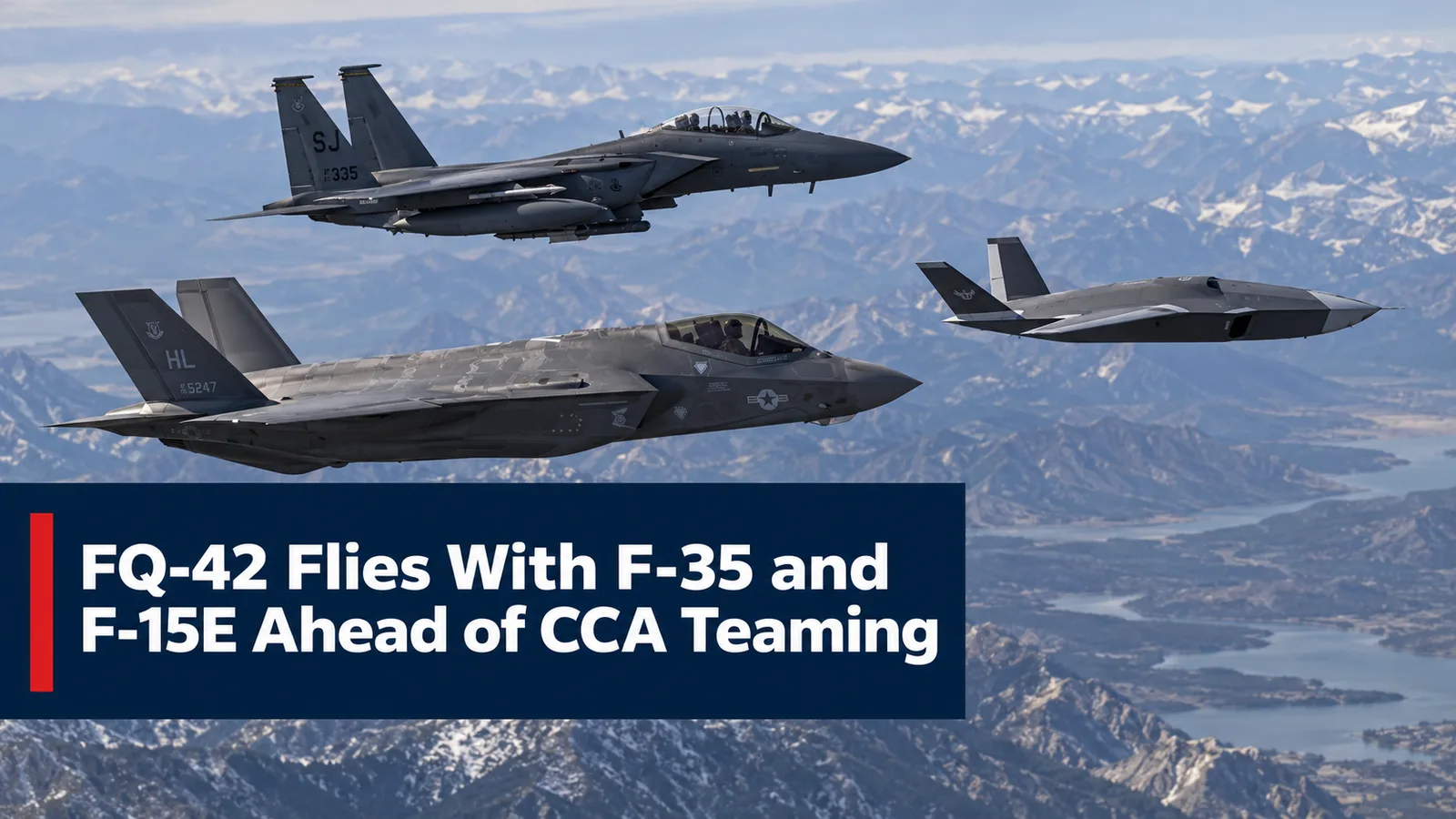
GA-ASI describes FQ-42 as a modular uncrewed combat aircraft designed for mission-system and autonomy-software integration. Earlier programme activity included flight demonstrations with crewed combat aircraft, but those events were not equivalent to a mature operational human-machine teaming capability. The US Air Force must still test control interfaces, autonomy behaviours and tactical employment under representative conditions.
The manufacturing announcement does not verify the number of aircraft currently complete, the final production tempo or an operational fielding date. Aircraft fabrication, military acceptance and deployable mission autonomy are separate milestones. Programme coverage should therefore track flight and integration results alongside industrial contracts.
What the partnership means for future suppliers
Spirit Defense’s selection signals that the CCA industrial base may draw on companies whose experience lies in commercial-scale aerospace structures as well as traditional combat-air manufacturing. That can increase competition for qualified subcontractors and encourage manufacturers to invest in flexible production systems able to handle modular designs and changing volumes.
GA-ASI also describes broader Gambit-family applications and potential international industrial participation, but no additional foreign customer is confirmed by this specific release. Announced market interest and possible localisation pathways must be kept separate from signed export contracts and authorised technology transfers.
Separating fuselage manufacture from avionics and autonomy integration also creates a useful way to assess progress. Structural articles can be inspected for dimensional conformity and repeatability before a completed aircraft is available, while software integration and flight-control qualification follow different schedules. That should allow planners to identify whether delays originate in airframe output, subsystem delivery, mission software or government test availability. However, a second manufacturing partner can only increase throughput once design authority, production data and acceptance responsibilities are settled. Adding factory capacity before a stable baseline risks producing hardware that later requires rework. The US Air Force will therefore need evidence that supplier hand-offs support the required configuration and cost profile. Neither GA-ASI nor Spirit has supplied the public figures needed to calculate production rates or per-aircraft savings from this specific partnership.
Implications / Next
Watch for a defined workshare, initial Spirit-built fuselage article, delivery and quality milestones, US Air Force acceptance data and any funded follow-on order. Spirit’s participation strengthens the announced industrial team; it does not itself establish operational availability of FQ-42.