Wingman aircraft are moving to the centre of Europe’s rearmament debate as air forces look for faster, cheaper and more survivable ways to expand combat airpower.
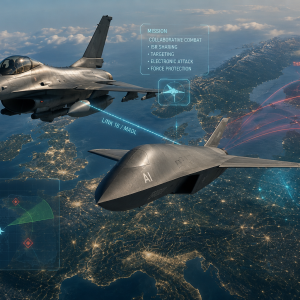
The concept is simple. An unmanned aircraft flies alongside a crewed fighter and supports it with sensors, electronic warfare, communications relay, decoys or weapons. However, the strategic effect could be significant. Wingman aircraft can help air forces add mass without buying only high-cost crewed fighter fleets.
At the Berlin airshow, Airbus, Boeing, Helsing and General Atomics presented different approaches to this fast-growing category. These systems are often described as Collaborative Combat Aircraft, or CCA. They can range from smaller autonomous drones to larger unmanned jets that operate near crewed aircraft.
The timing matters. Russia’s war against Ukraine has shown that drones, electronic warfare and sensor disruption can shape the battlefield as much as traditional kinetic strikes. As a result, European air forces now need aircraft that can adapt, survive and operate in dense electronic warfare environments.
Wingman Aircraft and Europe’s Airpower Gap
European air forces face a difficult problem. They need more combat mass, but crewed fighter aircraft remain expensive, complex and slow to produce. Wingman aircraft offer a different route. They can extend the reach of existing fighters and increase mission options without placing another pilot at risk.
For NATO air forces, the model also supports distributed operations. A crewed fighter can stay farther from the highest-risk area while unmanned systems move forward to sense, jam, deceive or strike. Therefore, wingman aircraft could become an important layer between traditional fighters and smaller tactical drones.
The capability is not only about hardware. The decisive element is the autonomy stack. Air forces need artificial intelligence that can process data, support mission decisions and operate within clear human-control rules. This is why European sovereignty over AI, software and mission data has become a central issue.
Airbus, Boeing, Helsing and General Atomics Compete for the Future
The industry field is widening. Airbus is developing a European wingman concept linked to future combat air requirements. Boeing is promoting the MQ-28 Ghost Bat, an unmanned jet developed in Australia and positioned as a force multiplier for crewed aircraft. Helsing is advancing AI-enabled combat aircraft concepts focused on autonomy and electronic attack. General Atomics is also moving forward with its YFQ-42A collaborative combat aircraft work.
Each company approaches the mission from a different industrial base. Airbus brings European fighter-aircraft experience and deep ties to Eurofighter operators. Boeing offers a more mature unmanned jet pathway through Ghost Bat. Helsing brings software-centric autonomy and AI expertise. General Atomics adds long experience in unmanned systems and U.S. Collaborative Combat Aircraft development.
This competition gives European customers more options. However, it also forces governments to decide how much autonomy, software control and industrial workshare they want to keep inside Europe.
Why Wingman Aircraft Are Not Just Larger Drones
Wingman aircraft differ from many tactical drones because they must operate as part of a high-end air combat system. They need speed, secure communications, mission autonomy and compatibility with crewed fighter tactics. They may also carry sensors, jammers or weapons that support the broader mission package.
In practice, this creates a new combat-air architecture. The crewed fighter becomes a command node. The wingman aircraft becomes a forward sensor, jammer, decoy or shooter. Together, they create a more flexible air package than a single aircraft can provide alone.
This model also changes procurement logic. Air forces may buy different classes of wingman systems for different missions. Some may be recoverable and sophisticated. Others may be lower-cost and more expendable. Consequently, the future combat air fleet may become a mixed ecosystem rather than a single aircraft programme.
The FCAS and GCAP Context
Europe’s interest in wingman aircraft also reflects pressure on long-term fighter programmes. Future Combat Air System discussions have faced industrial and political challenges, while the Global Combat Air Programme continues under the UK, Italy and Japan. In both cases, the future fighter is no longer just an aircraft. It is part of a wider system of drones, sensors, networks and software.
This is why wingman aircraft may advance faster than some sixth-generation fighter timelines. They can upgrade existing fighter fleets before new crewed aircraft enter service. For Germany, France, Spain, the UK, Italy and other NATO members, that bridge capability could become strategically valuable.
Operational Deployment Still Takes Time
Despite the momentum, wingman aircraft have not yet entered European combat service. Integration remains difficult. Air forces must test autonomy, safety, communications, rules of engagement, electronic protection and command authority before they can field these systems at scale.
The timeline also varies by platform. Some systems may reach operational users before the end of the decade. Others will not arrive until the 2030s. This creates a near-term capability race, but it also leaves room for rapid changes in software, sensors and mission design.
Strategic Implications for European Defence
Wingman aircraft could reshape European defence industry in three ways. First, they create a new market between tactical drones and crewed fighters. Second, they make autonomy software a core airpower asset. Third, they force governments to define sovereignty not only by aircraft production, but also by control of algorithms, data and mission systems.
For Europe, the key question is whether it can build a competitive autonomous air combat ecosystem. Buying foreign systems may deliver speed. Building domestic systems may deliver sovereignty. A hybrid approach may become the most realistic path, especially if European firms partner with U.S., Australian or allied suppliers while retaining control of mission-critical software.
For further Defence Agenda coverage, read our unmanned systems, defence technology and Europe sections. Related analysis includes Shield AI’s Hivemind partnership with UAV Navigation–Grupo Oesía and Defence-as-a-Service and Europe’s new procurement model.
Wingman Aircraft Are Becoming a Procurement Priority
The rise of wingman aircraft shows how airpower is shifting from platform-centric thinking to system-centric warfare. Fighters will remain essential. Yet their future effectiveness may depend on the unmanned aircraft, autonomy software and data networks that fly with them.
Europe’s rearmament cycle is therefore not only about buying more traditional equipment. It is also about building combat systems that can evolve quickly. Wingman aircraft are now one of the clearest examples of that shift.