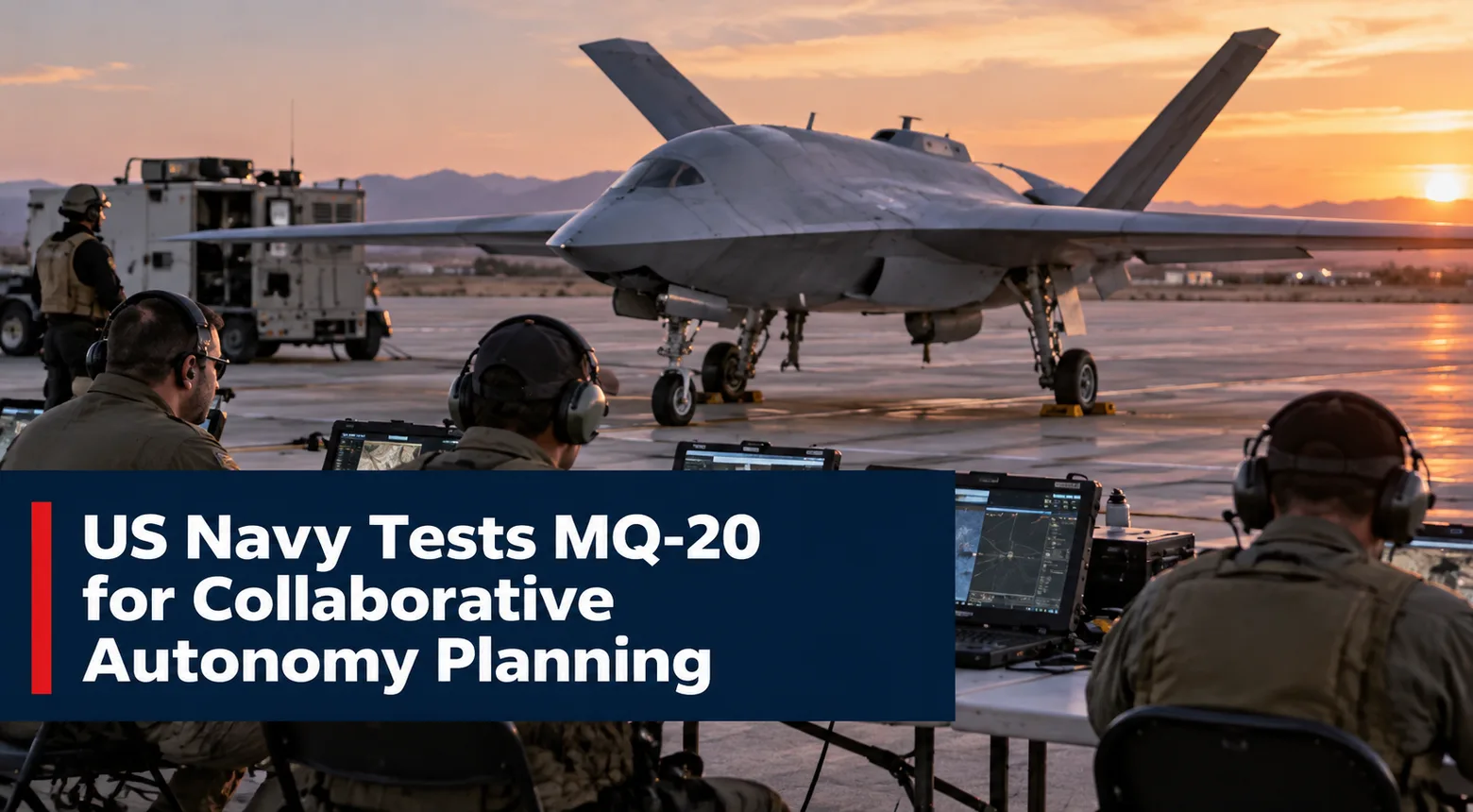
The U.S. Navy demonstrated Collaborative Autonomy Mission Planning during Gray Flag 2026 using an MQ-20 Avenger surrogate aircraft at Point Mugu. CAMP translated an operator-generated mission plan into instructions an autonomous aircraft could execute, testing the workflow that connects human planning with machine mission execution.
The Navy is testing the planning layer of collaborative autonomy
The U.S. Navy has demonstrated a mission-planning capability designed to connect existing human planning processes with autonomous aircraft. During Gray Flag 2026 at Point Mugu Sea Range in California, the service used a General Atomics MQ-20 Avenger surrogate to demonstrate Collaborative Autonomy Mission Planning, or CAMP. The core task was not simply autonomous flight; it was translating a plan created by operators into a machine-readable mission the aircraft could execute.
That distinction is central to future collaborative combat aircraft. Autonomy software can control an aircraft, but operational employment requires commanders to assign roles, timing, authorities, constraints and desired effects in a way that fits the wider force plan. CAMP is intended to provide that bridge, reducing the need for bespoke autonomous-aircraft workflows that sit outside established strike planning.
CAMP extends the Navy’s earlier EPIC experimentation
The Navy says CAMP builds on the Experimental Platform for Intelligent Combat effort, which has been used to demonstrate autonomous vehicle control and coordinated behaviours in live, virtual and constructive environments. CAMP moves the emphasis toward the operator-facing side of the problem: how a mission plan is created, transferred and executed without forcing planners to become autonomy software specialists.
DVIDS reporting from Portfolio Acquisition Executive Munitions states that the demonstration focused on turning a broader plan into roles, tasks, timing, authorities and constraints for individual participants. That architecture is relevant beyond aircraft. The same logic can apply to weapons, surface systems and other networked effectors as more platforms receive software-defined autonomous functions.
MQ-20 is a surrogate, not a Navy procurement decision
The Avenger is a useful testbed because it can host autonomy software, sensors and communications while operating as a high-performance uncrewed jet. It has also been used in U.S. Air Force and joint-service autonomy demonstrations. Its presence in Gray Flag, however, should not be interpreted as evidence that the Navy has selected MQ-20 as its future collaborative combat aircraft.
The programme signal is therefore about mission-planning integration rather than airframe procurement. The Navy has multiple autonomous aviation initiatives at different maturity levels, and CAMP could in principle support different aircraft if interface standards and mission software are designed to be portable. That portability may be more important to long-term force design than the specific surrogate used in this demonstration.
Operational value depends on resilient interfaces and authority design
In contested operations, the planning layer has to work despite degraded communications, changing targets and incomplete information. Mission autonomy also requires clear rules on what an aircraft may do when links are interrupted and which decisions remain reserved for human operators. Those questions are not solved by one demonstration, but CAMP provides a framework in which they can be tested in operationally relevant workflows.
For acquisition teams, the key measure will be whether mission plans can move reliably across different aircraft, autonomy stacks and weapons without extensive re-engineering. A common planning interface could reduce integration cost and allow the Navy to update autonomy software more rapidly while preserving familiar command-and-control processes.
Programme maturity and verification
For acquisition and programme-management teams, the milestone is most useful when separated from the claims that usually surround it. The confirmed event establishes technical or contractual progress, while production scale, operational availability, unit adoption and future performance still require their own evidence. That distinction keeps the programme baseline stable as new announcements arrive.
Implications / Next
The next indicators are broader Gray Flag use, integration with additional autonomous platforms and evidence that CAMP can operate across multiple mission-system architectures. An operational fielding decision or platform procurement would be a separate milestone and has not been announced.