Europe’s airpower future is becoming a layered investment problem rather than a straight competition between two sixth-generation fighters. The breakdown of the common Franco-German-Spanish New Generation Fighter has altered industrial choices across the continent, while the United Kingdom, Italy and Japan continue the Global Combat Air Programme (GCAP). Germany is pursuing fifth-generation aircraft and near-term collaborative combat aircraft (CCA), and France is exploring a national fighter pathway. A 6 November 2026 Breaking Defense examination frames the shift as a test of affordability, sovereignty and force design. The consequential question is how European air forces will connect new aircraft, upgraded fleets and autonomous systems without repeating the governance failures of earlier partnerships.
FCAS Fighter Rupture Does Not End Every FCAS Technology Programme
The planned common New Generation Fighter (NGF) once offered France, Germany and Spain a route towards a shared future combat aircraft, linked to Remote Carriers and a Combat Cloud. Disagreements about industrial leadership, intellectual property and design authority undermined the fighter partnership in 2026. That does not mean every activity conducted under the broader Future Combat Air System label has stopped.
Airbus's FCAS programme description says Phase 1B contracts are due to conclude at the end of 2026 and describes a revised industrial organisation, including Germany's Team Gen 6 and a Spanish industrial grouping. Airbus also presents continuing cooperation on networked systems, uncrewed platforms and enabling technologies. Accordingly, the common aircraft's failure must be distinguished from the remaining research, networking and autonomous-systems work.
For procurement officials, that distinction affects which supplier capabilities remain fundable. Secure communications, data fusion, low-observable technology, propulsion and software can proceed through revised structures even without a jointly owned fighter airframe. But continuing technology work is not equivalent to an approved, funded replacement aircraft programme.
France is considering a national Avion de Combat du Futur (ACF) as a successor to the Rafale. In 15 October 2026 reporting, the French Air and Space Force chief described a pathway aimed at conventional missions around 2040. This is a planning ambition, not an established delivery contract or guaranteed operational date.
GCAP Becomes the More Defined Multinational Fighter Track
GCAP has a more concrete contracting and governance structure. On 3 July 2026, the UK Ministry of Defence announced a £4.6 billion design-stage contract for the three partner nations' industry venture, Edgewing. London also stated a UK investment provision of £8.6 billion over four years. The partners continue to target aircraft service entry from 2035.
Those figures must remain separate. The £4.6 billion is a jointly funded industrial contract; £8.6 billion is a stated UK investment provision, not the all-in cost of the future fighter. Neither number establishes the eventual unit price, fleet size or life-cycle expenditure.
The trilateral GCAP framework creates a government organisation and corresponding industrial structure. It does not eliminate disputes over the precise allocation of design tasks, technologies or long-term workshare. Breaking Defense notes that detailed arrangements remained a sensitive issue in 2026.
Germany joining GCAP is a political and industrial possibility, not an agreed fourth-partner accession. Such an expansion would require negotiations with the existing partner governments and industry and could have consequences for the 2035 schedule. Canada was reported as an observer rather than a full development partner. The direction of travel should not be mistaken for a completed procurement decision.
Germany’s F-35 Fleet Addresses a Different Timescale
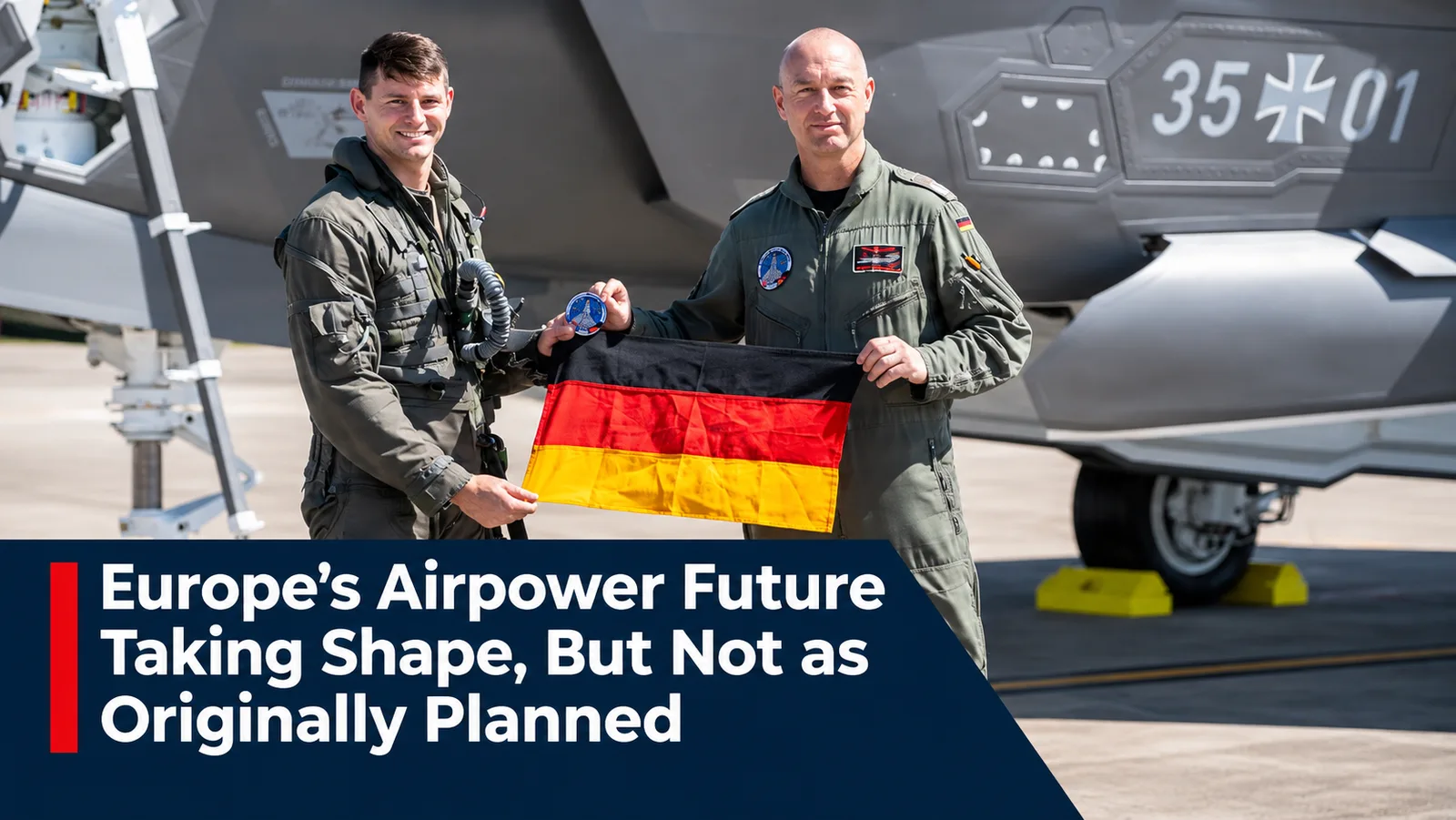
Europe's fighter market cannot wait until a new sixth-generation aircraft enters service. The Bundeswehr's 6 October 2026 update confirms a German acquisition of 35 F-35A fighters, intended to progressively replace the Tornado, with initial aircraft and pilot training activities advancing during 2026. This is a funded fifth-generation fleet introduction, not a substitute for every mission envisaged under NGF or GCAP.
Elsewhere, upgraded Eurofighter Typhoons, Rafales and Gripens will remain relevant into the 2040s in at least some air forces. Keeping them effective involves radar and electronic warfare upgrades, mission-data updates, weapons integration, structural life management and secure connectivity. Aircraft already in service can carry new sensors and weapons sooner than a fully new fighter can normally be developed and certified.
The resulting European force mix is likely to feature several generations concurrently. This generates interoperability and sustainment challenges, especially where national fleets rely on different software-release schedules, export-control arrangements and classified mission-data environments.
Collaborative Combat Aircraft Shift the Near-Term Equation
Collaborative combat aircraft are emerging as a complementary investment category. A CCA may extend sensing, serve as a decoy, perform electronic attack or carry an additional weapons payload. Unlike a low-cost FPV drone, a jet-powered collaborative aircraft requires more demanding autonomy assurance, airworthiness, secure communications, mission integration and maintenance.
Airbus and Kratos have reported tangible progress. In its 12 October 2026 announcement, Airbus said the U740 Valkyrie completed its first European flight, including rocket-assisted take-off, manoeuvres at different altitudes and speeds up to Mach 0.8, and in-flight mission changes. Airbus is developing its MARS European mission system for subsequent integration and continues to target an operational CCA offering for Germany by 2029.
The flight is a meaningful air-vehicle milestone. It is not proof of a complete MARS-enabled combat mission, Eurofighter teaming, autonomous engagement or German acceptance into operational service. Defence Agenda's U740 first-flight coverage details the difference between the demonstration and the planned mission-system trials.
Breaking Defense also reported an analyst's illustrative estimate that a CCA could cost roughly one-quarter of a crewed fighter. That is not a verified production price, and unit cost will depend heavily on mission payload, size, attrition tolerance, software support, production volume and operating concept. Buying multiple CCAs per crewed fighter can therefore be costly even if each uncrewed aircraft is cheaper than the fighter it supports.
Software Sovereignty Is Becoming a Procurement Requirement
Aircraft ownership and operational independence are not identical. A customer may operate a platform but still rely on a foreign prime contractor for mission software, source-code changes, cryptographic systems or sensor integration. This makes data rights and update authority central to acquisition negotiations, particularly for software-defined autonomous aircraft.
Germany has adopted one notable approach through the CFSN experiment. On 4 November 2026, Helsing delivered the MissionOSBw source code and development materials to the German procurement authority, according to Defence Agenda's reporting on the handover. The government-owned model is intended to enable independent integration and replacement of system components. Ownership by the state, however, is not the same as public open-source publication or proof of completed operational validation.
On the industrial side, Airbus is marketing its MARS mission system as a means of retaining European control over a mission layer carried on the US-origin Valkyrie airframe. These arrangements offer distinct compromises: rapid airframe acquisition may accelerate experimentation, while local autonomy development and in-country maintenance could strengthen future upgrade control. Such benefits depend on the actual licences, interface documentation and export conditions signed by the parties.
Comparing Europe’s Combat-Air Pathways
| Pathway | Verified 2026 position | Public milestone | Principal limitation |
|---|---|---|---|
| GCAP (UK–Italy–Japan) | Trilateral programme with a £4.6bn next-stage design contract | Targeted service entry from 2035 | Workshare, affordability and integration risk |
| Former common FCAS/NGF fighter | Shared aircraft structure broken down; other FCAS technology strands continue | Phase 1B work concluding by end-2026 | No replacement multinational fighter arrangement confirmed |
| French national ACF concept | National fighter direction described by air force leadership | Conventional-mission ambition around 2040 | Development financing and industrial timetable unresolved |
| German F-35A fleet | 35 aircraft being acquired, with training and transition under way | Introduction during the late 2020s | Dependence on foreign sustainment and software ecosystems |
| Airbus–Kratos U740 CCA | First European air-vehicle flight completed | Airbus operational-offering target in 2029 | Mission system, teaming and procurement decision outstanding |
The table does not rank alternatives. They serve different operational horizons and partly overlapping missions. A state can invest in near-term fighters and collaborative aircraft while retaining a long-term interest in a new-generation crewed platform.
Industrial Consequences for European and Allied Suppliers
For aerospace suppliers, the rupture of the former NGF partnership redistributes opportunities rather than automatically increasing total demand. A national programme may prioritise domestic design control, whereas a multinational programme can offer scale but require complicated workshare settlements. Subcontractors need to assess funded work packages and qualified-supplier routes rather than relying on programme announcements alone.
Software interfaces, autonomy verification, electronic warfare, advanced propulsion, composite structures and sustainment services are potentially relevant across several pathways. The counterargument is that programme fragmentation could duplicate fixed development costs and delay interoperability gains. Nor does a growing CCA market automatically improve margins: certification demands, production-rate assumptions and export restrictions can narrow the apparent cost advantage.
European programmes may be relevant to Türkiye's aerospace industry through future supply-chain partnerships, but no new Turkish participation in GCAP, ACF or German CCA procurement is established by the cited announcements. The Defence Agenda overview of European wingman aircraft provides comparative industrial context without implying an awarded Turkish contract.
Implications / Next: The Decisions to Watch
Three milestones will clarify Europe's combat-air direction. First, France, Germany and Spain must define the post-NGF industrial and contractual position beyond FCAS Phase 1B at the end of 2026. Second, GCAP must translate its July 2026 design contract into agreed architecture, industrial delivery responsibilities and a credible route to 2035. Third, European CCA teams must move beyond aircraft demonstrations into government-funded mission-system integration, security certification, weapons and crewed-uncrewed teaming tests.
Germany's next procurement decisions are particularly consequential, but no confirmed German entry into GCAP or nationally funded replacement sixth-generation fighter order can be inferred from current reporting. Europe's future airpower may become more distributed and software-defined; its success will be measured by tested interoperability, accepted platforms, long-term sustainment and realistic costs—not by the number of concepts displayed at air shows.