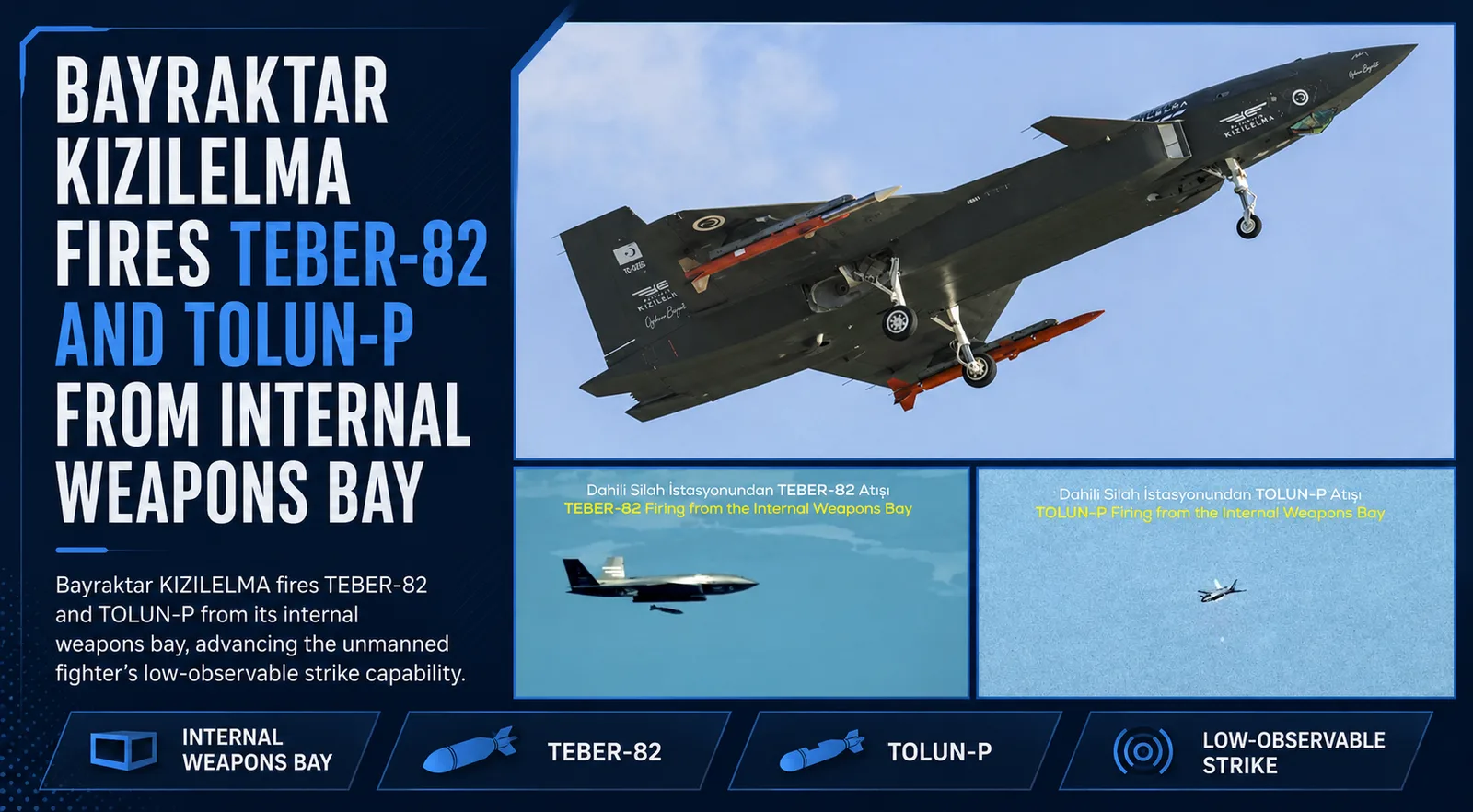
KIZILELMA internal weapons bay testing has reached a major milestone after Bayraktar KIZILELMA S2 released TEBER-82 and TOLUN-P precision weapons from inside its fuselage during two live-fire tests in July 2026.
According to SavunmaSanayiST’s report on the tests, KIZILELMA conducted the first firing from its internal weapon station on 25 July using a ROKETSAN TEBER-82. A second test followed on 28 July with an ASELSAN TOLUN-P.
Both missions were conducted from the AKINCI Flight Training and Test Center in Çorlu, Tekirdağ, and the weapons struck their designated targets.
The tests are significant because the official Baykar KIZILELMA specification identifies low radar cross-section as one of the aircraft’s principal design features. Moving weapons from external stations into the fuselage can reduce aerodynamic drag and avoid some of the radar reflections generated by externally carried stores.
ROKETSAN’s official TEBER guidance-kit information describes TEBER-82 as a precision-guided weapon based on the Mk-82 general-purpose bomb, using inertial, satellite and semi-active laser guidance. ASELSAN’s public TOLUN documentation describes the baseline TOLUN as a compact GPS/INS-guided precision weapon, although the detailed specification of the TOLUN-P version used in the KIZILELMA test has not been publicly released in the cited documentation.
Key Facts
- Aircraft: Bayraktar KIZILELMA S2 serial-production prototype.
- Milestone: First reported weapon firings from KIZILELMA’s internal weapons bay.
- First test: 25 July 2026.
- Weapon: ROKETSAN TEBER-82.
- Second test: 28 July 2026.
- Weapon: ASELSAN TOLUN-P.
- Location: AKINCI Flight Training and Test Center, Çorlu, Tekirdağ.
- Result: Both weapons struck designated targets, according to SavunmaSanayiST.
- Operational significance: Internal carriage supports the aircraft’s low-observable strike configuration.
- Published KIZILELMA payload: 1,500 kg.
- Published maximum take-off weight: 8,500 kg.
- Published combat radius: 500 nautical miles.
- Published maximum speed: Mach 0.9 for the current listed configuration.
- Previous weapon integrations: TOLUN, TEBER-82, LGK-82, KGK, GÖKDOĞAN and JET-230.
What Did KIZILELMA Fire From Its Internal Weapons Bay?
KIZILELMA used two different Turkish precision-strike weapons during the July test sequence.
The first firing involved ROKETSAN’s TEBER-82 guidance kit. The second involved ASELSAN’s TOLUN-P.
The tests demonstrated that the aircraft can carry, release and employ different air-to-ground weapons from its internal fuselage bay rather than relying exclusively on under-wing or external hardpoints.
Successful internal release is more complex than simply placing a weapon inside the aircraft. The munition must separate safely after the doors open while the aircraft is moving at high speed and while airflow around the fuselage and bay changes rapidly.
Why Is an Internal Weapons Bay Important for KIZILELMA?
Internal weapon carriage supports two of KIZILELMA’s principal design objectives: reduced radar visibility and improved aerodynamic efficiency.
Externally carried bombs and missiles can increase the radar-reflective geometry of an aircraft. They can also generate additional drag.
Carrying weapons inside the fuselage allows the external shape of the aircraft to remain cleaner during parts of a mission and can reduce the radar contribution of the weapon and its mounting hardware.
This does not mean that the aircraft becomes invisible to radar. Actual detectability depends on aircraft geometry, materials, coatings, engine installation, frequencies used by opposing radars, viewing angle and other factors.
No measured radar-cross-section figure for the current production-standard KIZILELMA has been publicly released.
What Did the TEBER-82 Test Demonstrate?
The 25 July mission demonstrated the release and employment of a comparatively large precision-guided weapon from the internal bay.
ROKETSAN describes TEBER as a guidance kit that converts Mk-81 and Mk-82 general-purpose bombs into precision weapons using inertial navigation, GPS and semi-active laser guidance.
The company’s current product information lists TEBER-82 at approximately 270 kg, while another current ROKETSAN catalogue gives approximately 260 kg. Published dimensions and weights therefore vary slightly between company documents.
The official product page lists a general TEBER engagement range of 2–28 km. ROKETSAN’s air-systems catalogue separately identifies UAV employment distances depending on configuration and release conditions.
The July KIZILELMA report does not disclose the release altitude, release speed, launch distance or guidance mode used in the internal-bay test.
What Is TOLUN-P?
TOLUN-P is identified in the test report as an ASELSAN-developed precision weapon integrated with KIZILELMA.
ASELSAN’s publicly available baseline TOLUN documentation describes TOLUN as a compact GPS/INS-guided munition designed for precision attacks against soft and hardened targets.
The baseline TOLUN document lists a weight of 139 kg, a maximum published range of 55 nautical miles and a penetration capability against reinforced concrete under specified conditions.
Those figures should not automatically be applied to TOLUN-P. The specific TOLUN-P configuration used during the July 2026 internal-bay test has not been described in a complete current technical specification in the official material cited here.
Defence Turkey has previously reported that TOLUN-P exists in multiple variants and has been integrated with KIZILELMA, AKINCI and ANKA III.
TEBER-82 and TOLUN Family Comparison
The table below uses official public data for TEBER-82 and baseline TOLUN. It does not assume that every published baseline TOLUN specification applies unchanged to TOLUN-P.
| Capability Area | TEBER-82 | Baseline TOLUN | July 2026 KIZILELMA Test Relevance |
|---|---|---|---|
| Manufacturer | ROKETSAN | ASELSAN | Both companies supplied weapons used in the internal-bay test sequence |
| Weapon architecture | Guidance kit fitted to Mk-82 general-purpose bomb | Purpose-designed compact precision munition | Demonstrates compatibility with two different weapon form factors |
| Published weight | Approximately 260–270 kg depending on ROKETSAN document | 139 kg for baseline TOLUN | TOLUN-P test configuration may differ from baseline TOLUN |
| Guidance | INS, GPS and semi-active laser | GPS and INS in baseline configuration | Provides different guidance options for precision strike |
| Published range | Up to 28 km on the current product page; platform-dependent values also published | 55 nautical miles for baseline TOLUN | No release range was announced for either July test |
| Target type | Static and moving ground targets | Soft and hardened targets | Expands KIZILELMA’s precision air-to-ground mission options |
| Internal-bay KIZILELMA firing | 25 July 2026 | TOLUN-P fired on 28 July 2026 | First reported KIZILELMA firing sequence from the internal weapon station |
How Does Internal Weapon Release Affect Aerodynamics?
Opening an internal weapons bay changes the airflow around an aircraft.
The open cavity creates turbulence, pressure fluctuations and separated airflow. These effects can influence both the aircraft and the weapon being released.
The munition must move away from the fuselage without striking the bay doors or being pushed back toward the aircraft by the disturbed airflow.
Release testing therefore validates more than the weapon itself. It also evaluates door sequencing, ejector or release mechanisms, weapon separation, flight-control response and software timing.
The published source confirms successful target engagement but does not disclose detailed separation-test data, release envelopes or aerodynamic measurements.
Does the Test Prove KIZILELMA’s Stealth Performance?
The test demonstrates operational use of an internal weapons bay, but it does not by itself quantify the aircraft’s radar signature.
Internal carriage is one engineering method used to reduce radar reflections from externally mounted weapons and pylons.
Baykar officially lists low radar cross-section among KIZILELMA’s advanced features, but no publicly available measurement establishes the aircraft’s detection range against specific radars.
The most accurate conclusion from the July tests is that KIZILELMA can now release precision weapons from the internal bay while retaining the external configuration intended to support reduced observability.
What Weapons Has KIZILELMA Tested So Far?
KIZILELMA’s weapons-integration campaign has expanded rapidly since its first live-fire missions.
- TOLUN: Precision air-to-ground munition
- TEBER-82: Guided Mk-82-class air-to-ground weapon
- LGK-82: Laser-guided Mk-82-class weapon
- KGK: Wing-assisted guidance-kit family
- GÖKDOĞAN: Beyond-visual-range air-to-air missile
- JET-230: Air-launched supersonic missile
- TOLUN-P: Precision weapon used in the July 2026 internal-bay test
The integration of both air-to-air and air-to-ground weapons reflects Baykar’s objective of developing KIZILELMA as a multi-role unmanned combat aircraft rather than a conventional strike-only UAV.
How Does the July Test Differ From Earlier TOLUN and TEBER Firings?
KIZILELMA had already used TOLUN and TEBER-82 during earlier live-fire testing.
In October 2025, the PT-3 prototype conducted separate sorties with ASELSAN TOLUN and ROKETSAN TEBER-82 and successfully struck ground targets.
The critical difference in July 2026 was the carriage and release location.
The latest tests moved the weapons into the aircraft’s internal bay, validating a configuration more closely aligned with KIZILELMA’s low-observable combat concept.
How Does the JET-230 Test Fit Into KIZILELMA’s Weapons Roadmap?
The internal-bay firings followed another major weapons milestone earlier in July.
On 13 July, KIZILELMA S2 launched ROKETSAN’s JET-230 from an external station during testing at Merzifon.
Baykar stated that the weapon was released from more than 120 km and struck its target. The company describes JET-230 as a supersonic air-to-ground weapon.
Together, the JET-230 and internal-bay tests demonstrate two different carriage concepts: external carriage for larger stand-off weapons and internal carriage for missions where reduced radar signature may be more important.
What Are KIZILELMA’s Current Published Specifications?
Baykar currently publishes the following baseline performance figures for KIZILELMA:
- Maximum take-off weight: 8,500 kg
- Payload capacity: 1,500 kg
- Combat radius: 500 nautical miles
- Endurance: More than three hours
- Cruise speed: Mach 0.6
- Maximum speed: Mach 0.9
- Operational altitude: 25,000 feet
- Service ceiling: 45,000 feet
- Wingspan: 10 metres
- Length: 14.5 metres
- Height: 3.5 metres
- Powerplant: Turbofan engine
- Communications: LOS and BLOS
Baykar also lists subsonic, transonic and supersonic variants in its current technical material. The company does not provide a public variant-by-variant specification for every production aircraft.
What Sensors Support KIZILELMA’s Strike Missions?
KIZILELMA is being developed with an integrated sensor suite intended to support both air-to-air and air-to-ground missions.
Baykar identifies a multimode AESA radar, electro-optical targeting system and infrared search-and-track capability among the platform’s planned or integrated mission equipment.
Earlier tests have involved ASELSAN’s MURAD AESA radar and TOYGUN electro-optical targeting system.
Sensor integration is important for internal weapons because the aircraft may need to find, identify and designate targets without relying on externally mounted targeting pods that could increase drag or radar signature.
What Does Internal Carriage Mean for SEAD and Deep Strike?
An aircraft configured with internal weapons can be better suited to missions where radar detectability and survivability are major concerns.
This could support mission concepts such as penetration strike, suppression of enemy air defences and destruction of enemy air defences.
Baykar lists strategic attack and SEAD-DEAD among KIZILELMA’s intended mission profiles in its current technical material.
Operational effectiveness in these roles will depend on more than weapon carriage. It will also require electronic warfare, accurate threat geolocation, resilient communications, mission planning, sensor fusion and survivability against modern air-defence systems.
The July firing tests validate one part of that larger mission architecture but do not independently demonstrate a complete SEAD-DEAD capability.
How Does KIZILELMA Compare With Conventional Armed UAVs?
| Capability Area | Conventional Armed MALE UAV | KIZILELMA Concept |
|---|---|---|
| Propulsion | Typically turboprop or piston | Turbofan |
| Weapon carriage | Primarily external stations | Internal and external carriage |
| Radar-signature design | Usually not the primary design driver | Low-RCS shaping identified as a core feature |
| Air-to-air role | Limited or secondary | Integral part of the mission concept |
| Speed | Generally lower subsonic speeds | Mach 0.9 published maximum for current configuration; faster variants planned |
| Mission concept | Persistent ISR and strike | Air combat, strike, SEAD-DEAD and human-unmanned teaming |
What Remains to Be Tested?
Internal-bay weapon release is one stage in a broader qualification process.
- Weapon release across a wider speed and altitude envelope
- Repeated opening and closing of the bay at operational speeds
- Safe separation with different weapons
- Multiple internal-store configurations
- Air-to-air missile carriage inside the bay
- Release during higher-G manoeuvres
- Electromagnetic compatibility between aircraft and weapons
- Operation under electronic warfare and GNSS disruption
- Environmental and vibration qualification
- Mission-system integration with sensors and targeting networks
- Operational testing with crewed and uncrewed aircraft
Baykar has not published a complete internal-bay loadout, maximum internal payload figure or all approved weapon combinations.
Why Does the S2 Aircraft Matter?
The July firings were conducted by KIZILELMA S2, which Baykar identifies as a serial-production-model aircraft.
Testing weapons on a production-representative aircraft is important because it moves qualification closer to the configuration intended for operational service.
Earlier prototypes were used to validate flight characteristics, avionics, propulsion and initial weapons integration.
The S-series aircraft reflect changes introduced as the programme transitions from prototype development toward serial manufacture.
What Does the Test Mean for KIZILELMA’s Development?
The internal-bay firings close an important gap between the aircraft’s low-observable design concept and its demonstrated weapons capability.
KIZILELMA had previously demonstrated precision strike, beyond-visual-range air-to-air engagement and supersonic air-to-ground weapon employment.
The July tests add the ability to employ weapons from inside the fuselage.
This gives the programme additional flexibility to balance payload, range, aerodynamic performance and radar signature according to the mission.
Conclusion
Bayraktar KIZILELMA’s first reported internal-weapons-bay firing tests represent a significant step in the aircraft’s transition toward a low-observable multi-role combat configuration.
The S2 aircraft released ROKETSAN TEBER-82 on 25 July and ASELSAN TOLUN-P on 28 July from its internal weapon station, with both weapons striking their designated targets according to SavunmaSanayiST.
The tests demonstrate that precision-guided weapons can be carried and released without relying exclusively on external pylons, supporting the aircraft’s intended reduced-radar-signature configuration.
They do not, however, quantify KIZILELMA’s radar cross-section or independently establish operational survivability against modern integrated air-defence systems.
The next important indicators will be expansion of the internal weapon-release envelope, integration of additional munitions and qualification of the internal bay for operational service.
For related coverage, visit Defence Agenda’s aerospace, unmanned systems and air warfare sections. Related reports include ANKA III’s upgraded serial-production configuration, Anduril YFQ-44A production at Arsenal-1 and Airbus MARS networked UAV autonomy.