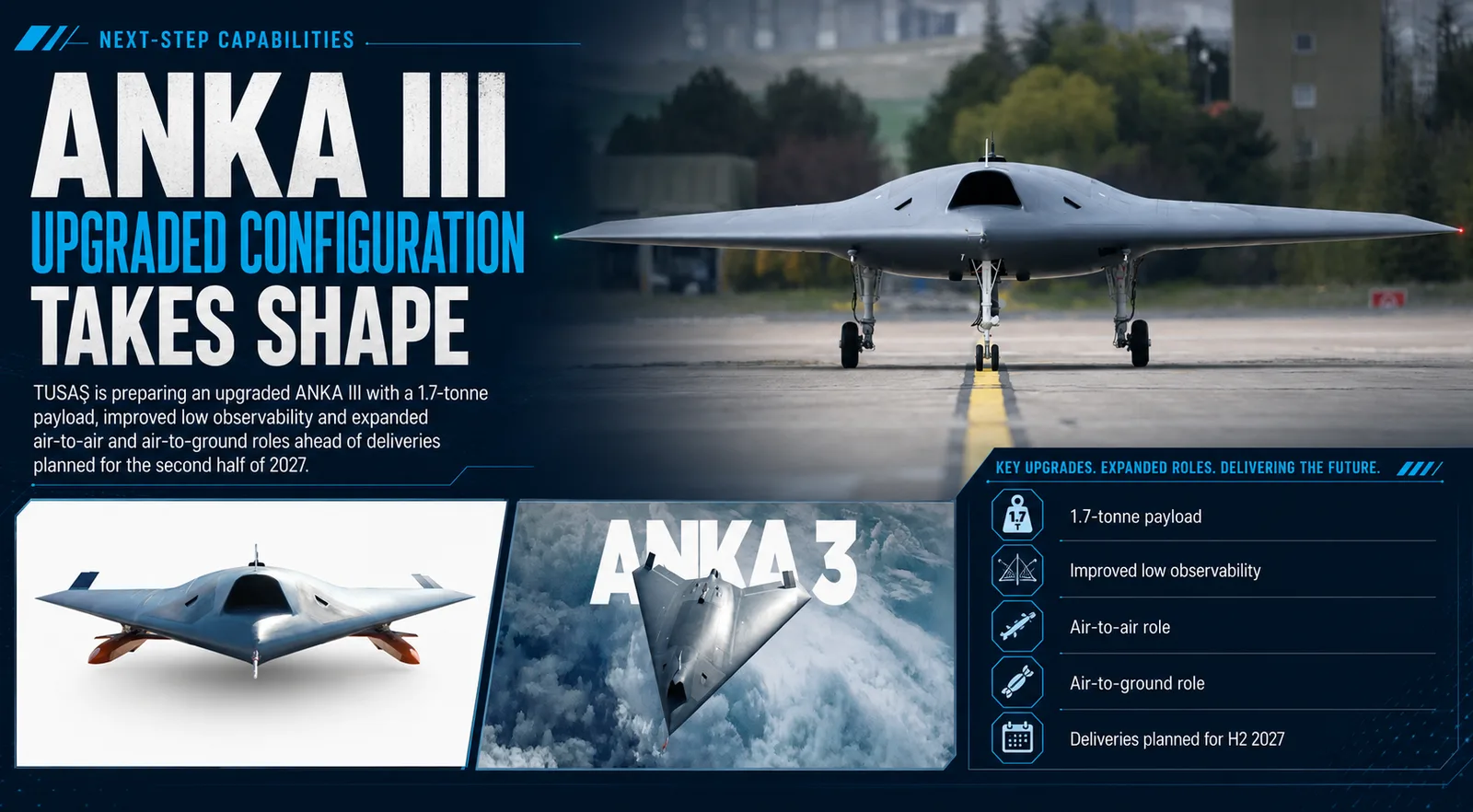
ANKA III 2027 deliveries are expected to begin in the second half of the year after TUSAŞ completes an upgraded serial-production configuration with greater payload, improved range and expanded combat capabilities.
According to DefenceTurk’s report on the updated ANKA III programme, TUSAŞ General Manager Mehmet Demiroğlu said lessons from the aircraft’s first two prototypes had been incorporated into a substantially revised design.
The new configuration is described as the final configuration intended for serial production. Prototype manufacturing has started, with the first updated aircraft expected to emerge by the end of 2026 and make its first flight during the first quarter of 2027.
The latest statement goes beyond the specifications currently published on the official TUSAŞ ANKA III product page. TUSAŞ currently lists a maximum take-off weight of 6,500 kg, a payload capacity of 1,200 kg, endurance of up to 10 hours and a maximum speed of 0.7 Mach.
Key Facts
- Updated payload: The serial-production configuration is expected to carry up to 1.7 tonnes.
- Previous development figure: Demiroğlu referred to an increase from 1.3 tonnes to 1.7 tonnes.
- Published TUSAŞ baseline: The current product page continues to list a payload capacity of 1,200 kg.
- New prototype: The updated aircraft is expected to emerge by the end of 2026.
- First flight target: The first quarter of 2027.
- Delivery target: The second half of 2027.
- Mission expansion: Air-to-ground and air-to-air engagements.
- Low observability: Further radar-cross-section reductions and improved coatings are planned.
- Engine: The current Ukrainian engine remains available, while TF6000 and alternative engines are being evaluated.
- Export prospects: TUSAŞ reports significant domestic and international interest.
What Has Changed in the New ANKA III Configuration?
The second ANKA III configuration incorporates design changes derived from testing the first two prototypes. TUSAŞ used the prototype campaign to identify aerodynamic, structural, manufacturing and systems-integration areas requiring further development.
Demiroğlu described the revised aircraft as the final serial-production configuration. The changes are intended to improve both operational performance and the repeatability of series manufacturing.
The update includes a higher payload capacity, greater flight range, longer endurance, additional low-observable refinements and an expanded mission set covering both air-to-ground and air-to-air engagements.
How Much Payload Will the Upgraded ANKA III Carry?
The most significant numerical change announced for the updated aircraft is an increase in payload capacity from approximately 1.3 tonnes to 1.7 tonnes.
This represents an increase of approximately 400 kg compared with the development figure cited by Demiroğlu. The additional capacity could support heavier weapons, additional fuel, electronic-warfare payloads, reconnaissance sensors or combined mission configurations.
However, the official TUSAŞ product page currently lists a payload capacity of 1,200 kg. The difference indicates that the website continues to describe the earlier published configuration rather than the latest serial-production design.
TUSAŞ has not yet published a complete revised technical data sheet confirming the updated maximum take-off weight, internal payload allocation or external-station limits.
ANKA III Prototype and Production Configuration Comparison
The comparison below distinguishes between the specifications currently published by TUSAŞ and the updated serial-production configuration described by the company’s general manager.
| Capability Area | Published ANKA III Baseline | Updated Serial-Production Configuration | Operational Significance |
|---|---|---|---|
| Development status | Two initial prototypes used for testing and development | Final serial-production configuration under prototype manufacture | Moves the programme from experimental testing toward operational production |
| Payload capacity | 1,200 kg on the current TUSAŞ product page; 1.3 tonnes cited as the development configuration | Up to 1.7 tonnes | Supports heavier weapons, sensors, fuel or electronic-warfare payloads |
| Maximum take-off weight | 6,500 kg on the current product page | Increased, but the revised figure has not been disclosed | Provides additional growth margin for payload and fuel |
| Endurance | Up to 10 hours at 30,000 feet | Increased, with no revised figure announced | Extends patrol, strike and electronic-warfare mission time |
| Flight range | No maximum-range figure published on the current product page | Increased, with no exact value disclosed | Allows operations at greater distance from the launch base |
| Maximum speed | 425 knots or Mach 0.7 at 30,000 feet | No revised maximum-speed figure announced | Maintains high-subsonic performance for rapid mission response |
| Service ceiling | 40,000 feet | No revised ceiling disclosed | Supports high-altitude surveillance and strike missions |
| Low observability | Flying-wing configuration and reduced radar observability | Further radar-cross-section reductions and improved paint and coating applications | Improves survivability in contested airspace |
| Mission set | Air-to-ground strike, ISR and electronic warfare | Air-to-ground and air-to-air engagements | Expands the aircraft from a strike platform toward a broader combat-air role |
| Weapons stations | Two internal and five external payload stations | Revised station capacities have not been disclosed | Internal carriage supports lower observability, while external stations increase load flexibility |
| Programme timeline | Prototype and weapons-integration testing | Prototype completion by end-2026, first flight in Q1 2027 and deliveries in H2 2027 | Establishes the transition toward operational service |
How Is ANKA III’s Low Observability Being Improved?
ANKA III already uses a tailless flying-wing configuration intended to reduce radar reflections compared with conventional aircraft designs.
The updated configuration includes additional refinements intended to reduce its radar cross-section. Demiroğlu also referred to advances in the paint and coating processes applied to the aircraft.
Low observability depends on more than the external shape of the aircraft. Materials, panel alignment, surface quality, engine installation, air intakes, exhaust treatment, payload carriage and production tolerances can all influence the final radar signature.
The emphasis on serial-production improvements suggests that TUSAŞ is working to ensure low-observable characteristics can be reproduced consistently across multiple aircraft rather than demonstrated only on individual prototypes.
Will ANKA III Conduct Air-to-Air Missions?
The revised ANKA III is being developed for both air-to-ground and air-to-air engagements, according to Demiroğlu.
The statement represents an expansion beyond the platform’s initial public positioning as an unmanned air-to-ground mission aircraft. An air-to-air role could include self-defence, engagement of slow-moving aerial targets, cooperative operations with crewed fighters or missions against other unmanned aircraft.
TUSAŞ has not disclosed the missiles, sensors, radar, data links or rules of engagement associated with the planned air-to-air capability.
The practical scope of the capability will therefore depend on future weapons integration, sensor performance, command-and-control architecture and operational testing.
What Weapons Can ANKA III Carry?
The current TUSAŞ product information lists precision-guided bombs, laser-guided rockets and anti-tank missiles among the platform’s potential weapons.
ANKA III has already conducted ammunition tests with weapons including the TEBER-82 guidance kit and TOLUN precision-guided munition. TUSAŞ has also reported a successful LGK-82 laser-guided munition test.
Its two internal and five external payload stations provide two different operating approaches. Internal carriage can help preserve low observability, while external stations allow the aircraft to carry larger or more diverse mission loads where radar signature is less important.
The 1.7-tonne payload target could enable more flexible combinations of weapons, sensors, fuel tanks, electronic-warfare systems and air-launched unmanned vehicles.
Which Engine Will Power the Production ANKA III?
The programme currently uses a Ukrainian engine. Demiroğlu said there was no immediate problem with the engine supply but confirmed that TUSAŞ was monitoring the development of the indigenous TEI-TF6000 and evaluating additional engine alternatives.
The official TEI-TF6000 product page describes the engine as a 6,000-lbf indigenous turbofan designed to support future manned and unmanned aircraft applications.
TEI states that the engine has a two-stage axial fan, six-stage axial compressor, single-stage high-pressure turbine and single-stage low-pressure turbine.
No final decision has been publicly announced regarding the use of TF6000 on ANKA III. Engine integration would require extensive work involving air intake compatibility, aircraft structure, flight-control software, fuel systems, thermal management and flight testing.
When Will the New ANKA III Fly?
Manufacturing of the new production-standard prototypes has started. TUSAŞ expects the first aircraft to emerge by the end of 2026.
The first flight of the revised version is planned for the first quarter of 2027. This flight will begin a new qualification campaign covering the aircraft’s updated aerodynamics, structure, flight controls, payload capacity, coatings and mission systems.
Further testing will likely be required before customer deliveries, particularly for air-to-air integration and the higher payload configuration.
When Will ANKA III Deliveries Begin?
TUSAŞ is targeting the second half of 2027 for the start of ANKA III deliveries.
The statement does not disclose the number of aircraft in the initial delivery batch, the final customer configuration or the exact delivery month.
TUSAŞ’s official product information states that ANKA III is intended for delivery to the Turkish Air Force within the planned programme schedule.
The delivery target will depend on the progress of prototype production, first-flight testing, weapons integration, low-observable qualification and serial-production preparations.
Is There International Interest in ANKA III?
Demiroğlu said ANKA III had attracted serious interest from both domestic and international parties.
The combination of a flying-wing design, turbofan propulsion, internal weapons carriage, electronic-warfare options and a 1.7-tonne payload could position ANKA III between conventional armed drones and more expensive crewed combat aircraft.
Potential export customers would still need information on acquisition cost, engine availability, weapons compatibility, data-link security, support infrastructure and technology-transfer conditions.
No export customer, contract, quantity or delivery schedule has been publicly announced in connection with the latest statement.
Why Does the Upgrade Matter for Türkiye?
The updated ANKA III represents Türkiye’s effort to move from armed surveillance drones toward high-speed, low-observable unmanned combat aircraft capable of operating in more contested environments.
A platform able to conduct strike, electronic-warfare, intelligence and air-to-air missions could complement crewed aircraft while reducing direct risk to pilots.
It could also support manned-unmanned teaming, distributed sensor operations and coordinated missions involving other Turkish unmanned platforms.
The planned increase in payload and endurance also gives the programme greater flexibility for future sensors, weapons and propulsion systems.
What Are the Main Programme Risks?
The 2027 schedule remains dependent on the successful completion of several technically demanding activities.
- Completing the revised prototype on schedule
- Validating the higher maximum take-off weight and payload
- Confirming improved endurance and range
- Qualifying revised low-observable coatings and manufacturing processes
- Integrating air-to-air sensors and weapons
- Securing a sustainable engine supply
- Transitioning from prototype manufacture to serial production
- Completing operational and customer acceptance testing
The company has not published a complete revised specification sheet or detailed production schedule. The announced figures should therefore be treated as programme targets until demonstrated through testing and confirmed in official technical documentation.
Conclusion
ANKA III is moving toward a substantially upgraded serial-production configuration ahead of planned deliveries in the second half of 2027.
The revised aircraft is expected to carry up to 1.7 tonnes, remain airborne for longer, fly farther and achieve a lower radar cross-section through design, coating and manufacturing improvements.
Its planned ability to conduct both air-to-ground and air-to-air engagements would also broaden the platform’s operational role beyond its original strike-aircraft positioning.
The next key milestones will be completion of the updated prototype by the end of 2026, first flight in the first quarter of 2027 and qualification ahead of initial deliveries.
For related coverage, visit Defence Agenda’s aerospace, unmanned systems and defence industry sections. Related reports include BETA MV250 hybrid-electric military VTOL, HÜRKUŞ 2 export talks with Azerbaijan and ASELFLIR-500 integration with Mwari.