US European Command (EUCOM) launched a Europe-wide force-protection awareness campaign on 2 November 2026, urging service members, civilian employees and military families to report unusual activity, safeguard personal information and adopt a more security-conscious approach to everyday routines. The initiative, branded “See Something, Do Something”, comes as NATO countries confront concerns about drones, cyber incidents and suspected sabotage. For commanders, the significance is not a new combat deployment but an effort to make personnel security part of operational readiness across the European theatre. The official EUCOM announcement confirms the campaign; Defense News reported on its broader threat context on 6 November 2026.
What EUCOM Announced on 2 November
In its release from Stuttgart, Germany, EUCOM described the vigilance campaign as a theatre-wide effort to strengthen personal security, community resilience and the protection of military installations. Its audience includes military personnel, civilian employees and family members, recognising that risks to readiness do not stop at the perimeter of an airbase or barracks.
The announcement identifies three practical themes: situational awareness and reporting, digital discipline, and avoiding overly predictable personal routines. Personnel are encouraged to report suspicious behaviour or unattended items through military police or host-nation authorities. The digital component addresses unnecessary exposure of travel, location and unit-related information through public posts, device settings and fitness applications. The overall message is that timely, appropriate reporting can help security organisations assess possible risks before they disrupt routine activity.
EUCOM commander Gen. Alexus G. Grynkewich linked the initiative to the safety of personnel and families and to the preservation of combat readiness. The campaign is intended to support coordination with host-country law enforcement and NATO partners, rather than replace local emergency procedures or command-specific protective measures.
Importantly, the 2 November release does not name a specific attack as its trigger. It does not announce a new base-wide alert level, deployment of additional counter-drone equipment, a procurement award or a change to NATO's military posture. Those distinctions matter because an awareness initiative can be relevant to a deteriorating security environment without constituting evidence that a particular incident is imminent.
Why the European Hybrid-Threat Environment Matters
In its 6 November report, Defense News placed EUCOM's announcement against rising concern about uncrewed aircraft near sensitive locations, electronic interference, attempted sabotage, intimidation and hostile activity in the information environment. Some incidents described in European reporting remain under investigation, and attribution can be difficult where perpetrators use proxies, anonymous messages or deniable methods.
NATO defines hybrid threats as the combination of conventional and non-conventional methods, including cyber operations, disinformation, economic coercion and sabotage. Its countering hybrid threats guidance, updated 29 January 2026, stresses that the primary responsibility to respond normally rests with the affected state, while NATO can support Allies through coordination, preparedness and collective defence mechanisms.
In October 2026, NATO and partner representatives met in Bucharest to discuss the protection of critical infrastructure and lessons from recent drone, cyber and sabotage concerns. NATO's 19 October statement attributed a range of hybrid actions to Russia. Such NATO assessments provide strategic context, but they do not establish responsibility for each local security incident described in press reporting. EUCOM's own vigilance announcement did not identify a perpetrator.
RAF Fairford and Airbase Security: Context, Not a Stated Trigger
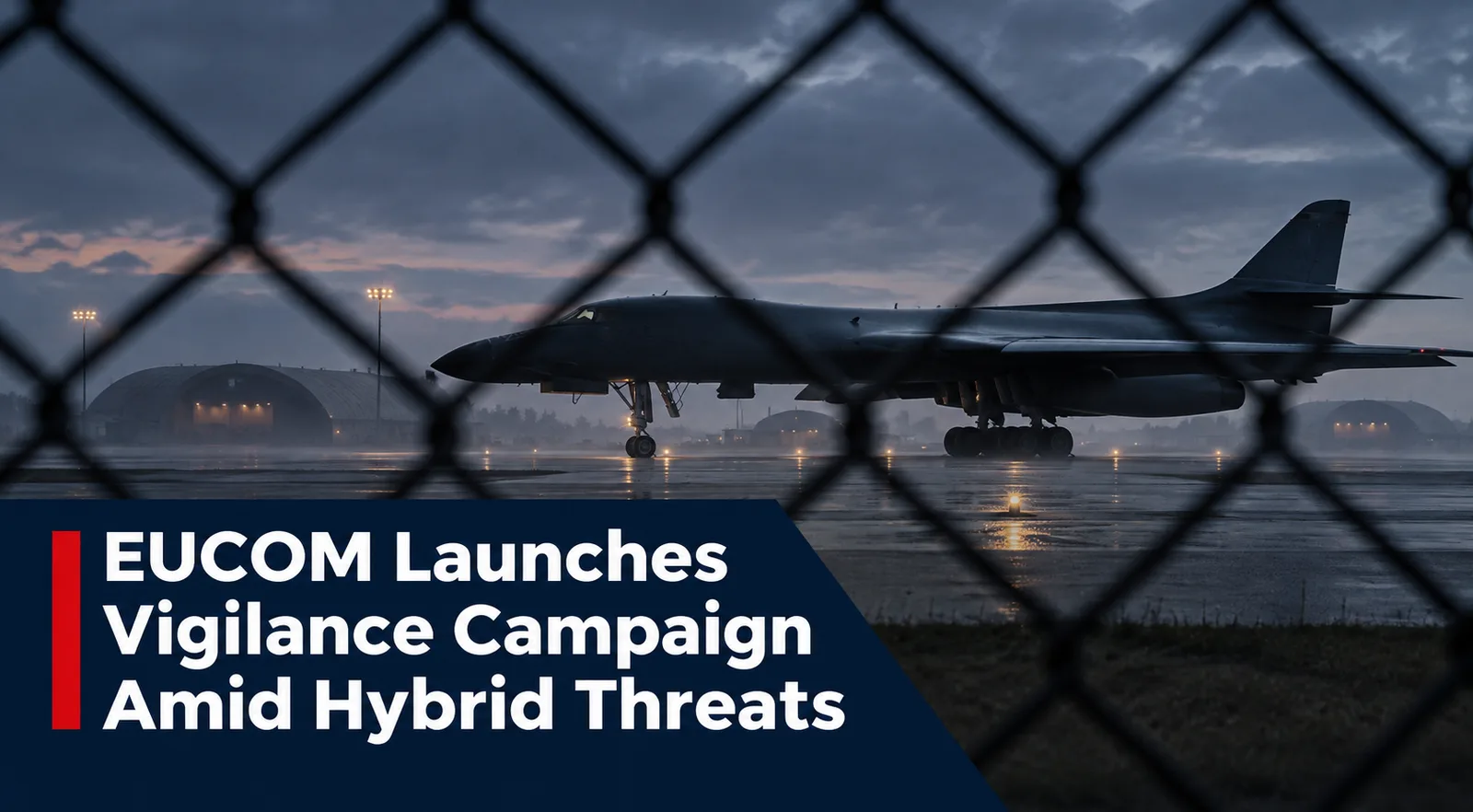
Defense News highlighted the reported security concerns around RAF Fairford, a UK base used by US bombers, alongside other European incidents. Separately, Stars and Stripes reported on 3 November that the US had withdrawn B-1 bombers from Fairford in October amid warnings about possible attacks. UK authorities had been investigating suspected hostile activity and possible foreign involvement. Those reports should remain attributed to the relevant news organisations and authorities, because no publicly available EUCOM campaign statement links the general awareness drive to a single confirmed attacker or one operational decision at Fairford.
The distinction between a reported incident and a verified campaign trigger is essential. Military bases must manage different types of risks, including physical intrusions, disruptive unmanned aircraft, threats to civilian logistics routes and exposure of sensitive personnel movements online. Not every drone sighting is hostile, and technical detection does not by itself determine the identity or intent of an operator. Investigations, corroborating evidence and host-nation legal authorities therefore remain central to any response.
For aircraft and ground-support operations, a prolonged security disruption can reduce available training windows, complicate access and impose additional demands on force-protection teams. However, the public EUCOM release contains no quantification of sortie losses, delays or other operational impacts caused by the campaign itself.
Digital Discipline Becomes a Readiness Requirement
One feature of the November initiative is its attention to information generated outside traditional military networks. Public travel posts, location-enabled social media and connected devices can create unnecessary exposure for people associated with defence installations. EUCOM's guidance therefore extends to families and civilian staff, not just uniformed personnel working on base.
This approach reflects a broader understanding of operational security: a digital footprint can expose patterns even when no classified information is deliberately shared. Security awareness consequently involves routine behaviour, communications habits and the ability to recognise and escalate concerning observations through established channels. The campaign is not evidence that a particular application or device has been compromised.
The official EUCOM vigilance resource page places the campaign under the theme “Vigilant Minds, Vital Readiness, Valued Allies” and directs personnel towards local antiterrorism and emergency-management resources. Its public guidance does not set out a new universal technical standard or provide a procurement requirement for commercial cybersecurity tools.
For programme offices and defence contractors, the relevance is organisational. Workforces involved in logistics, base services, maintenance and technology integration may need clear reporting channels and consistent information-handling practices. Implementing those practices can incur training and administrative costs, but the materials available do not disclose a dedicated EUCOM campaign budget.
NATO Coordination and Counter-Drone Defence
Physical security and digital precautions are complements to, not substitutes for, layered force protection. Military installations also depend on surveillance, access control, local law-enforcement cooperation and specialist capabilities suited to the threat. NATO has separately been strengthening counter-uncrewed-aircraft capabilities and the protection of critical infrastructure; those are distinct programmes rather than newly ordered assets under EUCOM's November awareness campaign.
Defence Agenda's coverage of Northern Viking 2026 and GIUK Gap defence discusses how counter-UAS measures have become part of exercises involving bases and reinforcement routes. Its report on NATO counter-drone investment and training examines the larger industrial and capability agenda. Neither establishes that these resources were allocated specifically to the EUCOM vigilance campaign.
The undersea domain illustrates the same distinction between preparedness and incident attribution. NATO's 21 October 2026 critical undersea infrastructure update emphasised data sharing, resilience and rapid response across governments and infrastructure operators. These developments show how the Alliance is organising for ambiguous threats, while individual investigations still require their own evidence.
Procurement, Implementation and Limits of the Announcement
The campaign is a force-protection communication and behaviour initiative rather than a disclosed acquisition programme. No contract value, supplier selection, equipment quantity, new radar site or force-wide implementation deadline was published in the EUCOM announcement. It would therefore be misleading to present the launch as a purchase of counter-drone systems or as the activation of an entirely new operational command.
There is also a practical limit to what individual vigilance can achieve. Better reporting can support early assessment, but excessive unverified reporting may consume security resources unless procedures are clear. Nor can personal precautions replace technological detection, investigation, intelligence sharing or host-country policing. A sustainable campaign will depend on how clearly installation leaders communicate reporting thresholds, responsibility and feedback to military and civilian communities.
Conversely, focusing exclusively on physical defences would miss other dimensions of the problem. A technically well-protected airbase may still be vulnerable to disruption through surrounding transport networks, public-information exposure or threats to families off base. The value of EUCOM's initiative lies in closing part of that organisational gap without suggesting that awareness alone can eliminate hostile activity.
Defence Agenda's USAF research coverage on drone-based airfield damage assessment offers a separate example of the broader trend towards more resilient airbase operations. It relates to post-attack recovery research, however, not an announced component of the vigilance programme.
Implications / Next
The next public milestones will be updates from EUCOM and individual installations showing how the campaign is communicated, integrated into routine training and coordinated with host-nation authorities. Possible evidence of effectiveness could include more consistent reporting processes, clearer emergency-notification coverage and lessons from exercises; EUCOM has not published quantitative performance targets against which these could yet be tested.
For NATO and US commanders, the wider question is whether personnel protection, digital resilience, counter-UAS systems and civil-military coordination can reinforce one another without unnecessarily disrupting day-to-day operations. For defence industry suppliers, the campaign may sharpen awareness of security requirements around deployed personnel and logistics, but it is not itself a confirmed procurement opportunity. The established fact remains the 2 November 2026 launch of a theatre-wide security-awareness campaign, reported in the context of Europe's hybrid-threat concerns on 6 November.