3D-printable counter-UAS drones have moved into a new US–Australian industrial partnership after MAG Aerospace and Rocket Fast Drones announced the MAG-RFD unmanned-aircraft initiative on 27 October 2026. The companies intend to combine MAG’s US defence-market integration and operating experience with an Australian family of tube-launched, vertical-take-off-and-landing (VTOL) aircraft that can be manufactured largely through additive processes. The initiative addresses the growing demand for affordable, adaptable aircraft for interception, reconnaissance and electronic warfare, but it is not yet evidence of a US military production order or an operationally qualified interceptor.
What the MAG-RFD Partnership Actually Covers
The 27 October MAG Aerospace announcement describes a strategic partnership rather than a named government acquisition award. MAG brings lead-systems-integration expertise, experience operating uncrewed aircraft and relationships in the US defence market. Brisbane-based Rocket Fast Drones contributes its EP-Φ family of small VTOL aircraft and a manufacturing concept that relies heavily on 3D-printed airframes.
The intended applications extend beyond a single counter-drone task. MAG identified counter-uncrewed-aircraft-system (C-UAS) missions, air-launched effects, intelligence, surveillance and reconnaissance (ISR), electronic warfare and attritable strike roles. This breadth matters commercially: the same airframe family may be marketed to buyers with different payload and operating requirements. It does not establish that each configuration has passed the tests required for those missions.
The partnership was announced on 27 October, while The Drone Front's detailed report appeared on 30 October 2026. Those dates refer to the company announcement and subsequent reporting, respectively; they are not evidence of two separate contracts. Neither the initial release nor the reviewed reporting discloses a purchase quantity, contract ceiling, military customer, delivery date or unit price.
3D-Printable Counter-UAS Drone Specifications: Claimed Versus Demonstrated
MAG describes aircraft diameters spanning 90–450 mm, modular payloads up to 2.2 lb (about 1 kg) and an advertised family range of up to 40 nautical miles (about 74 km). The release also cites speeds projected to reach 155 mph (approximately 249 km/h). Because different models are offered, none of these family-wide maxima should be assumed to apply to every aircraft simultaneously or to a particular mission load-out.
The important distinction is between a projected programme figure and a test record. In a 27 September 2026 engineering update, Rocket Fast Drones reported 143 km/h demonstrated cruise and 179 km/h demonstrated maximum speed for its heavily tested EP250. The same update cited a longest single flight of 12.2 km with 40% battery reserve at landing. A longest published flight and an advertised maximum system range measure different things, so the 12.2 km record neither validates nor automatically disproves the wider 74 km claim.
The manufacturer also reported 267 logged flights over 53 flying days and 208 soft landings as of 27 September. These figures provide more useful evidence of repeated operation than a projected headline speed, while leaving open questions about performance with interception payloads, degraded navigation, adverse weather and different launch configurations.
| Performance measure | Public figure | Evidence status |
|---|---|---|
| Family diameter | 90–450 mm | Manufacturer-reported range across aircraft models |
| Family mission range | Up to 40 nautical miles / 74 km | Announced capability; not a verified EP250 endurance trial |
| Future speed ambition | Up to 155 mph / 249 km/h | Projected, not demonstrated |
| EP250 cruise | 143 km/h | Manufacturer-reported flight demonstration |
| EP250 maximum | 179 km/h | Manufacturer-reported flight demonstration |
| Modular payload | Up to 2.2 lb / around 1 kg | Family-wide upper limit, configuration-dependent |
Field Printing Changes the Supply-Chain Proposal
A central selling point is that most structural parts can be manufactured through 3D printing, potentially reducing dependence on long deliveries of complete airframes. Rocket Fast Drones says its designs are created and flight-tested in Australia and manufactured using an in-house printing operation. MAG argues that local production could help provide a larger supply of low-cost aircraft where units need to replace or adapt equipment quickly.
However, field-printable does not mean a complete aircraft can be created from raw material without external components. Motors, electronics, energy storage, optical equipment, sensors and other non-printed elements remain material to availability and cost. Local printing therefore shifts part of the supply-chain challenge rather than eliminating it. Public material does not establish the number of machines, labour hours or quality-assurance resources needed to sustain a particular output rate in deployed conditions.
For programme managers, the procurement issue is repeatability: printed structures need consistent manufacturing controls, traceability and acceptance criteria if they are to support safety-critical use. A design that can be made locally might improve resilience, but the overall economic benefit depends on materials, consumables, components, labour, rejected parts, maintenance and integration. Neither partner has published a validated cost per accepted air vehicle or a comparison with conventionally manufactured alternatives.
The distributed-production proposition also has an export and industrial-policy dimension. An Australian-designed system integrated for US customers may involve licensing, technical-data controls and local servicing arrangements. The partnership does not specify ownership of technical data or a US production location. These are questions for later agreements, not terms that can be inferred from the announcement.
Interceptor Guidance Remains a Development Milestone
The aircraft combine a launch approach that does not require a runway with the ability to transition into forward flight and return for a vertical landing. MAG also describes point-to-point autonomy and potential swarming functions. These characteristics could support multiple mission sets, but autonomous flight is not equivalent to independently verified airborne interception.
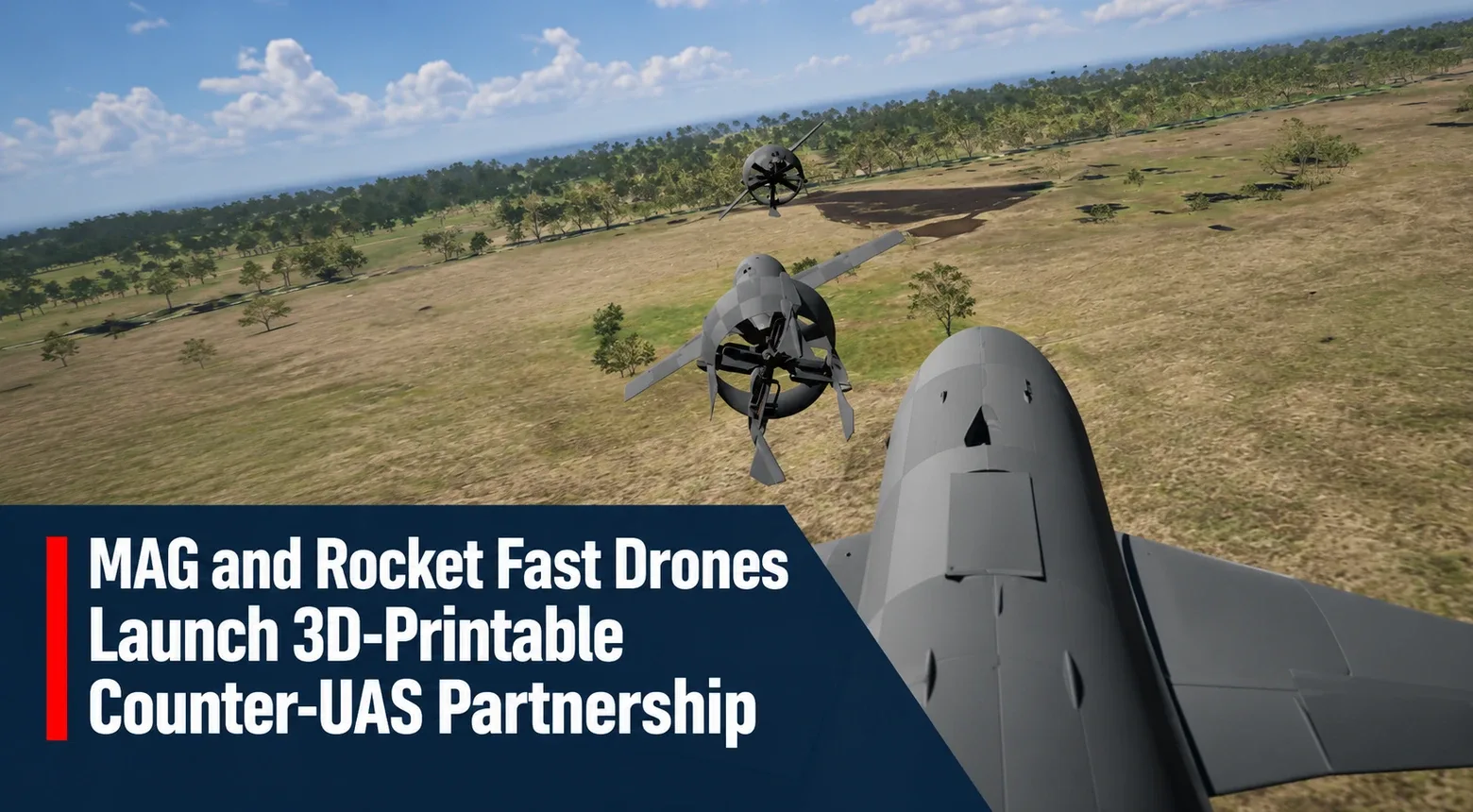
Rocket Fast Drones explicitly distinguished the two in its September update on the US Army's xTech|Apex Intercept competition. It said the separate flight regimes had been demonstrated but that terminal guidance had been validated in simulation, not flown as an integrated interception sequence. The company described a forthcoming demonstration phase rather than a completed end-to-end kill chain. That distinction is especially important for the supplied image, which is labelled as a simulation rather than evidence of a successful interception.
The broader military requirement is to confront low-cost drones without routinely expending interceptors that cost much more than the incoming aircraft. A recoverable aircraft with modular equipment may offer a different cost profile from a single-use missile. Yet the public figures do not establish successful target acquisition, engagement reliability, electromagnetic resilience, acceptable false-target rates or a representative cost per intercepted drone.
Defence Agenda's reporting on STM's TUNGA-X interception demonstration shows how a completed exercise engagement is a distinct evidentiary step from a development presentation. Its coverage of Merops counter-UAS systems observed during US training in Germany likewise separates equipment appearances from formal procurement or combat validation. The MAG-RFD announcement should be judged against similar evidence standards.
Industry Context: Low-Cost Drones and Defence Acquisition
MAG's Chief Engineer Matt Jessup framed the initiative around the challenge of spending expensive defensive resources against inexpensive unmanned aircraft. That assessment reflects a wider acquisition debate, but it is not a quantified cost-benefit study for MAG-RFD. The companies have not disclosed the system's military selling price, likely production volume or an independent comparison with competing air-defence effectors.
There are trade-offs that buyer evaluations will need to resolve. Aircraft which return for reuse may save replacement costs, but recovery can entail additional infrastructure, maintenance and battery cycles. Expendable configurations may reduce retrieval requirements but increase demand on manufacturing and components. Swarm-enabled systems can broaden mission concepts while introducing control, communications and governance requirements. The ideal configuration is therefore mission-dependent, not established by a single projected speed or low-cost claim.
The US–Australian relationship can offer complementary strengths. Rocket Fast Drones supplies a small, tested airframe family and an Australian industrial base; MAG offers systems-integration and market-access capacity in the United States. That is a plausible route to future competitions, rather than proof that a US military branch has accepted the product. The scope of MAG's future work and any government procurement decision remain undisclosed.
The partnership also differs from Skydagger's MDF500 containerised drone factory, which Defence Agenda covered on 8 November 2026. MDF500 concerns a transportable FPV assembly facility with a reported monthly output target, whereas MAG-RFD is a collaboration built around air vehicles designed for largely printable structures. Neither announcement validates the other's production assumptions.
Procurement Gaps and Competing Approaches
To compare MAG-RFD with other interceptors, buyers would need verified data for target identification, terminal guidance, engagement probability, recoverability after test flights, integration with existing sensors and command systems, and total lifecycle cost. They would also need to see whether the product line's widest-range and highest-speed configurations can retain the published modular payload in representative conditions.
Traditional electronic-warfare countermeasures, ground-based guns, directed-energy systems and other interceptor drones each address different subsets of the threat. Electronic attack can be constrained by target design and operating conditions; kinetic systems can depend heavily on ammunition availability and accurate tracks. A fast, printable air vehicle may add flexibility, but there is no public basis to declare it universally cheaper or more effective than these alternatives.
A further issue is industrial qualification. Converting an aircraft that has flown in development into a widely supplied military product can require documentation, maintenance guidance, cyber assurance, spare-parts support, controlled software updates and repeated customer acceptance trials. The companies have yet to provide a public schedule linking these milestones to contracted deliveries. A strategic partnership is an early commercial step, not evidence of production at scale.
Implications / Next
The next meaningful milestones are an integrated interception demonstration, publication of instrumented flight and guidance results, confirmation of representative payload configurations, and a named customer's evaluation or procurement decision. Any subsequent production announcement should specify actual deliveries or accepted output separately from advertised maximum capacity.
For defence acquisition offices, the MAG-RFD proposition is worth monitoring because it connects reusable VTOL design, modular mission equipment and distributed manufacturing under a US–Australian industrial arrangement. For suppliers, it highlights potential demand for controlled additive production and reliable integration of non-printed components. But the near-term assessment must remain evidence-led: the 27 October 2026 development is a partnership, the fastest published aircraft performance is below the announced projection, and no operational interceptor qualification or defence contract has been disclosed.