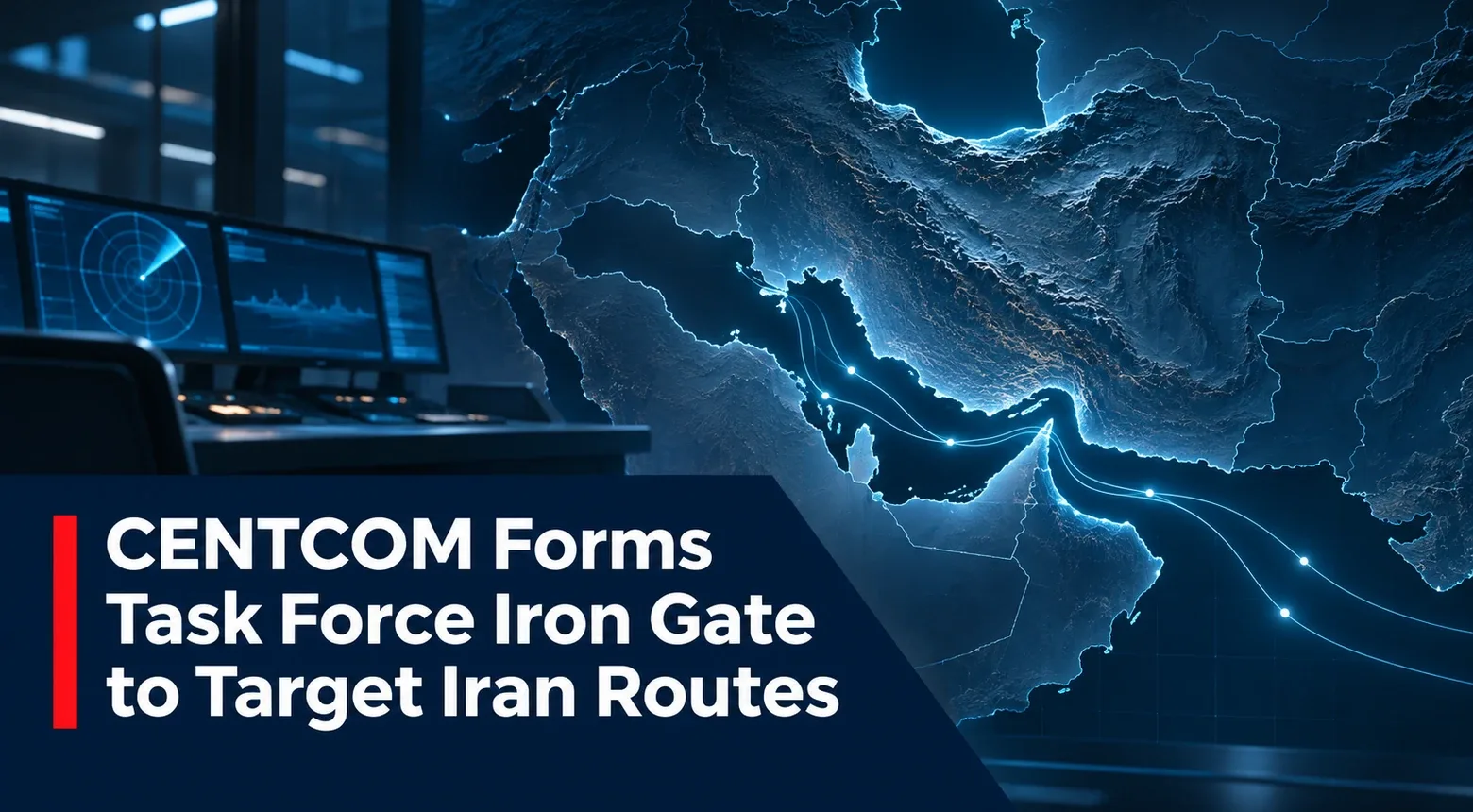
US Central Command (CENTCOM) has announced Task Force Iron Gate, a roughly 20-person team intended to coordinate US government efforts against the movement of advanced weapons, dual-use technologies and sanctioned materials across Iran’s land borders and the Caspian Sea. Admiral Brad Cooper ordered its formation on 7 November 2026, according to CENTCOM’s published statement. The decision broadens Washington’s pressure on Iranian supply networks beyond an existing naval blockade, but the command did not disclose new interdiction powers, operating rules, personnel deployments or a timetable for measurable results.
Task Force Iron Gate: Mission and Staffing
The new organisation is based in Tampa, Florida, where CENTCOM is headquartered, and comprises approximately 20 military and civilian personnel. Its stated role is to coordinate with other US government agencies on the movement of advanced weapons systems, dual-use technologies, sanctioned cargo and revenue streams described by Washington as illicit. The official statement identifies Iran’s land borders and the Caspian Sea as the geographical scope of concern.
The phrasing matters. This is an interagency coordination staff, not a publicly confirmed 20-person force patrolling every Iranian border crossing. CENTCOM did not name all participating agencies, describe inspection arrangements, identify specific interdiction sites or announce a new statutory authority. Those gaps should not be filled with assumptions about military activity on third-country territory.
The announcement also does not establish that any shipment has already been intercepted by the task force. Its immediate milestone is organisational: a named command-directed mechanism for bringing different US government activities together under a common focus.
How the Initiative Extends the US Naval Blockade
CENTCOM linked Iron Gate to the naval blockade already being enforced against traffic entering or departing Iranian ports. The command claimed that the maritime campaign had prevented more than US$25 billion in Iranian crude oil exports in recent months. That amount is a CENTCOM estimate, not an independently audited measure of cargo prevented from leaving Iran, revenue lost or oil permanently removed from global supply.
A 7 November Reuters report described the new task force as an attempt to extend pressure from maritime commerce to land and Caspian transit. The distinction is material: a blockade enforced at sea does not automatically provide the same authority or practical access at land borders, where sovereign states, border authorities and domestic laws become central to implementation.
A separate CENTCOM release on 7 November reported that US forces disabled the St Kitts-flagged cargo vessel M/V Huda in the Gulf of Oman after what the command described as repeated failures to obey blockade warnings. That was a distinct maritime enforcement incident, not an Iron Gate ground-route operation. Keeping the events separate helps avoid attributing already reported naval actions to the newly announced team.
Weapons, Dual-Use Components and Revenue Networks
The task force's remit reaches beyond completed weapons. Dual-use technology can include commercially traded equipment with legitimate civilian applications as well as potential military relevance. Whether a particular product is controlled depends on the applicable export-control lists, end-user restrictions, sanctions designations and relevant jurisdiction; the term itself does not prove a shipment is illegal.
The CENTCOM statement also identifies financial flows as a target of coordination. That makes the initiative relevant to trade documentation, sanctions enforcement and financial intelligence as well as the movement of physical goods. Its public release, however, offers no specific list of controlled goods, named exporters, intermediary banks or transactions under investigation.
For defence-industry compliance departments, this distinction matters. A broad security-policy objective does not replace the need to verify an actual legal restriction. Procurement organisations and suppliers operating internationally should distinguish sanctioned parties and prohibited end uses from lawful civilian trade rather than treating all regional commerce as suspect.
Interagency Coordination and Operational Constraints
The main implementation challenge is information and authority fragmentation. Military commands, diplomatic bodies, customs services, sanctions authorities and investigative agencies may collect different kinds of evidence under different legal standards. A coordinating staff could improve how leads are assessed and shared, but CENTCOM has not published an agreed operating model or performance framework for Iron Gate.
The legal and diplomatic questions are particularly significant around the Caspian Sea and overland corridors. These areas involve countries with their own sovereign control of ports, roads, airspace and border infrastructure. The public announcement does not authorise an inference that US personnel will inspect, seize or strike shipments in those jurisdictions without consent or another asserted legal basis.
Consequently, the command's declared intent should be separated from any future execution. Evidence of progress would require official reports of actions, legal instruments, sanctions decisions, cooperation agreements or measurable changes in shipment patterns. Without that evidence, the initiative's effectiveness remains an open question.
The Wider Iran Campaign and Regional Security
The task force appears against a background of sustained confrontation involving US forces, Iranian military assets and regional transport networks. Its strategic rationale is to reduce Iran's ability to replenish military capabilities and generate revenues while keeping pressure on cross-border logistics.
There are also risks and counterarguments. Restricting access to sanctioned military goods is a different policy objective from broadly suppressing civilian trade. Any enforcement measure must be assessed for legal basis, humanitarian consequences, third-country effects and unintended disruption to legitimate supply chains. Neither the CENTCOM statement nor the Reuters report provides a complete impact assessment of those issues.
Defence Agenda's investigation summary on damage to US regional installations explains why infrastructure resilience remains important in this conflict. Our coverage of Iran's capture of a US Dive-LD underwater vehicle provides separate context on the risks of operating uncrewed systems in contested maritime areas. These are related operational questions, not evidence that Task Force Iron Gate participated in either event.
The broader policy debate is also reflected in Defence Agenda's analysis of reported US strike contingencies. Reported contingency planning, maritime enforcement and the new transit-focused task force represent different categories of activity and should not be conflated.
What CENTCOM Has Not Disclosed
Several procurement and operational details remain unknown. CENTCOM has not announced a dedicated Iron Gate contract, new equipment purchase, operational command transfer, unit deployment outside Tampa, participating agency roster or defined end date. There is no public evidence in the cited release of an initial seizure, destroyed weapons shipment or independently audited financial impact arising specifically from Iron Gate.
The claimed US$25 billion maritime-export figure also requires careful handling. A command estimate of exports prevented is not the same as a published ledger of seized vessels or a verified calculation of lost Iranian government revenue. The announcement does not provide the estimation method, counterfactual export baseline or calculation period needed for independent replication.
Implications / Next: From Announcement to Measurable Outcomes
For defence and security decision-makers, three milestones will determine the initiative's practical meaning: publication of the task force's interagency operating arrangements, evidence of legally documented enforcement actions connected specifically to its work, and independently scrutinised indicators of changes in controlled-goods or revenue flows.
The 7 November 2026 announcement establishes a coordination body and a declared priority, not a completed blockade of all Iranian land commerce. Its potential influence will depend on cooperation, evidentiary standards and enforcement mechanisms that have not yet been publicly defined. Future reporting should evaluate confirmed activities rather than project outcomes from the task force's name or the maritime campaign's attributed economic claims.