Airbus MARS Autonomy is moving unmanned-aircraft operations away from the traditional one-operator-to-one-drone model toward networked teams that share mission information, allocate tasks and adapt their routes collectively.
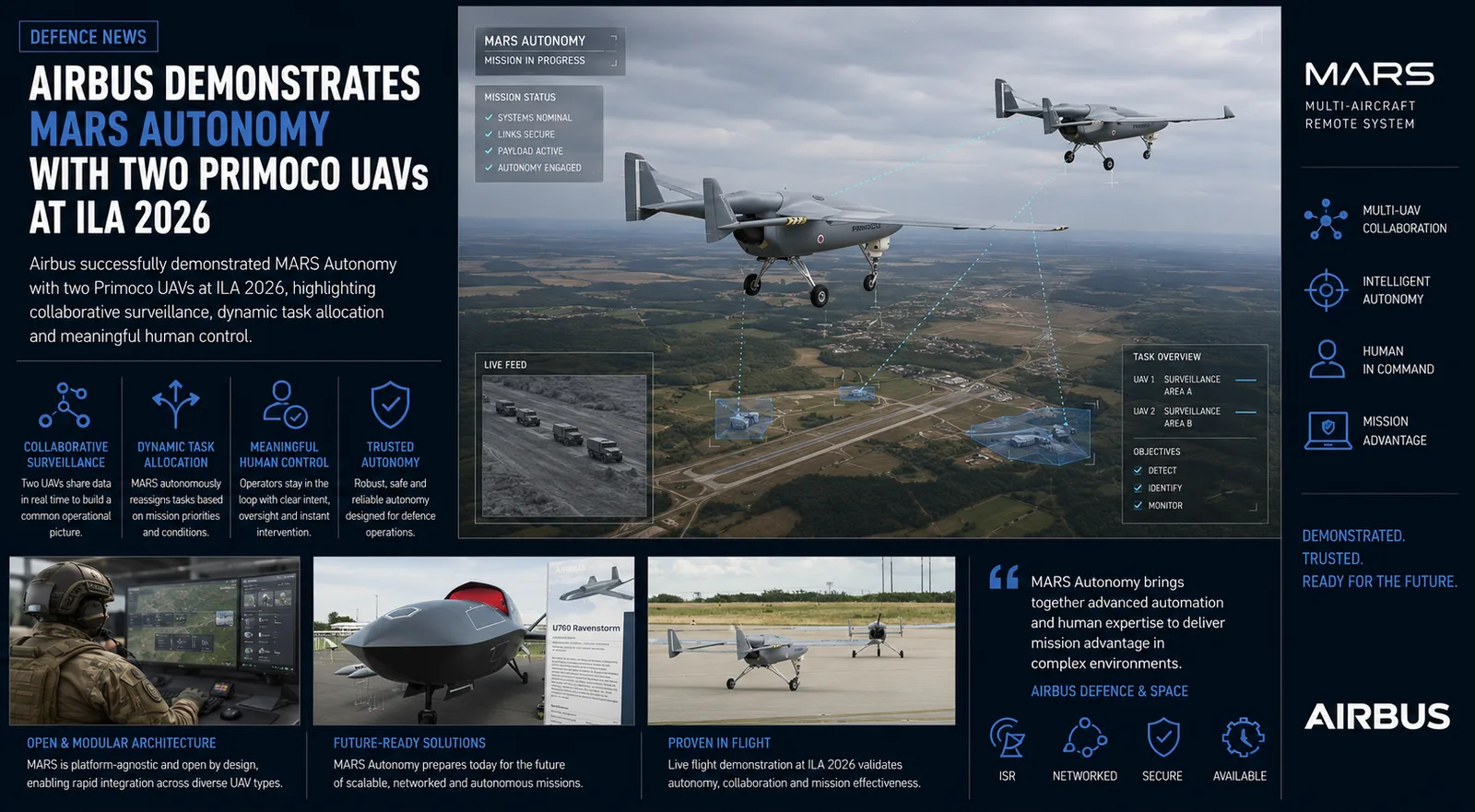
During the 2026 ILA Berlin Air Show, two Primoco unmanned aerial vehicles conducted two collaborative autonomous missions using Airbus Defence and Space’s AI-enriched autonomy software. Airbus described the demonstration as the first live collaborative autonomous flight involving uncrewed assets at a major European public trade show.
According to Airbus’s account of the ILA demonstration, the aircraft completed teamed multi-role surveillance and a second surveillance mission designed to increase the speed of coverage. The software distributed responsibilities between the aircraft rather than requiring separate operators to control every manoeuvre.
The official Airbus MARS Autonomy page describes the technology as a platform-agnostic software solution that enables crewed and uncrewed systems to execute missions collaboratively. It is part of the wider MARS Mission System family, which uses an open architecture to connect sensors, effectors and platforms across multiple domains.
Key Facts
- Demonstration: Two Primoco UAVs conducted collaborative autonomous missions at ILA Berlin 2026.
- Software: Airbus MARS Autonomy, part of the Multiplatform Autonomous Reconfigurable and Secure mission-system family.
- Mission types: Teamed multi-role surveillance and accelerated teamed surveillance.
- Operator model: A human supervises the overall mission instead of manually piloting each aircraft.
- Task allocation: The software assigns routes and responsibilities across the UAV team.
- Dynamic replanning: Aircraft can adjust tasks and routes as mission conditions change.
- Data functions: Automatic target recognition, data fusion and live video distribution.
- Flight functions: Automated manoeuvring, route following and collision avoidance.
- Human control: Critical decisions remain subject to human authorisation.
- Initial deployment: Operational use on Primoco One 150 UAVs is scheduled for 2026.
- Future platforms: MARS is planned for the U740 Valkyrie by 2029 and the U760 Ravenstorm by 2032.
What Is Airbus MARS Autonomy?
MARS stands for Multiplatform Autonomous Reconfigurable and Secure. MARS Autonomy is a software suite designed to coordinate several crewed or uncrewed platforms around a shared mission objective.
Instead of treating each UAV as an independent aircraft that requires continuous manual control, the software distributes mission intelligence across the connected group. Each platform can receive information gathered by the others and use that shared picture to coordinate its actions.
The concept allows an operator to issue a high-level command rather than detailed flight instructions. Airbus gives the example of directing a UAV team to search a defined area for surface-to-air missile systems, provide their coordinates and transmit video of the detected targets.
The system can then divide the search area, allocate tasks, calculate routes, manage sensors and update the mission as new information becomes available.
How Did the ILA 2026 Autonomous UAV Demonstration Work?
The live demonstration used two Primoco UAVs equipped with Airbus’s autonomy and teaming software.
In the first scenario, the aircraft conducted teamed multi-role surveillance. Detection and identification tasks were distributed sequentially between the two platforms, allowing one UAV’s observations to inform the actions of the other.
The second mission demonstrated teamed surveillance designed to accelerate area coverage. Instead of following separate pre-planned routes without coordination, the aircraft operated as one mission team under a common mission manager.
Airbus says the concept can be scaled to include additional UAVs and mission roles. Future configurations could add surveillance, electronic warfare, communications relay, logistics or engagement functions under the same mission-management architecture.
Traditional UAV Control and MARS Autonomy Comparison
The main difference is not the UAV airframe but the way aircraft, sensors, data and operators are organised during a mission.
| Capability Area | Traditional UAV Operations | Airbus MARS Autonomy | Operational Effect |
|---|---|---|---|
| Operator model | Each UAV normally requires dedicated flight and payload attention | One mission manager supervises a coordinated UAV team | Reduces repetitive operator workload and supports larger formations |
| Command level | Operators issue detailed steering and sensor commands | Operators define the mission objective and operational constraints | Shifts human attention from manual control to mission supervision |
| Mission planning | Routes and tasks are planned separately for each platform | Routes and tasks are allocated across the connected group | Improves use of available aircraft, sensors and time |
| Task allocation | Operators manually assign responsibilities | Software automatically assigns tasks according to mission needs | Allows faster responses to emerging targets or changing priorities |
| Replanning | Changes depend heavily on operator intervention | Mission tasks and routes can be dynamically recalculated | Supports continued operations when conditions change |
| Data sharing | Information may remain tied to individual control stations or platforms | Target tracks, sensor data and video are distributed across the team | Creates a shared situational picture |
| Target processing | Operators review and correlate much of the sensor information manually | Automatic target recognition and data fusion support identification | Can shorten the detection-to-decision timeline |
| Flight management | Manual monitoring of routes, separation and manoeuvres | Automated route following, manoeuvring and collision avoidance | Reduces routine flight-control burden |
| Scalability | Additional UAVs normally require additional operator capacity | Multiple homogeneous or heterogeneous platforms can share the mission | Supports greater combat mass without matching growth in operator numbers |
| Human control | Humans control most flight and tactical actions directly | Routine coordination is autonomous while critical decisions require human approval | Maintains human authority over sensitive mission actions |
| Platform integration | Mission software may be specific to one aircraft type | Platform-agnostic interfaces support Airbus and third-party systems | Creates broader interoperability and upgrade potential |
Does MARS Autonomy Remove the Human Operator?
MARS Autonomy changes the operator’s role but does not remove human authority from the mission.
Airbus describes the model as meaningful human control. The software can manage non-critical flight actions, distribute tasks, recommend responses and coordinate the UAV team, while the operator retains oversight and the ability to intervene.
Critical decisions remain subject to human authorisation. The system may provide intelligence, options and recommendations, but the human operator is responsible for approving the most sensitive actions.
This distinction is particularly important for armed missions. The ILA demonstration focused on surveillance and did not establish that the software independently authorises weapons employment.
What Capabilities Are Included in MARS Autonomy?
Airbus groups the principal MARS Autonomy functions into four connected capability areas.
- Multi-platform mission planning: Automated task allocation, area division and route planning.
- Mission management: Real-time execution, mission monitoring and dynamic replanning.
- Data distribution: Automatic target recognition, data fusion and live video streaming.
- Flight management: Automated manoeuvring, route following and collision avoidance.
These functions allow aircraft to operate collectively rather than simply flying near one another. The value comes from the shared mission logic that connects their observations, routes and assigned tasks.
Which Missions Could Networked UAV Teams Perform?
Airbus presents MARS Autonomy as a scalable solution for surveillance, combat-support and logistics missions.
- Collaborative intelligence, surveillance and reconnaissance
- Persistent wide-area surveillance
- Automatic target detection and identification
- Suppression of Enemy Air Defence operations
- Destruction of Enemy Air Defence operations
- Collaborative combat and attack
- Precision strike support
- Communications relay
- Autonomous cargo logistics
- Troop resupply
- Convoy protection
- Crewed-uncrewed teaming
- Uncrewed-uncrewed teaming
The actual mission set available to a customer will depend on the aircraft, sensors, communications systems, weapons, national rules and level of autonomy approved for the operation.
What Is the Difference Between MARS Autonomy and the MARS Mission System?
MARS Autonomy is the cluster of software applications responsible for autonomous mission execution and teaming. It provides functions such as task allocation, route planning, data sharing and flight coordination.
The broader MARS Mission System is the architecture that connects platforms, sensors, effectors, communications and mission applications. It is designed to work across air, land, sea and space domains as part of a larger system-of-systems approach.
Airbus compares this architecture to a smartphone. The platform supplies the underlying digital environment, while different applications can be installed or updated according to the aircraft and mission.
This software-defined approach is intended to allow capability updates without waiting for a complete aircraft redesign. Third-party applications, including automatic target-recognition tools and other AI components, can be connected through standardised interfaces.
Why Is Platform-Agnostic Architecture Important?
A platform-agnostic architecture is designed to operate independently of one specific aircraft manufacturer or airframe.
The ILA flight with Primoco UAVs provided Airbus with a public example of its software operating on a third-party aircraft. The company says the same architecture can be adapted to proprietary and external crewed or uncrewed platforms.
This could allow military customers to combine aircraft from different suppliers within one mission network. It may also reduce the need to replace an entire platform whenever a new sensor, mission application or autonomy function becomes available.
Actual interoperability will still depend on secure data links, interface standards, cybersecurity, certification and access to each platform’s mission systems.
When Will MARS Autonomy Become Operational?
Airbus states that the initial operational deployment of its autonomy solution on Primoco One 150 UAVs is scheduled for 2026.
The company has not published the number of aircraft involved, the customer, the precise delivery date or the final operational configuration.
The transition from a public demonstration to operational deployment will require customer-specific integration, verification of communications, software validation, operator training and approval of the intended autonomy level.
How Does MARS Support Airbus’s UCCA Roadmap?
MARS is also the digital foundation of Airbus’s Uncrewed Collaborative Combat Aircraft strategy.
The company plans to integrate its European mission system with the Kratos XQ-58A Valkyrie to create the Airbus U740 Valkyrie. The programme is intended to provide the German Air Force with an operational UCCA capability by 2029.
The U740 is planned to operate independently, with other unmanned aircraft or alongside the Eurofighter. Airbus is preparing two Valkyrie aircraft for flight with the European mission-system configuration.
The next step is the larger and fully sovereign Airbus U760 Ravenstorm, which is intended to support air-to-surface strike, air-to-air defence and electronic-warfare missions from the early 2030s. Airbus’s autonomy article identifies 2032 as the planned milestone for the aircraft.
| Programme Stage | Platform | Planned Milestone | Role of MARS |
|---|---|---|---|
| Tactical operational deployment | Primoco One 150 | 2026 | Collaborative surveillance, task allocation and autonomous mission coordination |
| Initial European UCCA capability | Airbus U740 Valkyrie | 2029 | Sovereign European mission system and teaming with Eurofighter |
| Fully sovereign UCCA development | Airbus U760 Ravenstorm | 2032 | Autonomy for strike, air defence, electronic warfare and multi-domain missions |
Why Does Airbus Link MARS to European Defence Sovereignty?
Airbus positions MARS as a European-controlled mission system that can connect existing and future aircraft without dependence on a single non-European digital architecture.
This approach is intended to give European customers greater control over mission data, software updates, autonomy functions and integration priorities.
The U740 strategy combines an existing US-built airframe with a European mission system to deliver an operational capability sooner. The later U760 programme is intended to move toward a fully European aircraft and mission-system combination.
The sovereignty claim will ultimately depend on ownership of software, access to source code, control of data, cybersecurity arrangements, supply chains and the customer’s authority to modify the system.
What Are the Operational Advantages of Networked Autonomy?
Networked autonomy can allow a military to operate more aircraft without increasing operator numbers at the same rate.
It can also shorten the time required to search an area, correlate sensor data, assign targets and respond to changes. When one aircraft identifies a threat, the information can be distributed to the other members of the team without waiting for separate manual reporting processes.
Mission resilience may also improve. If one aircraft becomes unavailable, the system could redistribute its tasks among the remaining platforms, subject to available capacity and communications.
For crewed-uncrewed operations, unmanned aircraft could perform higher-risk surveillance, electronic-warfare or strike-support tasks while the crewed platform remains at a safer distance.
What Are the Main Technical and Operational Challenges?
The ILA demonstration showed collaborative surveillance in a controlled public environment. Operational use in contested airspace presents additional challenges.
- Maintaining secure communications under jamming and cyberattack
- Coordinating aircraft when data links become intermittent
- Validating automatic target-recognition performance
- Preventing incorrect data from spreading across the network
- Certifying collision avoidance and dynamic flight replanning
- Defining the limits of autonomous decision-making
- Preserving human oversight as the number of aircraft increases
- Integrating aircraft and sensors from different manufacturers
- Ensuring compliance with national rules of engagement
- Testing the software against unexpected battlefield conditions
Airbus has not disclosed detailed performance data for operation under electronic attack, degraded communications or complete loss of external navigation. These capabilities will require further operational testing and customer qualification.
What Happens Next?
The immediate milestone is the planned initial deployment of the autonomy solution on Primoco One 150 UAVs during 2026.
Further demonstrations may involve additional aircraft, mixed platform types and more demanding mission scenarios. Airbus also intends to extend MARS across its wider unmanned-aircraft portfolio and future collaborative combat systems.
Progress will be measured by the system’s ability to move from controlled demonstrations to fielded operations involving secure communications, contested environments and customer-approved mission functions.
Conclusion
Airbus MARS Autonomy represents a shift from manually controlled individual drones toward distributed, software-defined UAV teams.
The ILA 2026 demonstration showed two Primoco aircraft sharing surveillance tasks, mission data and flight responsibilities under the supervision of a human mission manager.
The system combines automated mission planning, dynamic task allocation, target-recognition support, data fusion and flight management while retaining human authority over critical decisions.
Its planned deployment on Primoco One 150 aircraft in 2026 will provide the first indication of how the concept performs outside a public demonstration. The longer-term roadmap extends the same mission-system architecture to the U740 Valkyrie by 2029 and the U760 Ravenstorm by 2032.
For related coverage, visit Defence Agenda’s unmanned systems, aerospace and C4ISR sections. Related reports include ANKA III’s upgraded production configuration, BETA MV250 hybrid-electric military VTOL and ASELFLIR-500 integration with Mwari.